I’m back with the promised pitching numbers spit out by good ole SONAR. Unlike the position players, where it was appropriate to cover each position individually, I’m going to break down all of the pitchers together. But instead of 25, I did a chart of the top 100, with brief thoughts on a few, and more detailed thoughts on some of the interesting rankings. I recommend you checking out my revised SONAR post from a little while back, which talks about the way the system was tweaked. Most of it had to do with the position player aspect of SONAR, but I updated the weightings for the pitching formula, as well as fixing a few bugs with park factors and age factors. I’m going to first present the chart for all Phillies pitchers, then present the Top 100, split into 3 separate charts to make it easier to read. Check below for more..
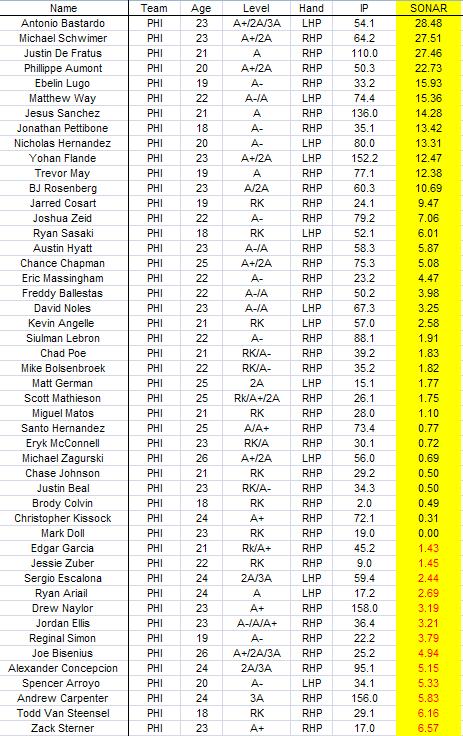
First, the Phillies chart. This list has not been pruned, so a few guys on this list may have been released/some are just minor league filler, but I left all the names on as a frame of reference. You can analyze the list as you see fit, but I’m going to focus on the overall Top 100 in this post. I’ll definitely answer any questions related to the Phillies chart though, so ask away in the comments if you have questions.

(If you can’t see the charts, click here and here.)
As you will see in the top 100, the Phillies current crop did not score all that well in the SONAR system, but this is partly a function of their best pitching prospects throwing a limited number of innings in 2009. SONAR has a sample size weighting built in, which places less weight on smaller samples, and I think its an important aspect of the system. 120+ innings from May and Cosart, with dominant numbers, will surely shoot them up the rankings.
Before I post the Top 100, I want to stress a few key points about SONAR again, just so I can avoid doing it 5 times in the comments.
* This is a 1 year score, based only on what a player did in the minors. Stephen Strasburg is the best pitching prospect in baseball, but isn’t on the list because he didn’t pitch. I can’t computer/analyze something that didn’t happen
* The score is dependent on peripheral performance, as well as age, league and home park context. If a player had a low score (or a high score), it was for a reason, there is no bias or opinion in any of these calculations.
* Players who played only a small handful of games/innings will have very low scores. Its the nature of the system. These players are ranked at the top of prospect lists based on scouting reports, not what they’ve done as pros. And that’s why scouting reports are a vital part of understanding prospects. But my goal in devising this system is to evaluate what a player has actually done, then compare that to the scouting reports.
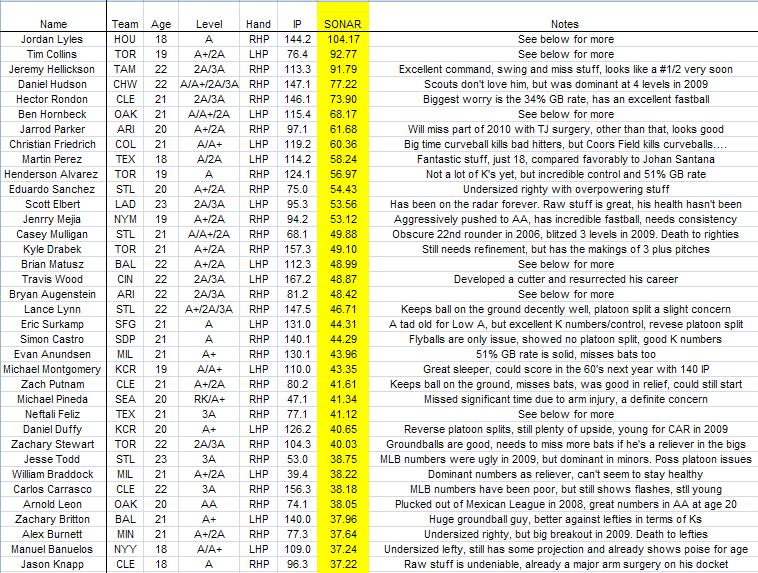
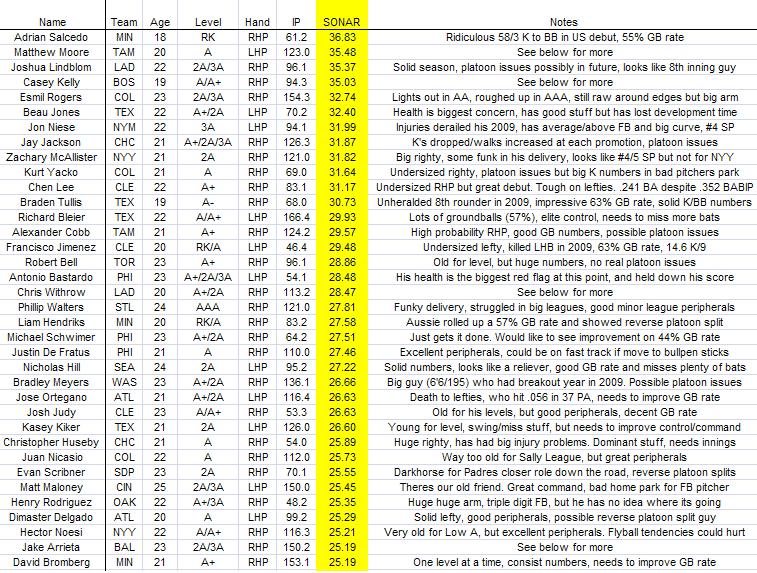
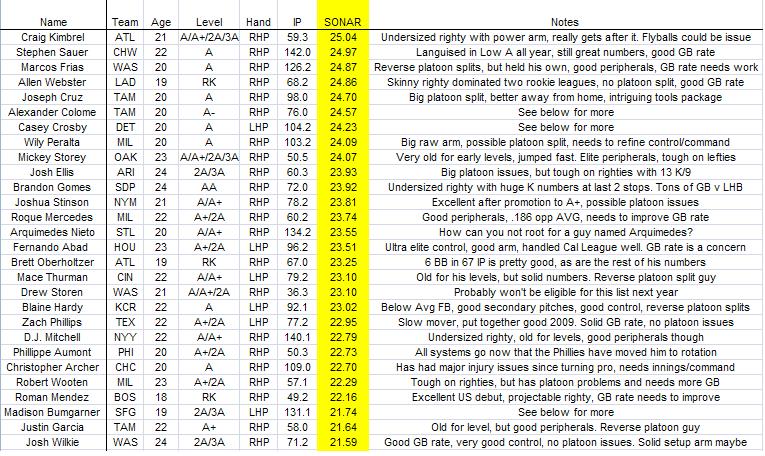
So, here we go. There are 3 separate pieces, which will make it easier to view. I’ll list them back to back to back then provide some thoughts. Before I do, a quick refresher on the scale and how to view these scores

(If you can’t see the charts, click here, here and here to see them in a different window/tab)
Now I’ll add blurbs for the guys with “See below for more” in their description box
* Jordan Lyles tops the SONAR charts. And I think its important to realize just how special his 2009 was. He proved to be durable, throwing 144 innings in his first full year, and that could impact him down the road, as he threw only 55 innings in his 2008 debut at age 17. After facing 142 batters in May, he faced 113, 119 and 115 over June, July and August. His peripherals were excellent, including a 10.2 K/9 rate, a 2.32 BB/9 rate, and only 5 HR allowed. Lefties hit just .220 off of him, righties hit .262, and what makes his line even more impressive is the .346 BABIP, an unlucky number. If you want to find one flaw in his stat line it was the 43.9% GB rate. Some other prospect evaluation sites have gone out of their way to play down his numbers, talking about his “average” stuff. But again, he was 18 for the entire season, turning 19 in mid October. At 6’4/185, he has an ideal pitcher’s frame and his fastball, which reportedly sits 91-94 now, could firm up into the 92-96 range if he’s able to add a bit of muscle. His secondary offerings my need to be refined, but that’s the case with most very young pitchers. Also of quick note, over the last three years Lexington, his home park in the SAL, has been a bit of a hitter’s park, inflating home runs above the average (and in 2009, significantly above) in the SAL. Despite that, he showed no home/road splits. If the Astros promote him one level to A+ in 2010, he’ll have to deal with one of the worst parks in the minors for pitchers. Should they skip him straight to AA, he’ll be one of the youngest pitchers in AA, maybe the youngest. Scouts don’t seem fully convinced, SONAR is in love with him.
* If Lyles is an interesting case, Tim Collins is the most interesting case. Let’s look at his raw numbers in 2009. He pitched 77 innings across A+ and AA at age 19. So before I go any further, I’ll point out that he was one of the youngest pitchers at both levels in all of the minors. Now his numbers; 77.1 IP – 59 H – 35 BB – 116 K. Yes, 116 strikeouts in 77 IP, that’s 13.66/9, an astounding rate. Lefties hit just .109 against him. So looking at just those numbers, considering his age, you’d think he’d be an elite prospect, right? Well, here’s the part that turns off most scouts; he’s listed at 5’7/155 pounds. If Tim Lincecum is undersized, what does that make Tim Collins? But just like Lincecum, Collins has a lightning fast arm and generates plus velocity on his fastball. His numbers, adjusted for age/level, are video game like. He walked his share of hitters, but 3.97/9 for a 19 year old in A+/2A, with those K numbers, isn’t anything to panic over. But scouts can’t seem to get past his size, and its a legitimate concern. He’s a flyball pitcher, namely because he is so short and can’t really get a whole lot of downhill plane on his pitches. He’s a guy who is always going to have to prove himself at every level, but he’s been flat out unhittable, especially against LHB, and he’ll be one of the youngest pitchers in AA in 2010. He’s one of those guys you want to watch just to see what happens, because he’s such a unique prospect.
* Ben Hornbeck is another guy I can’t figure out. Look at his body of work in 2009. He started in the MWL at age 21, a year old for the level, but then made it to A+ and finished with 1 start in AA at the end of the year, so the bulk of his work came at A/A+. His total line; 116 IP – 88 H – 46 BB – 159 K. The K rate was off the charts good, his control was average, and hitters had a tough time against him, hitting just .212 overall despite a .329 BABIP. He was actually slightly better against righties than lefties, holding righties to a .207 average and lefties a .226 average. His K rate dominance was almost identical, but he walked a few more righties (3.93/9 compared to 2.18/9 v LHB). He also posted a 48% GB rate, not amazing but also pretty solid. He’s listed at 6’5/180, so he’s not Tim Collins-esque, yet he gets no love. Baseball America didn’t rank him in Oakland’s Top 30, and listed him as a lefthanded reliever. Of his 29 appearances in 2009, 16 of them were starts. Opponents hit just .232 against him as a starter, but he was even more effective out of the pen, holding hitters to a .156 average in 34 IP. His BB rate spiked a bit as a reliever, but the K rate was fairly constant. I can only imagine he doesn’t throw very hard to not gain any attention at all despite a very impressive 2009 season. My hope is that SONAR has found a guy that everyone else will show up to the party on in 2010.
* Matusz ranks “low” on the chart because he logged only 112 innings in the minors. His peripherals were very good at both levels, and had he stayed in the minors for the full season and logged another 25 innings, he’d likely have scored in the high 50’s and ranked in the top 10. The one “knock” against him is that he doesn’t have elite pitch. His fastball, curve and change all rate as plus, but none of them will blow hitters away, and he pitches half his games in a bandbox, and all of his games for a poor team in the toughest division in baseball. Having to face the Sox/Yankees/Rays 6-7 times a year could put a cap on his ultimate shiny numbers, but he’s a fantastic prospect.
*Augenstein is an interesting guy. He has ridiculously good command and control, as well as some deception in his delivery(go to the 0:30 mark), and it worked well in the minors, as he posted an elite 1.66 BB/9 between 2A/3A, but he really struggled in his brief big league stint, posting a 7.94 ERA in 17 IP with only 6 K and 6 BB. Will his stuff not translate to the big leagues? I think it will. Lots of guys come up, get the jitters, and get away from what got them there. I think that he’ll eventually be a quality starter in the big leagues. Pitching in a very hitter friendly park limits his upside, but he’s got a shot I think.
* Neftali Feliz is one of my favorite pitchers in the game. I’ve never seen a guy throw as easy as he does and generate the power he does. If you haven’t seen him pitch, just watch this clip. Or this one. A 99 mph fastball, with an 87 mph changeup….I mean, he could probably make it through 6 innings throwing 85% fastballs and be an above average big league starter. His score was held down by the limited innings (just 77), and his numbers actually improved by a wide margin in the big leagues. He’s still very young, and his role in 2010 is yet to be determined, but his arm is one of the best in the game.
* Matt Moore is a big scouts favorite because he’s a lefty with well above average fastball velocity. So far, he’s compiled big strikeout numbers, but he’s also struggled with his control. His 5.12 BB/9 rate is troubling, but he helps offset it with the ridiculously good 12.88 K/9 ratio. He struggled with control in his 2007 debut, he harnessed it last year in the Appy League with just 3.02/9, but he regressed a bit in his first taste of full season ball. For his career, lefties actually have a higher batting average off of him (.200) compared to only .177 v RHB. He has a special arm, but his control is a worry for me and for SONAR, hence the more conservative ranking compared to some of the other prospect ranking type outlets.
* Casey Kelly’s score is a reflection on his two way days, as he split the season playing shortstop and pitching. He’s finally given up the shortstop ruse, and will now concentrate on pitching full time. He has impeccable command and control which makes his pitches play up a bit, but he doesn’t have an overpowering fastball or a knockout secondary pitch, which I think limits his upside. I think because he’s a Boston prospect, scouts are quicker to overlook the lack of a knockout pitch and how that will impact him pitching in the toughest division in baseball in a hitter friendly park. I think he’s still an excellent prospect, and if his fastball moves from 91-93 to 92-95 with the same cutting/sinking movement, then his probability increases quite a bit. But I’m still not 100% sold.
* Withrow had seemingly been injured ever since he was drafted in 2007, pitching just 9 innings that year, then only 4 innings in 2008. He was healthy in 2009, logging 113 innings at A+/2A, and he flashed plus stuff, striking out 131 batters. But he also walked 57, which is a bit of a concern. My other big concern is his 38% GB rate in 2009. Though Dodger Stadium will eventually help him in that regard, that is a ton of flyballs. He showed a somewhat significant platoon split in 2009, and I think SONAR is as down on him as any of the other PROs (Prospect Rating Outlets) out there.
* Arrieta was considered a Top 100 overall prospect by some heading into 2009, but his season was a bit of a disappointment. His strikeout numbers were good, but his walk rate was mediocre, and he allowed 13 HR in 150 innings, not a super high rate, but a modest rate nonetheless, and important for the same reasons I highlighted with Matusz. His 38.6% GB rate is indicative of future elevation in the HR rate, considering his future home park. He’s often been grouped with Matusz and graduated prospect Chris Tillman, but while those guys are solid #2 starters, Arrieta looks a lot more like a #4/5, especially in that division and that park.
* Alex Colome was one of Kevin Goldstein’s big time breakout guys for 2010, and it seems just about everyone has gotten on board. He has an excellent power arm, similar to Neftali Feliz, and could be primed for a huge 2009. His 2010 was pretty solid in its own right, with a stellar 11 K/9 and 0 HR allowed. He walked a few too many, but because he keeps the ball down and can overpower weaker hitters, he got away with the walks. The Rays have an embarrassment of riches in terms of young talent, and Colome might go from sleeper to near the top of the pile in 2010.
* Crosby is fully back from Tommy John surgery and possesses one of the best raw lefthanded arms in the minors. He struggled with his control a bit in 2009, but that is expected when rehabbing from TJ. He keeps the ball down as well (50% GB rate), and lefties have very little change against him, hitting .174 in 2009 and ,181 overall. He has significant room to the upside on this list for 2010.
* And finally, Madison Bumgarner. If you look at the Top prospect lists put out by other sites, he’s near the top of all of them. But from a statistical standpoint, his 2009 didn’t really jump out. He was pushed very aggressively, which has something to do with the numbers, but a 6.32 K/9 rate is below average, though the 2.33 BB/9 rate was solid. Toward the end of 2009, scouts were reporting that his velocity had dropped into the high 80’s from the previous 92-94 level. Most thought it was simply a dead arm from a long first full season, but this spring his velocity has remained in the 88-90 range, and while he can still be effective there because of his low arm slot and deceptive delivery, its tough to see him becoming the star everyone expects him to be. Lefties hit just .123 off of him in 2009 after hitting .212 against him in 2008. Despite the excellent movement he generates on his fastball, he only rolled up a 43% GB rate in 2009, and had a 42% rate in 2008. If his velocity comes back to the 91-93 range, he obviously has a better chance. His secondary offerings still come and go, and he relies heavily on the fastball. However, if there is a structural issue with his arm causing the velocity drop, then its obviously reason for greater concern. He is still extremely young, and the Giants have optioned him to the minors, so he won’t start 2010 in the big leagues. His radar gun readings this year will be a popular topic for debate.
Thus concludes the position by position SONAR scores. I’m now going to piece together Top 30 lists for each team, and post them in batches by division. Looks for those over the next few days/week.
 Phuture Phillies
So, if you need a score of 30 to be well below average, I guess the Phillies do not have a minor league pitcher who escapes the poor designation to rise to the level of well below average. It seems the minors have a great number of pitchers who are well below average, maybe the vast majority, or is that the wrong interpretation? And Stephen Inch, here is a relatively high draft choice, pitches all of 2 innings and comes in with a negative score, Not just a couple of points negative, but going down to minus 8. How did he get to be more negatively rated than others? I don’t remember what he did in those 2 innings, he must have been really bad.
LikeLike
um… obviously the minors are chock full of pitchers who are poor prospects. If the Phillies have 100 arms in their system from top to bottom, in all likelihood, 90+of them will never see a day in a big league dugout. These are ratings for prospects, and frankly I’ve never seen a rating system that compares minor league pitchers to the average minor league pitcher. what’s the use of that?
LikeLike
Yeah, Inch gave up 6 runs and 8 baserunners in 2 innings. They were really bad. Did you completely ignore the part where he said that low sample sizes get low scores.
LikeLike
Marfis. I think you are misreading the scale. A score of 30 on a traditional scouting scale is well below average but a score of 30 on the Sonar puts you at a normal scout score of 60 which is above average. In order to be well below average in Sonar you need to have lower than a -15.
I don’t really understand why Mike Cisco has been rated so poorly. I mean I wasnt expecting a great score but his Sonar is just bad. 22 yrs old in A+/AA with 112 innings, 3.75 era, a .259 BAA, 1.21 WHIP, a 2.96 SO/BB. His K numbers are very unimpressive but his control is great. Is it just the K numbers that bring his score down? His age seems pretty appropriate and the innings are about what they should be.
LikeLike
James – Great work!!! The Phillies list is spot on, given your assumptions.
Johny2Times – Cisco’s good (not great) numbers last year came from his time as a 22 year old in A+ ball – 3.31 ERA, 1.15 WHIP, 6.28 K/9 & 3.4 K/BB. When he was promoted to AA, his numbers dropped to 4.58 ERA, 1.35 WHIP, 4.58 K/9 & 2.22 K/BB.
LikeLike
Yeah, a SONAR score of 30 is in the above average range. I guess I should have moved that column to the other side. I’ll fix it.
As for Cisco, he didn’t miss many bats in 2009, which is an issue.
LikeLike
Phuture…another thing you may want to look at, although I highly doubt it would change the scores that much, would be the total innings pitched. For instance, Matt Way has a total listed of 74.4 IP, when his totals across the two levels is 75 1/3. I’m guessing this comes from taking two .2 for 2/3 and adding them together to get the .4. It’s a fairly simple fix for Excel. I just know if you’re a perfectionist you’ll want the “best” data available.
Again, great work though. I absolulely love the concept and am anxious to see how 2010 fairs for some of these guys. Your site has got me excited about all of minor league baseball, not just the Phillies.
LikeLike
Great piece on Jarred Cosart posted over at Beerleaguer
http://www.csnphilly.com/03/23/10/Electric-Arm-Prospect-Jarred-Cosart-Exci/landing_v3.html?blockID=203038&feedID=5046
LikeLike
The IP totals not rounding has no impact on the scores. Its something that I’ll alter in next year’s SONAR, but I’m not going to worry about it right now since it won’t move the data.
LikeLike
Interesting that Schwimer is no. 2. He just got into a Grapefruit league game against the Braves with two outs and the bases loaded and struck out Blanco to end the inning.
LikeLike
Schwim looked pretty good in his .1 IP today. Low 90s fastball and an 85 mph slider to get the K.
LikeLike