I hope all of you have read my revised and updated piece on the SONAR score published a few days, but if you haven’t, check it out before proceeding here. After my initial release, I went through each position and did an examination of the top 20 at each position. I’m not going to do the same in depth analysis here, I’m just going to give you the Top 25 at each position, and then brief general thoughts underneath each chart. I’ve chosen here to also break down the OF spots into the more traditional LF, CF, and RF. As always, SONAR is an attempt to look at a player’s secondary skills (plate discipline, raw power, speed) and ignore the more superficial stats like batting average, which are more luck influenced. SONAR represents a data point, a means for further exploration, its not a replacement for scouting reports or other statistics. So check below and we’ll get started.
I’m just going to go around the horn, starting with C, then moving to 1B and finishing in RF. All of the images should display fine in any browser. If you cannot see the image in its entirety, simply right click and open the image in a new tab/window, or for Mac users, do whatever it is you do to copy the location of an image and then open it in another tab. Thanks.
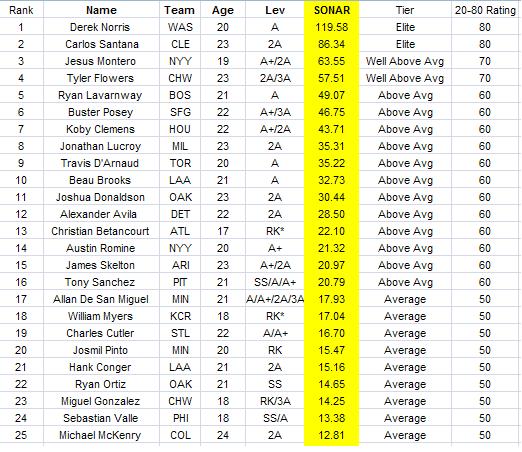
* Derek Norris takes the top spot, and I think its safe to say that SONAR likes him more than any of the prospect rating outlets (PROs from here on out) do. They all say hes a good prospect but with flaws. I see the strikeouts, and his score was docked slightly because of the K rate, but it also sees a guy who drew 90 walks as a 20 year old in Low A, and ended up compiling 53 extra base hits, 23 of them being home runs. Hagerstown helps inflate doubles, but in 2 of the last 3 years it has suppressed HR at a much higher rate. Sure enough, Norris went .275/.412/.440 at home with 5 HR, compared to .301/.419/.582 away from home with 18 HR. But anyway, he has enormous potential with the bat, and his peripherals were off the charts in 2009. His defense is lagging behind his bat, but he is plenty young enough to work out the kinks, and even if he has to move to an OF corner, his power and patience will make him an above average bat for sure.
* Switch hitting Carlos Santana takes the 2nd spot, a fair distance behind Norris, but still in the elite tier. He has an excellent approach at the plate, drawing plenty of walks and striking out at an acceptable rate. Like Norris, he also has excellent power. He’s hit about 50 points better righthanded in his minor league career, with more raw power, though hes still solid as a lefthanded hitter.
* Jesus Montero comes in 3rd here, despite ranking at the top of most of the PROs lists. What separates Montero from the two guys above is the lack of walks. Montero drew just 28 walks in 379 PA’s last year. He gets away with this because he has great hand/eye coordination and makes a lot of contact. For a 19 year old, he’s shown plenty of power. What remains to be seen is how he handles better pitching with his aggressive approach. Big leaguers are less likely to groove him fastballs like he’s seen in the low minors, and if he doesn’t draw many walks, he’s much more at the mercy of his luck on balls in play. His defense is also a big question mark, as some scouts say he has made small improvements, but most still feel he won’t make it as a catcher in the big leagues. The question then becomes, where does he play in the Yankees setup? Not many 20/21 year old DH’s in baseball.
* Tyler Flowers and Ryan Lavarnway fly under the radar a bit. Flowers has great power and patience, as does Lavarnway, but both guys need to cut down on the strikeouts. Both guys have defensive question marks on their resume as well. Buster Posey is an interesting case. Scouts love him and he’s consistently ranked as the best or second best catching prospect in the minors. But none of his tools really scream out elite to me, and I think he’s more of a solid guy than the star many think he’ll become.
* Beau Brooks might be the one name that doesn’t belong here. He struggled to make contact for much of 2009 as a 21 year old in Low A, but he did show excellent plate discipline, drawing 67 walks in 399 PA. He struggled even more in his 2008 debut, so 2009 was a step forward, but he’ll have to start making more contact to go with the walks. He’s on no one’s radar, so its a chance for SONAR to look smart at this time next year.
* Scouts favorite Tony Sanchez comes in just at the bottom of the above average tier, but his lower score is more than likely just a case of him not getting as many PA’s as players who got to play a full season. Wil Myers, another 2009 draftee, played even less, but posted eye popping numbers in his debut. If he can remain at catcher and survive the nightmare that is Low A Burlington, he’ll shoot up this list next year.
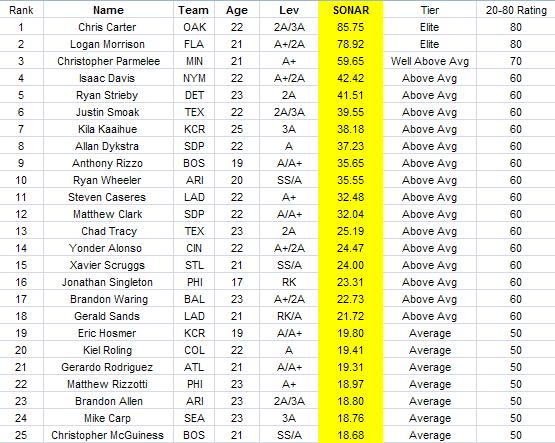
* Its pick your preferred flavor at the top. Carter offers you immense power and draws walks while striking out a ton. Morrison offers you very advanced plate discipline and 30-40 doubles power, with a question mark about his ultimate home run totals. Morrison also offers you a better glove. Both guys are elite.
* Parmelee at #3 is no doubt a surprise, until you look at his core numbers in 2009; 13% BB rate, .183 ISO in one of the toughest hitting leagues in the minors, with Fort Myers consistently rankings as a pitchers park. He struggled a bit after being drafted and viewed as a polished high school bat. He’ll need to make more contact, but his secondary skills look solid.
* Scouts have warmed up to Ike Davis, but they still appear to be doubting Ryan Strieby. He just keeps hitting though, posting an elite .262 ISO at AA in 2009, to go along with 57 walks in just 362 PA. Strikeouts will probably always be an issue, but he appears to be Chris Carter-lite with the bat.
* Another guy to mention here is Allan Dykstra. His full season debut looks pretty bad on the surface; .226/.397/.375 in the MWL at age 22. But he still drew a massive amount of walks (104 in 537 PA) and showed decent power considering the rough nature of the MWL. A .279 BABIP explains some of his crummy luck in 2009. He’ll need a big showing in 2010, and the Cal League should help, as would a normalized BABIP. Eric Hosmer, the #3 overall pick in 2008, is also looking for a big bouneback. Despite an ugly line across A/A+, he still showed off some core ability, and scouts still think he’ll come good. Single A Burlington appears to be kryptonite for highly touted Royals picks, nailing Mike Moustakas and Hosmer in back to back years. Beware Wil Myers.
* Yonder Alonso, another scouts fav, sits near the middle of the list after a somewhat uninspiring 2009. Its tough to see where he fits in with Joey Votto firmly entrenched in Cinci at 1B. Brandon Allen is a bit of a sleeper guy for me, he performed well in the minors in 2009 before struggling at the major league level in September. He’ll likely have to play a full year in AAA with Adam LaRoche now signed in Arizona, but if he rakes, especially against lefties, he still has a shot.
* Matt Rizzotti actually cracks the top 25. I debated his merits the other day in my updated manifesto, and really, he did have a nice season in the FSL. Nothing about him screams star, but he could yet turn into a useful hitter for some team, even if it isn’t the Phillies, and part of me wonders if maybe I should have found a spot for him at the back of my Top 30.
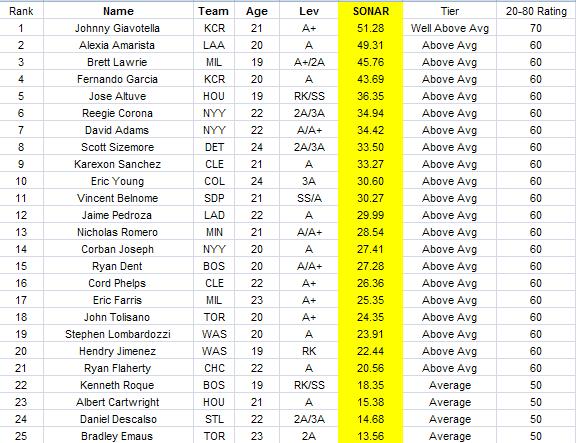
* Johnny Giavotella tops the list though he never really generated much buzz in 2009 from the PROs. He showed an excellent approach at the plate, drawing more walks (11.7%) than strikeouts (9.6%) and compiling 38 extra base hits despite playing in a tough hitters park in Wilmington, which consistently ranks as one of the toughest parks especially for hitting home runs. He posted a .268/.358/.426 line away from home, compared to .256/.344/.330. As you can see, the patience was there at both venues, but he showed much more pop in more hitter friendly settings. His .286 BABIP didn’t help his cause either, and with an increase there, his average should improve to the .275-.280 range. His excellent patience and contact skills + a few more extra base hits makes him elite, in my opinion.
* With the reworked system, Brett Lawrie sees a big boost to his score, which is in line with what the PROs think of him. Alex Amarista, who ranked #1 in the original version, now ranks 2nd, but his score stands up well.
* Jose Altuve, who I pegged as a guy that SONAR really loved but wasn’t on anyone else’s radar, still ends up ranked in the top 5, which makes me believe in him much more, even if no one else does.
* Scott Sizemore appears ticketed for an every day job in the majors this year, and scores fairly well. Eric Young Jr, one of the fastest players in the minors, gets a nice bump into the top 10.
* Phillies prospect Harold Garcia pops up at #27, with a score of 12.15, so he just barely missed making the top 25. His score was a bit lower because he was 22 and playing in Low A, but he has interesting tools. He just needs to move a bit quicker up the ladder.
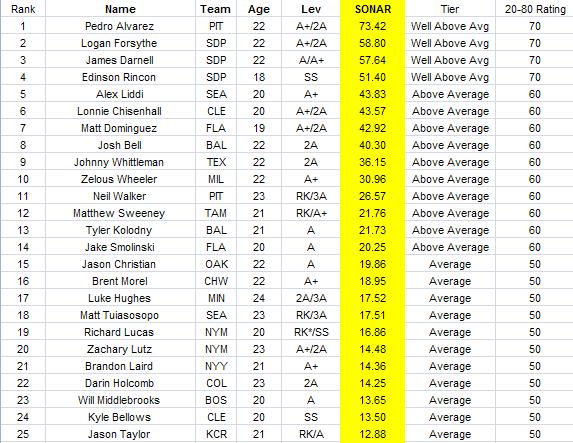
* Pedro Alvarez is a scouts’ fav, a PROs fav, and a SONAR favorite apparently. His power is unquestioned, but its the other skills that are still a tad up in the air. He raked at all destinations in 2009, but he did have trouble with lefties, hitting just .267/.320/.394 in 165 AB despite a .390 BABIP. Some scouts question his defense at 3B and suggest he will ultimately be a 1B. The offensive requirements will increase, and I just wonder whether he’s going to be a true star or more of a second tier player below the Prince Fielders and Adrian Gonzalez’ of the world. Either way, he should be good for a .350 ish OB% and 30-35 HR a year simply because he will kill RHP.
* Logan Forsythe is the opposite of Pedro Alvarez, as his calling card is an incredible eye at the plate and the ability to draw loads of walks, something the Padres preach up and down their system. He totaled 102 walks in 595 PA across A+/2A in 2009. The biggest question mark placed on him is his power, as he posted just a .140 combined ISO, and a .098 ISO at AA after his promotion. However, the Padres are now moving him to 2B, where his offensive profile will make him an elite option if he can handle the defensive duties.
* In addition to Forsythe, the Padres have the next 2 guys on the list in James Darnell and Edinson Rincon. Darnell is the more polished product, trailing Forsythe by one level. He’s a more traditional 3B with a blend of power and patience. Rincon has the most intriguing bat of the 3, but scouts think he will eventually end up in LF or RF. Until he does, I think he’s an excellent 3B prospect.
* Alex Liddi sat at the top of the list in the initial SONAR run, but drops down a bit with some tweaks to the formula. His score is still quite solid, and I think he’s a good bet to have a nice season in AA in 2010. I like Matt Dominguez quite a bit, and I’m glad SONAR agrees. Unlike some on the list, Dominguez seems to be a lock to stay at 3B and not just stay there, but play gold glove defense there. He’s been aggressively pushed, and I think his bat will catch up. He may never post big OB% numbers, but I think he’ll be a good source of power.
* Johnny Whittleman is one of my breakout guys for 2010. He was a more hyped guy a few seasons ago before seeing his progress stall out a bit. His surface line at AA in 2009 wasn’t good; .224/.345/.361 in 527 PA. But underneath, he posted an excellent walk rate (15.2%) and showed some promise against RHP, posting a .742 OPS compared to .568 v LHP. He was the victim of plenty of bad luck in 2009, posting an overall BABIP of .277, including a .209 mark against LHP. At 6’2/195, he’s not an undersized stick, and if his luck neutralizes a bit in 2010, I think his surface numbers will follow the peripherals. That’s kind of the point of SONAR.
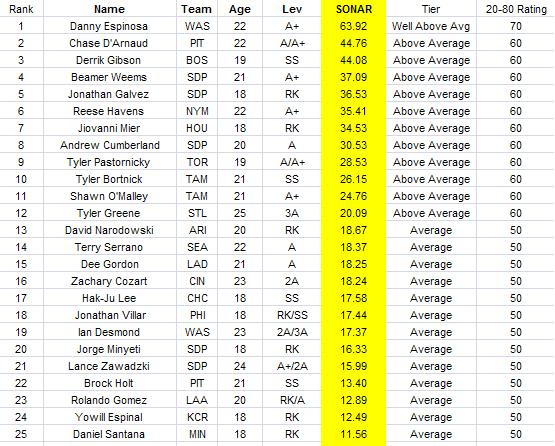
* As I’ve talked about before, shortstop is the toughest (along with catcher) position to figure out when looking at the minor leagues. The position requires so much defensively, that players who are able to hit as well are a big bonus. The position has been revolutionized by a small group of guys (Hanley Ramirez, Tulo, Rollins) who have provided elite level offense at the position, but after the elite guys, you see the same things; guys that can field but who are merely average hitters at best. At the minor league level, its very similar.
* Danny Espinosa is one of my top sleeper guys in the minors. He doesn’t seem to generate a ton of buzz or respect from the PROs. A polished college product, the Nats sent him to the pitcher friendly Carolina League for his first season, and he delivered a very solid .264/.375/.460 line in 576 PA with 53 XBH and 29 SB. His 12.8% BB rate was very good, and though he did strike out a lot, he makes up for it with above average power for the position and the speed. He was thrown out 11 times, which indicates he has a bit of work to do there, but if he can buff some of the rough edges in his game, he looks like an upper echelon starter at SS in the majors. That’s quite a valuable property.
* Chase D’Arnaud, brother of former Phillie Travis, ranks 2nd. He’s considered more of a grinder, but he put up very nice numbers in his first full season. Derrik Gibson is more of a tools guy, with excellent speed and a great idea at the plate. They have virtually identical scores, so its more of banking on the upside of Gibson or the polish of D’Arnaud.
* Jiovanni Mier had one of the highest scores for a player drafted in 2009, as he proved to be a bit more advanced with the bat than advertised. Jonathan Galvez, who ranked #1 on the original list, still ends up ranked in the top 5. As they did at 3B, the Padres place 3 guys in the top 10, yet none of these guys get much love from the PROs.
* Phillie Jonathan Villar ranks 18th, and I’ve detailed him quite a bit in my Top 30 writeup. He’s one of “my guys” for 2010.
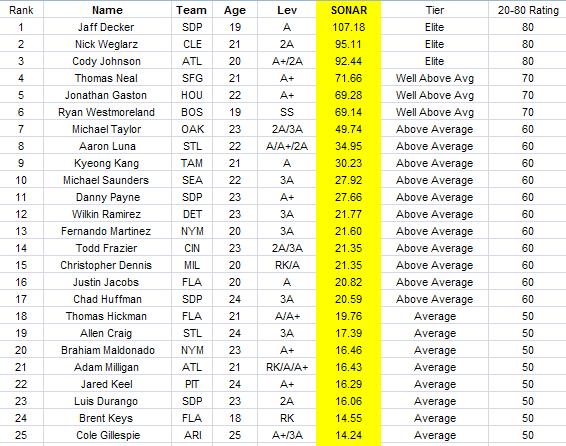
* Jaff Decker leads the list, and he’s a really interesting guy. For those of you who don’t know anything about Decker, he’s generously listed at 5’10/190 on baseball reference, but is generally considered to be about 20 pounds heavier. He draws very unflattering remarks on his athleticism, or lack thereof, and brings back fond memories of the Moneyball quote “we’re not selling jeans here!”. What he does is draw walks and hit for power, as he drew 85 walks in just 455 PA’s in 2009 and also ended up with 43 extra base hits. His power and eye are excellent, but the question becomes “where does he play?” At 19 going on 20, he’s already limited to LF, and he’s not particularly good there. If he played in a small home park, it would be less of a concern, but he calls the baseball version of the Grand Canyon his home, and that could pose problems. But his bat might just make up for any deficiencies in LF. The possibility of 1B is also there I suppose, but that would have to happen down the road, and the Padres already have A-Gonz and Kyle Blanks. An AL team might be better served trading for him and just using him at DH and going with it. Its never ideal, but it might get him to the majors and maximize his value.
* The next two guys are personal favorites. Weglarz’ surface line in 2009 didn’t look great; .227/.377/.431, but of course the walks and raw power both stand out. A 17.6% BB rate is elite, and his K rate was almost identical, meaning he controlled the zone and bat fairly well. He also posted a .204 ISO as a 21 year old in AA, a very solid number. His .253 BABIP is the biggest culprit here, and should normalize in 2010, making his 3 slash line look much better. He was young for AA, and I still think he has elite prospect potential, even if some of the scouts and evaluators are jumping off the bandwagon. Cody Johnson is another interesting guy. His raw power ranks at the top of the charts in the minors, and he could be a 40 HR hitter in the majors. His biggest problem is contact, as he’s struck out a ridiculous 478 times in 1,429 minor league PA’s. On the other hand, he’s started to draw his share of walks, increasing his BB rate to 12.9% in 2009 from 7.8% in 2008. He needs to make more contact, obviously, but his power is as good as it gets, and he’s shown its usable, not just a batting practice display. Like Weglarz, he was young for his level in 2009, 20 years old in A+ and even younger for AA in his brief finish to the season. He doesn’t get much credit for what he does right (patience, massive power) instead scouts are focusing on the strikeouts. There is some merit to that, its a definite concern, but age and his secondary skills outweigh that concern for now.
* Ryan Westmoreland, if you haven’t read, is now facing an injury much more serious than baseball, but that’s been the story of his pro career thus far. He looked like a 5 tool CF when drafted, and he still does, but he has other issues to work out right now.
* Hyped up Mets prospect Fernando Martinez settles in at #13 on the list, and like Westmoreland, his biggest issue has been staying healthy. The Mets have aggressively pushed him, and he’s been good considering his age, but he’s now a corner OF, which increases the requirements for his bat. He possesses good power and contact skills, though he’ll need to draw more walks if he’s going to be a complete hitter at the big league level.
* Thomas Hickman and Adam Milligan are two interesting guys for me. Hickman was seen as a very raw prepster when he was drafted, and in many ways, he still is. But guys like that can have it click at any moment, and he made some strides in 2009. Milligan is a football player trapped in a baseball player’s body, and has massive raw power, but needs to refine his approach quite a bit. He was limited because of an injury in 2009, but when he got on the field half way through the season, he put up great numbers.
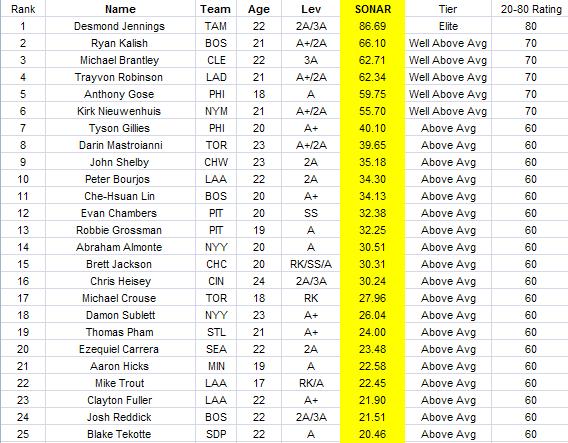
* I’d make the argument that Desmond Jennings is the third best prospect in baseball behind Jason Heyward and Stephen Strasburg. He does everything really well, he’ll hit for more power than most leadoff guys, has an advanced idea at the plate, can draw walks, control the bat, and steal tons of bases at a very high rate. He’s basically Carl Crawford but with more plate discipline. The Rays sure seem to have a good idea when it comes to player development.
* Ryan Kalish is kind of like Desmond Jennings-lite, in that he does everything well, but he’s not as good defensively and doesn’t have quite the raw speed, but he might have a bit more power. Michael Brantley is big league ready and has speed to burn, as well as good bat control. Trayvon Robinson had his breakout season in 2009, but some scouts wonder how much of it was a product of the Cal League. He has excellent speed and developing power.
* The Phillies occupy spots 5 and 7 with Anthony Gose and Tyson Gillies. Gose pops up on the list after the tweak in the system to account for speed, and it shows you just how special he is in that aspect of the game. He has a long way to go in terms of refining his approach at the plate, but according to scouts he made some adjustments in the 2nd half of the season. Gillies isn’t as far behind, and his score is brought down a bit by playing in one of the best hitters parks in baseball. But as I detailed before, his translated line would have looked really good in even a tough hitters league like the FSL. I have Gillies ranked slightly higher because his approach is more advanced, while Gose might have more upside.
* Kirk Nieuwhenhuis (good luck spelling that) has already been labeled a 4th OF by some PROs, but I’m not buying that yet. He has a well rounded offensive game, just needs to cut down on the K’s. He might profile better defensively in a corner, but he should hit enough to productive.
* Robbie Grossman is a good sleeper guy. He posted a pedestrian .266/.373/.355 line in 535 PA in the MWL. Even though he didn’t hit for a ton of power, he drew an impressive 75 BB in 535 PA and managed to swipe 35 bases in 47 attempts. On the downside, he struck out an eye popping 164 times, something he’ll obviously have to address. A switch hitter, he posted an impressive .330/.437/.460 line against lefties (so batting RH), but struggled batting lefthanded, hitting just .248/.355/.325. He has a lot of upside, but he isn’t without risk.
* A few guys near the bottom of the Top 25 get a lot of run among scouts, including Aaron Hicks and Josh Reddick. Both guys had solid but unspectacular seasons in 2009. Hicks is the proverbial toolsheed, and now that he’s out of the pitcher friendly MWL, he should see his numbers improve. Reddick is probably better served in an outfield corner, and just needs to ramp things up a bit in 2010. He reached AAA as a 22 year old, and will likely get a full year there at 23, which is age appropriate.
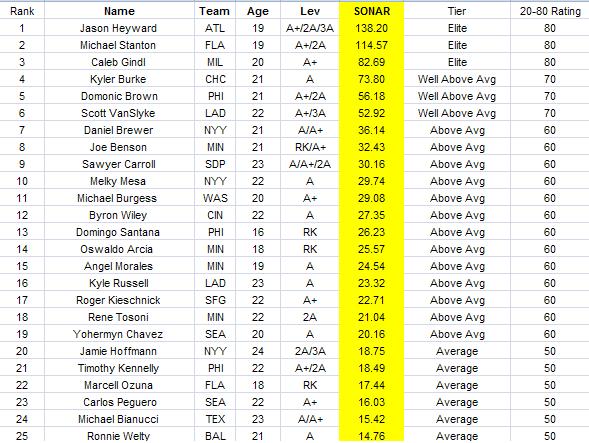
* And here we have Jason Heyward, the best prospect in baseball, and the highest scorer in the SONAR system. Unfortunately for Phillies fans (and fans of any team other than ATL), this guy is going to be tormenting us for years to come. He does everything extremely well, and because of his advanced approach at the plate, he could put up an unprecedented big league season at age 20. Braves fans, enjoy him, because we’re all going to hate him.
* The NL East in general has it made when it comes to athletic, toolsy RF’s, as the Marlins have Mike Stanton, a freakishly strong power hitting rightfielder. Stanton’s minor league home runs are the stuff of folklore, as he’s hit a bunch of 450 foot bombs in his short career. The Marlins have pushed him aggressively, and he’s holding his own this year in spring training. Strikeouts are going to be an issue, but he’s learning to work deeper counts and draw walks, and even if he’s only a .265ish hitter, he should draw enough walks to post a .350 OB% and that will play well with his 40-45 HR power. He’s not as polished as Heyward, but he has more raw power and upside than Phillies prospect Domonic Brown, who ranks 5th on the list. Brown, though lacking the raw power or polish of Heyward and Stanton, is a blend of those two, offering the potential for 30 HR and 25 SB in a season. He has a good idea at the plate, drawing his share of walks, and as we’ve seen in spring training, he has a cannon for a right arm. Some scouts mentioned his defense being an issue last year, but he’s looked ok in limited spring training action, so it should be just a case of him needing innings and chances to refine that part of his game. At the plate, his swing mechanics are still less than ideal, but his raw athleticism and ability allow him to overcome any flaws there to turn around even the best fastballs.
* Joe Benson is another guy on my breakout list in 2010. He’s had trouble staying healthy, but had a nice year at the plate in 2009, going .284/.414/.399 in 334 PA. He has a good approach at the plate, though he could cut down on the strikeouts a bit. His career has been a start/stop affair since signing, so staying healthy would be a solid step in 2010, his 5th pro season. He has the ability to post solid walk rates, a bit more power, and 20 stolen bases if he can stay healthy for a full year and log 525 PA’s.
* Domingo Santana, who ranked a bit higher in the first run, still ends up a solid #13 on the list. Taking strikeouts into the equation hurts him a bit, but his upside and raw power are still off the charts, and he offers a lot of hope going forward. One of the youngest players in pro ball in 2009, the Phillies have the luxury of letting him set his own timeline and can take it slow with him.
Thus completes the rundown. The pitchers are up next. If you’re wondering where Player X is on the above lists, let me know and I can post them, but I kept it to 25 for space reasons. I’ll go over notable guys that PROs love but SONAR doesn’t when I post my Top 30’s for each individual team.
A quick note. Someone brought up a question about the pitching scores that were integrated into the overall evaluation of the Phillies prospects a few days ago. And I went back and looked, and there appears to be an error somewhere in the thousands of lines of data. So I’m going to spend some time trying to figure out what went wrong there. I double checked all of the offensive scores and they look perfect, so its just an issue with pitchers. I’ll post the revised chart for the Phillies guys when I do the writeup for all pitchers. Sorry for the mix up, its more frustrating on my end, trust me, but I’m determined to get this right before the season starts.
 Phuture Phillies
As I said before it isn’t just Heyward’s incredible plate judgement. It’s also the fact that he is getting the rep and therefore the calls. Dangerous player to the Phils. How long he bats leadoff with McLouth second. Yikes
LikeLike
Sigh, I know I’m going to hate playing against Heyward even as I am going to love to watch him play. I cannot get over the fact he’s just 19/20 this year. By the time he’s 23, he might supplant Pujols as the MVP favorite each year….
I also am impressed with our 2(!) speedy, toolsy CF-ers, both of whom have what seems to be an all-star upside. An outfield with the two of them and Brown in 2012 = the best defensive outfield in baseball history 🙂
LikeLike
So if Brown goes 310/400/560 with 22 homers and improved routes on defense, what is he ranked next year? Higher than 5?
LikeLike
I know that we’re all ready to annoint Heyward as the next coming of the Lord himself and there’s little doubt he’s going to almost certainly going to be at least a very good player. Still, it’s not a foregone conclusion that he’ll become a superstar or MVP candidate. There is a good historical analogue to Heyward and that’s none other than Andruw Jones (if you don’t believe me, just look at the minor league stats and age comparisons – it’s almost a perfect match). He became an excellent player for a good long while, but he never fulfilled his potential and became an MVP candidate. So let’s hold off on the HOF induction speeches for now.
LikeLike
When Andruw became a full time player, the Braves exploded into a 100 win a year powerhouse. If Heyward “merely” becomes Andruw Jones, that’s a small comfort.
LikeLike
Alan – understood – I did try to convey that I expect, at the very least, that Heyward will be quite a good player.
LikeLike
I would not be so quick to under rate other teams prospects. To say that Jason Heyward just has a chance to be a good player, but it is not a forgone conclusion he is going to be great, is down playing his talents. Jason Heyward is the best hitting prospect since Chipper Jones. Outside of major injury he is going to be great.
If every Phillies prospect can be hyped as a major league player (Drew Carpenter is a #3 starter the level of Joe Blanton) then give other team’s prospects their proper due.
LikeLike
mike77 – fair point, if his name were Domingo Santana, not Jason Heyward, this site would become a Domingo Santana shrine.
LikeLike
Catch, I took up your challenge. It’s easier to compare since both players advanced at roughly the same ages.
Age 17 – Rk
Jones Heyward
.349 OBP .333
.411 SLG .488
.761 OPS .821
21 SB 1
11 CS 1
25 BB 3
44 K 9
3 HR 1
Age 18 – A ball
.372 OBP .388
.512 SLG .483
.884 OPS .871
56 SB 15
11 CS 3
70 BB 49
122 K 74
25 HR 11
Age 19 – A+ to AAA
.413 OBP .398
.651 SLG .555
1.064 OPS .953
30 SB 10
10 CS 11
60 BB 51
97 K 51
34 HR 17
Seems clear to me that Jones was a much better minor leaguer than Heyward. Also, Jones placed at #2 in the MVP voting in 2008. So take that for whatever it’s worth.
LikeLike
What about Ben Wallace?
Looked on 3B and 1B, am I missing something here?
LikeLike
Dan, I was being conservative, but you’re kind of making my point. However, Mike77 is also right – he really is a top shelf prospect and I am not trying to diminish that in any way. My only point was that, even with the best prospects, things don’t always pan out as you might expect.
LikeLike
I don’t think you can realistically compare Jones to a prospect. First, Jones was one of the greatest young players we’ve ever seen. Second, a great deal of his value was tied to his defense, something that will not show up in a straight comparison.
LikeLike
Its Brett. And he didn’t make either list. His secondary skills were rather pedestrian in 2009; 47 BB in 600 PA is only a 7.8% rate and his ISO of .162 is average at best for a corner guy, especially a 1B. He has no speed, and though he’s lauded for his “pure hitting ability” he managed to strike out 116 times in those 600 PA.
Basically, his secondary skills were very unimpressive in 2009, especially considering his perceived level of polish and the position he is going to play in the big leagues, and if his .338 BABIP slips at all, his numbers will slide even further. Just don’t see a lot to love in his bat.
On an unrelated note, I think I fixed the pitching data. It was a fairly simple mistake, but easily correctable, just going to take me some time to re-run the numbers. Such is trying to make this damn thing as close to perfect as it can be.
LikeLike
Great stuff, the lists look great especially since they correlate with a lot of top prospect lists because I have to believe that it will have more validity going forward when trying to identify sleeper prospects. As usual, great great work.
LikeLike
Catch, just for fun, Albert Pujols’ minor league numbers (age 20)
Level mostly A, some A+
OBP .378
SLG .543
OPS .920
SB 4
CS 5
BB 46
K 47
HR 19
And he became Albert Pujols, while Jones, with pretty clearly better minor league numbers, became Andrew Jones, so who really knows?
LikeLike
Jones faded faster than expected, I think partially due to injury, perhaps to a faked age, but he was a definite star, especially when you consider the great D to go with the offense.
LikeLike
Andruw Jones got fat, got slow and just seemed to slow down. I don’t know a damn thing about him personally, but my guess is that if he had the type of work ethic that, say, a guy like Raul Ibanez, Chase Utley or Ryan Howard has, he could very well still be a star. He’s a pretty clear example of why you want to be careful rushing very young players to the major leagues. But I can’t crush him too much because, even if he never plays another day, he had an excellent major league career.
LikeLike
Then PP you may agree with me Wallace for Mt was a give away.
LikeLike
Jones was a star, a far bigger star than Ibanez ever was.
LikeLike
Did not care much for the Sonar rankings at first. I retrospect, I got a lot out of it even before this latest version. It made me take a harder look at Jonathon Villar and Harold Garcia. Now I consider Villar one of the Phillies’ top 15 prospects. I also consider Harold Garcia one of the top 30. I would not have looked as closely at their numbers if not for the original SONAR chart.
Good Stuff.
LikeLike
If anyone is downplaying Andruw Jones’ career, they’re ridiculous. Yes, the guy seemed to get out of shape early and lose most of his skills, which is too bad. But when you consider defensive value as well as offense, Jones was an elite-level player for 10 years.
Let me repeat: ELITE for 10 years. No matter how highly rated they are, any team would take that level of production from any of their prospects. Andruw Joneses are few and far between.
LikeLike
Are they really that uncommon? I’d put heywards odds of being a perennial allstar at 40%, perennial MVP canidate 20%, above average starter – 70%. which are good numbers, no doubt about it, however… He doesn’t have a long sustained track record and has never faced major league pitchers with good batter scouting. Let’s just wait to see him for a year in the majors before we say he’s going to be great. In the mean time, I’ll say, he is great in the minors and he’ll do very well in the majors.
LikeLike
****Jones faded faster than expected, I think partially due to injury, perhaps to a faked age, ****
~coughs~ steroids ~coughs again~
Jones was the best defensive CF in the game for a good 5-8 years in a row and in the top handful of CFs for a solid decade. If he hadn’t collapsed a couple years ago, we’d be weighing his HoF credentials right now. That a terrible upside to have.
LikeLike
Thanks for setting the odds on Jason Heyward’s max career. That should replace SONAR as a grading tool.
LikeLike
Here’s a first hand scouting report by John Sickels on one of our draft picks from 2007…
Brandon Workman, Texas, RHP, Junior
Expected to be an early pick in the 2010 draft, and I see why. Went 6.2 innings on the second Saturday game, with eight strikeouts, two walks, seven hits, and two runs, threw 110 pitches. Big and strong at 6-5, 225. I saw him pitch last year as a sophomore, and he’s improved a lot: his delivery is smoother now, less mechanical, enhancing his command and probably reducing injury risk. Had the best fastball on either team, I caught two readings, one at 93 and one at 94 MPH, though I think he was throwing harder than that. The pitch had both movement and velocity. He mixed in two breaking balls, a hard slider and a slower curve, both very promising. Changeup needs some work. He has the look of a definite workhorse and is certainly worthy of a first round pick. 2.81 ERA so far with a 28/7 K/BB in 25.2 innings, 26 hits allowed. He doesn’t have Cole Green’s command but his stuff is better.
LikeLike