Instead of waiting to look back at my Top 30 until next season’s top 30, I figured I’d devote some substantial words to my list. My goal is to try and figure out where I was right on guys, where I was wrong, and identify if my philosophies as a whole have a blind spot, or if things were simply unforeseeable last winter. I’m going to refrain from making too many 2011 slanting comments, I’m not doing a preliminary top 30 now, this is just to look back at my rankings and figure out how good/bad they were. Check below for more.
I think the best way to do this is to post the “final thoughts” blurb from each of the top 30 guys, because that’s where I tried to summarize each player. And then I’ll give some now thoughts.
1. Domonic Brown, OF
Brown is the clear top prospect in the system, and has the potential to be the Phillies most productive home grown all around outfielder since….well, I don’t know who. All five of his raw tools are at least average, his power is emerging, and he has a good idea at the plate. If he can improve his route running in the outfield, he’s going to be a special talent in the middle of the Phillies lineup for the next decade.
Now: It’s nice to have a slam dunk. Everyone picked Brown #1, and it wasn’t really close. He had an awesome 2010 in the minors. He’s shown flashes in the majors despite limited playing time.
2. Tyson Gillies, OF
As I mentioned, I view Gillies as a high probability bet going forward, hence me feeling confident enough to rank him 2nd on this list. He has an excellent approach at the plate, and because he’s only 21, its not out of the question that he could add a bit of muscle or leverage to his swing which might give him a bit more pop. At 6’2/190 he’s not a short, wiry guy, so it could develop. But if the power doesn’t come, he still profiles as a leadoff hitter with above average on base skills and blinding speed who should play a well above average centerfield. While I initially didn’t love Gillies in the deal, after digesting everything, I’m fairly confident that he’s going to be the most valuable piece of the deal long term. For me, he’s our centerfielder of the future.
Now: Where do I even begin? My reasoning for loving Gillies in December 2009 was solid. He had an excellent spring training. I had one person with knowledge of his spring performance tell me that he showed excellent power in batting practice. With more experience, I assumed he would be awesome. Then he was injured most of the year. And he got busted with a bunch of cocaine. So his season was obviously a disaster on every level. But my ranking of him is still fine (in my own eyes), because I couldn’t see the injuries wrecking his on field performance, or the nose candy arrest potentially sending him to the slam.
3. Trevor May, RHP
May possesses a power fastball and an ideal pitcher’s frame, and his ability to miss bats in A ball at 19 to the degree he did is reason for great optimism. He’ll need to gain some control and refine his secondary offerings, but he looks like a #2 starter, maybe a #3 if he doesn’t significantly improve his command. His ability to generate groundballs should improve as he learns the intricacies of pitching, as he throws on a downhill plane. He’s rough around the edges, but there are no mechanical red flags or health issues that concern me, I think its just a matter of him polishing the rough edges and logging innings.
Now: I was worried about his command, but didn’t think it would be quite as bad as it was. Those “rough edges” proved to be quite jagged, and he struggled at High A. Well, he struggled throwing strikes, he still got plenty of swings and misses, and some of those could have been because guys were afraid to dig in against him. He didn’t sulk after his demotion, instead he mowed down SAL hitters at an insane clip, including 13 in the playoffs. More importantly, his control and command greatly improved. Because he took a step down the ladder, his stock has to reflect that to some degree, but he’ll be age appropriate at CLW next year. If he retains his newfound command and control, my above writeup still rings true.
4. Domingo Santana, OF
Santana probably has the most upside in the system, at least from the standpoint of having the single best tool of any prospect in his raw power. Most 16/17 years are in high school, hitting with aluminum bats, off guys who will never log a pro inning in their lifetime. Santana spent it bashing on 18/19/20 year old pitchers. What makes his season even more impressive is that it was his first exposure to pro ball in the US. I haven’t read anything about his grasp of English, or his general intelligence, but he sure looks like he adapted well to his surroundings.
Now: Earlier in my writeup, I said that I felt it was okay to rank Santana at 4 because their wasn’t anyone behind him that absolutely warranted being placed above him. I still think that argument was okay at the time. I loved Jon Singleton (which you’ll read soon), but even I didn’t expect the start he produced. Santana struck out A LOT at Lakewood, but he also drew a decent amount of walks. He didn’t hit much at all, and struggled even after being demoted, but again, he did all of this age 17, and he still managed to draw 52 walks in 416 PA. The most disappointing thing has to be the lack of power. But I’m not concerned really. He’ll probably get a chance to repeat Lakewood, which he’ll do at age 18, when he’ll still likely be the youngest player in the league. Maybe I was too early on him, maybe I could have ranked him 5-10 spots lower, but I still believe in his upside, and still think he has massive potential.
5. Anthony Gose, CF
Based on just statistics, Gose wouldn’t rank in the top 5, but you can’t teach the raw speed he possesses. He’s an excellent athlete, and scouts think he has a chance to develop at least modest power. At 6’1/190, he isn’t a short slap hitter, so developing line drive power will go a long way toward making him a quality #2 or #7 hitter, depending on his plate discipline/contact rates. He’s going to require patience, especially as he heads to a very pitcher friendly league in 2010, but his upside is substantial.
Now: He showed some improvement this year at the plate, but in a development that I’m sure not many here saw coming, he seemed to be completely lost on the bases, getting caught stealing an absurd 32 times. He was a key piece in the Phillies acquiring Roy 2.0, and I wish him well in Toronto. I think his #5 ranking was fair, but in hindsight, maybe 1 or 2 spots too high.
6. Jarred Cosart, RHP
Cosart probably has the strongest raw arm of the Three-Headed Monster™, with some scouts indicating that he could get into the 94-95 range consistently when he’s fully matured physically. He carries more risk than May at this point, because he’s already had some minor arm worries and his secondary pitches are a bit behind. His upside is arguably a #1/2 starting pitcher, and if his secondary stuff doesn’t develop, he’s a good closer candidate down the road.
Now: He delivered on the velocity projections, hitting 97 at times this year. The secondary pitches were still a work in progress, and the injury issues were a definite concern. In hindsight, I could have ranked him ahead of Gose and Santana, but I think because of his limited track record, I was right to leave him behind Gose. Maybe not Santana.
7. Brody Colvin, RHP
I liked the Colvin pick a lot at the time, and the Phillies ended up closing the deal, which basically makes him the highest profile 2009 draftee we were able to sign. His ranking in the 40′s by most publications pre-draft was a testament to his ability, but he also may have ranked higher without his strong commitment to LSU. The Phillies did their work on him and got the deal done, so kudos to them. His profile coming into pro ball was higher than both May and Cosart, and he has the all around package to be the best of the three, though he’s further behind the other two on the basis of his recent entry onto the list. None of his individual tools ranks ahead of the other two, but his all around package might in the long run, which means he could rank higher on the list next year.
Now: I think I nailed this one.
8. Phillippe Aumont, RHP
Aumont was a tough guy for me to rank. I wasn’t a big fan of his after seeing his original scouting video, as there is just something about his delivery that doesn’t look right to me. The Mariners decision to put him in the bullpen last year seemed odd, as it basically meant they’d given up on him as a starter after 1 pro season. Was the move done because they thought his arm was going to give out, and they wanted to maximize their value? Was it made because they felt his secondary pitches weren’t going to develop? I ranked Aumont 8th, behind three other pitching prospects, because I’m not a fan of his mechanics, I worry about future injuries more so than the other three, and because ultimately, if he’s forced into a relief role, his value drops significantly, in my eyes at least, as I generally don’t place a high value on relief pitchers in the minors. If he proves he can handle a starter’s workload in 2010, and he remains healthy for an entire season, I’ll definitely upgrade him next year. Most other publications are touting him as our best pitching prospect, I’m just not sure I agree.
Now: I’m going to make an admission. I originally was going to rank him in the 12-15 range. But I talked to a bunch of people I trust on prospects, and they all said he was one of the Phillies best prospects. And despite what I personally felt, I bought into it and moved him to 8th. I still think he has something to offer, and I think the experience he gained this year is going to prove very valuable down the road (starting next year), but looking back on it, I should have stuck to my guns and ranked him lower. I won’t make that mistake again next year.
9. Jon Singleton, 1B
Though we’re dealing with only 119 PA’s here, its hard to not love the package here. He controlled the strike zone extremely well for a very young prospect, and though his power tool might not be plus plus, he has plenty of room to add power as he moves up the ladder. I tend to believe its much tougher for a guy to learn strike zone discipline than it is to alter a player’s swing path to create more leverage. Singleton is our best corner infield prospect by a wide margin, despite his relative inexperience.
Now: Domingo Santana’s small sample size bit me, but I feel real good about my Singleton call.
10. Sebastian Valle, C
My view on Valle seems to be much lower than the consensus, similar to Aumont. I generally worry a bit more about guys who lack excellent plate discipline, because the pitching isn’t going to get easier the higher you go, and the offspeed pitches get even better. His power is above average, especially for the position, but if he can’t stick at catcher, I’m not sure where he goes. The reports on his defense were better in 2009, despite the poor caught stealing percentage, so I’m giving him the benefit of the doubt for now regarding his defensive home. He’s clearly our best catching prospect going forward.
Now: I feel good about my reasoning for ranking him here. He hit well in Lakewood, and his defense still seems to be going in the right direction (albeit slowly) so no complaints. He’ll get a bump up next season. Catchers remain the toughest prospects to evaluate, especially really young catchers.
11. JC Ramirez, RHP
I’ve been on the Ramirez bandwagon since his 2007 breakout in the Northwest League, and I like him a lot as a prospect, as I mentioned when the Lee deal was made. That said, 2009 did put a damper on his prospect status, even if he did pitch in an unfair home park. His road peripherals were poor, so it wasnt just his home park inflating his line, though the overall experience probably weighed on him as a whole. He showed a noticeable platoon split in 2009, and an even more pronounced split in 2008, and if his changeup doesn’t develop, he’s going to need a pitch to keep lefties honest. There’s a lot to like in his profile, but at the same time, I need to see him get back on track in 2010 before I rank him above any of the guys in the Three-Headed Monster. I maybe could have slotted him ahead of Aumont, but Aumont is actually 6 months younger, and his fastball is a bit better overall, so I felt ok with putting him here on my list. Initially (right after the trade) I had him ranked much higher, but having done the research, I felt I had to downgrade him based on his overall 2009 performance, even considering the park. My hope is that he can make some progress with his changeup in 2009 and maybe go to a more traditional power curveball instead of his slurvy slider. He has work to do, but his upside is considerable should it all come together.
New: Similar to my admission on Aumont, I originally had JC Ramirez ranked above him, and I should have stuck with it. He had an average season in his first year in the org, the strengths are still there, but he remains raw.
12. Antonio Bastardo, LHP
Bastardo’s 2009 is frustrating, because when he was healthy, he showed plenty of reason for excitement, but his season ended in predictable fashion, and I’m very concerned about the structure of his arm at this point. His velocity is excellent for a lefty, and I really believe he could be a viable starter, and at worst, a very good setup man similar to JC Romero. But he has to stay healthy first. If he is a reliever for sure, I could have ranked him a few spots lower, sticking with my general principles on ranking relievers, but he’s had some success at the big league level, and his fastball is plus, so I have no problem putting him here.
Now: Let’s see, he is a reliever, and he was injured again in 2010. I think I covered all the bases, and I think where I had him ranked worked.
13. Jiwan James, OF
Guys like Jiwan James is what makes evaluating prospects so difficult. He was a complete afterthought last winter, having missed all of 2008 because of injuries, and he wasn’t even really someone people were thinking about. But scouts loved his raw package of tools in 2009, and he is a true 5 tool talent. Like most guys with a similar profile, he is a long way away, and a lot can go wrong between now and then. But guys like this are great to have around, because if just one of them turns into a star, it pays for the entire draft class and then some. I could have ranked him lower, since hes still largely an unknown quantity, but in the absence of a better prospect who blends together tremendous upside with a longer track record, I felt he was a great gamble here. He’s one of the more intriguing guys to watch in 2010.
Now: I bought a bit of the BA hype on JJ, but this ranking seemed right in line with the consensus. I still like him as a prospect, but based on my interview with Mike from Scouting the Sally, I’ve downgraded his stock a bit, at least in my mental database.
14. Freddy Galvis, SS
My ranking of Galvis might seem like a stretch, but hear me out. Last year, I generally wasn’t a believer that he’d ever be an average big leaguer, but upon further reflection, I think maybe I just looked at him in the wrong manner. Most prospects lose value because as they climb the minors, they generally move to less demanding defensive positions, which puts more pressure on their bat. Galvis looks locked in at shortstop for the foreseeable future, and has legitimate gold glove potential there. His bat is terrible right now. There were rumors that he was considering giving up switch hitting. Maybe he should, maybe he shouldn’t. But when you look at his body of work, he’s always been 2 years younger than the average prospect at his level, and even younger when you consider the older filler-type players at each level. When you’re 17, raw with the bat, and facing 22 year old college pitchers, you’re never likely to come out ahead. Because of the advanced nature of his glove, the Phillies have moved him very quickly. As I alluded to above, at age 20, he’d be appropriately placed at Lakewood, playing against players his age. But if he’s going to develop offensively, facing good competition in AA is probably a valuable learning tool. My hope is that he spends the entire year in AA this year, and the entire year there next year as well. Slow him down, let him get comfortable, assess whether he should continue to switch hit, and then just focus on getting him as many AB’s as possible. I still think he could be a .270/.330/.360 hitter in the majors. A .690 OPS is less than ideal, but the offensive demand for shortstops is as low as any position on the field with the exception of catcher. What he loses in value with his bat he could offset with his glove. In a sense, we’ve been spoiled for the last decade having a shortstop who was very good defensively and also one of the best offensive performers at his position. I have a general rule on this site to not compare current prospects to Hall of Famers, so I’m not going to draw any parallels to Ozzie Smith, but I will point to another player who made his living with his glove, Mark Belanger of Orioles fame. Belanger’s career line was a meaty .228/.300/.280. He had no power, a decent eye, and was a decent base runner, but only stole 20 or more once in his career. But he was a defensive whiz, consistently ranking 40-50 runs better than a replacement level shortstop defensively. In his best statistical season, his age 32 campaign, he was basically a 6 win player, nothing to sneeze at, and most of that value came from his glove, as he hit just .270/.336/.326. What I’m trying to say is, Galvis is only 20, and he’s been very aggressively pushed up the ladder. I’m going to give him 2 years at AA/AAA before concluding his bat won’t at least be playable. His glove is the highest ranking tool that any prospect left in the system has, so he goes here for me.
Now: I wrote a novella on Galvis last winter. I really thought I was onto something. I now feel differently. Still a beautifully awesome defender though.
15. Justin De Fratus, RHP
I’ve always been a big De Fratus fan, and I think I generally overcompensate and rank him too low, for fear of appearing blinded by his wonderful peripherals. I ranked him 21st way back in 2007, 19th last year, and now 15th this year. And I could have ranked him 10th and found reasons to justify it in my mind. Guys without an overwhelming scouting portfolio pre-pro ball often times are forced to prove it every step of the way, even moreso than the average prospect. An 11th round pick out of a traditional baseball hotbed state, he just hasn’t generated a ton of buzz, but with a big year in Clearwater, maybe that will change.
Now: I’ve always felt like the proud older brother in the case of De Fratus. And I can’t wait to watch him pitch in Philly. He’s consistently outperformed the scouting reports (or lack thereof), but the scouting reports have now caught up. Power arm reliever. #15 last year seemed fair, he might edge up a few spots this year.
16. Kyrell Hudson, OF
Ranking at Hudson at 16 is probably going to draw a considerable amount of commentary, but I’m going out on a limb here for a few reasons. When you get past the first 10 or 11 guys, you’re dealing with either prospects who have limited ceilings (middle relievers, #5 starters, utility infielders, 4th outfielders) or guys who are so far away, and so raw, that they have massive attrition rates. I’d rather stick my neck out on the pure gamble guy, because his potential upside far outweighs the risk of him becoming a zero. I was harsh on Hudson around draft time, and his debut didn’t blow the doors off the place, but with guys like him (and Jiwan James, and Gose, and others), sometimes the improvement is drastic, and sometimes it takes more time. I’m always a bit hesitant to overrate guys without a solid hit tool, but now that he’s focused purely on baseball and not worried about football any longer, he may see improvements here. Its probably not going to happen overnight, the improvements will have to be gradual, but he’s well down on the depth chart among OF prospects, and the Phillies outfield is already crowded, so he has all the time he needs to develop his skills. Keith Law had Hudson ranked 93rd in the country prior to the 2009 draft, talking about his immense package of tools, but his rawness. I’m willing to gamble on him here.
Now: I’ll admit, when Powerball/Mega Millions gets over $150M, I buy 5 dollars worth of tickets. You never know, and someone has to win, right? Well, I bought Kyrell Hudson last winter. I didn’t even match one number. Such is life.
17. Michael Schwimer, RHP
Its tough not to root for a guy who takes the time to discuss the sport he loves with us common folk. But when you look at his skill set, he profiles well as a late inning reliever. I hate getting into “he can close, he can’t close” arguments, and whether a guy is a 7th or 8th inning reliever isn’t really important, its just the skill set that matters, and the role will be determined later. From his writings here, we can tell that he has a good understanding of how to set up hitters, and his fastball and slider are both slightly above average offerings, so there’s no reason he can’t be a late inning reliever. Improving his changeup to the point where he can comfortably use it in any situation against a LHB will determine just how high his upside is. MLB teams so often overpay for relievers, who’s performance fluctuates more on a year to year basis than any other position on the field. Its nice when your farm system can produce young, cheap options for that part of the team, and Schwimer looks the best of the bunch to me, based on his frame, his feel for pitching, and his ability to miss bats and keep the ball in the park.
Now: One of the best aspects of this site, since it started, was Schwim being able to share his thoughts with us as he climbed the ladder and met new challenges. Due to time constraints, he hasn’t been able to be as involved of late, but he’s still someone that everyone is going to be rooting for, and he’s almost finished the journey. As I mention, its tough to get super excited over relievers from a value perspective, but I think 17 was pretty accurate, and he’s right there with De Fratus in terms of relief prospects in the org.
18. Jonathan Villar, SS
Villar’s debut was impressive for me, as he showed similar skills to what he did in the Dominican Summer League last year, but to put up a similar line in the much tougher GCL is a positive sign. He has some feel at the plate, but is obviously still quite raw. He has the frame to develop at least some power down the road, though he’s not likely to be a big power hitter. His game seems more built on speed, which would be welcomed as well. I don’t have concrete info on his defensive chops, but according to minorleaguesplits’ total zone data, he was decent on defense in his brief 2009 stint. So I’m optimistic there. Up the middle prospects (C, 2B, SS, CF) are always at a premium, and with only Freddy Galvis to get excited about, Villar suddenly looks pretty intriguing. He’s obviously not the defensive whiz that Galvis is, but his bat already looks more advanced. If he is in Williamsport in 2010, we won’t have a complete picture on what kind of player he is, but a solid showing should at least confirm this spot in the Top 30 for him heading into next winter.
Now: Villar showed plenty of promise at Lakewood before being mailed away in the Roy 2.0 deal. Had he remained, he’d have been our top MI prospect, which might say more about the depth chart in general than him, but he’s still a fine prospect. I could have gone higher here, certainly higher than Galvis, but I think 18 was fair based on what we’d seen. At least I knew his name was Villar, something BA can’t claim!
19. Leandro Castro, OF
Castro kind of popped onto the radar this year after a very modest debut last year in the GCL. His power/speed combo is interesting, but he needs to improve his contact a tad and prove that he can remain in centerfield defensively. He spent time at all 3 outfield spots in 2009, and Lakewood’s outfield plans are a bit unclear at this point, so I’m not sure where he’ll play. A full season of data from Lakewood will tell us a lot about him going forward, but he’s a nice sleeper guy to keep an eye on.
Now: I mentioned it a few weeks ago, but I’m going to give Castro consideration for the top 10 on my 2011 list. I may end up dropping him a few spots outside the top 10, but he certainly didn’t do anything to hurt his stock this season. I think I did well slotting him at 19.
20. Kelly Dugan, OF/1B
The Phillies like Dugan, and though he is raw, his baseball instincts seem a bit more refined than the typical raw athlete the Phillies draft, as he can already switch hit, and he already has good power. He’s still a project, obviously, and because of that he’s going to take time to develop. The Phillies have a ton of high ceiling outfielders, so he’s well down the pecking order, but his raw tools are excellent, and with a big 2010, he could be a top 10 prospect. At 6’3/195, he’s got a solid frame and should add more power, which also might shift him back to an infield corner, or possibly an outfield corner. Nevertheless, I’m gonna stick with him here.
Now: I really don’t know. I liked the package of tools, I thought he could have a big 2010. He had injury issues, a huge hot streak, and ended with a .981 OPS overall, but most of the damage came in the GCL. Because of his small sample in 2010 (and 2009) its tough to know what we have. I think 20 was about right last year, I have no idea what to do with him this winter.
21. Quintin Berry, OF
I wasn’t as big on Berry last winter, mainly because he’d put up his numbers in the lower minors, and he was always 2 years too old for his level. His 2009 performance at AA was solid, and that he maintained his walk rate while making the jump was important for me. His bat is never going to be a plus, he’s an 8 hole hitter in the bigs, and he doesn’t have a path to everyday playing time here, but he could definitely serve as a great cheap 5th outfielder, and definitely a quality September callup. While he’s cheap, he’ll be an asset to the Phillies, but with all of the outfielders in the system, he’ll probably need to go elsewhere to get a shot at playing every day. With his speed, someone might want to take that chance on him if they can. I chose to put him on this list because I think he can be a positive value player for the Phillies this year, and he does have the one elite tool, as well as one average/slightly above average tool in his plate discipline.
Now: Well, he did go elsewhere, but he just had a poor 2010 at the plate, something he couldn’t afford based on his age/experience. I missed this one. I’m not proud of it, but I’ll own it.
22. Matt Way, LHP
If Way was righthanded, it would be easy to write him off as just minor league filler, but because he is left-handed he’s going to get tons of chances. We won’t know much about his chances until he reaches AA, which hopefully is at the start of the season, or by June at the latest. If he can keep the ball down, on the edges of the zone, and he can sharpen his breaking ball to make it at least a tick below average, I think he’s a quality #5 starter in the big leagues. Even if he can’t, he should be a viable middle reliever, and soon, which has value. If I’m the Phillies instructors, I’m helping him learn a cutter, or work on a better grip for his breaking ball, and telling him to focus on that entirely in 2010.
Now: He didn’t get to Reading. He barely got to Clearwater. And he was mediocre at Lakewood. My reasoning remains the same, and I think I ranked him appropriately last winter, but he almost has to be lower this time around.
23. Yohan Flande, LHP
I’m not really sure what to do with Flande. He’s an interesting guy, just because he was pretty much an obscure filler guy prior to his 2009 breakout. Based on the lack of raw stuff, it seemed odd at the time that he was chosen for the Futures Game, and it might have been more logistics than anything else. If he can continue to keep the ball on the ground and limit his walks, he can stay in the rotation for now. At 24, he’s basically maxed out physically and in terms of projecting future improvement. He’s basically going to be a fringy strike thrower, and he looks like he’ll be better against lefties because of his slider.
Now: Fringy. Moving on.
24. Scott Mathieson, RHP
Its a tough one to judge, obviously. The next few guys on the list are going to be relievers, and Mathieson is the highest up on the chain, he’s already faced big league hitters with some success, and he still has premium arm strength. If his changeup has really improved, and he can remain healthy, he’s a legit 7th/8th inning reliever. But with his injury record, I couldn’t rank him any higher. The odds are stacked firmly against him having a prolonged big league career, but everyone is obviously rooting for him. He seems to have exceptional makeup, and his determination can’t be questioned. Lets hope he remains healthy in 2010, and if he does, this will probably be the last time for him on this list.
Now: I resisted the urge to rank him higher, and while he was mostly healthy this year, he finishes on the DL with a strained lat muscle. He’s now just about outside of the prospect zone, age wise, and I think its time to move on and not write his name in ink with regard to future bullpen plans.
25. Austin Hyatt, RHP
If you’re a regular reader here, you know that I tend to downgrade relief prospects based simply on value. All but the very elite relievers generally are not game changing in terms of value added, and relievers tend to fluctuate more than any other position on the field in terms of year to year performance. Hyatt was already 23 when drafted, he has no projection left, and he’s essentially a 2 pitch guy with just an average fastball. Its tough to get too excited about him, but I think he will provide value for the big league club in his pre-arbitration years, and that’s important when the rest of the team is making a moderate sized fortune. Among the remaining relievers, I like Hyatt’s slider as more of a weapon, so he gets the slight edge.
Now: So, that reliever thing? The Phillies moved him to the rotation, and did so at CLW, and he beat up on younger competition like he was supposed to. Had I know he’d be used as a starter, I think I may have bumped him up a few spots. He rolled up big strikeout numbers in A+ against weak competition, in a pitcher friendly league. A full season at AA next year should tell us more.
26. BJ Rosenberg, RHP
I had Hyatt and Rosenberg flipped on the list a number of times, but I went with Hyatt above him just because I like his slider a tick more than any of Rosenberg’s offerings. He did finish the season at AA, which counts in his favor, and his numbers have been impressive, I’m just trying to gauge future value here. They are largely interchangeable on this list, as they are similar pitchers.
Now: I’m glad I ranked Hyatt 1 spot higher. Rosenberg had a disastrous year.
27. Zach Collier, OF
I can’t drop Collier all the way off my Top 30. He was a supplemental first round pick for a reason, and it wasn’t seen as a reach at the time, in fact, it was looked at as a nice get for the Phillies. He has a lot of adjustments to make, but the ceiling remains very high, just with a much lower probability right now. Because he is a good defensive center fielder, I like his value a bit more at the present than the next guy on the list.
Now: Speaking of disasters (TMac voice!), Collier didn’t log an AB in 2010, missing the whole season through injury. Which sucks for him. The good news is, he’s just 20 now (3 days ago), so he still has plenty of time. But he has to get on his horse and get going.
28. Anthony Hewitt, OF
How do you even rank someone like Hewitt? His potential is as high as almost anyone on this list, yet his chance of complete and utter failure is as high as anyone on the list too. The Phillies have made a habit of drafting guys like this the last few years, and if Hewitt ends up panning out, no one will be complaining. Looking back, I actually could have ranked him as high as #23, as his upside alone would almost justify it, but I still have my reservations. I ranked him one spot behind Collier because he’s older, has even more trouble with contact, and has an overall less refined approach at the plate, despite having more power and comparable speed. I think I’ve almost reached “Acceptance” on the Kubler Ross Model with regard to Hewitt, so I’m actually optimistic at this point on his future as a prospect.
Now: I get credit for a Kubler Ross Model reference, right?
29. Colby Shreve, RHP
I guess my obsession with Shreve probably seems weird at this point, but one of these years he’ll prove me right and make me look extra smart. I just hope he actually pitches this year, or someone informs us he’s retired, or his arm was amputated, or something. Anything. Just give us a story, a lifeline, anything on Colby Shreve. We’re getting close to milk carton status here.
Now: He really exists, I told you guys! I think I’d have been out of line ranking him 20th, which is what I wanted to do. But he’s a real person. And he’ll really be on the list again next year. Shocker!
30. Julio Rodriguez, RHP
When trying to settle on the last guy for the list, I tossed around a bunch of names, but I settled on Rodriguez for a few reasons. One is the quick arm action and long limbs. From the video, it looks like he’s releasing the ball on top of home plate, which adds some deception for him. Admittedly I’m no expert when it comes to pitching mechanics, but when I see a pitcher throw a baseball, my mind says to me either “that looks like it will work” or “that doesn’t really seem to add up”, and I stick with it until proven otherwise. I also picked him for the last spot because he is very young, and he’s shown swing and miss stuff at a young age. He has a long way to go, but I think he obviously has a shot to remain a starter. He has a solid pitcher’s frame, he could add a bit of muscle and velocity over the next 2 years, and if his secondary offerings are even average, he profiles as a #3/4/5 starter. Its obviously way too early to tell, and he could easily flame out, but its the last spot on the list, so I don’t really care, I’m going with a personal favorite.
Now: When people tell you that no one saw the J-Rod breakout coming, link them to my Top 30 list. Thanks!
I added Nick Hernandez and Vance Worley to my just missed list. On Worley
Vance Worley, RHP – His struggles at Reading might have been just him running out of gas in his first full year, or it could have been something else, but he lacks even one elite pitch, and he feels much more like a middle reliever. He didn’t miss many bats, and while the walk rate was good, he did allow 17 HR in 156 innings, and lefties knocked him around pretty good. Without a swing and miss pitch, or big groundball tendencies, I wonder how he’ll fit in as a reliever. He could still be a #5 starter in the bigs if he bounces back, but his upside is limited (and was limited before 2009), and I was way too aggressive ranking him 11th last year. He actually looks a lot like Drew Carpenter at this point, who I also left off my Top 30. Speaking of DC…
Now: He had a bounceback year. But I still question his ultimate upside. As a starter, he’s gonna sit 89-92, which means he has to live on the thinnest of margins.
A final comparison chart of my top 30, the reader top 30, and BA’s top 30.
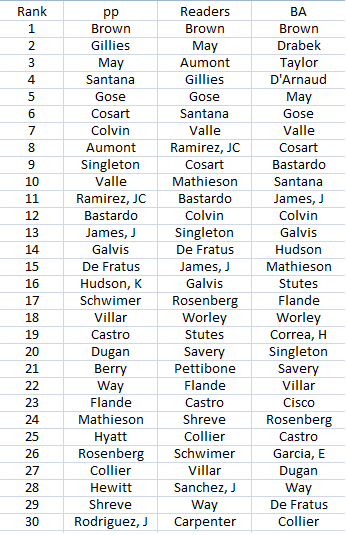
BA’s list obviously isn’t as relevant because it contains Drabek, Taylor and D’Arnaud.
Enjoy.
 Phuture Phillies
Nose candy??? I do believe you are giving the Lee trade guys way too much credit.
Other than that nice work,very good read.
LikeLike
This year’s list is going to be extremely difficult IMO. How do you go about comparing an MLB ready reliever like Scott Mathieson to a NYP second baseman like Cesar Hernandez? Or an older hitting prospect like Matt Rizzotti to a younger fielding prospect like Freddy Galvis? Where do you slot Tyson Gillies? A lot of good prospects, and a lot of philosophical questions in this group.
LikeLike
Good write up but you can’t seem to stop fighting for the Cliff (third worst trade in Phillies history) Lee and accept the facts on those three.
LikeLike
My comments were assessing where I ranked the guys last year. Not where I’ll rank them this year.
I don’t think its me that can’t let that trade go….
LikeLike
This was a great read…
Couple questions for the readers that frequent this sit…
1. How quickly could Jared Cosart or Brody Colvin get a shot at making the Phillies rotation? Is 2012 realistic for either of them?
2. Is there any new news on Tyson Gillies? Last I heard he got busted for coke and he claims it wasn’t his. Where is he? Is he in jail? Out on bond? How long will this take to get decided? Will he play for the Phils in the minors next year? Is there any new news or resolution? I feel bad for that situation. All the talk after the horrible Cliff Lee trade was how this kid was such a nice kid and good person. Trying to flag down a car on the side of the road at 2AM intoxicated with your shirt off after being at a titty bad, while normal for a young person, just doesn’t sound like the nice guy focused on getting to the big leagues that the media painted him to be after the trade.
LikeLike
Regarding JC Ramirez, for a drug bust like this it can take anywhere from a month to a year to get figured out. It depends on a lot of factors such as motions, defenses, prosecutor personality etc. In law school I worked for a juvenile justice clinic and we dealt with a lot of minor drug bust like this. The biggest factor was the prosecutor’s willingness to work with a young person without much of a record. I’m sure he’ll have a decent defense lawyer who will pepper the prosecution with motions and delay the whole process to try and wear them down for a favorable deal such as probation with a rule or something, which means if he successfully completes probation the charges are dropped. My best guess without more information would be 3 months after the arrest for things to get figured out.
LikeLike
Ooops I meant Gillies not Ramirez. I also apparently can’t get over the Lee trade.
LikeLike
The reader Top 30s didn’t make the transfer over here, but I’m pretty sure I had J-Rod quite a bit higher than 30. So I saw him coming too 😛
LikeLike
I still don’t see it with Leandro Castro. He’s an alright prospect but top 10 seems too high to me. He wasn’t young for Lakewood and hasn’t shown good on-base skills, a knack for stealing bases (he must have some speed, but his percentage is no good) or much power and he doesn’t have a very projectable frame at 5’11”. I’ve seen plenty of commenters on this site say that they like him, so it’s not just PP’s opinion. To borrow a line from Will Ferrell, I feel like i’m taking crazy pills.
LikeLike
On Gillies: I hope we still have the ancient bromide—> he’s not yet been PROVEN guilty. All we have is the bare police report. As far as I can tell Gillies has not admitted to any crime and has entered a Not Guilty plea. Do we doubt that the Phils org has assisted him with an attorney– maybe of his own choosing?
It’s a long way from an accusation to a conviction. What kind of bail terms he received might also influence whether he is obliged to cease his life’s work before any trial.
MAYBE he will be permitted to play in the AFL pending further developments. And, certainly that he has a clean record (!?) will be influential whether they proceed with the prosecution or find another means of resolution.
Hold your horses.
LikeLike
After Gilles, who is our best Outfield prospect?
LikeLike
I would say Jiwan James is our #1 outfield prospect. This was his first full season since switching from being a pitcher.
LikeLike
PP, given that “My goal is to try and figure out where I was right on guys, where I was wrong, and identify if my philosophies as a whole have a blind spot, or if things were simply unforeseeable last winter” you’ve only done part of the job by only looking at the players on your top 30-list. With the exception of Worley, you haven’t talked about players on the readers and BA’s list that weren’t on yours. It looks to me you were too optimistic on outfielders, (e.g., Hudson, Dugan, Collier, Berry, Hewitt) at the expense of being too pessimistic on pitchers, (e.g., Worley, Pettibone, Sanchez, Stutes, Garcia).
You wrote “Catchers remain the toughest prospects to evaluate.” I disagree. I think it is pitchers, partly because of injury concerns, which you rightly pointed out for Cosart, Matheison, Bastardo, and James (who was a pitcher when he was injured), and partly because of consistency problems, which I think is because command and control are more important than velocity and there is the smallest margin for error for command than any other baseball skill. If a batter has a 10 bad swings out of a hundred, he could still put up pretty good numbers. If a pitcher misses in the strike zone on 10 of 100 pitches, that could be and extra 2 or 3 extra homers he lets up. If he misses out of the strike zone, that will be a lot more hit batters, walks and wild pitches. My dad always said “its a game of inches”, mostly when a ball went less than a foot fair or foul. But for pitchers aiming at a 20 inch strike zone from 726 inches away it really is a game of inches nearly every play for a pitcher.
LikeLike
A lot of the readers saw Julio Rodriguez coming. It’s just that a majority seem to fall in love with reliever’s ERA and older starters. There was a small minority of us readers who ranked Rodriguez in the top 30. I remember the arguments during the poll.
LikeLike
I don’t understand the casual attitude about Gillies. Even if he is innocent in the eyes of the law, no one can believe there isn’t a serious problem,very serious. But maybe I am being an old fart. Most people with problems have to hit bottom before their eyes open. Maybe next year will be different but for me I can’t rank Gillies anywhere for now.
LikeLike
My Question on julio is if he is at 86-89 and doesnt increase, it will be tough for him as righthander to be successful in the majors. some have done it but its rare.
LikeLike
The guy who may be hardest for me to rank (especially in terms of his value with respect to prospects in other organizations) is Singleton because there seems to be a lot of contradictory evidence. The positives are his scorching early season and the consistently high evaluation of the scouts; the negatives are his two-month long summer slump, and his manager and others calling him out as stubborn and unmotivated. I think most posters here will rank Singleton very, very high because of age and overall performance. I’m very worried about a guy whose OPS was consistently about 1.100 in May and June, and consistently about .730 in July and August. I’d also love to know whether or not he can play LF since, again, we’ve heard both “yes” and “no” indications from the organization.
And I think Castro is fringy for the top 30. He’s an average fielder with little speed, little power, and less than optimal strike zone judgement. On top of that, he strikes out at a rate that indicates he should hit for power (84 K/471 AB), but he doesn’t. I’d be more optimistic if he were a good fielding 3B or 2B but I don’t think he can make it as a corner OF–there’s just too much bat required at that position.
LikeLike
Phillychuck never heard about him being stubborn or unmotivated, but makes sense,seeing his senior year was bad,maybe just thought he was too good to try harder, this worries me about him.
LikeLike
Sorry, if you are right-handed, command is NOT more important than velocity. Just ask Drew Carpenter and Kyle Kendrick. A 97 MPH fastball cures many pitching ailments.
LikeLike
That month-by-month OPS criticism is absurd. Albert Pujols had a nearly 400 point difference in his OPS between July and August. That is NOT unusual in the slightest.
LikeLike
Phillyfantastic — I don’t think we can equate Gillies arrest with lack of interest in getting to majors. We don’t have to go that far back in Phillies history to the bright, young pitching prospect who got drunk, got in a fight outside the bar and broke his hand, and since has pitched very well for the Phillies. Gillies would hardly be the first young black man to be framed by a Florida policeman.
Catch22-
I wouldn’t be so quick to use Kendrick as evidence of the obvious supremacy of FB velocity over control for RHP. There are a lot of guys who were in the minors with Kendrick, who had the good FB, but haven’t come close to what Kendrick has done in the majors.
I also don’t see Castro as a top 10 pick. I think he had a disappointing season. I put him near the end of my top 30. For PP and others who boost him — what really stands out? A .708 OPS is really poor for a guy who will almost certainly have to be a corner OF. He walks well less than once per 10 plate appearances. His SB/CS ratio stinks. Turning 21 at mid-season isn’t young for Lakewood. He had a good season in NYP league last season and didn’t make any top 10 lists. It’s hard to see what he did this past summer that could possibly boost his stock so much. Seems like trying to convince yourself to fall in love with a prospect.
LikeLike
Allentown
My point was ranking him now is useless.
1. He hasn’t played in the org.
2. He may not ever get into the country again.
LikeLike
Quick overall comments on Gillies.
1. In terms of missed time, I’d view this the same as an injury. Gillies has a track record, he’s not an unknown. It’s hard to gauge him after what was more or less a lost year, but that’s often true of other prospects.
2. The arrest is a serious issue, but I don’t think it takes him completely off the map.
3. In response to Nowheels’ 2nd point, I view that as irrelevant when rating a prospect. I rate a prospect based mostly on ability, though these types of intangibles can come into play. But whether he’s extended a work visa is the same as say, if there were a military draft in effect. I believe that you rate the player, and then explain the circumstances.
LikeLike
In regards to Mathieson, does anyone think he’s got a chance at the pen next yr? I guess he’s done as a prospect here but the Phills wouldn’t have held onto him this long unless they still believed in him.
LikeLike
Mathieson won the Paul Owens Award so the organization isn’t ignoring him. He’s still a prospect IMO but he is encroaching on the innings threshhold for eligibility.
LikeLike
During the construction of the readers’ top 30 I was actively promoting Vance Worley immediately after the top ten until he was placed at 18. He’s already made his major league debut and will be competing for a spot in next years Philly rotation. Four pitches thrown with control and command will allow him to beat out Kendrick in my opinion. Jon Pettibone was also a prospect I was high on although my reasons were more hunch than in depth evaluation. ( I’m still not a scout) He just threw a gem last night to get Lakewood back to the SAL Finals. His future should be as bright as May Colvin and Cosart although he’s slightly below them- at least in perception.
I’ll give you props for the early positive vibe you had on Singleton. He’s looking good at a very young age. I actually heard a report where some scout compared him to a young Willie McCovey. That’s high praise.
LikeLike
At what point does Pettitbone start getting hype? He’s 20 years old in Low-A with a ludicrous gb/fb rate with a soaring K rate. I’m really high on the guy and would probably put him somewhere in the 8-15 range minimum.
LikeLike
Not sure what to make of your comment on Mathieson. he dropped 65 very good AAA innings this year, and I don’t think it’s a stretch to say he was one of the 3 best relief arms in our org – including the big team – regardless of the decision to leave him in the minors. An injury history like his means its best to consider him depth, but a lat pull is not an injury to get too worked up over, and frankly any bullpen should be built with a focus on depth. But if you’re just saying your sick of having a 26 year old reliever on your lists, so be it.
LikeLike
Since baseball fans are permitted to dream, I have one recurring with no reason other than it’s better than nightmares for good sleep with a smile:
Singleton is and shall be one of those elite prospects that come no more frequently than blue moons. Should he turn out as imitative of McCovey, we are in for great pleasures for many baseball years. I don’t recall how well McC fielded at 1st base, but I understand that Singleton has been rated as a fine fielder there.
I can see (hope) that Howard will continue his game for at least 3 more yrs in Philly—with the possibility to trade him then if Mr. S continues to clone McC. A trade of such a superstar could yield superior returns to aid whatever needs the team then has.
It is all a dream….
LikeLike
****Not sure what to make of your comment on Mathieson. he dropped 65 very good AAA innings this year, and I don’t think it’s a stretch to say he was one of the 3 best relief arms in our org – including the big team – regardless of the decision to leave him in the minors.****
Blowing away AAA guys with high heat is great…that won’t work at the MLB level. Until he develops a legit 2nd pitch (see Sutter & split-finger training), he won’t do that at the MLB level. A flat 98 mph fastball with no movement is very very hittable for MLB hitters. That’s what James & the Phillies FO see despite his gaudy numbers in Lehigh.
LikeLike
Aumont as relief pitcher?
LikeLike
I agree with Rick Wise Guy and JoeDE on Pettibone…Lakewood guys could be all over top 30 next year….Cosart, May and Colvin could all be in the top 5. Pettibone maybe top 10-15. Julio Rodriguez could hit high teens to low 20s. Shreve and Zeid could get into the top 30 as well.
LikeLike
Why bother with Hewitt at this point?
Honestly, is there any reason to even waste an OF spot for him in Lakewood? Even if he improves, he’ll still be a 22 year old hitting in Lakewood and thus, old for the league. He struck out in 24% of his PAs this year and that’s about right for his career so far. He’ll be taking ABs away from actual prospects.
290 Ks vs 29 BB for his career.
LikeLike
Um, not to rain on anyone’s parade, but Pettibone has a K rate of 6.5/9.
That’s not exactly “soaring”. It’s fine, but you really want to see higher than that out of a pitching prospect at a low level. I’m not saying Pettibone isn’t a prospect, I’m just saying I think the idea that he’s some stud with a “soaring” K rate is a little bit of hyperbole.
LikeLike
I actually just went and looked at his splits. I could have sworn that his k rate got better as the season went on but it looks like it actually got worse.
LikeLike
“Mathieson… was one of the three best relief arms in our org… including the big club.”
LOL
LikeLike
Pettibone had 2.43 ERA in last 10 games in reg season and only walked 12 guys in 10 games (63 innings)…not to shabby
LikeLike
McCovey played left field for San Fran for two years until the Giants traded away 1B Orlando Cepeda to the Cardinals. The Cardinals getting Cepeda helped them win a World Championship.
Thought you’d be interested…
LikeLike
Jn’ :
Yes. Cepeda was a terrific righty hitter and power guy. So…could Mr. S play LF..? Supposedly a fine athlete but not a fast guy. Of course LF is where teams hide their lesser fielding OFers. Yet, with Mr. S in LF, Howard 1st base, and Brown in RF….they all are lefty hitters…without relief by any righty guys with some power. Thus, the dream had a trade of Howard for established righty guys for LF and 3rd base with Mr. S at first.
Fantasy could turn to reality; gimme the reins.
As dreams go, that’s not bad.
LikeLike
Pettibone has 29Ks in his last 28 innings pitched,which includes his playoffs performance. Its only 28 innings so it might not be something to get excited about.
LikeLike
Re-read the list and for all the credit on a few ‘wins’, Hudson appears the biggest miscalculation. He appears terrible and will be one for the scrap heap shortly after Hewitt.
Galvis is still super young but appears he will never be a starter so the John McDonald comparison are likely legitimate at this point. Not sure where to rank ‘probably backups’ as related to ‘lottery ticket types with limited information’.
I am not going to give May much credit for dropping down and dominating hitters he knows he can beat. He falls from the top to the bottom of the Three Headed Monster but he is still one of the heads.
Way and Flande are both lefties with limited stuff so again not sure where they rank when compared to say Collier who is just unknown. Worley (and Hyatt) were fringe stuff types that had very good years and because of it are near the majors.
Despite his troubles, I think Aumont deserves some comparison. His stuff still appears to be good and he is only one year older than May and started a level higher. He is another lottery ticket type who has to be in the Top30 for 2011.
LikeLike
I think people are sometimes a little too tough on Galvis. He’s always been raw with the bat, and young for his level. He made whats often called the biggest jump in the minors to start this season. He ended up improving his walk rate and maintained almost an identical OPS to his year in Clearwater. He also stole bases at a better clip, even it’s not really a weapon for him. Was anyone realistically expecting him to have a better offensive year than he ended up having?
LikeLike
you make good point handzus i don’t know what people expect
LikeLike
Someone ask “after Gillies who is our best outfield prospect”. D’Arby Myers is our best outfield prospect.
He is still young 21. He is a very good outfielder, speed and has made very few errors.
LikeLike
D’Arby Myers has tools, but is only barely a prospect at this point. I would be very surprised if he ever makes it to the majors. There are probably around a dozen outfield prospects ahead of Myers in the rankings.
LikeLike
“Despite his troubles, I think Aumont deserves some comparison. His stuff still appears to be good and he is only one year older than May and started a level higher. He is another lottery ticket type who has to be in the Top30 for 2011.”
Please how does 5.68 cum. and almost as many walk as Ks get you consideration for anything but release. His average against fell only slightly at CLW.
Make the guy a closer and HOPE.
BTW May is getting people out.
LikeLike
D’Arby Myers? LOL
So-so average, no power and for all his speed, can’t steal bases.
If the D’Arby Myers fanboys are out, then I’m going to argue for Derrick Mitchell as the Phillies best outfield prospect after Gillies. More power, steals more bases, comparable average and by the end of the season had beaten out Myers for the starting CF spot in Clearwater. James who? Santana who? Altherr who? Castro who? I’m driving the Mitchell bus and ya’ll should recognize it’s time to hop on board.
LikeLike
Myers is not the top prospect in Clearwater. I believe that Mitchell is better then him as well. Shoot Susdorf might be better. I would pick James and Castro over those three.
LikeLike
Thanks James, great reading. It will be fun working on the top 30 again. My early list has 5 or 6 starting pitchers (check the Lakewood squad). You can always trade starting pitching for hitting and if they all stay healthy, our system has a real glow to it with so many arms doing well. Keep an eye on the Lakewood final series starting tonight. In the semis, in three games, their starting pitching gave up only 1 run in 18 innings. There’s not a minor league team anywhere that can run starters out there better than Lakewood right now and that doesn’t even include Cosart.
LikeLike
nowheels….although Aumont may make a fine closer in the bigs, you don’t make him a closer now. He needs to refine his stuff, and to do that he needs to pitch. In order to pitch, you start. It’s simple. Look at all of the big time closers, they all start out as starters. Let’s give him at least one more year in the minor league rotation to work out some kinks before permanently moving him to the pen.
LikeLike
Art D you forgot Utley as a lefty power bat as well.
Werth is very important because he balances out the line up. Over the past three years, I believe he is in the top 5 in the league versus lefties. The Phillies are going to need right hand power – either at third, cf or ss. Ibanez has only his 4th home run yesterday versus lefties.
My solution is getting Kemp from the Dodgers, playing him in cf (Victorino would be a part of the trade). Kemp is also excellent against lefties.
LikeLike
I have an eerie feeling that the solution for balancing the lineup will be John Mayberry stepping in against lefties for Dom Brown next year; and coming off the bench. His splits against lefties are Werth-ish. It’s the righties that kill him.
LikeLike
except victorino is a switch hitter who is much better batting from the right side
LikeLike
Phuturephillies, great work on the article which was informative. As for the Cliff Lee trade comment i agree with you 1000%. It seems to me some people can’t or won’t see the forest from the trees.
LikeLike
I got an eerie feeling Mayberry wont even be on the 40 man next year.
LikeLike
“Blowing away AAA guys with high heat is great…that won’t work at the MLB level. Until he develops a legit 2nd pitch (see Sutter & split-finger training), he won’t do that at the MLB level. A flat 98 mph fastball with no movement is very very hittable for MLB hitters. That’s what James & the Phillies FO see despite his gaudy numbers in Lehigh.”
really? While it is fun to make predictions in the absence of evidence, I would say that AAA numbers tend to translate quite well to the bigs and it is this kind of paternalistic approach to talent evaluation that leads to signing Danys Baez.
LikeLike
I thought this was a very interesting comment from Chuck LaMar about DeFratus: “”If he stays healthy and keeps his head screwed on right, it’s a matter of time before he gets the chance to pitch in the big leagues.”
I do not remember any previous commentary about him not having his head properly attached to his neck. Anyone have any color on this particular insight?
LikeLike
Myers is a very talented ball player. Myers can play and has played all outfield positions very well, he is the fastest in the org. Myers and Mitchell are both good players. They were both underrated. Mitchell and Myers were there when Brown was there, Mitchell was a better outfielder than Brown then and is better than Brown now. Mitchell is a good outfielder with power. Myers also, except Myers had to pinch hit the majority of his low A season and had blockers. When Myers did do well he still had to sit back while other players came up and played his position. I went to the games in Lakewood and saw the majority of the games he played. In Most of all Myers games, Myers only pinched hit or came in to pinch run which brought down his stats just like Brown’s stats are going down in the MLB because he is pinch hitting. Now when Brown has to pinch hit and his stats are going down, does that make him less of a good player? Have Brown play in CF or LF out of his position and pinch hit or run for the season and let’s see how well Prospect #1 does. Myers deserves a fair chance too.
LikeLike
Myers didn’t hit well this year. He also didn’t hit well in 2007, 2008 or 2009. The funny thing is that this is the best year of his career. The only time he hit was a small sample of at bats in the GCL, fueled by a high BABIP and a poor K/BB ratio. It all adds up to the fact that Myers has already had 1,300 minor league plate appearances in this organization. In that time he has demonstrated little plate discipline and little power. He has speed. So on what should we rate him highly on? Blind faith? By that standard we could consider 100 guys reasonable prospects.
LikeLike
Well, Danny, I’m glad you’re not the GM – again, Myers and Mitchell are really borderline prospects. I like Mitchell more than Myers, however. Dom Brown is an inconsistent outfielder but has electric talent.
LikeLike
Myers was hitting .381 this year. Myers was hitting as a pinch hitter in 07 thru 08 and had to share playing time 09. Once he got to play everyday you can see his stats were climbing.
LikeLike
“Myers was hitting .381 this year.”
Uhh, Myers hit in the .260s this year. He hit .381 in his last 10 games of the season, great for him, with 1 BB and 10 Ks. According to milb.com he’s also Shaquille O’Neal’s cousin, so he’s got that working for him at least.
LikeLike
Myers did have overall a decent year. Next year is his 5th in the organization… so either he has a great year or, more than likely, he won’t make it. Having an OBP percentage below 300 over 4 years isn’t all that enticing.
LikeLike
Why would Myers have been forced to pinch-hit/share roles for his first few seasons when he’s the BEST PROSPACT EVAH?
No one ever explains that to me. And for all his speed, he had fewer stolen bases this year than Freddy Galvis. Oh, and where did he disappear to at the end of the season, when Mitchell took over at CF?
I was not being serious when I claimed that Mitchell was our best outfield prospect after Gillies. He doesn’t even make my top 30 list. He is at the top of my sleeper picks though. His walk rate wasn’t too bad, his average was decent, he’s able to play center field, he’s got speed and he hit for power in a stadium and league that kills power. It’s true that he’s a little old, but the book on him when he was drafted was that he was raw and needed time to develop. If he performs well at Reading, it just might mean that he’s finally put it together.
LikeLike
Where’s Waldo? ER, I mean Collier. He has a great disappearing act; can he be found somewhere nursing his constant injuries ?
A very early draftee choice who at first couldn’t hit and thereafter too hurt to play.
Wishing him a complete recovery for ’11. Get it happenin’ ! How long can we wait to see if he really has some worthy goods?
LikeLike
I think Dugan is the next best of potential top 5 guy. It will be interesting to see where he goes… you would think Lakewood and then you will see what he’s got.
LikeLike
Collier was consensus 25-30 last time. If you don’t dock him for missing a year he probably merits a back end mention. The problem for him is that a lot of good prospects joined the discussion. 31-40 for me I’m guessing.
LikeLike
1st of all Myers did not have fewer SB’s than Galvis. Myers 14 SB’s 3 CS in 66 games and Galvis 15 SB’s 4CS in 138 games. Brown has 12 SB’s and 6 CS. When Myers played in his 1st season he played CF everyday .313 avg. After that when he played his next few seasons he pinch hit and pinch ran most of the games and he played RT, CF and left field, he was not the everyday player anymore, that brought his avg down. I don’t know why he pinch hit, pinch run and played lf, cf, and rightfield after such a great season. I took pic’s of the prospects and I saw the games. He only played in one or two innings in the majority of his games.
I saw him play back then and I saw him play in Clearwater now, he’s got electric talent. To see him rob a homerun. He has great defensive skills. I would like to know why Freddy Galvis can be a prospect when he can’t hit, he never could hit or why our best outfielder is Gillies who’s inconsistent, his avg is .238 with only 2 SB’s and Myers is no longer a prospect. Now that he is getting more playing time his numbers are looking better he can regain his prospect status. Should we judge him on blind faith, if you have ever seen him play you will know he has talent.
LikeLike
Yes, I’ve seen him play. Did you see him outside of Florida? First off, he was a regular in Williamsport in 2007. 46 games played, ALL in center field. The next season he played a total of 114 games between Williamsport and Lakewood, and played 95 of those in center field. So right there in his formative seasons he’s mostly in center field. As for pinch hitting/running, here’s his ratio of plate appearances/games.
2006: 4.39
2007: 4.22
2008: 3.89
2009: 3.48
2010: 3.92
Now, it’s awfully hard to come up to the plate four times a game if you’re a pinch hitter/runner. The fact is that D’Arby Myers hit .313 in 2006 yes. But that’s the Gulf Coast League. He received regular playing time the next two seasons, and failed to hit. At that point the Phillies made him a part time player, as you’d expect. I know Myers is a great athlete, very good runner and fine defensive player. But there’s nothing in his hitting profile to indicate he can play in the majors any more than 30-40 other players in our system.
LikeLike
Not sure of the Myers love? He has been in the system for five years with a career .253 BA and .300 OBP. In 340 games he has 272 ks and 73 BBs. Despite a season/year to forget for Gillies in 263 career games he has .312 lifetime BA and 406 OBP. His K/BB 181/109. Hope Phillies can clean up Gillies and get his head straight.
LikeLike
The reason why Myers stats went down in Williamsport and Lakewood is because his playing time was not consistent. Just like I follow Myers, I follow Brown and I know if Brown continues to have to pinch hit his stats will go down just like Myers did and he’s going to look bad also, .214 avg looks as if he can’t make it in the majors.
In the case of Myers his games were inconsistent in 2o08 Myers 64 games 207 AB while Brown 114 games 444 AB
On 4-11-09 Myers played CF .333
4/12 Myers played RF .308 while Castro played CF .167
4/13 thru 4/17 Myers did not play
4/18/09 Myers played CF .353 then on
4/19 Myers played LF .333 while Gose played CF .234
4/21 Myers RF Gose played CF .240
in May and June same thing 5/14/09 did not play 5/15 taken out game early.
5/24 came in 9th no AB. defense only
5/25 came in 8th no AB, defense only 5 /27/09 did not play 5/28/09 PR
It is very hard for any player to play well with inconsistency’s with his playing time. Myers is the fastest in the phillies org and he is an excellent defensive player who can play all three of the outfield positions, he is still young 21, still growing and the power will come. Hitting alone can not be the only criteria to be a prospect, defense and playing your position well should matter also. with that being said, he should be in the top 30 prospect. Galvis must be defense he can’t hit he’s on the list. Hewitt, Hudson, Collier, James, Castro, Berry must be speed. Gose must be speed. Phillies need hitters and defense and speed.
LikeLike
****Myers deserves a fair chance too.****
LOL…I guess the last 5 seasons weren’t enough of one, eh?
LikeLike
Danny, Freddy Galvis is a shortstop with, by all accounts, a glove good enough to play in the majors right now. This will likely make him a utility infielder. Myers, on the other hand is older, at a lower level, is an outfielder, and has not hit well enough to justify his place in the outfield as a starter or utility player (4th outfielders really do have to hit – playing defense is not enough).
Danny, it just sounds like D’arby Myers is your favorite player and you like watching him and rooting for him. That’s a good thing – it’s nice you are so fond of him and I believe he is entertaining to watch. However, do not confuse that with his prospect status. Unless he blossoms overnight soon and starts hitting a lot, which I doubt he will do, he’s not going very far. Sorry to tell you this, but it’s the truth.
LikeLike
I agree with Catch….Myers would need to have a big yr next yr to move up prospect list. Some of the names given; Jiwan James he is clearly behind. James is a year younger, a plus defender, great speed, and had more production. Leandro Castro, also 21, plus defender (arm), and despite his .250 average he was a very productive hitter 27 doubles and 81 rbi’s. The Phils invested a lot in Hewitt, Hudson, and Collier even though they have yet to perform. Berry who is no longer in the system was a good lead off guy who had walked alot for a minor leaguer and stole 50 bases a year. He was a better hitter in the beginning of his career batting .312 3yrs ago but that has tailed off.
I hope Myers does do well in the next level because the Phils may need him in Reading if Gillies does not have his head screwed on right.
LikeLike
I think it’d be interesting to ask whether D’Arby Myers rates ahead of Anthony Hewitt.
LikeLike
Kyle Drabek making his ML debut for Toronto tonight
LikeLike
LOL, evidently 15<14 in Danny's world.
LikeLike
So-so outing for Drabek. Gave up 3 runs, 9 hits in 6 innings and took the L…
LikeLike
I think you’ll take that from a guy in his ML debut. Drabek was a little wild with 3 walks also, but he K’d 5.
LikeLike
Interesting thread.
I’m just curious, if you could have only player in the system to bet the farm on (non D. Brown), which way are you leaning?
I’m all-in on Colvin if you hold a gun to me.
Also, what do we make of Cameron Rupp after a short season?
LikeLike
Given his late-season surge and his stuff, I don’t see how Zeid could be left out of the next top 30 list. He’s looking like a high teens, low 20s prospect to me and could surge even higher next year. How about that Lakewood staff!
LikeLike
I’d add (P) Michael Stutes, (3B) Cody Overbeck, (2B) Harold Garcia and (Man without a position/DH type) Matthew Rizzotti to the list for 2011. Even though they are getting a bit old for prospects (they’re reaching their mid-20s), they are the most viable candidates for the majors who are at or near the top of the Phillies’ farm system.
Rizzotti and Overbeck impressed with their power. Rizzotti hit for a really high average at a couple of minor league levels. Garcia set a new Florida State League consecutive games hitting streak record, breaking a record that stood since The Korean War years. After hitting safely at Clearwater for 37 straight games from late May to early July he earned a promotion to Reading,(AA), where he continued to hit well. With Anthony Gose traded out of the orgainzation, Garcia is now probably the farm system’s biggest base-stealing threat. Stutes was a very pleasant surprise, performing well at (AA) Reading then earning a promotion and performing even better at (AAA) Lehigh Valley. He did so well that I even thought the Phillies might bring him up for September.
In you place I’d add about 8 to 10 new names to the Top 30 list for next year. You’ll have to replace the guys who were traded away and some of the deadwood/ non-performers with more promising players. – Dennis Orlandini
LikeLike