Welcome to the latest installment of the SONAR takes on series. If you’re new to the concept, I recommend you check out my intro piece on SONAR here, then check out the reports for first base, second base, shortstop, and third base so you have an idea of how I’m approaching the project. After catcher, I’m going to do the corner outfielders together, then centerfield, and that will wrap up the position player side of the ledger. I’ll then break down the pitchers, before finally releasing a top 100 prospects based on SONAR scores. After that, I’m going to reveal my top 15 prospects for each team, which will be a synthesis of my own personal opinions of the prospects, plus my work here with SONAR. We really won’t know how accurate my readings on these prospects are until we have multiple years of data, but it should be fun to look back at these lists next year and see which guys proved to be real and which faded into obscurity. So lets get started with the catchers…
The catcher is arguably the most valuable position in baseball. Catching requires a unique skill set, because the catcher is involved on every play. He’s in charge of calling the game (or sometimes relaying the plan from the dugout), he’s in charge of controlling the other team’s running game, and oh, he’s also expected to hit and produce offensively as well. He’s expected to do all of this while crouching down behind the plate for 3 hours a night, sometimes in 100 degree heat, wearing heavy gear that impedes his natural movement. The offensive expectations from the catcher position are lower than any other position for all of the reasons above, and the baseball lifespan of a catcher is generally shorter than at any other position. The catching position, by nature, requires a certain body type, moreso than any other position. Tall catchers are the exception (Joe Mauer, Matt Wieters), because the strain on the joints (especially the knees) of a tall player is tougher than on a shorter player. Players with a very thin frame sometimes struggle to hold up physically because of the abuse they take, and it leads to stamina issues. Nevertheless, teams are always trying to find guys suitable for the position, sometimes taking players who play other positions and moving them back there, like Russell Martin of the Dodgers. In other cases, guys simply can’t hold up physically, and their bat is deemed too special to lose, so they get moved, like current Phillie Jayson Werth. I guess what I’m trying to convey is, the catcher position is incredibly tough, and finding a guy who can a.) handle the defensive responsibilities b.) stay healthy for 150+ games and c.) be an offensive asset is an incredibly tough chore. Some of the guys on this list will not be able to stay at catcher physically. Some won’t be able to stay there because of their defensive liabilities, and some will actually make it as a catcher and be productive in the big leagues. This is one of the toughest positions to analyze on any level, from statistics all the way up through the scouting world.
Here is the top 20 chart. If it doesn’t display properly in your browser, click here.
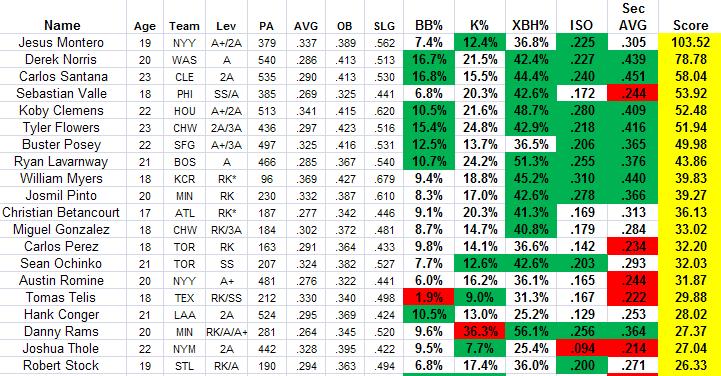
01 – Jesus Montero (NYY) – SONAR 103.52
Montero has the highest SONAR score to date through the positions we’ve covered, and that seems to go along with the consensus opinion of him as one of the best prospects in the minors. The biggest question of him (posed by just about everyone who ranks him so highly) is not IF he has to move off the position, but when. He’s considered by most people to be a future 1B or DH, as he simply doesn’t have the defensive chops to remain behind the plate. With the bat, though, he’s obviously a special prospect. As a 19 year old, he put up a composite line of .337/.389/.562 across A+/AA, a truly stunning line. While he has only a 7.4% BB rate, his contact skills are elite, as he posted a very low 12.4% K rate. His .225 ISO is very impressive for a 19 year old playing against 21-25 year old prospects/minor league vets, and scouts think he still has more power to come. As a Yankees prospect, the question always becomes, where does he fit? If he can’t catch, there is no opening for him at 1B. Its very rare that a prospect is promoted to the majors to be a full time DH, but that might be Montero’s path. Don’t let the .305 SecA fool you, at just 19, he’s playing against guys much much older than him, and he still has projection in his bat. His bat is elite, and it will play no matter what position he ends up at.
02 – Derek Norris (WAS) – SONAR 78.78
Norris, like Montero, is being questioned more for his glove than his bat. He put up an impressive .286/.413/.513 line in the SAL at age 20, following up his impressive .278/.444/.463 line in the NYPL in 2008. He’s an offensive beast, posting a 16.7% BB rate and a .227 ISO, helping him to produce an eye popping .439 SecA. His game is patience and power, and he’s played it well so far as a pro. He did strike out in 21.5% of his PA’s, a pause for concern, but not a major red flag at this point in his development. His .342 BABIP was fortunate, but he hits a lot of fly balls (44% in 2009), which is where he’s going to make his living. He doesn’t profile as a high average guy like Montero, but he should more than make up for it with his power and walk rate. Whether he can catch in the big leagues is another question.
03 – Carlos Santana (CLE) – SONAR 58.04
Santana may represent Dodgers GM Ned Colletti’s biggest mistake, as he traded Santana to the Indians for Casey Blake two deadline’s ago, and only included Santana because Cleveland was willing to pay the rest of Blake’s salary. That ended up being almost like a signing bonus for a first round pick, and I’m sure the Indians are absolutely delighted they made that move. Santana offers an impressive overall package, nearly mirroring Norris in his 16.8% BB rate and .240 ISO, slightly better peripherals. He also has better bat control, posting a solid 15.5% K rate. Akron is a moderate pitcher’s park when it comes to power numbers, so Santana’s score gets a boost there. What separates Norris from Santana, and is a core element to this system, is 3 years in age. Norris is essentially 2 levels behind Santana, but 3 years younger. He’s on pace to get to AA one year sooner, and if he replicates Santana’s slash line in AA, his score will be higher. There is something to be said for performing against a higher level of competition, but there is also something to be said for development and projection. Norris’ A ball performance is very impressive, considering its context. At age 20, Santana split his season between the short season Pioneer League and the A+ level Cal League. He posted a combined line of .282/.379/.436 in 391 PA, not a bad performance, but his .729 OPS in the Cal League wasn’t hugely impressive, even for a 20 year old, and his power didn’t emerge until last year, his age 22 season, which he spent between two A+ level affiliates. Norris, at 20, has already shown elite power, and that’s why the system favors him. I just wanted to point that out here, as a frame of reference, to try and shed some light on the process. Santana’s defense appears to be at least average behind the plate, so he shouldn’t be a risk to move off the position, at least not any time soon.
04 – Sebastian Valle (PHI) – SONAR 53.92
Here’s a familiar name. The Phillies started Valle in Low A, an aggressive promotion for an 18 year old, and he struggled to find his footing. After being sent back to Williamsport he got on track, posting a .307/.335/.531 line in 206 PA, giving him an overall line of .269/.325/.441. Valle has shown an ability to hit for power, evident in his .224 ISO at Williamsport. He struggled across the board at Lakewood, which brings his overall ISO down to .172, still a solid number. The rest of his game is crude, as he didn’t draw many walks (6.8% overall) and he swings and misses a fair bit, posting a 20.3% BB rate combined. Valle is still young, and he’ll get another shot at Low A in 2010. He is now the Phillies top catching prospect after Marson and D’Arnaud were traded away. He has youth on his side, as well as plus raw power, but he needs to refine the other aspects of his game and also prove he can handle the position defensively.
05 – Koby Clemens (HOU) – SONAR 52.48
Son of Rocket, most people are writing Clemens’ 2009 season off to a Cal League mirage, and while its possible, I think he might actually have legitimate hitting skills. The Cal League will inflate power, so his astounding .280 ISO is probably not going to be repeatable, but he did manage a 10.5% BB rate, and he posted a 13.3% BB rate last season, so it appears to be a real tangible skill. Playing a hitter’s paradise at Lancaster, I’m sure he wanted to swing more, and its tough to blame him. For the extreme hitter’s parks in the Cal League (High Desert, Lancaster, Stockton and Visalia) I like to look at the difference between home and away numbers, even though I concede splits at the minor league level are a tad flimsy. At home, Clemens went .352/.425/.662 in 210 AB, with 29 BB and 48 K. On the road, he went .337/.412/.606 in 208 AB, with 22 BB and 62 K. So Lancaster definitely helped him at the plate, but his road performance would look fantastic as his overall line. The Cal League has its hitters parks (mentioned earlier), but it also has a few very good pitchers parks, notably Inland Empire and Lake Elsinore, and San Jose and Rancho Cucamonga played as pitchers parks in the years of data I considered for park adjustments. So while the league is hitter friendly, not all parks are the same. Clemens still showed a good eye away from home, and he still showed legitimate raw power. SONAR reduces his score based on his home park and adjusts in the context of the Cal League, but it still believes in him at the plate. It will be very interesting to see what he does in AA next year at age 23. He is a converted 3B, so its unclear whether he’ll get good enough defensively to stick at C, but the Astros should leave him there as long as possible.
06 – Tyler Flowers (CHW) – SONAR 51.94
Flowers was a draft and follow signing in the 33rd round of the 2005 draft, and has posted solid numbers since turning pro, getting better and better each season. Thankfully for Phillies fans, the Braves traded Flowers in December 2008 in the Javier Vazquez deal, and he flourished in 2009, posting a .297/.423/.516 line in 436 PA across AA/AAA. Flowers is very patient (15.4% BB rate) and has great raw power (.218 ISO), but he swings and misses a lot, striking out in 24.8% of his PA, just missing a red light on the chart above. The walks help offset the strikeouts, so the White Sox probably aren’t going to complain. Having turned just 24, his bat is basically big league ready, but his defense is still suspect, and its unclear whether he’ll ever even be average defensively. He’s likely going to spend all of 2010 at AAA, presumably working on his defense.
07 – Buster Posey (SFG) – SONAR 49.98
The 5th overall pick in 2008, Posey split his season in unorthodox fashion, starting in A+ ball and then moving up to AAA, skipping over AA Connecticut (and the East Coast), something most prospects don’t do. Because the Giants are a west coast team, and their A+ ball affiliate is in California, with their AA affiliate on the East Coast, it made sense to keep him close in case he was needed at the big league level. Despite getting a callup in September, he barely played, and with the Giants re-signing Bengie Molina, it appears he won’t get a chance in 2010 either. Posey does a bunch of things well at the plate, posting a 12.5% BB rate and controlling the bat well, striking out in only 13.7% of his plate appearances. He posted a .206 ISO, a good number, but scouts seem split on how much power he’s going to hit for as a pro, and his home park isn’t going to do him any favors in that department. Defensively, he still has some question marks, which is likely the reason the Giants chose to bring back Molina for one more year. While I personally believe he has less upside than a guy like Carlos Santana, he’s already close to big league ready, hes going to hit for average, and he should be a 30-35 doubles guy with 12-15 HR in the big leagues, which is valuable if he can be an average defensive catcher.
08 – Ryan Lavarnway (BOS) – SONAR 43.86
Lavarnway might be the smartest guy on the list, drafted in the 6th round of the 2008 draft out of Yale University. The Ivy League isn’t known as a baseball hotbed, and Lavarnway abused college pitching, posting a line of .467/.531/.873 as a sophomore, and then .398/.541/.824 as a junior. He struggled in his brief debut in 2008, posting a .211/.317/.366 line in the NYPL as a 20 year old, but bounced back in 2009, going .285/.367/.540 in 466 PA at Low A. The power is obviously real, as he posted a .255 ISO, 4th highest of any of the guys on the chart. He was a year too old for Low A, but because he didn’t face much quality pitching in college, its not really that far out of line. His 10.7% BB rate is good enough, but he did strike out a bit too much, 24.2% of the time, and he’ll have to cut that number down a bit as he progresses. Ivy League guys generally don’t receive much hype, so Lavarnway is going to have to prove it at every level. He turned 22 in August, so the Sox could get aggressive with him and jump him to AA in 2010 to see how far along his bat really is.
09 – Wil Myers (KCR) – SONAR 39.83
The Royals took Myers in the 3rd round, after contemplating taking him with their first pick, and they had to give him first round money to keep him away from college, but if his debut is a barometer of what to expect, they made the right choice. In high school, he played a number of positions, including 3B, which some scouts envision as his future home defensively, but the Royals appear committed to giving him a shot to play at catcher, as he has an advanced bat for a high school prospect. His short season debut was off the charts, with a line of .369/.427/.679 in 96 PA in the Pioneer League, where he was one of the younger prospects. His score is actually adjusted down quite a bit because of his small 96 PA sample, but he still ranks an impressive 9th on the list. A 9.4% BB rate is solid, and scouts seemed to indicate he had a patient approach before the draft. But what jumps out is the ridiculous .310 ISO, the highest on the list by a wide margin. In his 96 PA, he managed 7 doubles, 2 triple and 5 home runs and also threw in 2 stolen bases. He’s obviously not going to hit .369 next year in a full season, especially in the pitcher friendly MWL, but he appears to have a sky high ceiling. The Royals last two high profile position players who went to the MWL for their full season debut (Mike Moustakas, Eric Hosmer) both struggled, so it will be interesting to see if Myers suffers the same fate.
10 – Josmil Pinto (MIN) – SONAR 39.83
Signed out of Venezuela in 2006, Pinto put up an impressive .332/.387/.610 line in the rookie level Appalachian League in 2009, after posting a .329/.394/.541 line in his brief 94 PA US debut last year in the Gulf Coast League. As a 20 year old, he was old for the Appy League, but he produced on the field, with a decent 8.3% BB rate, a manageable 17% K rate, and an excellent .278 ISO, the third highest mark on the list. I have no reports on his defense, none of the other outlets seem to be on him at all, but even if he can’t stick at catcher, he appears to have solid raw hitting tools, so his bat could play elsewhere. He’s listed at 5’11/185, so he’s probably peaked physically (or close to it), but I don’t see anything there that would indicate he can’t handle the position. He committed 4 passed balls, but threw out 14 of 26 base runners (46%), so I consider that pretty decent.
11 – Christian Bethancourt (ATL) – SONAR 36.13
Its actually Bethancourt, the entry in the chart above is a misspell that I didn’t catch when putting it together, as baseball-reference lists him as Betancourt. The Braves signed him for $600,000 out of Panama in 2008, and he’s impressed at a young age in the US. In 2009 he posted a .277/.342/.446 line in 187 PA spread across the rookie level GCL and then a brief cameo in the more advanced rookie affiliate in the Appalachian League. He possesses excellent raw tools and well built 6’2/175 frame, and his raw power started to emerge, as he posted a .169 mark in 2009 at age 17. His 9.1% BB rate is good, but his 20.3% K rate is of some concern. Scouts believe in his abilities both at the plate and behind it, and having just turned 18, he figures to be young for his level as he climbs the ladder.
12 – Miguel Gonzalez (CHW) – SONAR 33.02
Gonzalez, signed out of Venezuela, made his US debut in 2009 by posting a .311/.385/.503 line in 173 PA in the rookie level Appalachian League before a brief 3 game stop at AAA to end the year. He showed good bat control (14.7% K rate) and good plate discipline (8.7% BB rate) as well as solid raw power, with an ISO of .179. At 6’0/200, he might not have much physical projection left, but he appears to have usable power now. He allowed 8 passed balls in 38 games, while throwing out 35% of would be basestealers, but I have no idea how scouts view his defense. He doesn’t turn 19 until June, so he’s definitely got time to refine his skills.
13 – Carlos Perez (TOR) – SONAR 32.20
Perez appears to be an under the radar find out of Venezuela, and he made his US debut in 2009 at age 18, putting up a .291/.364/.433 line in the GCL. His walk rate was good, at 9.8%, and he showed good bat control, posting a 14.1% K rate. The raw power didn’t really emerge, but a .142 ISO isn’t too shabby for his debut season. At 6’0/185, he has a nearly ideal build for a catcher. He threw out 20 of 39 base stealers, an impressive 49%, so if nothing else, his arm appears plenty strong for the position.
14 – Sean Ochinko (TOR) – SONAR 32.03
Another Blue Jay, Ochinko was taken in the 11th round of the 2009 draft out of LSU, and he spent time at both catcher and 1B. I grouped him with the catchers because he spent more time there, but its hard to know if he’s going to be able to handle the position as a pro. If he proves he can’t next year, then he’ll be moved to the 1B chart. He showed a good approach at the plate, mixing a solid 12.7% K rate with an above average .203 ISO. He didn’t walk much, but he got by because of his contact abilities. As a 21 year old in shortseason ball, big numbers are the expectation. He needs to be aggressively moved next year, but if the plan is to leave him at catcher, his progress could be slowed to allow him to improve the defensive aspects of his game.
15 – Austin Romine (NYY) – SONAR 31.87
The Yankees took Romine in the 2nd round of the 2007 draft, and he’s been solid if unspectacular in his two full seasons in pro ball. Last year he went .300/.344/.437 in 436 PA at Low A as a 19 year old, and he followed that up by going .276/.322/.441 in 481 PA at High A in 2009. None of Romine’s peripherals jump out, as he doesn’t walk much (6%), he doesn’t have a ton of power (.165) and his bat control is just good (16.2%), but scouts love his defense, even though he threw out just 30% of base stealers in 2009.
16 – Tomas Telis (TEX) – SONAR 29.88
Another Venezuelan product on this list, Telis was signed in 2007 and made his US debut in 2009, posting a .330/.340/.498 line across two rookie level leagues, most of it coming in the lower level Arizona Rookie League. As you can tell from the line, he’s not a big fan of the walk, drawing just 4 in 212 PA’s, but he showed impressive bat control, striking out just 9% of the time, as well as decent raw power, with a .167 ISO. At 5’8/175, there may be some concerns about his durability unless he adds a bit of muscle, but he just turned 18 in June, so he’s still quite young. He threw out only 19% of base stealers, which isn’t good, but he threw out 31% last season in the Dominican Summer League, so I’m not sure about his defensive tools. He was fortunate on balls in play, with a .348 BABIP, so hes likely going to see some regression in his .330 batting average, but because he appears to have excellent bat control, he might be able to maintain a solid average while he learns what a walk is.
17 – Hank Conger (LAA) – SONAR 28.02
Conger was a first round pick in 2006, but he’s struggled to stay healthy and hasn’t yet lived up to the billing of power hitting catcher when he was drafted. In 2009 he showed a good 10.5% BB rate, but the power fell off, as he posted just a .129 ISO in 524 PA at AA. He did manage stay healthy, which is a plus, and should help his development. He did control the bat well, striking out in only 13% of his PA’s. Last year, while dealing with injuries in A+, he posted a .214 ISO, but it may have been Cal League influenced to some degree, and his 4.4% BB rate in 2008 was definitely a red flag which he seems to have made progress on. Conger just turned 22 in January, and has already played a full season at AA, so he’s moved up through the system, but he just hasn’t been able to remain healthy until 2009, which has hindered his development to a degree. Scouts were mixed on his defense when he was drafted, though his 30% caught stealing in 2009 is a big jump up from the 16% mark in 2008, its yet to be seen whether he’ll be able to stay at catcher. If his power returns in 2010 and he maintains his approach at the plate, he should rise up this list.
18 – Danny Rams (MIN) – SONAR 27.37
Rams, like Conger, was a high draft pick (2nd round in 2007 for Rams) who hasn’t really taken off yet in pro ball. The Twins moved him from low rookie ball in 2007 to the more advanced Appalachian League in 2008, but his overall game was still a disappointment. He started 2009 in extended spring training, then made brief stops in A+ and the Appalachian League before spending the bulk of his shortened 2009 at Low A Beloit in the Midwest League. He posted a cumulative line of .264/.345/.520 in 281 PA. Rams has massive raw power that he shows in games, evident in the .256 ISO, and while his 9.6% BB rate is good, his 36.3% K rate is extremely alarming. After 3 half seasons, Rams needs to play a full year, prove he’s healthy, and either increase his walk rate substantially or drastically cut down his strikeouts, or both. He caught 43 games in 2009 and played 20 games at first, so the Twins might be coming to the conclusion that he won’t be an MLB catcher. He did throw out 37% of base stealers in 2009, but also committed 16 passed balls and 6 errors. His massive raw power would play at 1B, but he’s going to need to overhaul his approach at the plate.
19 – Josh Thole (NYM) – SONAR 27.04
Thole was a 13th round pick in 2005, and its been a slow and steady climb for him as he’s moved one level at a time, playing 2009 as a 22 year old in AA, posting a line of .328/.395/.422 in 442 PA and then getting a brief cup of coffee in September. Thole resembles former Phillies prospect Lou Marson, as he has a good eye at the plate but no real power, and scouts seem to question whether the power is going to come. He’s hit just 8 HR in 1542 minor league plate appearances, and his .094 ISO in 2009 matches closely with his career mark of .084. The common consensus for guys who draw lots of walks but don’t hit for power in the minors is that they will struggle at the next level, because better pitchers will be more willing to challenge them, and when they put the ball in play, they won’t do much damage. Thole stands 6’1/190, the frame seems to be there, but it may be a mechanical issue in his swing that limits his power. His defense draws mixed reviews, he threw out just 30% of base stealers in 2009, but it was an improvement on the 22% in 2008. The Mets don’t seem sold on him entirely, but he should get at least 250 PA in the bigs this year to show what he can do, and likely exhaust his rookie status.
20 – Robert Stock (STL) – SONAR 26.33
Stock has been on the prospect radar forever, and he’ll probably always be known as the guy who skipped his senior year of high school to attend college, as he went on to play 3 years at USC. He never really took off at the plate in college, posting OPS of .725, .798 and .807 in his 3 seasons, but he put up much better numbers in his limited pro debut, going .294/.363/.494 in 190 PA across rookie ball and a brief stop in the MWL. He showed excellent raw power (.200 ISO) but didn’t walk much, just 6.8% of the time. Scouts love his arm strength, and he did some pitching at USC, which is actually were a few scouts thought his big league career might end up, but the Cardinals drafted him as a catcher, and appear willing to let him try the position as a pro. Stock isn’t like most college juniors, as he didn’t turn 20 until November, so his learning curve is somewhat different than your average college draftee.
The Sleeper
Dusty Ryan (SDP) – SONAR 9.41
Ryan was acquired by San Diego in December for a player to be named later, and I think it might have been a nice piece of business for San Diego. Ryan spent 2009 at AAA in his age 24 season, hitting .257/.359/.455 in 235 PA, while also getting a brief major league look, where he hit just .154/.267/.192 in a limited 30 PA’s. In 2008, he hit .318/.380/.500 in a limited 50 PA sample in the bigs. He put up a solid 12.3% BB rate in the minors in 2009, as well as a .198 ISO, but he struggled with contact a tad, striking out in 27.2% of his PA’s. Petco Park will ultimately hurt his upside, but he’s major league ready now, and projects as a solid bottom of the order bat with some patience and power. He regressed in terms of catching base stealers in 2009, throwing out just 25%, but threw out 39% in 2008. He also committed 13 passed balls in 2008 plus 7 errors, but cut that down to 3 passed balls and 2 errors in 2009. San Diego is in rebuilding mode and won’t be good this year, if I were them I’d give Ryan a long look and get him 3 or 4 starts a week to see what they have in him.
Some other notables
23 Tony Sanchez (PIT) – SONAR 24.39
Sanchez, the #4 overall pick in 2009, just misses the top 20, but puts in a respectable debut. His numbers were solid, as he went .309/.409/.539 in 215 PA, but as a 21 year old, he did most of his damage in Low A, where the average legit prospect is 20 years old. His 10.7% BB rate is good, as was the .230 ISO. Lots of people thought Sanchez was an overdraft, and think he profiles more as an average catcher than a star. His debut is definitely promising, and his score will be higher with a full season of solid performance in an age appropriate league.
26 Carlos Ramirez (LAA) – SONAR 21.39
Ramirez, a 9th round pick in 2009 out of Arizona State, had a blistering debut statistically, posting a line of .376/.500/.638 in 190 PA in rookie ball. Those numbers, on the surface, are amazing, but here is where SONAR gets some credit, as it realizes that as a 21 year old, Ramirez was playing against younger competition in a low league, so he was expected to dominate. He did, and his peripherals are excellent (18.4% BB rate, .262 ISO), so he is worth watching next season, but he should be in advanced A ball, maybe even AA before the end of the season.
28. Jon Lucroy (MIL) – SONAR 20.20
Lucroy took over the top spot in the Brewers catching depth chart according to lots of scouts, the same scouts who questioned his tools, both offensively and defensively prior to 2009. Lucroy’s calling card is his plate discipline, as he posted a 15.4% BB rate and a very good 13% K rate. His .151 ISO isn’t anything to get excited about, but he’s not getting the bat knocked out of his hands. He spent 2009 in AA as a 23 year old, and he should be close to big league ready in 2010.
29. Alex Avila (DET) – SONAR 20.00
Avila, a 5th round pick in 2008, put up a nice line of .264/.365/.450 in 387 PA at AA in 2009, then held his own in a brief major league look down the stretch, which convinced Detroit to trade Dusty Ryan (mentioned above) and give Avila the chance to be the every day catcher in 2010. He posted a solid 13.4% BB rate and has good power, with a .186 ISO. He does a nice job shutting down the running game, throwing out 44% of would be base stealers in 2009.
31. Jason Castro (HOU) – SONAR 17.96
The Astros took Castro 10th overall in 2008, maybe a tad higher than most experts projected he’d go, and he had a good if somewhat uneven 2009, splitting his time between A+ and AA. He posted an overall line of .300/.380/.446 in 511 PA, but did most of his damage in the Cal League, where he went .309/.399/.517, and then followed it with a .293/.362/.385 line at AA. His 10.8% BB rate is good, his contact rate was good (14.9% K rate), but the power didn’t really show in 2009, as he posted an overall ISO of just .146, including a .092 ISO in AA. Castro didn’t seem like an elite catcher coming out of the draft, and my opinion of him hasn’t changed after seeing his first full season. Defensively he is solid, and he did throw out 45% of stolen base attempts in 2009, so he should do the job defensively, even if his bat is just average.
32. Travis D’Arnaud (TOR) – SONAR 17.88
A casualty of the Roy Halladay mega-deal, D’Arnaud will look to build on his solid second half for his new team in 2010. His peripherals were all good but not great (7.6% BB rate, 13.9% K rate, .164 ISO), but he’s still young and still learning to harness his power. He was billed as a glove first guy coming out of high school who’d need to learn to hit, but its been the other way around, as his bat is now taking strides forward while his defensive game needs more refinement.
33. Wilson Ramos (MIN) – SONAR 16.12
Ramos is a scouting quarter favorite, but he’s still raw offensively. He walked in just 2.6% of his PA’s in 2009, and has drawn just 74 walks in 1,221 minor league PA’s. He does have good power (.179 ISO) and he has excellent bat control (9.9% K rate), but his approach is going to need to be refined as he moves up, and he needs to remain healthy and play a full season in 2010, as he logged just 233 PA in 2009.
117. Lou Marson (CLE) – SONAR 0.85
Marson, like Thole, has been a patience guy without much power, and he posted a .277/.361/.360 line in 357 combined PA’s across both the Phillies and Indians AAA affiliates. His patience is still there, evident in the 11.2% BB rate, but the .083 ISO indicates the power is still absent. Marson has a respectable .262/.355/.415 line in 76 MLB PA’s, and the Indians will likely give him a shot to be their starter in 2010 while Carlos Santana finishes his education in AAA. Marson might be a backup long term, or possibly a second tier starter.
Welington Castillo (CHC, SONAR -11.69) – Castillo was ranked #5 in the Cubs system heading into 2009, but he struggled at the plate, hitting just .232/.275/.386 in 339 PA. His 4.4% BB rate is poor, and he hasn’t hit for a ton of power (.154 ISO). His defensive tools were rated ahead of his bat, and that still appears to be the case.
Wilin Rosario (COL, SONAR -10.19) – Rosario draws praise from scouts for his raw abilities, as he has a strong arm, good raw power, and quick hands. It wasn’t reflected in his 2009 batting line, as he went .266/.297/.404 in 222 PA in A+. His 4.5% BB rate, coupled with his 24.8% K rate paints a rough picture of his approach, and the .138 ISO indicates the raw power still remains untapped. He played 2009 at age 20, so he’s got time, but he’s still got quite a distance to go at the plate. His arm still remains a weapon behind the plate, as he threw out 47% of base stealers, after throwing out 46% last year.
Kyle Skipworth (FLA, SONAR -16.93) – The Marlins took Skipworth 6th overall in 2008 and it was thought that his bat was going to carry him, as he had a lot of work to do defensively. That narrative appears to be off the mark, as he hit just .208/.263/.348 in 286 PA at A ball in 2009 after hitting .208/.263/.340 in his rookie ball debut in 2008. Skipworth’s plus raw power hasn’t emerged, and his 31.8% K rate in 2009 is in the alarming zone. He doesn’t turn 20 until March, so you can’t write him off, but he needs to show something resembling progress in 2010.
Bryan Anderson (STL, SONAR -8.70) – Anderson has consistently ranked among the Cardinals top 10 prospects since being drafted in the 4th round in 2005, but his offensive game went backward in 2009, as he posted just a .251/.309/.408 line mostly at AAA in just 194 PA, after posting a .308/.377/.416 line at AA/AAA last year. Having just turned 23 in December, Anderson still has youth on his side, but his peripherals were all mediocre in 2009, including a 7.2% BB rate, 23.7% K rate, and .156 ISO. Anderson feels more like a tweener in the Marson/Thole mold, and he has no real path to the majors in St Louis with Yadier Molina ahead of him for the foreseeable future.
JP Arencibia (TOR, SONAR -11.10) – Arencibia, ranked as the Blue Jays 2nd best prospect by BA heading into 2009, struggled at the plate, posting a .236/.284/.444 line in 500 PA at 3A. Arencibia’s calling card is his raw power, as he posted a .208 ISO in 2009 after a .229 mark in 2008 across A+/AA. His 5.2% BB rate isn’t going to cut it, and his 22.8% K rate is near the danger zone. Because of his raw power, he should at least get a shot in the bigs, and if he doesn’t improve his walk rate, he’s probably a Miguel Olivo type, a decent second tier starter. With Travis D’Arnaud entering into Toronto’s fold, Arencibia needs to get on track in 2010 to get his crack at the starting job.
If there is anyone else you’re curious about, just ask and I’ll post their score.
Summary: I went over many of the pitfalls in projecting and evaluating catchers in the open, so I won’t regurgitate it here. Montero’s bat stands out, as he is very young but has already put up big numbers outside of the short season leagues. Norris and Santana are both elite options, and then the field kind of opens up, with some young guys who have a lot of upside, but also a lot of question marks. Next stop on the SONAR train is corner outfielders.
 Phuture Phillies
That list looks pretty good. I personally think Posey is the best catching prospect in baseball. Montero’s going to be a great hitter, but probably not as a catcher.
LikeLike
I wonder about Posey’s defensive chops, to be honest. I know there were question marks there by some when he was drafted, and he did commit 14 passed balls in 2009, though his 46% CS rate is very good. It seems the Giants have some concerns too. The offensive value of just about every player who plays in San Francisco takes a hit because of the park, but he should be a big doubles guy. Just not 100% sold on him, though its easy to rank him ahead of Valle, Clemens and Flowers based on his progress and all around game.
LikeLike
No Marlon Mitchell?
LikeLike
Mitchell was at -4.30
His overall line wasn’t impressive, the 8.1% BB rate was intriguing, but it was only a 62 PA sample, not much you can draw from that.
LikeLike
PP…How does SONAR score Matt McBride of Cleveland, and will he be able to stick at catcher? That org seems pretty well stocked at catcher, but he’s one of my favorites since we share our alma mater.
LikeLike
I thought McBride, who posted an 1120 OPS at high-A last season, followed by a 728 OPS in more ABs at AA, would be a rule-5 selection by someone. Although he looks like a AAAA player to me at this point, I think without the injuries he would have made the show. Don’t know if his arm is good enough for even a AAA catcher now, and his bat doesn’t play elsewhere.
Also rooting for my fellow Lehigh alum.
LikeLike
I for one was shocked that valle ended up with a score over 50, and ranks in the top 5 catching prospects in MLB. Impressive, if this kid has the same 50 “sonar” score in 2 years I’ll jump for joy! Lol no seriously, he demolishes the potential of the two catchers we traded away and I for one would feel much better about those trades if he realizes most of that potential.
LikeLike
Did not expect Michell to have a positive score when I checked his numbers. I like his 39% rate catching Base stealers. Must have a decent arm. His hitting may catch up later. He is young.
LikeLike
McBride is no longer a catcher. He split his time between 1B and LF in 2009. His SONAR score was 9.51, which ranks him 111th among corner outfielders.
LikeLike