Sorry for the delay after the 3B writeup, I took some time to get all of the pitcher reports in order, but now we’re moving on to the shortstop position, one of the toughest to evaluate, along with catchers. If you’re new to the concept of the SONAR score, I recommend you read the intro here, and then check out the reports for 1B, 2B, and 3B. SONAR is a look at what a player has accomplished statistically, looking at the metrics that are most indicative of future success, and putting it into the proper context with regard to league, level and age. Its a one year score, based on pure 2009 data, and is not meant as a replacement for scouting reports, just as a supplemental piece of data, one which should be used in conjunction with other evaluation methods. After 2010, a new statistic will be introduced which combines 2 years of SONAR data to form a weighted score. For now, we just have one score for 2009. Lets get right into it.
As I mentioned in the opening, shortstop is a really tough position to gauge. Its at the top (or left, depending how you look at it) of the defensive spectrum and is considered the toughest of the non-catching positions to play. It requires not only excellent reflexes and instincts, but elite range and a strong throwing arm. In high school, the most gifted athlete often plays shortstop. But once guys get to pro ball, they are often forced to move off the position unless they possess elite physical tools, and the most common move is to 3B. If a player possesses the raw athleticism, but lacks the skill aspect of the position (throwing accuracy, reads on balls), he could move to CF instead of 3B, which gives him a bit more value. In the modern game, the emphasis on offense at the position has increased (think the 90’s/00’s, with A-Rod, Jeter, Tulo, Tejada, Hanley Ramirez), but it still remains a demanding defensive position, and with more teams focusing on defensive performance, solid defensive shortstops will always be in demand. As with any other position, when evaluating a shortstop prospect, you have to assess his chances of remaining at the position, and then how his offensive profile would look at a position with less defensive value but more offensive expectations. True shortstops, ie, those that won’t have to move to 3B, CF or any other position, have the most defensive value of any prospects in baseball, and the ones that can actually hit too are maybe the most valuable commodities in baseball. Then again, there is always the chance that the player will have to move to a new position for whatever reason, or his bat stalls out. Such is the life of a prospect on the road to the majors.
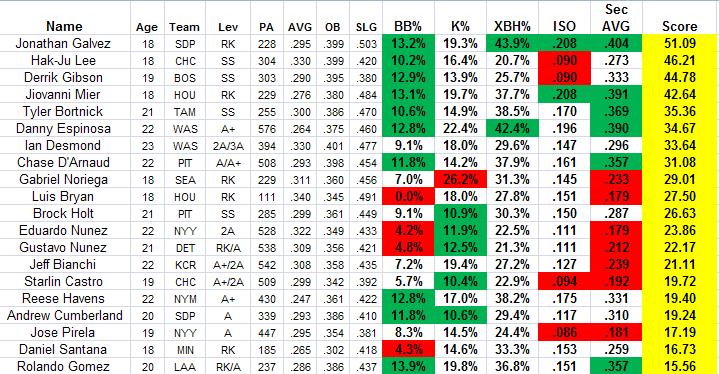
With all of that out of the way, lets look at the chart for the top 20 shortstops according to SONAR (if it doesn’t display properly in your browser, click here and open in a new window/tab)
01 – Jonathan Galvez (SDP) – SONAR 51.09
When you look at the chart as a whole, you see that the position lacks a true superstar bat, a player with a score in the 70’s or 80’s, and in fact, the list compared to 2B, also a very demanding position defensively, looks very similar. Galvez ranks at the top of the list thanks to a stellar 13.2% BB rate and a .208 ISO, which coupled with his 14 stolen bases gives him a .404 SecA, an outstanding number. Galvez, signed out of the Dominican Republic, was making his US debut in 2009, and did his damage as an 18 year old in the rookie leave Arizona League. At 6’2/175, he’s probably at the top end of the frame you’d like to see for a shortstop, so if he fills out more, he could be forced to shift to 3B, or he might suffer a bit in the range department. He has no huge red flags, his 19.3% K rate was a tad high, and he did a ton of damage against LHP in 2009, while merely putting up an average line v RHP. I generally don’t worry about splits in rookie ball though, as the sample size is already small, which SONAR accounts for in adjusting the score. Still, at just 19 now, Galvez looks to have all the tools, he’s just very far away at this point.
02 – Hak-Ju Lee (CHC) – SONAR 46.21
The Cubs have been aggressive in the Pacific Rim over the last few years, and Lee looks like he might be the best of the bunch. He received a $700,000 bonus during the 2008 signing period and made his US debut in 2009, heading to the Northwest League, a more advanced affiliate than the Arizona League, and he more than held his own, putting up a .330/.399/.420 line in 304 PA, with 25 SB in 33 attempts. Lee’s 10.2% BB rate is good, and he showed good bat control, striking out in only 16.4% of his PA’s. The power wasn’t there, as he posted just a .090 ISO, but the speed on the walks helped him salvage a .273 SecA. Baseball America raved about his raw tools and saw power coming as he filled out his frame, but it hasn’t happened just yet. He’s listed at 6’2/170, almost identical to Galvez, but showed no power. His speed is obviously a weapon, and over the course of a full season, you can dream on a 45-50 stolen base output. Both he and Galvez should find themselves in the MWL in 2010, and it will be interesting to compare and contrast the two of them, as they appear to have different games, but equal upside.
03 – Derrik Gibson (BOS) – SONAR 44.78
The Red Sox lured the Deleware prep product away from UNC, and after an uneven debut in 2008, Gibson fared reasonably well in the NYPL as an age appropriate 19 year old in 2009, posting a .290/.395/.380 line in 303 PA. Gibson was lauded for his athleticism and speed when drafted, with an eye on power development down the road. The power is yet to emerge, but the rest of his secondary skills look just fine, as he posted a 12.9% BB rate and showed excellent bat control, K’ing in only 13.9% of his PA’s. His .090 ISO mirrors Lee’s number, but he bettered Lee’s SB total, swiping 28 in 33 attempts, which led to his superior .333 SecA. Lee hit for a higher average, which bumped his score slightly. Their SONAR scores are nearly identical, and you could flip flop them on this list and it wouldn’t make much of a difference, but Lee is one year younger, which gives him a slight edge. Gibson should get a good test of his progress this year in Low A.
04 – Jiovanni Mier (HOU) – SONAR 42.64
Mier was the Astros’ first round pick in 2009, going 21st overall, and he didn’t disappoint in his debut, posting a .276/.380/.484 line in 229 PA. Mier was touted before the draft for his glove and the liklihood that he’d be able to stick at SS, but he showed a more advanced bat than expected, posting an excellent 13.1% BB rate and an excellent .208 ISO, leading to a .391 SecA, second on the list to only Galvez. Mier’s base running isn’t refined, he was only 10 for 15 in stolen bases, but he should have at least 15-18 SB speed in the majors. If his glove turns out to be as advertised, he should definitely stick at the position, and his bat already looked more advanced than advertised, which means he looks like a bargain for the Astros in the early stages.
05 – Tyler Bortnick (TAM) – SONAR 35.36
Bortnick was a somewhat obscure 16th round pick by Tampa Bay in 2009 out of Coastal Carolina. A young college senior (only 21), he posted solid college numbers in his junior and senior years after a rough sophomore season, showing a solid approach at the plate and good bat control. He carried that over to his debut in the NYPL, posting a .300/.386/.470 line in 255 PA. A typical college aged player in a short season league, he was predictably very good compared to the league standard, but he showed good all around peripherals, including a 10.6% BB rate, a good 14.9% K rate, and a respectable .170 ISO, while also swiping 24 bases in 32 attempts, all leading to a .369 SecA. Bortnick played SS, 2B, and 3B in his debut, so its unclear where Tampa will use him going forward. As a college senior, albeit a 21 year old, he needs to move quickly to not fall well behind the age curve. An assignment to A+ should be mandatory, with an aggressive move to AA being more ideal in terms of figuring out what his offensive profile will look like.
06 – Danny Espinosa (WAS) – SONAR 34.67
Espinosa, a 3rd round pick by Washington in 2008, is a product of the shortstop factory at Long Beach State that has produced Evan Longoria and Troy Tulowitzki in recent years. Espinosa doesn’t fit that mold, as he doesn’t have the power or defensive chops of those two, but he’s a good prospect in his own right. He’s more of a grinder than a raw tools type, but he has a strong arm and is fundamentally sound at SS, even if he isn’t the most physically gifted. After a nice debut in 2008, the Nats were aggressive with him and jumped him to A+, where he put up a .264/.375/.460 line in 576 PA. He showed a good approach, with a 12.8% BB rate, and solid power (.196 ISO), but he did K in 22.4% of his PA’s, which is close to red, and is definitely a pause for concern. He stole 29 bases in 40 attempts, not an excellent percentage, but a positive contributor, and when putting together the total package, he winds up with a .390 SecA, third on the list of all SS. A switch hitter, he was much better against RHP in 2009 (batting LH, obviously), posting an .891 OPS compared to his .748 v LHP. He struggled mightily against LHP in 2008, posting a .508 OPS, so I view this is as major progress. Scouts don’t seem to love his defensive tools except his arm, but his bat looks excellent for the position. If he’s forced to move to 3B, his bat should still play, and if he can handle 2B, it will definitely play. Hes an interesting name to watch.
07 – Ian Desmond (WAS) – SONAR 33.64
Back to back Nats on the list, as Desmond manned the position a level (and then two) above Espinosa in 2009, putting up a .330/.401/.477 line at 2A/3A, while also getting a brief 89 PA cup of coffee at the end of the year. None of his peripherals rate as excellent, but none are below average, as he posted a 9.1% BB rate, an 18% K rate, and a .147 ISO. He stole 21 bases in 26 attempts, a good percentage, but doesn’t figure to be a huge base stealing threat in the majors. Desmond struggles against LHP, going .263/.342/.333 in 99 AB in 2009, and .239/.311/.371 for his career in 620 AB, compared to a career .271/.338/.407 line against RHP in 1523 minor league AB’s. He has good instincts at short, as well as above average range and a good arm, so he should be able to stick defensively. The Nationals don’t have much in the way of a road block at the big league level, so he could have a chance to be the starter in 2010, and could ultimately battle with Espinosa for the every day job in the future.
08 – Chase D’Arnaud (PIT) – SONAR 31.08
D’Arnaud, the older brother of former Phillies/current Blue Jays prospect Travis D’Arnaud, split his time between Low A and High A as a 22 year old, posting a .293/.398/.454 line in 508 PA, posting an 11.8% BB rate, with a solid 14.2% K rate and a .161 ISO. He also stole 31 bases in 39 attempts, a very solid success rate, which helped contribute to a .357 SecA, tied for 5th on the list. The Pirates were conservative starting him in Low A, but his numbers actually improved upon promotion, moreso his power output, as he put up a pedestrian .136 ISO in Low A, but upped that to .186 in High A. His walk rate was almost identical, though his contact rate declined slightly, which is acceptable with the uptick in power. He split his time between 2B and SS in High A, and scouts think he’s more suited for 2B or 3B than SS the closer he gets to the majors.
09 – Gabriel Noriega (SEA) – SONAR 29.01
When you think Noriega, its tough to think of anyone but Manuel, but Gabriel looks like the latest in a long line of interesting Latin American prospects the Mariners have cultivated, as they signed him out of Venezuela in 2007 for $800,000, one of the largest bonuses of the signing period. He made his stateside debut last year as a 17 year old, splitting his time between the AZL and the more advanced Appalachian League, and this year he repeated the Appy League, going .311/.360/.456 in 229 PA. His approach is still rather crude, evident in the very high 26.2% K rate and the modest 7% BB rate, but he did improve across the board from his struggles in the Appy League last year, when he hit just .238/.266/.291 in 159 PA. On the surface, he was the beneficiary of a very unsustainable .420 BABIP, a feat not likely to be repeated in 2010. Scouts love his defense, and its considered his ticket to the big leagues. His bat is well behind, and he’s going to be a project, but he’s on the radar now, it will just take him a long time (and probably many struggles) to get to the bigs. However, like the Phillies Freddy Galvis, the glove gives him a chance to be a positive overall player, even if his bat relegates him to hitting 8th. He showed improvements from 2008 to 2009, and while his line is influenced by his BABIP, if he continues to show improvements, he should be able to hold his own in the pitcher friendly MWL.
10 – Luis Bryan (HOU) – SONAR 27.50
I love prospects like Bryan. Signed out of the Dominican Republic, he was terrible in the Dominican Summer League in 2008, posting a .154/.222/.186 line in 172 PA. The Astros bring him stateside in 2009, at age 18, and he posts a .340/.345/.491 line in 111 PA. Bryan’s sample is small, his walk rate non-existent (literally 0), but he showed modest power with a .151 ISO. A .410 BABIP will help produce a .340 batting average, but he did crank out almost 40% flyballs, he wasn’t just skimming groundballs through the hole. He has obvious issues with his approach, I mean 0 walks in 111 PA is some kind of special, it makes Anthony Hewitt look like Adam Dunn, but I’m intrigued. For a US debut, after that horrendous line in the DSL, he obviously made some adjustments, and I’m willing to wait and see what he does after getting better instruction here in the US. That kind of walk rate, or lack of one, is a huge red flag. But I see other areas of optimism. He’s one you obviously have to question, and that’s why its important to look at these results on a case by case basis, but we’ll see what he does next year.
11 – Brock Holt (PIT) – SONAR 26.63
A 9th round pick in the 2009 draft, Holt reported to the NYPL as a 21 year old, like many college juniors taken in the draft, and posted a good line, going .299/.361/.449 in 285 PA. He showed an intriguing skill set, striking out in only 10.9% of his PA’s, an excellent rate, and also walking in a respectable 9.1% of his PA’s. He showed modest power (.150 ISO), and stole 9 bases without being caught. At 5’10/165, Holt doesn’t have much of a power ceiling, and is likely to be just a line drive hitter as he progresses. His bat control, however, is a big asset, and he should be able to hit for average as he moves up the chain. As with most college draftees who did their work in short season leagues, Holt needs to be promoted aggressively. He should start in A+ next year, with a move to AA in season.
12 – Eduardo Nunez (NYY) – SONAR 23.86
Signed out of the Dominican Republic way back in 2004, Nunez has been a slow mover after making his US debut in 2005, spending time in Low A and High A for the last three seasons before jumping to AA Trenton in 2009, where he hit .322/.349/.433 in 528 PA. At 22, his approach still seems raw, as he walked in just 4.2% of his PA’s, but he showed good bat control, striking out in only 11.9% of his PA’s, though he hasn’t shown much power. His .351 BABIP probably tells the story here, though his in play charts aren’t much different from last year, when he posted a rough .692 OPS in A+ ball. He actually saw his line drive rate drop in 2009, but his BABIP and batting average actually increased. With only modest speed and not much of a batting eye, his bat control is what will continue to carry him, and thus he’ll always be at the mercy of balls in play. For a team like the Yankees, that normally means you’re trade bait or quad A fodder.
13 – Gustavo Nunez (DET) – SONAR 22.17
Another product of the Dominican Republic, the Tigers signed Nunez in 2007, and he made his US debut in 2008, posting a combined line of .235/.289/.273 in 207 PA across the GCL and the A+ level Florida State League. In 2009, he spent the bulk of his time in the Low A MWL, with a brief stint in the GCL again, posting a combined .777 OPS, but in the bulk of his time in the MWL he went .315/.360/.425 in 514 PA. Like Nunez, the player one spot above him, he doesn’t walk much (4.8%), but has great bat control (12.5% K rate), and identical raw power. Where he has an advantage is on the base paths, as he stole 45 bases in 70 attempts, helping him salvage a .212 SecA, bettering Nunez’ mark of .179. He ranks lower because he was 21 in Low A, a year old for the level, which brought down his score, and his .353 BABIP also helped inflate his batting average. Like the guy above him, his calling card will be his bat control, but the added speed could give him a bit more value.
14 – Jeff Bianchi (KCR) – SONAR 21.11
Bianchi was a 2nd round pick of the Royals way back when in 2005 out of the Lancaster PA area, and after years of post rookie ball struggle, he finally emerged as a prospect again, hitting .308/.358/.435 across A+/AA in 542 PA. Bianchi’s raw skills are somewhat fringy, he posted a 7.2% BB rate overall, but was slightly better at A+ before the promotion, and his power wasn’t great, with a .127 ISO overall, but a .139 mark after promotion is cause for slight optimism. He has a line drive swing, so hes never likely to be more than a doubles hitter. His K rate is in the warning zone, 19.4% in 2009, so not quite red, but still a tad high for a guy without a ton of secondary skills. He did steal 22 bases in 28 attempts, which helps, but hes not a true base stealing threat. Though it feels like hes been around forever, he didn’t turn 23 until October, so its possible he could finally be putting the pieces together. That said, his upside isn’t huge, he just had a decent 2009.
15 – Starlin Castro (CHC) – SONAR 19.72
This is the first huge point of contention on the list. Castro is a consensus Top 50 prospect in all of baseball, and one that SONAR is underestimating for one reason; projection. Signed out of the Dominican in 2006, he made his US debut in 2008, posting a .311/.364/.464 line in the rookie level AZL as an 18 year old. The Cubs were ridiculously aggressive with Castro, starting him in A+ and then promoting him to AA midseason as a 19 year old, where he was one of the youngest players in the league. His overall line of .299/.342/.392 doesn’t look overly impressive, but when you consider his age, it gets more impressive. His peripherals aren’t great, a 5.7% BB rate and a .094 ISO are both below average, but his 10.4% K rate shows his excellent bat control, and most scouts think hes going to hit for average at every level. He stole 28 bases in 39 attempts, and should steal at least 18-20 bases a year in the majors. The Cubs were really aggressive with him, and there are actually rumors that he could be in the majors this season, which might be going overboard. His defense is above average, as is his athleticism, so he should stay at SS for the foreseeable future. His power is all projection at this point, and his walk rate is substandard. But he’s a gifted pure hitter, and scouts are banking on him developing more power as he fills out physically. Whether the walks ever come is another story, as he doesn’t appear to be a selective hitter. He’s an interesting case because of his age, and the extreme aggression the Cubs have shown promoting him.
16 – Reese Havens (NYM) – SONAR 19.40
The Mets took Havens in the first round of the 2008 draft, 22nd overall, and he held his own after making the jump from short season ball to A+ in 2009, posting a .247/.361/.422 line in 430 PA. What he lacked in batting average, he made up for with a 12.8% BB rate and a .175 ISO. He showed decent bat control, with a 17% K rate, though hes not much a speed threat, he still ends up with a .331 SecA. Havens is an interesting case. He was poor at South Carolina in his freshman and sophomore seasons, but exploded with a .359/.486/.645 line in his junior season, moving up draft boards and winding up in the first round. So far, his pro career resembles his first two college seasons, not his breakout junior year. At 6’1/195, he has a solid frame, but having turned 23 in October, he probably doesn’t have much projection yet. He’ll be tested at AA, and with an uptick from his .277 BABIP in 2009, he could move up this list next winter.
17 – Drew Cumberland (SDP) – SONAR 19.24
Cumberland, a supplemental first round pick in 2007, struggled in 2008 in the MWL, but improved on that showing in 2009, repeating the level and hitting .293/.386/.410 in 339 PA. Cumberland’s game is based on his bat control, but he had a solid 11.8% BB rate to go with the exceptional 10.6% K rate. His .117 ISO shows the lack of power, but he added 19 SB in 22 attempts and that boosted his SecA to a solid .310. He has no power projection really, and his ability to hit for average is going to have to carry him. In a cavernous park like Petco, it just might.
18 – Jose Pirela (NYY) – SONAR 19.24
Pirela, signed out of Venezuela, was awful last season in the GCL in his US debut, posting a .234/.288/.277 line, but followed that up with a more respectable .295/.354/.381 line in A ball at age 19. It seemed an aggressive assignment for someone who struggled so mightily in his debut, but Pirela seemed to deal with it decently well. His 8.3% BB rate is grounds for optimism, but the .086 ISO and the lack of speed (9 SB, 8 CS) indicate his one real trait his his contact ability. His ranking here is more an indication of the lack of depth at the position, performance wise.
19 – Daniel Santana (MIN) – SONAR 16.73
A product of the Twins recent commitment to Latin America, Santana made his US debut in 2009 after signing out of the Dominican Republic, posting a .265/.302/.418 line in 185 PA. His 4.3% BB rate was poor, but his contact skills were decent (14.6% K rate) and he showed average raw power, with a .153 ISO. He also stole 12 SB in 13 attempts, leading to a .259 SecA. With his contact skills, he should be able to handle the jump up, but the Twins will no doubt be cautious with him based on their track record.
20 – Rolando Gomez (LAA) – SONAR 15.56
Gomez logged only 16 PA in his debut last season in the AZL after being taken in the 11th round of the draft. This season, he repeated the AZL as a 20 year old, 2 years too old for the league, but put up good numbers, going .304/.408/.464 in 217 PA before a brief late season promotion. He’s patient at the plate, boasting a 13.9% BB rate, the highest on the list, and his power was average for the position, with an ISO of .151. He also added 12 SB in 16 attempts, giving him a SecA of .357, tied for 5th highest on the list. Of course, he was also 20 playing against 17 and 18 year olds, which is why SONAR adjusts his raw score down. Listed at just 5’7/145, power is likely never going to be part of his game, and he’ll need to work counts and continue to hit for average to have a big league career.
The Sleeper
Chris Nelson (COL) – SONAR 4.68
Nelson has been on the radar forever, but has struggled with injuries of late, playing only 81 games in 2008 and 29 games in 2009. When he’s on the field, he’s pretty interesting, as he posted a .280/.355/.477 line in 122 PA in AA this year, before suffering an injury in late May. His BB rate is solid (9.8% in 2009, 8.5% career), and he shows excellent raw power, with a .197 ISO in 2009. He seems to have lost a bit of his speed, or he just hasn’t been confident enough to regularly try to run, but he did swipe 27 bags in 32 attempts as recently as 2007. He’ll play all of 2010 at age 24, and should do so in AA or AAA. He’ll be old for the level, but because of the time missed due to injury, he’s not that for out of line with where he should be.
A few other notables from the list, good and bad.
21. Dee Gordon (LAD) – SONAR 15.47
Gordon, son of Flash, just missed the list, and has already drawn comps to guys like Jose Reyes. He stole an eye popping 73 bags in 98 attempts in 2009, and his speed is his calling card. His 7.2% BB rate is decent, he shows good bat control (15% K rate), but he has no power at all, evident in the .093 ISO. He’s still largely a project and is many years away, despite being a college product. He played all of 2009 in Low A as a 21 year old, so he was slightly old for the level. If the power doesn’t develop, he’ll need to refine his eye at the plate to get more out of his speed.
26. Jeremy Barnes (PHI) – SONAR 11.53
The Phillies highest representative on the list. Barnes put up a raw line of .287/.359/.464 in the NYPL, not a bad line, but not quite what you’d hope for as a 22 year old in the NYPL. His 8.5% BB rate is adequate, as is the .177 ISO, but his 22.2% K rate is on the high side, and he lacks real secondary skills. His future is likely as a utility infielder.
30. Tim Beckham (TAM) – SONAR 10.32
Beckham, the #1 overall pick in 2008, struggled a bit in his full season debut, posting a .275/.328/.389 line in 537 PA. His physical tools are abundant, but his approach proved to be a bit more crude than originally expected. He didn’t draw many walks, didn’t hit for much power, and stole only 13 bases in 23 attempts. You never write off a guy with his tools and ability, but at the same time, you have to lower expectations a bit. Justin Upton fooled some people with his weak full season debut in the MWL a few years back, then exploded and soared to the big leagues soon after. I don’t think Beckham goes that fast, especially since there is talk he might have to switch positions sooner rather than later, but with tools like his, the light could go on at any moment. Or it might not.
34. Jonathon Villar (PHI) – SONAR 8.56
The Phillies second representative, Villar had a pretty nice US debut, putting up a combined line of .263/.346/.353 in 155 PA spread across the GCL and NYPL. Villar did a little bit of everything, starting with an 11% BB rate and ending with 17 stolen bases in 19 attempts. He didn’t show much power, and his 24.5% K rate is right on the edge of the danger zone, but at 18, his debut gives you plenty to consider going into next season. With a 6’1/180 pound frame, you can project him to add a bit more muscle, and in term, an uptick in his power, which would complement his solid batting eye and good speed on the bases. In what might be an aggressive move on my part, I ranked him #18 in the Phillies system in my upcoming top 30.
54. Reid Brignac (TAM) – SONAR 4.13
Brignac is a great case study for prospect analysis. When he was getting started, he was considered an offensive first prospect who might have to move off of shortstop. In the last few seasons, its his glove that has taken off, while his bat has regressed/stagnated. He doesn’t show much willingness to work a walk, his power hasn’t really emerged, and he doesn’t have a ton of speed on the bases. He was once considered an elite SS prospect, but now feels like almost an afterthought in Tampa with Jason Bartlett’s surprise emergence, and Tim Beckham behind him.
63. Alcides Escobar (MIL) – SONAR 1.86
Escobar is another scouts favorite, consistently ranking near the Top 100 of most prospect lists. As a 22 year old in AAA, he put up a line of .298/.353/.409 in 487 PA. He’s gotten onto prospect lists largely on the strength of his excellent defense, but his bat doesn’t appear to be elite. He shows good bat control, with a 13.3% K rate, but he doesn’t draw many walks (6.6%) and doesn’t have much power (.111 ISO), though he does have good speed, stealing 42 in 52 games in 2009. Without much power and without a good eye at the plate, he could struggle a bit against major league pitching, and profiles closer to a #8 hitter than a leadoff guy. Because he is a good defender, he should stick as a big league regular, but its hard to see his bat as anything more than fringe.
Brandon Hicks (ATL, SONAR -5.67) – Hicks was ranked #11 in Atlanta’s system by BA last year, but didn’t have the best of seasons at AA, hitting only .237/.319/.373 in 534 PA. His 9.9% BB rate is solid, but he strikes out too much (24.5%) for a guy without standout power (.136 ISO)
Casey Kelly (BOS, SONAR -5.11) – Kelly will show up on the positive side of the ledger as a pitcher, as he’s one of the most advanced pitching prospects in the minors despite pitching for only half the season. Drafted as a pure two way prospect out of high school (and linked to the Phillies, pre-draft, before his bonus demands were known), Kelly proved to be too raw at the plate, and has finally decided to pitch full time in 2010 and beyond.
Yamaico Navarro (BOS, SONAR -4.73) – Ranked 10th by BA heading into 2009, Navarro is one of the many interesting shortstop/middle infield prospects in the Red Sox system, but he struggled a bit in 2009, splitting the bulk of his time between A+ and 2A, and putting up a .240/.310/.392 line overall as a 21 year old. He showed good contact skills (15.5% K rate) and decent power (.152 ISO), but didn’t really put the package together. He’s a decent breakout guy for 2010 if he can put things together.
Chris Valaika (CIN, SONAR -25.82) – Valaika was ranked as the #4 prospect in the Reds org heading into 2009, but he bombed out in a big way, hitting only .235/.271/.344 in 392 PA at AAA after posting an .843 OPS last year across A+/AA. His BB rate dropped to an abysmal 4.1%, his K rate at 19.4%, and his ISO at .109. The previous season, he posted a BB rate of 6.2%, a K rate of 18.1%, and an ISO of .164. His .288 BABIP doesn’t appear to be too fluky, but he posted a 20.7% LD rate, so its reasonable to say he was unlucky. He struggled across the board, but is young enough to rebound.
Hector Gomez (COL, SONAR -9.07) – Gomez ranked #5 in Colorado’s system at this time last year, but struggled in the Cal League, posting a line of .275/.310/.423 in 368 PA. His walk rate is poor, but he has shown a bit of pop, though speed doesn’t look to be part of his game going forward.
Cale Iorg (DET, SONAR -23.77) – Iorg was an unsignable 16th round pick back in 2004, then went on a Mormon Mission to Portugal, missing two seasons. The Tigers gave him late first round money in the 6th round of the 2007 draft to get him signed, but things haven’t gone so well in pro ball. He made his full season debut in 2008, posting a .251/.329/.405 line in A+ as a 22 year old, and followed it up with a .222/.274/.336 line in AA in 2009. He walked only 6% of the time despite striking out in 28% of his PA’s, and posted a low .114 ISO. He has a strong physical frame and great raw tools, but so far the results haven’t matched. Detroit would probably be best served to slow him down, as his two lost seasons developmentally appear to have taken their toll, and he needs to get a solid footing before moving on. BA had him ranked #3 in the org heading into 2009.
Ivan DeJesus Jr (LAD, SONAR -0.17) – DeJesus, son of the former Phillie with the same name, was ranked #6 in the Dodgers system after a breakout 2008 campaign, but he missed essentially the entire 2009 season due to an injury suffered early on. He showed an excellent eye at the plate in 2008, and hit for a solid average with very little power. He still needs a bit of work around the edges, but he has good defensive tools and should rebound if healthy in 2010.
Wilmer Flores (NYM, SONAR -35.10) – The Mets are notorious for their aggressive promotions, sometimes sending guys up a level or two even when they haven’t shown that they are ready for the challenge. Flores was sent to the SAL this year as a 17 year old, 3 years younger than the average prospect, let alone average player in the league. He predictably struggled, hitting just .264/.305/.332 in 528 PA. He shows good contact skills (13.6% K rate), but very little else, and his .068 ISO was obscenely low. Its tough to really gauge what kind of prospect he is, as he put up good numbers in rookie ball as a 16 year old, but bombed out in his first taste of full season ball. As an 18 year old if he repeats the SAL, he’ll still be one of the youngest prospects in the league. Surely the Mets wouldn’t attempt to promote him to the pitcher friendly FSL in 2010.
Grant Green (OAK, SONAR -0.33) – Green, who was in the running for top college player in the draft heading into 2009, had an uneven junior year and slid to Oakland at #13 overall. He had only 20 pro PA’s, so his number is pretty meaningless, just wanted to mention him here.
Freddy Galvis (PHI, SONAR -41.55) – Galvis, like Wilmer Flores, has been promoted aggressively, though not quite to the same extent. A defensive wizard, the bat is still well behind the glove, and his attempts at switch hitting may be abandoned if he doesn’t get on the right track soon. He hit just .240/.272/.296 in 365 PA, with almost zero secondary skills to speak of. He does have decent bat control (14.8% K rate), but very little else. Its tough to figure out what to make of him, since he played 2009 at age 19, and was very young for A+. He’s likely never going to be more than an 8 hole hitter, but if he can get to the point where he can hit .285 and draw at least a few walks, he might be a positive value player because of how good he is defensively. The Phillies have the luxury of having one of the best SS in baseball now, and under contract still, so they can afford to slow Galvis down and let him get more reps against advanced pitching.
Ehire Adrianza (SFG, SONAR -12.80) – Ranked #6 in the Giants org prior to 2009, Adrianza struggled in Low A at age 19, hitting .258/.333/.327 in 448 PA. He showed good patience, with a 9.4% BB rate as well as good bat control (14.7% K rate), but he has no power, and speed isn’t a big part of his game. Scouts rave about his defense, and he’ll get plenty of chances to show he can handle the bat as he moves up.
Justin Jackson (TOR, SONAR -19.08) – Jackson was a guy I liked heading into the 2007 draft, and the Blue Jays ended up grabbing him in the supplemental round. So far, he’s struggled in pro ball, posting a dismal .515 OPS in his 2007 debut, followed by a .708 OPS last year in the MWL, and a .213/.321/.269 line in the FSL in 2009. He showed excellent patience, posting a 13.3% BB rate, but he struck out in almost 30% of his PA’s, and his power was non-existent. He managed 17 SB in 21 attempts, but doesn’t figure to be a big base stealer in the majors. He’s disappointed in a big way with the bat, and the #4 ranking in the Toronto system heading into 2009 was more an indictment of Toronto’s system than praise for Jackson’s performances.
Summary: That should wrap up SS, and all of the non-catching positions in the infield. I’m going to hit catchers next, then corner outfielders and finally centerfielders before moving on to pitchers. Shortstop, as I mentioned in the intro, is a tough position, because here more than any other non-catcher position, defense is vital to providing an evaluation of the prospect as a whole. Guys with sub-par range, reactions or throwing arms can’t stick at SS, because it plays a big role in the pitcher’s ultimate performance. If the catcher is like the quarterback of a baseball team, the shortstop is like the playcalling middle linebacker. The defense runs through him, and if he struggles with range/his throws, it puts the defense as a whole at a big disadvantage. The guys who are able to combine a good all around offensive game with a great glove are few and far between, which is what makes them such valuable commodities. If there is a player not mentioned above that you’re curious about, let me know and I can look up his score.
 Phuture Phillies
Interesting that you have Villar #18 on your top 30. Some guys have been mentioning him for a while but I wasn’t paying much attention to him. I downloaded stats from Baseball-Reference.com and they list his name as Jonathan Villan. Maybe this messes me up when I’m ranking the prospects.
I have Galvis at #19 on my top 30. I may have to give Villar / Villan another look.
LikeLike
Your scoring system is intriguing. A suggestion. Rather than scoring home park, perhaps consider the league in question. For example, the New York Penn League was one of the toughest pitchers’ leagues (ERA wise) in all of MiLB last year whereas the Norwest League was one of the very worst. Thus, the hitters in the respective leagues perhaps are not compared statistically neutral like they ought to i.e., a .320 average in one league is statistically comparable to a .290 hitter in the other league. I have seen Bill James analysis where he compares different periods in baseball history by pointing out a .250 hitter in the dead ball period may be equivelent to a .300 hitter in modern times.
Ineresting analysis nonetheless – thanks!
LikeLike
I’m 90% certain it’s Villan. I certainly think he’s a top 30 candidate, just as soon as Jesus Sanchez gets pushed through.
LikeLike
How about Donald? How’d he score?
LikeLike
When Villar came along the name was rendered as Villar, Villan, or Vilian. I had come to undoubtedly come to believe it was Villar, as it has been listed as such on http://www.milb,com and carribean sources lately, and when I seen him at State College they announced him as Villar, I was pretty much sure of that.
Shortstops sans fielding evaluation , though I believe that fielding stats would have to be subjective and therefore variable according to the enumerator, what is the true measure?
LikeLike
There is an adjustment for the league the player was in. So a line of .250/.350/.450 in the NYPL is treated differently than the same line in, say, the Eastern League.
Also, I’m pretty sure its Villar, since that’s what minorleaguebaseball.com uses, and I believe they get their info from the MLB teams directly. I’ve only seen it as Villan on baseball-reference.com, which is where I get my data, but I changed it manually in this case.
LikeLike
Also, Donald was -10.05. Way too many strikeouts, didn’t work the count nearly as well, and the power wasn’t there. A pretty disappointing season, all things considered.
LikeLike
It really seems like the Phillies ‘sold high’ on Donald. He did have a real stinker of a year. Thanks for putting it up.
LikeLike
I wonder if Ivan DeJesus Jr. will eventually be traded for Ryne Sandberg Jr.
LikeLike
i told everyone the two prospects the phils should have recieved for lee were liddi 3rd and lo and behold gabe norieaga but once again no response from our minor league guru’s.
LikeLike
Do you want a prize?
I’m close to marking your comments as SPAM. Your boorish tone is really out of place on this website.
LikeLike
BA listed the name as Villan in their book. At this point, who knows? He’ll probably pull a Domonic Brown and correct it in two years anyway just to throw us off.
LikeLike
I think I know how we can find out.
LikeLike
Just got off the phone with someone at the Crosscutters office, and he told me it was “Villar”, which is what is listed on their official website as well. So I’m going with Villar until someone confirms otherwise.
LikeLike
when i mentioned it at the time of the trade i thought it was the missing piece. but apparently no one cared and no i dont want a prize only fair coverage.
LikeLike
Seems like fewer A+/2A type players with higher SONAR for the middle infield. Any particular reason? Do players get moved from the middle infield as they ascend the minors?
LikeLike
Yeah, I think there is something to that. As I mentioned in the open, lots of guys start as shortstops in high school, and they are fine at the position there because they are the best athlete on the team. But once they get to pro ball, the field changes.
LikeLike
That’s exactly right. Look at Miguel Cabrera for example. Started out as a shortstop, finally moved off the position when he got to class high A.
LikeLike
Seems like too many extra young players ranking high. Is that usual?
LikeLike
Late to the party here, but once again, it’s another solid piece. I’m looking forward to tracking the progress of the Galvez/Lee/Gibson/Mier quartet in Low-A next year — Mier in particular could really shoot up prospect lists.
John, everyone’s entitled to their opinion, but I don’t think you could find a single prospect expert out there who would prefer Liddi and Noriega to any of the Gillies/Ramirez/Aumont trio. Personally, I’m dubious regarding Liddi’s breakout 2009 because of the High Desert factor and the strikeouts, and Noriega’s so far away (and has such contact problems) that I prefer the certainty offered by the trio the Phils got. To each his own, but SONAR alone isn’t justification for why you’re right and everyone else is wrong.
LikeLike