Tromp is intriguing. Seems to have good power for a CF. Batting average is low, though some of that may be small sample size and aggressive promotion. I think he earns a look at Lakewood next year. K rate is a little worrisome but not uncommon for an 18-year-old. The Phillies clearly like him even if the Williamsport promotion was mainly to fill a hole there. They did choose him to promote from GCL over guys like Pullin or Cozens. He may be at their prospect level even though the short term stats hide it a little.
Looks like some inconsistencies have developed vis-a-vis the Tromp and the average run-of-the-mill Latin American player. If a Latin American player doesn’t get to the states until 18 they are panned as “no prospect” by some, because some Latin American players come at 16. Why doesn’t this apply to the Tromp? Was his quality of instruction in the Netherlands Antilles (or wherever he’s from) that high above the Latin American player as to place him at the lofty level of a USHS player? Of course there is always the default excuse of Small Sample Size, but the aggressive promotion thing, I don’t think he hit much at GCL either as I recall. it could be he was defensively reliable and they chose to risk rushing him rather than younger players.
Nobody says 18 year olds are not prospects from Latin America. It is the 20-year-olds we have doubts about that have 2-3 DSL seasons. Tromp probably went to high school and that is why he waited the extra year to sign.
The Phillies clearly like him. Small sample size batting averages don’t mean much. The best prospects will play OF in Lakewood if the Phillies think they are ready. There is also room for 4 (Greene, Pointer, Hudson, and someone else).
Quinn and LGJ are definitely the guys to watch from this Williamsport team. Guys like Walding and Tyler Greene have been largely unimpressive although it’s still possible they improve. I don’t have high hopes for Serritella or Perkins but it’s still too early to give up on the possibility of them becoming something.
With it being their 1st year as professionals a lot of these kids aren’t used to playing this long of a baseball season. The tailing off at the end of seasons is usually signs of fatigue and gives the organization something to work on in the instructional league so they’ll work on building endurance with players like Walding.
Tyler Greene just needs to learn patience at the plate, because he struck out way too much for a player that’s not a power bat.
Any good examples in the recorded history of baseball of a player “learning” patience at the plate? It seems about as likely as “learning” how to run fast.
So he’s hitting .300. There is no power to go along with that and his BB rate that frankly isn’t very good. The only reason his OBP is as high as it is, is because of HBP of which he has 7. It’s probably very BABIP driven. His BABIP for the record is .351. In short it all looks rather flukey. We’ll see what happens but because of all those reasons I’m not that excited.
I wouldn’t say no power. Definitely not impressive power but some of those doubles may be homers in a smaller park, who knows. Also, if he’s really 6’5”195 lbs, he might be able to add some more muscle on his frame. I don’t consider him a really great prospect or anything but I’m interested in him going forward.
22 doubles, second on the team. The lack of HRs doesn’t concern me in the slightest considering Serritella led the team with six, and no one else had more than three. It’s just awfully difficult to hit a ball out of Bowman Field.
No power may have been a poor way to put it. Unimpressive, like Handzus said would be better. Even so Perkins has a bad walk rate and OBP buoyed by HBP and a BA driven by a relatively high BABIP.
It will be interesting to see if Reading starts Ruf in left field or first base. We will see if they are more concerned about developing or winning in the playoffs. I think they are better team with Myers in left.
Take a ook at Ruf. Real thick, even a little flabby in the middle, a bit of a double chin developing. Love the guy, but if he can do some rigourous personal training in December. Jan-Feb, that will help his flexibility and mobility a lot. Seems like a smart guy. Needs to maximize his athleticism. He does not look as bad as Rizzotti, but it’s a similar case. Pat Burrell was not a great athlete, but he was in superb shape and it helped him play an adequate LF until his foot got hurt.
He reach base 103 times by hit or walk. He hit 11 triples, 9 doubles and stole 29 bases. He put himself in scoring position 49 of 103 times on-base, so it’s not surprising that he scored 43.7% of the time.
Are you saying that it’s normal for a player to score in over 90% of the instances when he is in scoring position (45 runs / 49 times in scoring position = 0.92)? Please tell that to the big league team in Philadelphia.
No, I’m not saying it is normal (abnormal) to score 90 percent of the time you are in scoring poistion. I’m sure a few of his runs came when he was not in scoring position. I’m saying that he helped his own chance of scoring quite a bit, by getting into scoring position, almost 50% of the time he got a hit or walk.
Looked up on baseball-reference. The average player/team scores a runner 30% of the time he is on base. The best team percentage is 33% (BOS,TEX,HOU), the worst is 27% (Houston). Obviously team batting influences the stat on a large scale. On an individual level it is more revealing. Using a 300 PA minimum, the players with the highest runs scored percentages are Carlos Gomez, Jarrod Dyson, Drew Stubbs, Mike Trout, Nyjer Morgan. All fast players. The lowest is John Buck. Ryan Braun is the only player with 20+ steals and a below average percentage.
It’s tricky to evaluate speed statistically in the minors though. Run Scoring is incredibly team dependent. It’s only in the last five years that baserunning has been tracked even at the major league level. No one is keeping track of how often a Roman Quinn takes an extra base on a double, first to third on a single, etc.
 Phuture Phillies
PITCHER;’S DUEL….
LikeLike
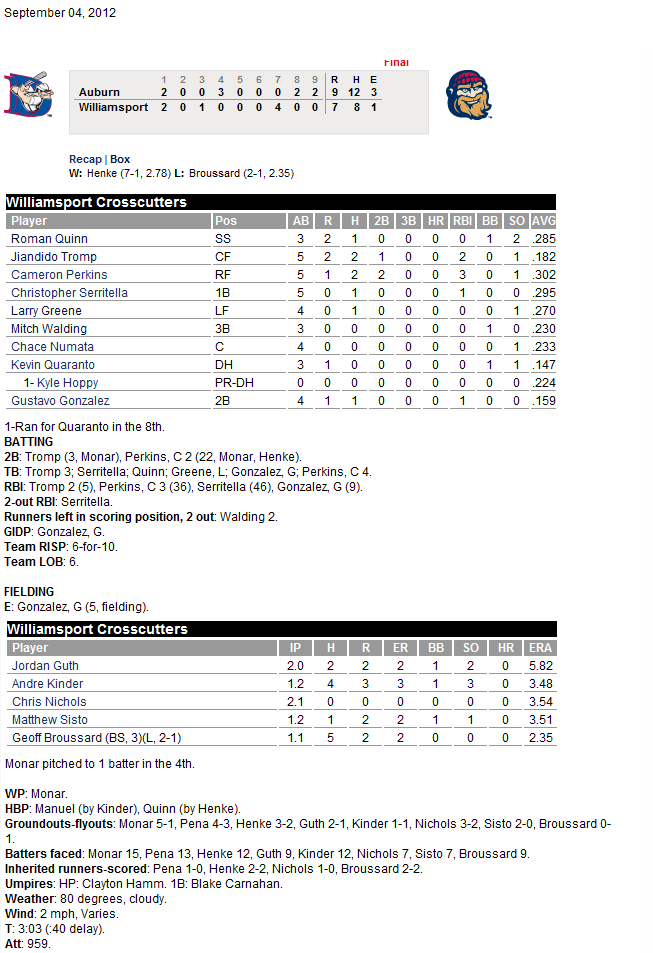
Quinn was on base three times (single, bb, hbp). Nice to see Tromp have a few good games in a row.
LikeLike
Tromp is intriguing. Seems to have good power for a CF. Batting average is low, though some of that may be small sample size and aggressive promotion. I think he earns a look at Lakewood next year. K rate is a little worrisome but not uncommon for an 18-year-old. The Phillies clearly like him even if the Williamsport promotion was mainly to fill a hole there. They did choose him to promote from GCL over guys like Pullin or Cozens. He may be at their prospect level even though the short term stats hide it a little.
LikeLike
No room at Lakewood for Tromp to start the year. You have to figure that Hudson and Pointer will start there with LGJ.
LikeLike
I don’t think Hudson is a guaranteed starter next year. Depends how much the Phils’ brass likes him and the other OFers at that level.
LikeLike
Looks like some inconsistencies have developed vis-a-vis the Tromp and the average run-of-the-mill Latin American player. If a Latin American player doesn’t get to the states until 18 they are panned as “no prospect” by some, because some Latin American players come at 16. Why doesn’t this apply to the Tromp? Was his quality of instruction in the Netherlands Antilles (or wherever he’s from) that high above the Latin American player as to place him at the lofty level of a USHS player? Of course there is always the default excuse of Small Sample Size, but the aggressive promotion thing, I don’t think he hit much at GCL either as I recall. it could be he was defensively reliable and they chose to risk rushing him rather than younger players.
LikeLike
Nobody says 18 year olds are not prospects from Latin America. It is the 20-year-olds we have doubts about that have 2-3 DSL seasons. Tromp probably went to high school and that is why he waited the extra year to sign.
The Phillies clearly like him. Small sample size batting averages don’t mean much. The best prospects will play OF in Lakewood if the Phillies think they are ready. There is also room for 4 (Greene, Pointer, Hudson, and someone else).
LikeLike
I stand corrected. On base 3 times, only scored twice. Weak.
LikeLike
Quinn and LGJ are definitely the guys to watch from this Williamsport team. Guys like Walding and Tyler Greene have been largely unimpressive although it’s still possible they improve. I don’t have high hopes for Serritella or Perkins but it’s still too early to give up on the possibility of them becoming something.
LikeLike
It’s their first year in organized ball, they all get a pass. Even Code Asche’s first season was pretty bad.
LikeLike
Walding started hot, but he has been very cold for the last month or so.
LikeLike
With it being their 1st year as professionals a lot of these kids aren’t used to playing this long of a baseball season. The tailing off at the end of seasons is usually signs of fatigue and gives the organization something to work on in the instructional league so they’ll work on building endurance with players like Walding.
Tyler Greene just needs to learn patience at the plate, because he struck out way too much for a player that’s not a power bat.
LikeLike
Any good examples in the recorded history of baseball of a player “learning” patience at the plate? It seems about as likely as “learning” how to run fast.
LikeLike
what dont you like about perkins? the kid is hitting over .300..he got off to a slow start but has been hitting a lot better
LikeLike
So he’s hitting .300. There is no power to go along with that and his BB rate that frankly isn’t very good. The only reason his OBP is as high as it is, is because of HBP of which he has 7. It’s probably very BABIP driven. His BABIP for the record is .351. In short it all looks rather flukey. We’ll see what happens but because of all those reasons I’m not that excited.
LikeLike
I wouldn’t say no power. Definitely not impressive power but some of those doubles may be homers in a smaller park, who knows. Also, if he’s really 6’5”195 lbs, he might be able to add some more muscle on his frame. I don’t consider him a really great prospect or anything but I’m interested in him going forward.
LikeLike
22 doubles, second on the team. The lack of HRs doesn’t concern me in the slightest considering Serritella led the team with six, and no one else had more than three. It’s just awfully difficult to hit a ball out of Bowman Field.
LikeLike
No power may have been a poor way to put it. Unimpressive, like Handzus said would be better. Even so Perkins has a bad walk rate and OBP buoyed by HBP and a BA driven by a relatively high BABIP.
LikeLike
Perkins and LGreene have similar ExBH stats.
LikeLike
Perkins went to College. Larry Greene can take a walk better. I think his power has a better chance of developing.
LikeLike
Also, High School and college kids adjusting to a demanding schedule. Impressed with LG and Roman though.
LikeLike
It will be interesting to see if Reading starts Ruf in left field or first base. We will see if they are more concerned about developing or winning in the playoffs. I think they are better team with Myers in left.
LikeLike
Just read Ruf is starting at first. Reading guy Mike Drago ( @mldrago ) mentioned it on Twitter.
LikeLike
I think that is the right thing to do. The LF experiment will flesh itself out in winterball. It will either come natural to him or it won’t.
LikeLike
I sure hope they try to develop it a little…cause it doesn’t seem to come natural 😉
LikeLike
Take a ook at Ruf. Real thick, even a little flabby in the middle, a bit of a double chin developing. Love the guy, but if he can do some rigourous personal training in December. Jan-Feb, that will help his flexibility and mobility a lot. Seems like a smart guy. Needs to maximize his athleticism. He does not look as bad as Rizzotti, but it’s a similar case. Pat Burrell was not a great athlete, but he was in superb shape and it helped him play an adequate LF until his foot got hurt.
LikeLike
Myers or Jiwan in left.
LikeLike
Roman Quinn has scored 43.7% of the time he reaches base. Incredible.
LikeLike
Perkins, Serritella and LGreene helped the cause.
LikeLike
He reach base 103 times by hit or walk. He hit 11 triples, 9 doubles and stole 29 bases. He put himself in scoring position 49 of 103 times on-base, so it’s not surprising that he scored 43.7% of the time.
LikeLike
Are you saying that it’s normal for a player to score in over 90% of the instances when he is in scoring position (45 runs / 49 times in scoring position = 0.92)? Please tell that to the big league team in Philadelphia.
LikeLike
No, I’m not saying it is normal (abnormal) to score 90 percent of the time you are in scoring poistion. I’m sure a few of his runs came when he was not in scoring position. I’m saying that he helped his own chance of scoring quite a bit, by getting into scoring position, almost 50% of the time he got a hit or walk.
LikeLike
Looked up on baseball-reference. The average player/team scores a runner 30% of the time he is on base. The best team percentage is 33% (BOS,TEX,HOU), the worst is 27% (Houston). Obviously team batting influences the stat on a large scale. On an individual level it is more revealing. Using a 300 PA minimum, the players with the highest runs scored percentages are Carlos Gomez, Jarrod Dyson, Drew Stubbs, Mike Trout, Nyjer Morgan. All fast players. The lowest is John Buck. Ryan Braun is the only player with 20+ steals and a below average percentage.
It’s tricky to evaluate speed statistically in the minors though. Run Scoring is incredibly team dependent. It’s only in the last five years that baserunning has been tracked even at the major league level. No one is keeping track of how often a Roman Quinn takes an extra base on a double, first to third on a single, etc.
LikeLike