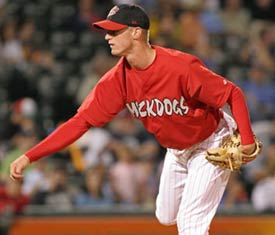
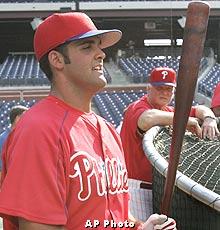
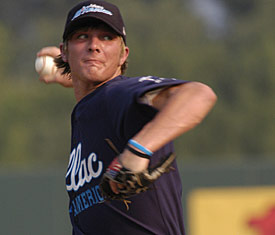
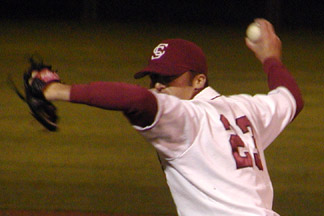
Happy Monday. Having seen snow for the first time this winter, I think I’ve already seen enough. Inside and warmed up, let’s crank out a piece on one of the most under the radar high draft picks I can remember, one Andrew Carpenter. The Phillies selected the RHP in the second round, #65 overall, in the 2006 draft out of Long Beach State. Carpenter had one season left of eligibility after transferring in to LBSU for his junior year, but chose to sign with the Phillies for $570,000. Like many of my fellow draft/minor league junkies, this pick caught us a little off guard, as all of the drama was surrounding our selection at #18, and then taking Adrian Cardenas in the sandwich round, who was projected to go a few rounds later. At this pick, I really had no clue who the Phillies would take, though I feared they’d begin taking the toolsy outfielders like Jared Mitchell, who was rumored to be on the Phillies wishlist in the compensation round. The selection of Carpenter, a college pitcher, seemed to go against the Phillies general philosophy of taking raw, projectable high school arms, and to be honest, I didn’t know a great deal about him. Couple all of that together, and I was a bit disappointed in the pick at first, based on my own lack of knowledge on Carpenter, if nothing else.
Carpenter signed a few weeks later, but he didn’t report to any of the our minor league teams immediately, and he showed up on the GCL Phillies roster online first, which was a surprise. Most college pitchers skip right over the GCL level and head to the short season league, in the Phillies case, the New York-Penn League. Carpenter was the Saturday starter for LBSU and threw a ton of innings (117.2), but he wasn’t used in relief, which helped save some wear and tear on his arm. Nevertheless, he was shut down for quite a while after being drafted, which isn’t too uncommon, especially for the Phillies. He made two appearances with the GCL Phillies, pitching only 3 innings , giving up 0 runs, 2 hits, 0 walks and striking out 4. He was shuttled off to Batavia, where he got a little more work in, starting 3 games, pitching 11 innings, allowing 1 run, 10 hits, 5 walks, and striking out 12.
It’s obviously tough to figure out anything by looking at his brief 15 innings of work, but he did strike out 16 in 14 innings, he allowed fewer hits than innings, and walked only 5 in 15 innings. I guess that’s not bad, but the sample is so small, it’s tough to figure out what “bad” might have been. Most importantly, the Phillies handled him carefully because of the college workload, and he didn’t appear to pick up any knocks, so he should be ready to go in 2007. At this point, I have him projected to start at Clearwater, but I really am not confident in that guess. The Lakewood rotation looks to be quite crowded, with Drabek, Garcia, Pfinsgraff, Brauer, Concepcion, and Dubee all likely candidates, as well as Andrew Cruse and possibly Walter Tejeda. Considering Carpenter’s polish, it makes sense that they’d skip him to Clearwater over any of those other names, age and experience considered.
Now, to what Carpenter actually throws. He features a low 90’s fastball that he locates well, as well as a hard slider and a split finger fastball, both of which grade out to be slightly above average pitches. He also used a curveball in college and a changeup at times, but both are average offerings, and he’ll probably scrap his curveball going forward and focus on just the slider. His changeup will probably need the most work, but his splitter will help neutralize LH batters. The Phillies considered him a “safe” pick on one hand, because he lacks true dominant stuff that would project him to be a front of the rotation starter, but because of his durability, his solid pitching aptitude, and his array of pitches, he might be a bit better than an innings-eater at the back of the rotation. He doesn’t have the electric fastball/curveball combination of Kyle Drabek, but he does have more experience, a better understanding for pitching (at this point), and much more polish, which makes him a safer bet going forward, just not the #1 starter potential of Drabek.
Carpenter is an interesting guy to watch, because really, he has been under the radar. If his combination of stuff and approach to the game translate well, he could become a good #2/#3 starter at some point down the road. He’s probably going to get a full season at High A this year, start at AA next year, and then possibly make a case for ML action in 2009, maybe even near the end of 2008, depending on how things go. His worst case right now is as a power reliever, his best case is the aforementioned #2/#3 starter.
Let’s see if that works. If not (I think it messed up the formatting earlier) I’ll just post the URL link. He shows his fastball, reaching 96, as well as his splitter.
Welcome to the second installment of Make or Break 2007. Joining Tim Moss on my “on notice” list is 2003 draftee Kyle Kendrick. Kendrick, a seventh round pick in 2003, has four years of time in, and with the new CBA rules regarding the minors, Kendrick will be eligible for the Rule 5 draft after 2007 if he isn’t placed on the 40 man roster. A 6’3, 185 lb right hander from Washington, Kendrick has yet to really assert himself in his 4 seasons in the system, but his 2006 was a step in the right direction. Kendrick was a tremendous athlete in high school, playing baseball, basketball and football, and eventually turned down a scholarship to Washington State to begin his baseball career. The Phillies loved his long frame and live arm, and figured he’d learn the nuances of pitching as he progressed. Even more so, there was quite a bit made about his strong character and aptitude, and the Phillies felt he had the total package needed to be a successful pitcher.
Things didn’t start so well for Kyle. He struggled in 2003 after being drafted, posting a 5.46 ERA in 31 innings at the GCL Level. He split time at Batavia and Lakewood in 2004, and the results were worse, with a 5.48 ERA at Batavia in 70 innings, and a more painful 6.07 ERA at Lakewood in 66 innings. He gave up 179 hits and 51 walks, compared to only 89 K in 133 innings combined over the two levels. Kendrick saw time at three different levels in 2005
His progress at Batavia was somewhat encouraging, but his first taste of full season ball didn’t go the way he’d have liked. In 2006, the Phillies decided to start him at Lakewood and see what happened. In 46 innings, he posted a nice 2.15 ERA, allowing only 34 H and 18 BB, against 54 K’s. The Phillies bumped him up to Clearwater, and he performed surprisingly well, with a 3.53 ERA in 130 innings, allowing 117 H, 37 BB, and striking out 79. He finished the season in the AFL league, where he struggled a bit, albeit in only 10 innings. His 2006 represents a huge improvement to actually getting results on the field, and because 2006 was only his age 22 season, he’s still in the prospect territory. In my overall top 30, he’d be somewhere between 22-28, simply because I’m not sure what to expect from him going forward, the 2005 version or the 2006 version.
Kendrick is basically a three pitch pitcher, featuring a fastball that sits around 90-93 with good movement, an average changeup, and a slider. He originally threw a slow curveball, but the pitch was inconsistent and he wasn’t able to get many swings and misses, especially ahead in counts, so the Phillies had him scrap the curve late in 2005 and switch to the slider. If the 2006 results are an indication, it was a wise move to switch. The movement on his fastball enables him to get a lot of ground balls, as he had a 1.79 GB to FB ratio in 2006, and he had a solid 0.77 HR/9 rate in 2006. He was tougher on righties than lefties, but not by a margin that suggests he’d be better suited to relief at this point. He does still appear to lack the true qualities of a strikeout pitcher, which could spell some trouble going forward.
Kendrick seems like a lock to start the season in the Reading rotation, and it will represent a huge test for him. He initially struggled when promoted to full season ball, but in 2006 he handled the move from Low A to High A well, so it will be interesting to see how he handles the move to Reading. He’ll be playing in a tougher park for pitchers than he did at Clearwater, and a league that generally promotes a little more offense in the Eastern League than he was accustomed to in the Florida State League. With a strong season, he will almost assuredly find his way onto the 40 man roster come November, and he may get a spot either way, because the Phillies have invested a lot of time in him, and he has shown signs of improvement. However, if he is intent on making a big league contribution, not just the 40 man roster, he’s going to need to step up in 2007 and prove what he can do at Reading.
If you’ve been following the Phillies big league club this season, you’ve heard Fabio Castro’s name mentioned quite a bit, and you’ve probably heard various stories about his role in 2007. I don’t think anyone really knows at this point where he’s going, with some reports saying the starting rotation at AA or AAA, and some saying he’s going to end up in the Phillies bullpen. For those who didn’t know, Castro was acquired by the Phillies last season for Dan Haigwood, who was part of the Jim Thome deal. But because Castro was acquired in the Rule 5 draft from Chicago (by Kansas City, then traded to Texas), he had to remain on the Phillies 25 man roster all season. At times, we debated putting Fabio’s picture on a milk carton last season, because he pitched very infrequently, mainly because the Phillies felt he wasn’t ready to pitch in the big leagues with any kind of consistency.
Castro was originally signed by the Chicago White Sox out of the Dominican Republic as a free agent in 2001, at the tender age of 16. He didn’t make his US debut until 2003 in the Appalachian League. In 123 minor league games, over the span of 213 innings, Castro put up a quality 2.41 ERA, allowing only 160 hits, with 95 walks and 218 K’s, and allowed only 11 home runs. He obviously has the talent, but because he was so young and raw, he didn’t move quickly through the minors, and Chicago just ran out of space in their system. The Royals took him and then immediately traded him to Texas for Esteban German. He was traded to the Phillies on June 29th, and from there, began his participation in the baseball version of the Witness Protection Program. Castro pitched very infrequently, mainly in blowout games, and normally only 1 inning at a time. He ended up logging 23 innings for the Phillies, posting a 1.54 ERA, allowing 12 hits, 6 walks, 1 HR and striking out 13. The Phillies successfully kept him on the 25 man roster all season, and he is now Phillies property, on their 40 man roster.
But, even though we know all of that, we still don’t know where he’s going in 2007. While he showed he can pitch at the big league level, he was kept out of most high leverage situations, and the one memory Phillies fans probably have of him is the grand slam he allowed late in the season. The early talk involved putting him the starting rotation at either Reading or Scranton. This idea has merit, because Castro’s stuff, while good, could use improvement, especially his slider, which is an average at best pitch. Developing his slider pitching every few days for an inning might be tough, and the Phillies think he has a good enough arm to be a starter at some point. Since starters have more value than relievers, if he has the capability, it might not be a bad avenue to explore. With the Phillies having six starters now, and three other guys with more seasoning (Happ, Segovia and Germano) lined up to fill in, Fabio could stay in the minors this season and get 150 or 160 innings in as a starter to really fine tune his stuff.
On the other hand, if he experiences similar success in 2007 as he did in 2006, he could provide a solid arm in the Phillies pen. With teams eager to shell out 4 million, sometimes more, for setup guys, having Castro, who makes the league minimum, could prove to be a very profitable decision, based on production to cost. The danger here, of course is that he will be underused in relief, his pitches will lose their sharpness, and his development as a pitcher will be stunted. It’s not an easy decision, and it’s one that will probably be made in Spring Training. As of now, Castro would be competing with the likes of Bisenius, Warden, Simon, and others. Warden and Simon are both Rule 5 picks this year, which means they probably have a leg up, since Castro has options left and those guys must be kept on the 25 man roster.
Looking at Fabio’s stuff, it’s clear why Gillick wanted him, and maybe sacrificed the roster spot to keep him. Only 5’8, 160 lbs, Castro still has a big fastball, sitting at 91-92 and hitting 94 on occasion. He located his fastball reasonably well in the games he pitched for the Phillies, but he could probably use a little work on commanding it consistently to different quadrants of the strike zone. His changeup is a beauty, featuring late fade and break, giving him an equalizer against RH batters. His slider, as I mentioned above, is fringy now, showing inconsistent break and tilt, but will come around as he uses it more. In 2006, he dominated left handed batters, holding them to a 0.74/.188/0.74 line, allowing only 2 hits and 4 walks against the 32 batters he faced. He was tough on righties too, holding them to a .202/.297/.304 line, allowing 16 H and 9 BB against the 92 batters he faced.
Gillick, since taking over, hasn’t been afraid to challenge younger players, whether it be with aggressive promotions in the minors or throwing guys like Matt Smith into major league roles. With Castro, he really has a tough decision to make. 2007 will be his age 22 season, so he is still really young, age wise, but has already been in pro ball since 2003, so this will be his fifth professional season. If he can master his breaking ball and turn it into a third average/above average pitch, he could profile as a #4 starter going forward. If he is thrown into the ML bullpen now, he has the potential to be a solid 7th inning reliever. The people who get paid money to make these decisions obviously have a tough one to make.
If the Phillies don’t acquire another reliever, then I think Castro has a good chance to make the bullpen out of ST if he performs well. If they trade Jon Lieber for a reliever, which I still think they will, then Castro will probably start the year in the AA rotation. While this might seem like a “step back” for him, I think this might actually benefit him in the long run, and pay larger dividends to the Phillies in the long run. He’s only 22, he has a great arm, it would be a shame to see him only used in middle relief if he were capable of more. We’ll probably know more in 6 weeks, and we can revisit it then. What we do know is, Fabio has a bright future, regardless of the role he’s playing.
I’ve gotten a lot of interest in Mike Costanzo, whether it be emails, comments, or just how people are finding this site, so I felt I needed to give him some face time. I think he’s a year away from me having to call this his “make or break season”, so we won’t lump him in there just yet. First, some background. I’m sure that most people who follow the minor leagues at all know that Costanzo is a local product, coming from the Springfield area, and was the Phillies first pick in the 2005 draft, which because of the Jon Lieber signing in 2004, didn’t come until the second round. He played third base for three seasons at Coastal Carolina, and being selected by the Phillies, was a feel good homecoming story, much to the delight of the media, who get paid to write such feel good stories.
Third base inside the Phillies organization, from the top down, has been somewhat of a black hole since the departure of one Scott Rolen. The Phillies thought they might have struck gold with Welinson Baez, a free agent signed out of the Dominican Republic, but his 2006 looked nothing like his 2005, and he has to be thought of as a question mark at best going forward. Other than Baez, there really wasn’t much to brag about in the organization at the hot corner, so the drafting of Costanzo looked like a good idea. Consider his batting line at Coastal Carolina in his sophomore and junior years
Also, he posted a 2.13 ERA in 55 innings pitched, with 69 K to only 24 walks.
Costanzo looked intriguing as a possible reliever as well, but the Phillies were convinced that he was better suited to third base, a position the organization lacked depth in, and that he could possibly be the answer to our third problems at the major league level in a few years. Upon being drafted, like most college guys, he was sent to Batavia. His line was respectable, not great, but not bad for having played a full season of college ball then going to pro ball:
.274/.356/.473, 11 HR, 50 RBI
The Phillies double jumped him, choosing to send him to Clearwater to start 2006. For young 19 year old players, the double jump is often a really big test. For college guys, however, skipping Low A should not be as big an issue, as they played against more advanced competition in college (most of them anyway) and should be able to adapt in a more timely fashion. Costanzo didn’t enjoy that type of success, as he started off the first two months of the season in rough form
April: .240/.302/.396
May: .233/.319/.340
At this point, many of us who follow the minors closely started to groan and already write off the mighty Costanzo. However, he responded over the next three months, showing gradual improvement
June: .247/.352/.344
July: .234/.359/.421
That may not look like improvement, but his plate discipline began to return, as he drew 34 walks in June in July compared to the combined 16 he drew in April and May. He also drastically cut down on his strikeouts, K’ing only 46 times in June and July compared to 63 times in April and May. Then, August came…
August: .327/.465/.525
Wow, talk about pulling a 180. Obviously he saw his numbers improve drastically, aided by his .387 BABIP, but also another really positive indicator surfaced. From April through July, he was hitting more balls on the ground than in the air. For a power hitter, that’s probably not a good thing. Check out his progression
Costanzo, in college, was a power hitter. Since turning pro, however, the power just hasn’t been there, either in the form of consistent home run power or even good doubles power. His .473 slugging % at Batavia was okay, but against tired high school and college arms, he probably should have been around .525 or so, especially considering his college performance. In August, it seemed like he really turned it on, but we don’t know if he “figured it out” or just caught lightning in a bottle, because the season ended. At this point, he is still struggling against LHP, putting up a miserable .191/.308/.388 line against southpaws in 110 AB’s, compared to .277/.371/.442 in 394 AB against RHP.
Defensively, he was well thought of coming out of college, but struggled at Batavia in 2005, committing 21 errors in 69 games. In 2006, he “improved” by committing only 25 errors in 135 games. Obviously he is going to need to sharpen his game. Looking at his small sample pitching-wise, arm strength doesn’t seem to be the problem, and it is more than likely going to be his range and instincts that limit him defensively. Because the organization is so weak at 3B, he is going to be given every chance to improve and succeed there. It’s tough to measure defense at the major league level, let alone measure defense in the New York Penn League or the Florida State League, so let’s not put too much weight on his defense just yet. The Phillies haven’t talked of moving him off third yet (that I know of), so he’ll be there for the foreseeable future.
So then, 2007. Mike will open the season, his age 23 season, as the starting 3B at Reading. At 23, he needs to be in AA, and he needs to put up a season in the .820-.860 OPS range to remain a prospect worth watching. It’s certainly not unrealistic to expect a .280/.370/.470 season from him at Reading. Parkwise, Reading plays fairly well for hitters:
Costanzo, if he gets close to 500 AB, should hit 23-25 HR, especially if he can maintain his fly ball tendencies that he “discovered” in August. What Reading takes away in doubles it appears to more than add in home runs. If Mike steps up this season and has a big year, he could be pushing for playing time in Philly in 2008 at some point, but should be primed for time in 2009. Of course, that’s a long way away, and he needs to avoid starting the season with two sub .700 OPS numbers like he did in 2006. The Reading team should be fun to watch, with the pitchers climbing the ladder and Costanzo manning the hot corner. I had him ranked in my 11-15 range a few weeks ago, but if he puts up the type of season I described above, he’ll be pushing for a spot in the top 5 or 6 at this time next year. Time will tell.
In June, if you’d have told me that I’d be writing a piece gushing praise towards D’Arby Myers and proclaiming him “the next big thing”, I’d have laughed you right out of the room. As I expressed in previous entries here, I am ALWAYS skeptical of guys the Phillies draft as “athletes who need to learn to play baseball”, and at first blush, that’s exactly what D’Arby Myers seemed to me. Now, here I am, 7 months later, getting ready to write what will probably look like the biggest puff piece I’ve ever written. It’s funny how one guy can make you forget about years and years of mistakes, even if that suspended cynicism could rear it’s ugly head at some point down the road. But, as I clarified before, we’re all just projecting and guessing, so why not hold out a little hope for now?
For those who don’t know him, Myers was drafted out of high school in the 4th round and signed three weeks after the draft. He certainly fit the mold the Phillies look for in high school athletes, he’s already 6’3, 175 lbs, wiry strong, and looks like the perfect projection guy to add 30 pounds and an inch or two and turn into a physical specimen. He’s a superior athlete, having played baseball, football, basketball and even hockey in high school, but he ended up always coming back to baseball. Myers was recruited and signed a letter of intent to USC, based partly on his really strong academic background (4.0 GPA) and his good high school performance, where he hit over .460 in both his junior and senior years. Because of his academic prowess as well as his baseball abilities, the scholarship to Southern California was seen as an obstacle by many teams, and he slid to the 4th round. In what would become a trend in the Phillies 2006 draft, they took a shot, and surprisingly, got Myers signed in only 3 weeks, which has to be seen as somewhat of a coup.
Before we go on about Myers and everything he offers, we need to address why I called him “the Phillies winning lottery ticket” in the title of this article. Guys like Myers, that is, the raw high school athlete, fail much more in pro ball than they succeed. Every year, every team drafts a bunch of guys like Myers, guys they think COULD become the next big thing, but the reality is, many of them don’t, simply because playing the game of baseball, and more specifically, teaching the nuances of the game of baseball, is not an easy task, and in most cases, just being a good athlete isn’t enough. In the Phillies case, their record of drafting guys like Myers is simply awful. Reggie Taylor and Greg Golson immediately come to mind, but there have been others (Shomari Beverley in 1997….who? Exactly) and in general, the Phillies just haven’t had any luck developing high school hitters. In fact, since the 1996 draft, the only high school hitter I can even think of that the Phillies have really succeeded with is Jimmy Rollins. One success in 10 years is hardly a solid track record. But, with Adrian Cardenas and D’Arby Myers, the Phillies might be onto something…..or they may have just gotten lucky, hence the “lottery ticket” analogy.
Just one more point on this, then I swear I’m going to start talking directly about Myers. Most teams draft guys like Myers and they never pan out, it’s not unique to the Phillies, but I know I’m not alone in wondering why it seems these guys show up in the GCL and seemingly can’t hit at all. Or, why we hear in the media that Greg Golson, with 2.5 years of pro ball experience, still has an “aluminum bat swing”, which to me, seems inexcusable. Some teams live and die by their farm system because they have to, teams like Minnesota and Oakland, but could it also be that these teams just have better teachers and instructors? Is it really a surprise that Minnesota churns out so much quality pitching? Many of the guys they bring up were not heralded as super stud prospects when they were drafted, but it seems like the teachers in the lower levels of the Minnesota system bring out the best in these prospects…..can we say the same about the Phillies? I’m not sure we can. That’s why a guy like Myers is so surprising to me, but at the same time, gives me hope that the Phillies might just be getting it.
Anyway, back to D’Arby. The fact that he signed so quickly was a surprise, but it also helped him, as it gave him more time to get adjusted to life in pro ball. Having not turned 18 until December, Myers played the entire GCL season at age 17, making him one of the youngest players in the league. So, we have a really young, really raw guy playing pro ball the summer after his senior year in high school….we shouldn’t expect too much, right? Well, most didn’t, and that’s why we’re so surprised. Myers final line was impressive
.313/.353/.430, 10 XBH, 13 RBI, 11/15 SB
The only area you could be somewhat concerned with is his 32 K’s in 128 AB’s, but all things considered, this is almost a zero worry type deal. What’s more impressive, though are his splits
June: .154/.267/.154 in 13 AB
July: .344/.382/.484 in 64 AB
August: .364/.364/.500 in 44 AB
He actually seemed to get stronger as the season was winding down. Maybe the most promising split is his ground ball to fly ball ratio. He had 49 GB to only 25 FB. He knows his strength, at this point, is to utilize his speed, and the best way to do that is to hit the ball on the ground.
The bigger issue, though, when looking at his numbers is his age….17. After the 2005 season, Yankees prospect Jose Tabata was considered one of the 50 or so best prospects in baseball, based on his GCL performance and his age, also 17 years old. In 2006, in low A, Tabata put up a .298/.377/.420 line, and was ranked the Yankees second best prospect, and will probably get some consideration for the Top 25 prospects in baseball lists. Here is a quick comparison of their respective numbers for their GCL seasons, both coming at age 17
Tabata: .314/.382/.417, 9 XBH, 25 RBI, 22/28 in SB in 156 AB
Myers: .313/.353/.430, 10 XBH, 13 RBI, 11/15 in SB in 128 AB
Pretty similar, yes? But there is one big different. Tabata is 5’10, 165 lbs, while Myers is 6’3, 175 lbs. What’s the difference? As Tabata gets older, he’s unlikely to grow more than a few more inches. Many scouts see his speed diminishing slightly as he fills out his frame and adds weight. He may develop more power, but Myers is a better bet to retain his speed, and because of it, has a better chance to remain a CF, while Tabata will likely be relegated to RF, because he does have a strong arm, but will lack the speed for CF. Tabata also has a slight edge in his plate discipline, drawing 15 walks to only 14 K’s his rookie year, while Myers drew only 7 walks to 32 strikeouts. Again, though, Myers is still learning the nuances like controlling the strike-zone, whereas Tabata was already an advanced hitter prior to coming to the GCL.
So, in the short term and in the long run, what are we looking at? We could be looking at the makings of a super star, or we could be looking at the next Reggie Taylor. Lets look at Myers’ numbers compared to Reggie Taylor and Greg Golson, the two suspects mentioned earlier.
Myers, age 17 (GCL): .313/.353/.430, 10 XBH, 13 RBI, 11/15 in SB in 128 AB
Taylor, age 18 (SS): .222/.301/.314, 12 XBH, 32 RBI, 18/25 in SB in 239 AB
Golson, age 18 (GCL): .295/.345/.410, 14 XBH, 22 RBI, 12/14 in SB in 183 AB
Now, lets look at the second year for both Taylor and Golson
Taylor, age 19 (A-): .263/.305/.327, 26 XBH, 31 RBI, 36/53 in SB in 499 AB
Golson, age 19 (A-): .264/.322/.389, 31 XBH, 27 RBI, 25/34 in SB in 375 AB
At this point in time, it looks like the Phillies could challenge Myers to a full season at Lakewood. The original plans were probably to keep him in short season ball in 2007 to help him get acclimated to pro ball, but with his outstanding showing in the GCL, the temptation to move him up and skip Williamsport is no doubt strong, and based on his baseball aptitude, might not be a bad move. Back in the summer, I advocated that he should probably start at Williamsport and then get bumped to Lakewood for the last month or so, but knowing what I know now, looking at the situation more closely, challenging him to a full season might just be the right idea. If he can put up a .375 OB% at Lakewood and increase his walk rate a bit, 2007 will be a major success, not even considering other parts of his game. In the next 2-3 years, his power should increase as he adds muscle and fills out, so that part of his game will come. The most important aspect for his future success is learning the strike zone and how to approach each at bat. If he can learn those skills, he’ll remain on the fast track.
Long term for D’Arby? Well, as cliche as it sounds, the sky is the limit. He has above average speed, an above average bat, plays a decent CF at such an early stage, and shows signs that he could hit for power. He basically has everything you look for in a star player. But of course, the warning has to be attached to this. He may not develop at all, and he may turn into the next Reggie Taylor. Every prospect has that chance, and Myers, as promising as he was in 2006, has the same possibility of failure as anyone else. It’s going to be exciting watching him develop, and at this time next year, everyone might be gushing over “the Great D’Arby Myers”…we can only hope.
This is a post I’ve been meaning to write for a little while now, and since I’m home for the holiday today, now seemed like a good time. When the Phillies selected Drabek 18th overall in the June draft, nearly everyone had an opinion right away. As many people know, Drabek had very detailed, and what some might say “extensive” off the field issues leading up to him being drafted. Having never seen any police reports, I have no real way to know what exactly happened or how. It’s easy to write something off as a kid “just being stupid”, but in many cases (the Cole Hamels bar fight comes to mind), there are always two sides, and sometimes many more. What we can determine, though, is pretty simple: Kyle Drabek is not your typical teenager.
As has been well publicized, Drabek is the son of former Cy Young award winner Doug Drabek. Kyle certainly isn’t the first son of a big leaguer to get drafted, but few have had the media attention surrounding them like Kyle has gone through. You normally always hear the stories about the kids who grew up in poor families, who could barely afford a glove, and who just got to where they were because someone took a chance on them…..that’s not Kyle. Having grown up the son of a Major League pitcher (and a decent one at that), he was given more opportunities, and even more importantly, had his own personal pitching coach from a young age. What sometimes gets lost, however, is that people like Kyle experience things somewhat differently than your common teenager. While I was playing with my Tonka toys out in the sand box, Kyle got to go into Major League clubhouses. When I played catch with my dad, we were just playing catch. When Kyle played catch with his dad, he was learning how to throw a spike curve and develop arm side run on his fastball. While I was really happy to be able to get a car as nice as my old Subaru when I turned 16, Kyle probably expected nothing less than the Escalade he ended up damaging in a 1 car accident.
I think what I’m trying to say there is, it’s not Kyle’s fault that he was born into the lifestyle he was. It’s not like he had control over the fact that his father was a successful major league pitcher and he could grow up in a privileged household and enjoy the benefits of a privileged lifestyle. I’ve seen people comment that this is somehow a reflection of him, and this is a flaw in his character. I tend to think the opposite, that it’s just something he’s been dealt, and at some point, he’s either going to learn from his mistakes, or he’s going to end up a zero in life all together, not just baseball-wise. The temper, the throwing bats, the punching walls, we’ve all heard those stories, but let’s be honest, he’s a teenager. This writer is only 25, and not too long ago, I can remember slamming my driver into the ground when I’d hook a drive off the 4th tee in an important high school golf match (cue chuckling), or cursing myself out during practice. Hell, I may have even kicked my golf bag a time or two. In my mind, I was just really competitive. When it came time to put the chips on the table, I was always able to get the better of my emotions. When you look at Kyle’s track record, he seems to have done the same.
In fact, before we dig into Kyle’s numbers and figure out where he’s headed, I think it’s important to take note of one thing. Some of the greatest players in recent baseball memory are noted for their fiery, sometimes over the top behavior. Remember when Roger Clemens fired the broken bat piece at Mike Piazza? Clemens wasn’t vilified, we had to hear how “he’s just such a fiery competitor”…..ok. Randy Johnson? He never met a guy (teammate or not) he didn’t like to yell at. There is the other side. There are guys like Greg Maddux and Tom Glavine who show little emotion. But the point is, it works on both sides. As a fan, I don’t really like guys who accept losing, or who don’t seem phased by losing. Now, there is a limit to what you can do, and I’m not advocating that Drabek berate every umpire he sees from now till 2015, or that he kick a water cooler once a week, but he is 18, he is still a kid, and he is a “fiery competitor”, so hey, let’s give him some time.
Now that I’ve waxed poetic, let’s get to the issue at hand. Most draft experts prior to the draft felt Drabek was a top 5 talent, but that he could slip, maybe even to the bottom of the first round, because of his off the field issues. A few days prior to the draft we learned that the Phillies had scouted him (many teams did), but unlike many, they had been doing extensive research on Drabek’s off the field issues. On draft day, it was still unsure just where he could go. He was being mentioned anywhere from the Dodgers at #7, to the Rangers at #12, to the Phillies at #18, all the way down to the Dodgers again at #26. LA took Clayton Kershaw, the best high school LHP in the draft, at #7, and the Rangers took Kasey Kiker, another high school LHP, at #12. That cleared the way for the Phillies, who went ahead and took the gamble. The reason this is called “Hero or Zero”, is because most feel Drabek will either become a star, or he’ll be out of baseball in 3 years, and most don’t see a lot of middle ground.
Based on stuff alone, his fastball/curveball combination was one of the best in the draft. He possesses a real quick arm and his mechanics are smooth. During his high school season, he regularly threw in the 93-95 range, dialing it up to 97 with some frequency. His curve is a true 12-6 spike curveball, normally in the 75-79 range. He also threw a slider, which sat more in the mid 80’s, and a rarely thrown (not needed) changeup. Here is the scouting video of Drabek, courtesy of mlb.com
Now, I’m not a pitching coach, or Sean Salisbury, but I’m going to attempt to break down the video here. If anyone else wants to add anything to my analysis of the video, please leave it in the comments. I’ll use the time on the video to make my comments
[0:00-0:17] Warm up tosses, nothing exciting
[0:18-0:22] This would be his curve ball. 76 mph, with tight downward motion.
[0:23-0:27] Four seam fastball, 94 mph, nice downward plane on the pitch.
[0:28-0:31] This looks to be his slider, 85 mph. Great late movement and tilt.
[0:32-0:35] Four seam fastball, 94 mph. Lots of movement, especially in the final 3rd of the way to the plate.
[0:36-0:39] Four seamer, this one not as much movement, but good late life.
[0:40-0:44] This looks like a 2 seam fastball, 90 mph, where he just takes a little off and gets more movement.
Rest of the video shows him from the side, not much to add there, except that he looks in control of all of his movements and doesn’t seem to waste any effort or have any extraneous movements/hitches that could cause mechanical problems.
Now that you know his story, now that you’ve seen him throw a few pitches and have a general idea of what he brings, it’s time to figure out what he’s going to become. That’s a trick statement, really, because it’s nearly impossible to figure out what ANY prospect will become, because they are just that, prospects, and we know that “prospect” basically means “could be in the future”. Drabek, based on his talent, COULD be a #1 pitcher some day, or, based on his previous off the field issues and temper, could be the next Chris Enochs. Who? Exactly. His arm is strong enough to carry him, but it’s going to come down to what’s in between the ears. I’m a believer, some aren’t, but time will tell. What I want to do is quickly look at some of the best pitching prospects/young pitchers in the game who were drafted out of high school and see how they progressed in their first full season. That will give us a benchmark and show us what Kyle needs to shoot for if he wants to put himself into the upper echelon of pitching prospects. Here is a short list I’ve compiled, along with their first season after being drafted
All of these pitchers above were ranked in the Top 80 overall prospects in baseball by Baseball America before the 2006 season started. All are still considered elite talent now, though in different respects. Billingsley, Olsen, Zumaya, Cain, and Lester all made it to the majors in 2006 and all of them will be in the majors in 2007. Bailey and Hughes are considered the two best RHP prospects in the minors, and Elbert is considered by many to be the best LHP prospect in the minors. So, I’d say we have a pretty good idea what it takes to be considered an elite prospect, and at this point, that’s what we’re hoping Drabek turns into over the next season, right? By all accounts, if Drabek has a good spring, and “good” basically means he doesn’t get into any trouble off the field, he doesn’t beat up a coach, and he doesn’t injure himself, he’ll be assigned to full season Lakewood. That seems to be the trend for those on the list above, as they were all assigned to low A in their first season after being drafted, with the exception of Billingsley, who was sent to high A to start his first full year.
Lakewood is a moderate pitcher’s park, based on the 3 year weighted park factors list compiled at Baseball Think Factory, suppressing runs (0.86, with 1.00 being “average”), and especially home runs, at only 0.51. When you look at the numbers for the elite high school pitchers above, you’ll notice that in almost every case (except Lester) strikeouts are prevalent, and home run suppression is at a premium. This tells you that these pitchers are generating swings and misses, and when batters do make contact, they aren’t hitting the ball very hard. The one area that you will see a great fluctuation is walks per 9. Control (not to be confused with command) can give you an idea how quickly a guy will move through the minors, but it’s not absolute. Homer Bailey really struggled with his control in 2005, but greatly improved in 2006 at High A, cutting his walk rate in half. Sometimes it’s a small adjustment here or there. However, a pitcher with superb control at a young age, like Philip Hughes, lends to much better projections and predictions down the road.
So what should we expect from Drabek? Well, I don’t really know. You can take his GCL numbers from the summer and basically toss them out the window. He threw a lot of innings in high school and signed a little later (July), so he probably wasn’t quite sharp when he reported, and he was probably dealing with a tired arm. His starts were either good or awful, and he wasn’t consistent. He reportedly was taking well to instruction during the Florida Instructional League, which is a good sign, and he should report to spring training with a fresh arm, ready to go. The Phillies would like to be aggressive in starting him in full season ball, but he will probably stay in Lakewood all season, unless he either flat out dominates or he completely bombs out….kind of back to this hero or zero theme again. If he puts up a 1.95 ERA in his first three months, he might see a promotion to Clearwater for July and August, and similarly, if he puts up a 9.65 ERA in his first three months, he might head to Williamsport for the final two months, but in all likelihood, he’ll be a fixture at Lakewood for the duration of 2007. The Phillies will more than likely be cautious with his pitch counts, and because of that, he might only pitch 120-135 innings this year. You can’t really fault them for it, it’s just the way the game has progressed (or regressed, depending how you feel), and because he’s only 19, it won’t hurt his development if he doesn’t log 160 innings this year.
The SAL league generally favors pitching slightly, so Drabek should have a chance to shine. Everyone will be watching, and he knows it. One bad season won’t break him, and it won’t make him a non-prospect, but it will increase the vitriol already being thrown in his direction. If his head is in the game, if he wants to be the best and wants to work for it, you might just see a special season from him. The last time the Phillies took a gamble on a pitcher who slid in the draft, they found themselves with Cole Hamels at #17 in 2002…..let’s hope in 5 years we say “the last time we gambled on a pitcher, we stole Kyle Drabek at #18 in 2006.” Good luck this year Kyle.
I’ve gotten some great feedback on the site so far, and I’m really appreciative for all the people who come here to read my ramblings every day, and even more thankful for those who leave comments and take the time to send an email. When I know what you’re thinking, or what you’re interested in, it really helps me figure out where to go next, and what things to talk about. A few people have asked me about guys to watch that might be flying under the radar a bit, and I felt like that might be a good topic for a post. I covered my top 15 list already, so I won’t include any of those names. Here are 5 underrated arms to watch in 2007.
Jarrod Freeman, RHP. Freeman was drafted as a high school senior in the 11th round in 2006 and signed shortly after, a good start to the middle portion of the first 20 rounds for the Phillies. He fits the mold of what the Phillies like in terms of right handed pitchers, as he’s already 6’3, 187 lbs, and the Phillies envision him growing a few more inches. He threw in the mid 80’s in high school, with an average changeup and good curveball, a rare combo for a pitcher so young. However, in the last year his velocity has climbed into the high 80’s/low 90’s, and he can be expected to add a few more mph, possibly topping out around 93-95 consistently. He has a fluid motion and smooth mechanics, which bode well for future projection. He started in the GCL and pitched well: 45.1 IP, 3.38 ERA, 47 H, 5 BB, 37 K and only 3 HR allowed. One of the things that I like most about him, he posted a stellar 2.6 groundball to fly ball ratio, and he was a tad unlucky (.342 BABIP) against right handed batters, so he should see an improvement on his ERA if his peripherals remain solid. He didn’t come from a baseball hotbed (Utah), so we’ll have to wait and see how he pitches against advanced competition. He turned 19 in November, so that’s the age he’ll pitch at for all of 2007. I expect he’ll be assigned to short season Williamsport and spend most of the season there, possibly getting bumped to Lakewood for 1 start at the end of the year. If all goes well, he’ll open 2008 at Lakewood at age 20, and be right on track.
Darren Byrd, RHP. The Phillies took Byrd in the 18th round of the 2005 draft, and he had already signed a letter of intent to go to Junior College, but after mulling it over for a few days, he decided to pass on junior college all together and sign right away. That immediately speaks to his aptitude and commitment, and it gave him some extra development time. He again fits the “Phillies mold”, which I think I should trademark, for right handed pitchers, 6’3, 170 lbs, wiry, long loose arm action. His velocity was in the high 80’s, but again, the Phillies felt that as he grew a little bit, his velocity would jump. They started him in the GCL in 2005, and he was pretty solid, posting a 2.66 ERA in 44 innings, allowing 36 H, 10 BB and 1 HR, while striking out 24. He pitched 2006 at age 19, and again the Phillies handled him gently, starting him back at the GCL, where he again pitched well: 36.1 IP, 3.22 ERA, 33 H, 15 BB, 1 HR, 27 K. Upon promotion to Batavia, he didn’t disappoint, allowing only 4 ER in 15 innings. He struck out 14 but also walked 11 in his first exposure to short season ball. If he continues to add velocity and depth to his secondary offerings, he has the makings of a middle of the rotation starter or a 7th inning reliever. Lefties had a potentially fluky .386 BABIP against him, and if that levels out, his overall numbers should improve. Like Freeman, he also has strong groundball tendencies. He’s still a long way away, but he shows good promise at this point. The Phillies will more than likely open him up at short season Williamsport, and he could see a promotion to Lakewood at some point.
Carlos Monasterios, RHP. Monasterios’ name should sound familiar, he was one of the pieces that came to the Phillies in the Bobby Abreu trade at the deadline. He was signed by the Yankees as a free agent out of Venezuela in 2004, but didn’t make it stateside (as far as I can tell) until 2006. He’s 6’2, 175 lbs and only 20 years old, so there is still some room for him to fill out and possibly add velocity. That’s good news, because his fastball already sits in the 91-93 range and tops out at 95, with great downward movement. His curveball and changeup are lagging behind his fastball, but show signs of at least being a tick or two above average in the future. His numbers were better for the Yankees, but he still finished with an overall line of 45 IP, 3.20 ERA, 41 H, 6 BB, 35 K, and only 3 HR allowed. Monasterios generates his share of ground balls (79, to 43 FB) and he kept the ball in the park, another good sign. He will be 21 at the start of 2007, but he’s still somewhat raw. He’ll likely start at Williamsport and pitch most of the season there. If his secondary pitches catch up to his fastball, he could possibly reach Clearwater sometime in 2008, and possibly the Phillies bullpen in 2009. So yes, a long way away, but a very promising arm.
Patrick Overholt, RHP. In 3 years, when we look back at the 2005 draft, Overholt might be one of the names we instantly think of, even though he’s flown under the radar to this point. The Phillies took a flier on him in the 22nd round, as he was a red shirt junior with 2 years of eligibility left at Santa Clara University. Overholt was one of the better closers in the country in 2003 but missed all of 2004 with Tommy John surgery. The Phillies gamble looks well met now, as he’d have surely climbed draft boards in 2006, and it looks like he’s finding his groove slowly coming back from surgery. He’s only 6′ 200 lbs, but throws a low 90’s fastball and a hard slider with excellent bite. Many in the Phillies org feel he has “the closer persona”, and as mentioned, has previous experience in that role. While I never jump to consider pitchers who are reliever-exclusive as prospects, college closers are a bit different. Performance wise, Overholt has been pretty solid. In 2005, he was good at Batavia, with a 2.65 ERA in 34 innings and an impressive 51 strikeouts. He started 2006 in Lakewood, posting a solid 3.15 ERA in 42 innings, with an impressive 52 K’s and only 37 hits allowed. He was promoted to Clearwater, and while his ERA jumped a bit (4.10), his peripherals were strong, allowing 20 hits and 10 walks while striking out 41 in only 26 innings. Overholt’s career K/9 in the minors is an eye popping 12.23. While he needs to harness his command to become a successful reliever, his ability to generate swings and misses looks very promising. He’s likely to start 2007, his age 23 season at Reading. He’ll be part of a solid pitching staff, and should get plenty of save chances if given the closers role. With a strong 2007, he could be a bullpen candidate in Spring Training 2008, or midseason ’08 at the latest.
Andrew Cruse, RHP. Cruse, the Phillies 9th round pick in 2006, is an interesting guy. He was a red shirt sophomore at South Carolina, despite being 22 years old. He was thought of in the spring as a first 5 rounds guy but was inconsistent the last two months of the season and fell to the Phillies in the 9th round. While not that big (6’1, 190 lbs), he has a good strong arm and could add a tick of velocity, especially if used in relief. Cruse stated his desire to get his career moving since he was already 22 as his main reason for leaving USC. He was used as a starter, a swing man, a middle reliever and a closer in college, and his arm proved quite resilient in bouncing back. The Phillies decided to try him out as a starter at Batavia, both to see how he’d handle the role, and also to give him more of a chance to develop his secondary pitches. His fastball sits in the 92-93 range, and he was throwing a slurvy type breaking ball, which the Phillies will probably try to turn into a slower conventional curve or a power slider with tighter break. In 66 innings at Batavia, Cruse allowed 60 hits and 19 walks, while striking out 48 and allowing only 2 home runs. Cruse was very strong against LH batters, holding them to a .584 OPS, and had very strong groundball tendencies, inducing 98 ground balls to only 50 flyballs. At this point, it’s unclear what the Phillies view in terms of his role going forward. Since he did well as a starter, he may get a shot to start in 2007, which will be his age 23 season. However, because of his age, the Phillies will probably try and move him quickly. The Lakewood rotation already looks crowded, so he seems to slot in as possibly a bullpen arm, or they could get ambitious and start him at Clearwater in a starting role, where only Carlos Carrasco is currently penciled in. Looking long term, Cruse might turn into a setup man or a swing man. His success against LH batters in 2006 speaks to his improving changeup, and if he can pick a breaking ball and command it, he’s got a chance to be a back of the rotation starter. If that doesn’t work out, he should be a useful swing man, or possibly a setup guy.
According to this nugget in Baseball America, the Phillies have signed Landon Jacobsen to a minor league contract. No mention of it on Phillies.com yet, to my knowledge. Jacobsen appears to be filler for the Ottawa rotation. He’s 28, so he isn’t a prospect, and his numbers aren’t very impressive overall. He’s experienced fluctuating strikeout rates, but his numbers have dipped in that category at higher levels. He doesn’t walk a ton of batters, but gives up about one hit per inning, though he does keep the ball in the park. He could be this year’s Brian Mazone, pitch well, and position himself to come up in an emergency situation. Or, they plan to give him a chance at a bullpen spot. His numbers were nearly identical against lefties and righties last season, .699 OPS against LHB, .689 OPS against RHB, and he has extreme groundball tendencies, inducing 263 groundballs to 166 flyballs.
Ok, not really. We’ve had some issues here at the apartment with a busted drain pipe, no new post today, but I hope to crank out Part 4 of the 2002 Draft Report Card tomorrow, and a few other ideas I’ve been pondering.
I figured I’d do something like this just to post any random things I come across while reading, maybe mentions of players here or there, or possibly other blogs. For those of you curious about our division rivals and what they have cooking on the farm, check out
I also wanted to quickly add (in a moment of pride), that my Alma Mater is ranked #44 in the country by Baseball America in their pre-season top 50. Considering we were Division II athletics up until a few years ago, I consider this quite an accomplishment. We were consistently in the 20-30 range last year near the end of the season, and with a strong start, we’ll be right back there again this year. Congrats fellas!