All posts by giventofly41

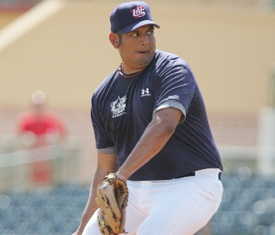
Player Profile: Zach Segovia

segovia2.jpg

Today’s player profile is a guy I’m having a hard time figuring out, 2002 2nd round pick Zach Segovia. Since being drafted in 2002, Zach has seen his share of ups and downs, including Tommy John surgery in 2004 and what appears to finally be a return to full health in 2006. With much uncertainty surrounding the Phillies bullpen entering the season, his name has been mentioned a few times as a possible candidate. Entering his age 24 season, he’s seen his performance fluctuate wildly, and his ERA hasn’t always matched his peripherals, couple that with his sometimes less than awesome stuff, his possible conditioning issues, and he really is impossible to project.

First, lets take a look at his numbers, season by season, and see if we can figure them out.

2002, GCL: 34.1 IP, 2.10 ERA, 21 H, 3 BB, 30 K

An impressive debut at age 19 for Zach. He kept his hits way down, allowed only 3 walks, and struck out 30. Expectations were obviously high after the strong start.

2003, GCL: 9 IP, 4.00 ERA, 8 H, 0 BB, 6 K
2003, Lakewood: 49.2 IP, 3.99 ERA, 63 H,  14 BB, 27 K

Clearly something was up here. His hit rate went through the roof, and while his control was still solid, his K rate plummeted. The Phillies knew something was wrong, and sure enough, he had done ligament damage in his right arm and needed Tommy John surgery, causing him to miss the entire 2004 season.

2005, Clearwater: 144.2 IP, 5.54 ERA, 168 H, 48 BB, 83 K

At first glance, the ERA is awful, and he allowed a ton of hits with few strikeouts. However, there is a silver lining, that being his great control. With pitchers recovering from Tommy John surgery, command and control are normally the last things they regain, but Segovia still displayed great control in his first season back, and maybe more importantly, he pitched 144 innings, showing that his arm was healthy.

2006, Clearwater:  49.1 IP, 2.19 ERA, 39 H, 12 BB, 41 K
2006, Reading: 107 IP, 3.11 ERA, 90 H, 24 BB, 75 K

In his second season back, his trademark control again remained intact, but this time, his hit rate jumped right back in line with where it should be, though his K rate was still lagging behind. I like to look at walk rate and strikeout rate separately, as I think K/BB can sometimes be misleading,  but he does average 3 K per BB, which is decent. The other great asset which he has retained is the ability to keep the ball on the ground and not allow home runs. In 394 IP as a pro, he’s allowed only 30 HR, a very respectable number. In 2006, he allowed 10 in 156.1 IP, again not a bad total. Last season he also induced 220 groundballs to only 170 flyballs, a solid ratio for a guy who doesn’t strike out many guys.

So, if we look at his numbers overall, they are pretty decent. His 2005 ERA is bloated, but that’s to be expected for a guy in his first year after Tommy John. Now we have to look at his stuff. Depending on who you talk to, it appears the majority opinion is that he hasn’t regained his pre Tommy John velocity, and two years removed from the surgery, he probably never will. From most scouting reports of him last season, he was consistently in the high 80’s with his fastball, hitting 91 or 92 on occasion. He has at least average secondary offerings, and his stuff plays up a bit because of his excellent control, but it does leave us with a tough time projecting his future.

Command and control guys, or finesse pitchers if you will, have much less room for error than guys with overpowering stuff. Often times, flamethrowers are overrated by scouts, and even despite terrible numbers, are more well thought of as prospects because of the notion that they “might put it all together one day” and become special. However, a larger percentage of these guys never make it, and end up flaming out because of lack of control. On the other side, finesse pitchers who are able to outmaneuver minor league hitters often struggle when they get to the big leagues, mainly because they fall victim to nibbler syndrome, where they try and be too fine and hit corners, end up walking a ton of guys or always end up behind in the count, which results in fat pitches hit to all quadrants of the park. The obvious best solution is a guy with good stuff who also has good control. But those guys don’t grow on trees.

So, where does that leave Zach? Well, I’m not really sure, and in doing my grades and projections, he was a tough guy to figure out. I gave him a solid B grade in my prospect grades, and I feel like he could be a starter at the big league level, but I wrestle with that thought now. His command is obviously good enough to be a starter, his groundball tendencies are there, but is the lack of overpowering stuff going to kill him at the next level? Is he going to be better off as a 7th inning reliever, where he doesn’t have to face a lineup 3 times? As a #5 starter, I think he’d be a fine addition on most teams. On a mediocre team, he might even be the 4th best option. On the worst of teams, he might even be a credible #3 eventually. But on this current Phillies team, he might be better suited to pitching in relief. I think he’s going to spend time at Ottawa this season before he makes it to Philly, unless he’s absolutely lights out the rest of spring training and most of the other candidates in the bullpen implode. I’m not a fan of low strikeout guys pitching in high leverage situations, but with Segovia, I really have no idea what to expect out of him at the next level, so I’ll go with the “never say never” line until we have a better read on him.

Some light Tuesday morning reading

roberson.jpg

As we get closer to opening day, there will be more re-assignments of players to minor league camps, players either getting optioned or released, and so we’ll have more stuff to look at and try and figure out. I still plan to write a few more player profiles before the season starts, but I want to address the news as it comes and try to figure out how it will impact guys in the minors going forward. Also, there are plenty of articles and fluff pieces out there about various minor leaguers, but I’m not very interested in that stuff, I’m more interested in analysis and substance. With all of that blathering out of the way, let’s get into it.

Chris Roberson was the first of the “big names” optioned to the minors this spring. A guy like Kyle Drabek doesn’t really count, since everyone knew he was going down anyway. In this piece, it talks about his mental lapses on the field this spring, and how the coaches were disappointed with what seemed to be a lack of focus on his part.

“Any player may have those thoughts,” Arbuckle said. “But the one thing a backup player has to be is fundamentally sound. You can’t have backup players who aren’t fundamentally sound.”

There was a feeling in the organization that Roberson relied more on his spectacular physical gifts – gliding speed, a fine arm, potential power from both sides of the plate – more than he worked on the simple aspects of making the smart throw and making contact.

“I think that’s apt,” Arbuckle said. “It’s not only about ability. It’s about production.”

Well, a few things here. First, Arbuckle identified Roberson’s role correctly….a backup. 5th outfielders are fairly fungible, as evident by guys like Greg Dobbs and Karim Garcia, despite poor histories, in major league camps getting a shot at a 25 man roster. Guys who don’t hit a whole lot, don’t have a ton of power, and aren’t defensive specialists generally are interchangeable and replaceable. Roberson’s minor league track record is a mixed bag, to say the least. The second thing is, the author of this article clearly hasn’t examined Roberson’s numbers if he thinks he has “power potential”. Potential is a word often used when trying to project a 19, 20 or 21 year old, not a 27 year old that turns 28 in August. Roberson is what he is, there isn’t much projection there or really much “potential”. In nearly 2,000 minor league AB’s, Roberson has 25 home runs and 86 doubles. Those aren’t power numbers, those are weak hitting outfielder numbers. So, Roberson offers you a defensive replacement in late innings, because he is a solid runner, and that’s about it. Roberson is a career .281/.355/.395 hitter in the minors, that just doesn’t have a whole lot of value at all. The biggest thing, though, is that he still had an option left, so sending him down is a no brainer.

This article gives a full list of those who were re-assigned.

Roberson and pitcher Anderson Garciahave been optioned to minor-league camp. The Phillies also reassigned catchers Tim Gradoville, Jason Hill, Jason Jaramillo andLou Marson; infielder Andrew Beattie; outfielders Lou Collier and Greg Golson; and pitchers Jim Crowell, John Ennis, Jeff Farnsworth,Yoel Hernandez and Brian Mazone.

No surprises here, really. Garcia, a waiver wire pickup in the fall, probably wasn’t ready for the majors just yet, but could see some action this season depending on injuries. Gradoville, Hill, Jaramillo and Marson were no surprise, all are going to spend at least all of 2007 in the minors, Jaramillo has a shot to maybe get a look in September. Beattie and Collier are roster filler, and Golson clearly wasn’t going to be kept around, he’ll likely head to Clearwater once the season opens. Crowell, Ennis and Farnsworth are roster filler as well and probably won’t see the majors this season. Hernadenz is an interesting case. Some buzz was building about him at this time last season, but he struggled a bit early on in the season, then went down with an injury and missed quite a bit of time in 2006. He’s 27 now, you have to think time is beginning to run out on him, at least in the Phillies org. Mazone pitched well last season, and nearly got his cup of coffee before his scheduled start was rained out. He’ll likely pitch at AAA Ottawa, and who knows, he may get an emergency start at some point this season, but you’d have to think James Happ, Zach Segovia, and Justin Germano are all ahead of him in the pecking order.

Finally we have an article about James Happ. This article contains one of my pet peeves, which is this:

He doesn’t overpower hitters. His fastball is consistently in the high 80s and will hit 91 to 92 m.p.h. on occasion.

“People like to say I’m not overpowering, but at the same time I feel my fastball plays better than my velocity,” Happ said. “I think I’ve averaged a strikeout per inning, and I think that’s pretty good for not being a power-type pitcher. It’s just control and getting ahead. That’s the whole thing. I didn’t do that today.”

From everything I’ve read since October, Happ’s fastball no longer sits in the 87-90 range, instead more in the 90-92 range. That may not seem like a big deal, but it is. Happ isn’t a soft tosser, and after the mechanical adjustments the Phillies made with him after this season, his fastball velocity increased. That’s a big deal, because he already possesses the best changeup in the organization, and a curveball that needs work. At lower levels, you can get by with an average or below average fastball if you have good command, but at AA, where the competition is much better, Happ still thrived. You can’t expect reporters to have accurate info all of the time, but I think they should at least make an effort.

There has been quite a bit of talk about whether to use Happ in relief this season in the major league pen. Personally, I could go either way on this one. I think his greatest value to the team is going to come as a starter, and honestly, I see him as a fine #3/#4 starter, based on everything he’s done up till this point. He’s going to need to refine and better his curveball, but he hasn’t had to use it as much in the lower minors, and as he throws it more, it should tighten up and become at least an average pitch. His fastball/changeup combination is good enough to pitch in relief now, but I worry how that might impact his future going forward. If the Phillies do decide to use him in the bullpen, my hope is that they keep him there all season, and then figure out what his 2008 role will be after the season. I think moving a guy from bullpen to rotation mid-season can have an adverse affect not only on his concentration/mental aspect of the game, but also the health of his arm. Routines for warming up/preparing for a game are much different for a starter as opposed to a reliever, and I worry how that could affect his arm strength.

Either way, Happ will be an asset to this team, whether it be waiting in AAA for his chance to start, or out of the pen. His ability to pitch on a downward plane, as well as keep hitters of balance means he should have success at the highest level, but his ultimate value will be determined by the viability of his curveball. I’m curious as to where people stand on Happ and what role they see for him in 2007 and beyond.

Lastly, thanks to reader BC for posting this article on recent signing Mike McTamney. He definitely sounds like an interesting guy, and this was a no risk-all reward type move for the Phillies.

Saturday Morning Reading

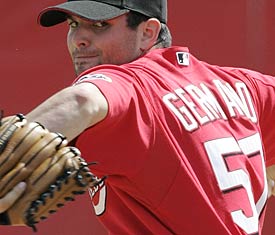
germano1.jpg

A few articles of note this morning. First, a piece talking about Justin Germano, his minor league numbers and his brief major league experience, and the possibility of him moving to the bullpen and breaking camp with the team.

However, in his last six seasons of professional ball, he has three relief appearances.

”Coming up, I had the attitude that I’m a starter, and that’s it,” said Germano. ”Now, I want to do whatever I need to do to get there. ”I’m getting into the mind-set of being a long reliever right now. I pitched out of the pen a few times and felt a little uncomfortable. I’m working on figuring out what I need to do to get ready quickly.”

Charlie Manuel wouldn’t mind seeing a capable reliever emerge in a hurry. ”He has good off-speed stuff and he throws it for strikes,” Manuel said. ”The hitters aren’t used to seeing sharp off-speed pitches this early, but if he can keep getting guys out, he can be [in the majors].”

Germano as a reliever is an interesting idea. He doesn’t turn 25 until August, so it’s not like he has no chance of being a successful starter, but he really lacks the stuff to be anything more than a 5th starter on a good team/4th starter on a poor team. He’s always shown great command with poor strikeout numbers, and I’m hesitant of having those types of guys in high leverage situations, but as a long man, he could provide a cheap, decent option. Who knows, not all relievers are high strikeout/swing and miss type guys, but that’s what you look for, and that isn’t Germano. Never say never though. I rated Germano the 36th best prospect in the organization, giving him a C+

Also, an AP article talking about the Phillies move to Ottawa this season. For all your Ottawa Lynx needs, visit the unofficial and definitive Ottawa Lynx Blog.

This brief blurb touches on the progress of Alfredo Simon and Jim Ed Warden this spring. I was really expecting nothing from Simon, but had hopes that Warden would work out. It looks like his confidence hasn’t returned and he’s struggled all spring. The Phillies plan to contend from Day 1, so don’t expect them to keep either Rule 5 guy around if they don’t really turn things around soon, and I have a feeling Gillick won’t be afraid to cut bait early on. The article also mentions the idea of Germano moving to the pen.

In this article, reliever Matt Smith really tears into himself about his performance, and ponders the thought of being sent down to the minors.  Smith, the only viable lefty we have right now, probably doesn’t have to worry about that, but it’s nice to see he realizes he needs to be sharp and not just rest on his positive performance in 2006.

The Phillies bullpen is the obvious glaring weakness at this point. Germano’s name emerging is interesting, and I have a feeling you’ll hear thoughts of Zach Segovia and James Happ starting the season in the pen as well. Earl Weaver was a big fan of breaking in young pitchers in the bullpen, so with a strong spring, you’d think they might give those two a look. However, I think in terms of long term health and value, if the Phillies feel Happ will be a starter, they should leave him in relief all season, and then have him resume a throwing pattern/workload next offseason to get his arm into starter mode again. Some pitchers have a hard time bouncing back on a day’s rest, and you never really know how each pitcher will react. I think that moving a guy between roles who isn’t familiar with doing that can sometimes cause problems, whether it be the arm’s resiliency, or the pitcher’s performance. You have to wonder if Madson’s struggles last year had anything to do with him just not being in the right frame of mind to pitch in relief after starting earlier in the season. I’m sure it’s different for every pitcher.

Player Profile: Adrian Cardenas

cardenas2.jpg

Today’s selection for the player profile is one of the brighter prospects in the Phillies system, SS/2B Adrian Cardenas. The Phillies selected Cardenas in the supplemental first round of the 2006 draft, 37th overall, and he signed quickly for $925,000. Cardenas might be one of the best stories in the 2006 draft. Originally well off the radar, his stock began to rise, and rise rapidly, when he found himself playing in front of scouts at every game, scouts who were there to see his teammate, first round pick Chris Marrero. While Marrero was thought to have the better tools set, it was Cardenas who was tearing the cover off of the ball, putting together one of the best seasons in the entire country for a high school player. In his senior season at Monsignor Pace High School (a superb prep school in Opa Loca Florida), Adrian hit .647, with 18 2B, 2 3B and 18 HR, knocking in 65 and stealing 14 bases, truly outstanding numbers. He basically went from being a mid rounds pick to a first round talent in just a few months, and was good enough to nab Baseball America’s High School Player of the Year award.

Without any real top quality middle infield prospects in the system, the pick of Cardenas may have looked like a “desperation move” at first glance, but when you see the type of hitting ability Cardenas brings, you have to re-examine that criticism and wonder if the Phillies didn’t get the best player available. Standing only 6’0, 185 lbs, there isn’t a ton of projection available on him, which is one reason he might not have been a pure first round pick. Chances are he’ll only add an inch or two and maybe 15 pounds, meaning he’ll probably max out at 6’2, 200lbs, which isn’t tiny, but also isn’t your prototypical size for an offensive machine. While he played SS in high school, most scouts/talent evaluators see him being much better at 2B, which is where he’ll play at Lakewood. His range and arm are probably not quite good enough to be a major league shortstop, though he doesn’t have to be moved to 3B yet, an area where the Phillies are also struggling, prospect-wise,  as it will be easier for him to get adjusted to pro ball, especially full season ball, playing 2B as opposed to the hot corner.

Cardenas’ greatest strength is his pure hitting ability, as seen in his monstrous senior year in high school, and his strong GCL debut. After signing, he played 41 games in the GCL, posting an impressive .318/.384/.442 batting line across 154 AB. He finished with 11 extra base hits, he stole 13 bags in 16 attempts, and he drew 17 walks to only 28 strikeouts. Overall, his debut couldn’t have gone much better. Right now, he doesn’t have a ton of raw power, and he doesn’t look like a 35 HR hitter per year at the big league level, but his swing is very compact, and he does get good loft on the ball, which indicates that as he gets stronger, he might have a good chance of being a 20 HR per year type hitter, and that’s nothing to sneeze at for a middle infielder. Glove wise, he was a solid fielder at short, but as I mentioned, his range/arm will keep him off there. He’ll play 2B at Lakewood next to Jason Donald, and the team will probably wait before figuring out where to ultimately move him to, since 2B will be filled in Philly for a while by a guy named Utley.

Which leads me to the next part of this profile. When drafted, many people were saying “he reminds me of a young Chase Utley”…..that’s not a bad comparison, huh? Like Utley, he has a very compact stroke, and like Utley, he’s lefthanded. But that’s about as far as we can go for now. Utley was a college player and didn’t make his pro debut until age 21, when he played 40 games at Batavia upon being drafted out of UCLA. Utley, who stands at only 6’1, 185lbs, is an illustration though, that you don’t need to be 6’5, 230lbs to hit 30 HR a year. Cardenas looks like he could be very similar to Utley in terms of size, and the swing is similar. One other note, in terms of comparisons. Over at Baseball Prospectus, they’ve devised similarity scores, which help to analyze what a player has done, and who he is most similar to based on all of those variables. His number 1 comparable is Marcus Giles, and in his top 10, you also find David Wright (#3), Erik Aybar (#9) and Wilson Betemit (#10), not bad names for sure. In fact, Wright and Cardenas had very similar debuts, and it will be even more interesting if Cardenas eventually ends up at 3B.

At this point, it’s tough to temper expectations on Adrian, and it’s easy to get way ahead of ourselves. His debut went just about as well as could be expected, and he’ll be making the jump to full season ball, spending 2007 at Lakewood, playing 2B beside fellow 2006 draft pick Jason Donald. 2007 represents his age 19 season, so he’ll be a tick young for the league and playing against advanced competition. There is really no need to worry about moving him to a position of need right now, the most important thing is letting his offense develop, because that is what will ultimately determine his overall value in the big leagues. If his bat is good enough, it won’t matter if he’s playing 2B, 3B, LF, or RF, he’s going to be a big asset. One interesting thing to watch will be how aggressive he is on the bases. His speed rates as merely average, maybe even a tick below average, yet he did steal 13 bases in the GCL, and was only caught 3 times. If he can swipe 20 bags at Lakewood, it further increases his value.  His 2007 should be one of the more entertaining things to watch in the Phillies minor league system.

Suggestion for next player profiles?

I’ve been slacking a bit, but I’ve been busy and haven’t had time to write as much as I’d like to, so I’m going to take suggestions for player profiles and then hopefully get cracking. So far, we’ve covered Michael Bourn, Edgar Garcia, Brett Harker, Dan Brauer, Andrew Carpenter, Fabio Castro, and Mike Costanzo. Who’s next?

Looking for a few contributors

First off, I know I’ve said it in the past, but I’ll say it again, thank you for stopping in every day and checking out my site, and thank you to those who have linked me from their sites and helped to spread the word. I’m really still surprised how well this has taken off, but it’s been a lot of fun, and should be even more fun once the season starts. I have a few more ideas in the pipeline, so stay tuned here for more updates and ideas.

However, I’d like to extend out a call for help here. As the season gets underway, there will be a lot of minor league action taking place nightly. I plan on writing up game summaries/previews every day, that won’t take long, but I would like to enlist the help of a few people to help write some stuff for each of the minor league affiliates. Ideally, you would be the type of person who goes to a bunch of games for one of the affiliates, you’d be able to write up interesting things you see, take some pictures, etc etc. I’d like to start out with it being a once a week type deal, where you could just write up a few paragraphs about the recent happenings on the team, any transactions or moves, players who are hitting their stride/players who are struggling, just stuff like that. If that’s something that interests you, please send me an e-mail at phuturephillies at hotmail dot com, replacing the “at” and the “dot” with their appropriate symbols. Andyb will continue to report on our teams in the DSL and VSL, but I could definitely use a Lakewood, Clearwater, Reading and Ottawa contributor, and because I live in Baltimore, my ability to get to games will be limited to those played at affiliates near me. Again, this will start out being really only a once a week type deal, and we’ll see where it goes from there. So if interested, drop me a line.

As always, if you have any suggestions, comments, questions or concerns, please don’t hesitate to let me know.

Interesting article regarding pitching prospects

If you aren’t member over at Baseball Prospectus, you really are missing out, but I’m not trying to sell anything here, and in fact, this content is 100% free. Nate Silver, the most prominent figure at BP, wrote an “unfiltered” blog entry today, touching on the popular phrase “TINSTAAPP”, also known as “There Is No Such Thing As A Pitching Prospect”, and how relevant it is. This was the most interesting part of the article

One thing that distinguishes young hitters from young pitchers is that young hitters can pretty much count on making steady improvements from the time they start playing professional ball until the time they’re 26 or 27. You might have a guy like Cameron Maybin who would be pretty overwhelmed if he tried to play in the major leagues today — but we can be fairly certain that he’ll be able to handle the big leagues in two or three years time. Cameron Maybin is a prospect.

The same is not the case with pitching prospects. Although there are a few categories of pitching prospects — particularly guys with good stuff, high strikeout rates and highish walk rates (think Homer Bailey) — that tend to improve more often than not, in general there is no systematic pattern of improvement after the age of 21 or so. Sometimes guys get better, of course, and sometimes they do so in a hurry — but you can’t take a young pitcher in a vacuum and expect him to improve the same way that you can for a hitting prospect. Mark Rogers (to pick on some low-hanging fruit) will probably never get his command sorted out, Yusemiro Petit will never add enough ticks to his fastball to become a useful major league starter, Gavin Floyd will never learn how to keep the ball down, and so forth. All of these things are possible — but they’re not very likely.

This strikes me as being a very interesting area of study. Do pitchers really not drastically improve after the age of 21, for the most part? If you disagree with this notion, I’d love to see some data to illustrate the point. I may work on this as a project at some point down the line.

Player Profile: Michael Bourn

bourn2.jpg

We’ve got a slow Monday here “news wise”, so I thought I’d get back to writing some player profiles. Also, a link I wanted to pass along that I thought I had before, is the link to James Happ’s blog. Happ has been writing a blog for MLB.com and talking about his experiences in his first big league camp. Check it out and say hello. Also, scroll down below this post and read contributor andyb’s take on our Dominican Summer League prospects. Now, onto Mr Bourn…

Michael Bourn was drafted in the 19th round of the 2000 draft by the Houston Astros, but chose to go to college, attending the University of Houston for three seasons before being drafted in the 4th round by the Phillies. At 5’11, 180lbs, Bourn never hit for power in college, but he did have a very impressive batting eye, and stole 90 bases in 3 years. The Phillies nabbed him in the third round and sent him straight to Batavia. In 35 games, he posted a .280/.404/.296 line and stole 23 bases in 28 attempts. The lack of power probably wasn’t a surprise, but for his first taste of pro ball, the fact that he drew 23 walks to only 28 strikeouts had to be viewed as promising in the Phillies eyes.

Bourn spent all of 2004 at Lakewood, his age 21 season, and he held his own. In 109 games, he posted a .317/.433/.470 batting line, with 20 2B, 14 3B and 5 HR. The triples obviously helped raise his slugging %, and he further utilized his speed to the tune of 57 stolen bases, getting caught only 6 times, for a 90% success rate, and incredible number. With his really strong full season debut, the Phillies decided to double jump him in 2005, skipping him over High Class A Clearwater and straight to AA Reading. 2005, his age 22 season, proved to be a bit of a disappointment. In 135 games, his batting line dipped to .268/.348/.364, 18 2B, 8 3B, and 6 HR. His slugging obviously dropped way down as a result, but he still managed to swipe an impressive 38 SB, but this time was thrown out 12 times, only having a 76% success rate. Still, Bourn was only 22, and had plenty of time to get back on track.

In 2006, the Phillies decided to have him start back at Reading again. He didn’t show much improvement, as in 80 games, his batting line was only .274/.350/.365, with 5 2B, 6 3B, and 4 HR. The Phillies still decided to promote him to Scranton, maybe with the hopes of kick-starting him. And it kind of worked, as he put up a line of .283/.368/.428 in 38 games. Over all of 2006, he stole 45 bases, being caught only 5 times, and appeared to be back on track in that department. Still, his power and ability to use his speed out of the box appeared to struggle again. A guy who lives and dies on his speed should have more than 10 doubles over the course of 130+ games. Nevertheless, when the rosters expanded in September, the Phillies decided to give Bourn a promotion and get him a taste of Philadelphia. He was used mainly as a pinch runner/defensive replacement, getting only 8 AB, where he got 2 hits and drew 1 BB. He also stole 1 base, but was caught stealing twice, one an in infamous play in Houston, where he was sent in to pinch run and was then picked off of first base in front of his home town fans.

So, where does Bourn go from here, and what can we expect from him? Right now, he’s a long shot to make the team out of camp, mainly because of the presence of guys older than him and have more experience. Long term value wise, Bourn probably has more potential than Greg Dobbs, but Dobbs is off to a hot start, and he’s been around much longer. The Phillies still control Bourn for quite a while, and he’s already on the 40 man roster, so they don’t have to do anything special with him. As a 5th OF, Bourn could bring quite a bit of speed and the ability to improve late inning defense, but Dobbs offers a power bat off the bench, and I’m sure that’s something Gillick and Manuel will talk about. But with injuries, and certainly in September when the rosters expand, Bourn will get his looks, if it doesn’t happen now.

The problem is going to be defining Bourn’s role, and figuring out how he fits into this team. Bourn has a very defined skill set that doesn’t appear like it’s going to change anytime soon. He has almost ZERO raw power, which means he’s always going to live and die by his legs and ability to make things happen. In the lower minors, Bourn had an excellent walk rate and seemed like the perfect leadoff hitter. But as he’s climbed the ladder, the strikeout totals have been rising and his walk rate hasn’t been rising enough to justify just throwing him into the leadoff spot on our team. If he can post a .380 OB% at the major league level, he becomes a very valuable asset. However, if he’s more like a .340 OB% guy, he’s just going to make a ton of outs, and his speed on the bases will not be properly utilized. The other problem is, the Phillies currently have Shane Victorino and Aaron Rowand already on the roster, two pure centerfielders. Bourn does not profile at a corner spot unless it’s just for late inning defense, and neither Rowand nor Victorino are really corner outfielders, both are much better utilized in center. That leaves the Phillies in a tough spot with Bourn.

Ultimately, if his batting eye returns, he’s going to be a solid big leaguer, but that remains a big if to me. Right now, I can’t see a true spot for him on this team. If he gets hot in Ottawa and has a nice start, the Phillies could explore trading Rowand and then using Bourn in CF and Victorino in RF, but that doesn’t seem all that likely, and if Rowand is traded, it probably just increases the likelihood of Greg Dobbs making the team. That really looks to leave Bourn as a guy who won’t make it back to Philly until the summer some time in the event of an injury, or possibly even as late as September with the roster expansion. His performance at AAA this season will ultimately go a long way in determining what role/impact he’ll have in 2008, but he should

Draft and Follow Update

Thanks to emailer Dave, I have an update on Patrick Murray, one of our numerous draft and follows. Murray is playing at Golden West College, a solid program in a solid league, and is off to a nice start

.443/.494/.543 with 5 2B, 1 3B, and 14 RBI. He’s drawn 7 walks to only 4 strikeouts in 70 AB.

Also, it should be noted, Murray has already signed a letter of intent with Oral Roberts University. That doesn’t mean the Phillies won’t make a run at him, but it probably means he’s going to demand a decent sized bonus. Here is the blurb from the above article on Murray

Patrick Murray * IF * 6-2 * 230 * Huntington Beach, Calif. (Marina HS/Golden West College)

Currently a sophomore at Golden West College in Huntington Beach, Calif. … Starred last year at Santa Anna Junior College where he hit .330 with three home runs and 22 RBI in only 29 games played … Prepped at Marina High School where he earned 1st team all-league honors his junior and senior year … Drafted by the Milwaukee Brewers in the 31st round in 2005 and by the Philadelphia Phillies in the 46th round in 2006 … Choose ORU over UNLV, Cal Poly, and Loyola Marymount … says Walton, “Patrick has good size and is a very good hitter who should fill one of the holes in our lineup next year. He has a chance to bat in the middle of the lineup and to drive in runs.”

Stay tuned…

Phillies 6, Indians 4

burrellhoward.jpg

The Phillies claimed a win on Friday, beating Cleveland 6-4. Some prospect news of note:

Michael Bourn, 0/1
Justin Germano, 1 IP, 0 ER, 1 H
James Happ, 2 IP, 0 ER, 1 H, 1 K

Happ, getting his first taste of spring training, works two solid innings. I wonder if the Phillies might be tempted to keep Happ on the 25 man roster with a great spring and struggles from other relievers? Personally, I don’t think he has much of a chance, especially with two Rule 5 guys on the roster right now, and I think his biggest value is still in the rotation.