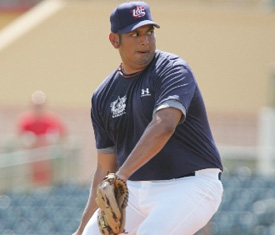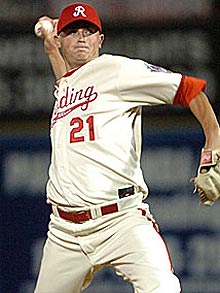
Joe Bisenius, will he or won’t he?

bisenius5.jpg

I’ve commented on Joe at length in the past, and as spring training has progressed, the buzz surrounding him has started to grow. The question everyone is asking is, will he make the team out of spring training? I wanted to look at the three determining factors, in my mind, which will ultimately lead to that decision.

His spring performance.  9 IP, 2 ER, 4 H, 6 BB, 6 K. As I mentioned whenever talking about Bisenius, his control is the last missing piece, and it doesn’t appear to be there just yet. 6 walks in 9 innings is WAY too many, especially considering it is spring training, and he’s not always facing quality major league hitters. No one really questions his stuff, the mid 90’s heat is there, the hard slider is there, but unless he can command it, he’s going to frustrate his manager, his teammates, and all of us. Pitching to contact isn’t what you want out of your high leverage relievers, but you also don’t want a guy walking 2 in every appearance. If will be interesting to see how his numbers look at this time next week, and ultimately, that will probably go a long way in determining his immediate status.

The performance of everyone else. The Phillies bullpen was obviously wide open this spring, but few have really taken advantage.  Of the non-certainties, only Zach Segovia has pitched well (2.70 ERA in 10 IP), while the next best performance is Clay Condrey’s 4.82 ERA in 9.1 IP. Hopefuls Jim Ed Warden (5.69 ERA), Brian Sanches (6.75 ERA), Alfredo Simon (12.47 ERA, already offered back to Texas), and Anderson Garcia (9.00 ERA) have disappointed. Couple that with Alfonseca’s disappointing spring (7.20 ERA), and Bisenius looks like he HAS to be included. The Phillies surefire guys have to be Gordon, Smith, Geary, and Madson. That’s 4 slots, and there will be at least 2, probably 3 more spots to fill. Alfonseca is probably going to get a spot on the team until Gillick is forced to release him due to suckitude of the highest order. That means 1, maybe 2 spots to fill. Bisenius and Segovia seem like slam dunks, barring any kind of trade.

The 40 man roster.  At present, the Phillies have 4 spots open on the 40 man, so this doesn’t seem like a factor. Also included in that number are Warden, who may be removed and sent back to Cleveland. Segovia is already on the 40 man roster, so he has one less obstacle to overcome, but there is plenty of room there, so it shouldn’t be a means to keep Bisenius in the minors.

So, I suppose it all comes down to the last week of spring training. If I had to handicap it right now, I’d say there’s a 60% chance of him breaking camp with the team. The other 40% involves them keeping Warden, at least for now, Castro making the bullpen despite his poor spring, or a trade bringing in a reliever from another organization. However, with Alfonseca’s performance so far, I doubt it’s very long before Bisenius makes his way to Philly.

Also, is it just me, or does he look like Jeremy Bonderman’s twin brother?
Plans for the blog as we get closer to opening day

I don’t have time to write a new profile today, not much in the news department, but I wanted to just briefly share some plans and ideas for the site as we get closer to meaningful minor league games. If you’re a repeat visitor, thanks for constantly checking in and seeing what I have to offer, and I hope you continue to do so once the season starts. I’d also appreciate you passing the site along to those you feel might enjoy the content, the readers are the reason people even have blogs. If this is your first time finding the blog, thanks for checking it out, and hopefully you come back. Now, onto the details…

If you look on the left side of the main page, you know about all of the tags, some for various features, and then a player specific tab for most prospects. The main tags you’ll want to keep an eye on once the season starts will be the Game Writeups, Transactions, Rosters, and a new section which will be added in a few days, the “Affiliate Reports” section. I’ve enlisted the help of a few people to help on covering the affiliates in detail, and once a week, we’ll be writing more in depth reports on the happenings at each level. Think of this as your one stop shop for the rundown on each level of the Phillies system. Tentatively, Lakewood will be Tuesdays, Clearwater on Wednesdays, Reading on Thursdays and Ottawa on Fridays. Once the short season leagues start, there will probably be one report for both leagues on Mondays.

In addition, every Monday I’ll be writing a who’s hot/who’s not feature covering the 5 or so best performers of the week, and the 5 worst. I’ll also be creating an online photo album, in which people can share their digital photos from minor league games throughout the season. I’m also open to any other suggestions anyone may have, so if you have an idea for the site, or something you’d like to see, or an area you’d like to help with, please either leave me a comment or drop me an e-mail. I’m extremely happy with the traffic and response I’ve gotten so far, and I can only hope it continues as the season kicks off. Thanks again for checking in.

Some light Wednesday morning reading

segovia3.JPG

The latest hot topic appears to be Zach Segovia moving into a position to make the bullpen out of spring training. The Inquirer makes a brief mention here, citing his most recent impressive outing against the Yankees, and the Daily News talking about his control and composure. This idea seems to really be picking up steam recently, and maybe more because of everyone else’s general state of suckitude rather than Segovia’s complete dominance. As I highlighted in my profile of Zach, pitching out of the pen, at least for now, might be his area of greatest value to the big league club. The overpowering velocity isn’t there, the strikeout numbers aren’t there, but he doesn’t walk a lot of guys, and that’s an important component for any quality reliever.

Quick update on our top Draft and Follow prospect, Rashad Taylor. Through 71 AB, his batting line:

.423/.535/.809,  25R, 4 2B, 4 3B, 5 HR, 21 RBI, 19 BB, 12 K

Hey Pat, please make this guy a quality offer.

Also, a plea to my fellow Phillies fans….don’t panic about Cole Hamels and his spring struggles, he’s going to be fine.

Update on Mathieson, Mitchinson and Drabek

In Baseball America’s latest prospect blog entries, some updates on Phillies prospects are given. First, Scott Mathieson has begun long tossing from 150 feet and appears to be right on schedule. He should be back to pitching from a mound sometime in July, and might make a cameo in September. However, it’s highly unlikely he’ll be effective right away, as pitchers coming back from TJ almost always go through control/command troubles while regaining arm strength. The realist says that sometime mid 2008 he should be fully ready to contribute at the big league level, the question remains in what role he’ll play. Some argue he should get a shot to be the next closer, others argue his highest value is still in the rotation. Until we know what his arm/stuff is going to look like post surgery, that type of speculation really is just that, speculation.

Mentioned in the same article, Scott Mitchinson is also recovering from shoulder surgery (which I apparently missed) and should also be back and throwing in July. Also, there was a blurb on Drabek and his most recent outing in a Low A spring training game. Apparently the Phillies tried to alter Drabek’s delivery, and because of it, he suffered with a bit of velocity drop and wasn’t sharp. He revised his mechanics, somewhere between what he originally was using and what the Phillies suggested, and his fastball velocity shot back up into the 94 range with improved control, his curve was great, and his changeup was better than it was last season in his brief debut. Drabek was also praised for his attitude and ability to work with his coaches, which has to be seen as a great sign. It looks like he’s a lock to start the year at Lakewood, barring a late injury here.

Phillies lose Germano to Padres

Though it apparently hasn’t been confirmed yet by Phillies.com, Justin Germano was placed on waivers and claimed by the Padres, according to beerleaguer. This move, if true, is disappointing on two fronts. First, Germano was acquired for Rheal Cormier last summer. Cormier, at the time, had to have at least some value, and getting a guy who was out of MLB options, if you didn’t plan on keeping him around, probably wasn’t the smartest move. Second, Germano is younger than some of the other options (Condrey and Warden) and though he isn’t a prime prospect, was still in the 20-30 range, and still could have helped down the road in some capacity, whether it be as a reliever or an emergency starter.

The Phillies bullpen is in disarray right now, and it’s hard to see how this move can be viewed as an improvement. It isn’t like losing a top prospect, but it still stings when it seems this could have been avoided. Interestingly, Germano was traded by San Diego to Cincinnati, and is now returning back to the place he got his start. Best of luck to him going forward.
UPDATE ——-> Sportingnews has the article and this quote from Germano

“I’m pretty shocked,” Germano said soon after assistant general manager Ruben Amaro Jr. informed him of the move. “I thought I was right there. I had one bad inning. I knew they didn’t expect me to be perfect every time out.”

Simon offered back, more on Bourn

In the notes section today, The Inquirer mentions the Phillies have offered Rule 5 reliever Alfredo Simon back to the Rangers. No real shock here, as Simon has been downright awful, and unlike guys like Clay Condrey who can be sent back to the minors, Simon would have needed to remain on the 25 man roster all season.

Also, DelewareOnline has a nice piece on Michael Bourn, and indicates his chances of making the team are getting better each day. This part was interesting..

The Phillies are so impressed that, more than ever, they view Bourn as their next center fielder. And, under different circumstances, his spring success would make them even more inclined to deal Aaron Rowand, who will become a free agent after the season and has been the subject of trade rumors since October.

But expectations for the Phillies are sky-high. And for now, they are hesitant to have someone with just 152 Class AAA at-bats in the lineup. “He’s done nothing to make us say, ‘We need to see this or that before we can put him on the team,’ ” Arbuckle said. “But you’ve got to see it over a period of time. There’s a comfort level that needs to be established. If we were in a building stage, then you can take a young player and say, ‘If he makes some young mistakes, we can live with it and move on.’ “

The rumors about Aaron Rowand trades have been plentiful, but this makes it appear that they don’t trust Bourn in CF everyday, despite saying great things about his potential and future, and how much better he looks in camp this year. You’d think the only way anything would happen would be an injury to Rowand or Victorino, where Bourn could get every day AB’s. Either way, this will be an interesting story to watch the rest of the spring.

Similarity Index and Comparable Players

If you’re a subscriber at Baseball Prospectus, you know all about similarity index and comparable players. If you don’t know, here is a real brief summary. Basically, the backbone of this is the PECOTA system, and is broken down into four main attributes; on field production, shear amount of numbers, physical traits like handedness, and then finally defensive position. The database contains over 20,000 seasons from major leaguers since World War II, as well as 10 years worth of minor league seasons from 1997-2006. Similarity index is basically a snapshot of all of the player’s comparable, with an index of 50 being a very common player, historically speaking, and a rating lower than 20 meaning the player is very unusual in a historical context.

Just for fun, on this miserable looking Friday, I looked at the comparable lists for the Phillies 10 best prospects, according to my prospect grades I did a little while back. Here are just a few brief thoughts on each guy.

1. Carlos Carrasco: SI = 57. At this point, his ten most comparable pitchers isn’t a pretty sight, but near the bottom of the top 10, then the 11-15 range, you see names like Jeremy Bonderman of 2003 (#7) and Yovani Gallardo of 2006 (#12). Because he had such a night and day change from 2005 to 2006, it’s tough to project him. The upside is definitely there.

2. Adrian Cardenas: SI = 24. Lots of interesting guys in his Top 20, including David Wright (#3), Ian Stewart (#13) and Milton Bradley (#14). Again, we’re dealing with a small sample size, hence his low Similarity Index.

3. D’Arby Myers: SI = 7. Clearly, because he was only 17 in the GCL, he’s a somewhat unique case. However, numbers 8-10 on his list include Carl Crawford, Jose Reyes and Carlos Gonzalez, one of the best prospects in baseball.

4. Scott Mathieson: SI = 66. Mathieson’s top 20 is all over the map, but does include a few really good signs, including Jake Peavy circa 2004 (#3) and Catfish Hunter circa 1969 (#7). However, it also includes guys like Victor Santos and Seth Etherton. We won’t really know anything about his future until sometime in 2008.

5. Josh Outman: SI = 59. Outman’s top 20 is absolutely ugly in every way. He really turned things up in 2006, and he was outstanding over the last 6 weeks of the season, but he still has control issues. We can only hope his list looks better at this time next year.

6. Edgar Garcia. No comparables in the PECOTA system yet.

7. James Happ: SI = 62. Happ’s top 20 is ugly as well, but interestingly, Doug Davis circa 2000 is his #3 comparable. Prior to Happ adding velocity on his fastball, he shared a lot of similarities to Davis. You could do worse than Doug Davis, who is a capable innings eater, but with a strong 2007, I’d imagine Happ’s comparable pitchers list will change a bit.

8. Joe Bisenius. No comparables in the PECOTA system yet.

9. Dan Brauer. No comparables in the PECOTA system yet.

10. Ben Pfinsgraff. No comparables in the PECOTA system yet.

Since a few guys aren’t in the system yet, I figured I’d look at a few lower ranked prospects and see how they stacked up.

Matt Maloney: SI = 60. Doug Davis circa 1999 comes in as his #2 comparable, and Brian Fuentes circa 1999 his #7 comparable.

Michael Bourn: SI = 49. The 2004 version of Tim Raines is his #4 comparable, and the only guy that looks anywhere near decent is Randy Winn circa 1998, who is his #15 comparable. Maybe this helps affirm my worries about him being a regular player in the big leagues.

Still looking for Lakewood/Clearwater correspondants

I’ve had a number of people get in touch with me about helping with the Reading Phillies, and we’ve got our Ottawa connection taken care of, but I still would like two people, one to cover the Threshers and one to cover the Blue Claws. Basically, you’d be writing an entry once a week, either on a Thursday or Friday (or a Saturday, we can work that detail out), just basically talking about the state of the team, any news or tidbits you feel are worthy, and anything else you’d like to share. I can certainly write these, but I felt it would be a better feature if there were people who actively followed these affiliates and wanted to get their opinion/voice out there. If you have an interest, please send me an e-mail and we’ll work out the details. Thanks.

Player Profile: Zach Segovia

segovia2.jpg

Today’s player profile is a guy I’m having a hard time figuring out, 2002 2nd round pick Zach Segovia. Since being drafted in 2002, Zach has seen his share of ups and downs, including Tommy John surgery in 2004 and what appears to finally be a return to full health in 2006. With much uncertainty surrounding the Phillies bullpen entering the season, his name has been mentioned a few times as a possible candidate. Entering his age 24 season, he’s seen his performance fluctuate wildly, and his ERA hasn’t always matched his peripherals, couple that with his sometimes less than awesome stuff, his possible conditioning issues, and he really is impossible to project.

First, lets take a look at his numbers, season by season, and see if we can figure them out.

2002, GCL: 34.1 IP, 2.10 ERA, 21 H, 3 BB, 30 K

An impressive debut at age 19 for Zach. He kept his hits way down, allowed only 3 walks, and struck out 30. Expectations were obviously high after the strong start.

2003, GCL: 9 IP, 4.00 ERA, 8 H, 0 BB, 6 K
2003, Lakewood: 49.2 IP, 3.99 ERA, 63 H,  14 BB, 27 K

Clearly something was up here. His hit rate went through the roof, and while his control was still solid, his K rate plummeted. The Phillies knew something was wrong, and sure enough, he had done ligament damage in his right arm and needed Tommy John surgery, causing him to miss the entire 2004 season.

2005, Clearwater: 144.2 IP, 5.54 ERA, 168 H, 48 BB, 83 K

At first glance, the ERA is awful, and he allowed a ton of hits with few strikeouts. However, there is a silver lining, that being his great control. With pitchers recovering from Tommy John surgery, command and control are normally the last things they regain, but Segovia still displayed great control in his first season back, and maybe more importantly, he pitched 144 innings, showing that his arm was healthy.

2006, Clearwater:  49.1 IP, 2.19 ERA, 39 H, 12 BB, 41 K
2006, Reading: 107 IP, 3.11 ERA, 90 H, 24 BB, 75 K

In his second season back, his trademark control again remained intact, but this time, his hit rate jumped right back in line with where it should be, though his K rate was still lagging behind. I like to look at walk rate and strikeout rate separately, as I think K/BB can sometimes be misleading,  but he does average 3 K per BB, which is decent. The other great asset which he has retained is the ability to keep the ball on the ground and not allow home runs. In 394 IP as a pro, he’s allowed only 30 HR, a very respectable number. In 2006, he allowed 10 in 156.1 IP, again not a bad total. Last season he also induced 220 groundballs to only 170 flyballs, a solid ratio for a guy who doesn’t strike out many guys.

So, if we look at his numbers overall, they are pretty decent. His 2005 ERA is bloated, but that’s to be expected for a guy in his first year after Tommy John. Now we have to look at his stuff. Depending on who you talk to, it appears the majority opinion is that he hasn’t regained his pre Tommy John velocity, and two years removed from the surgery, he probably never will. From most scouting reports of him last season, he was consistently in the high 80’s with his fastball, hitting 91 or 92 on occasion. He has at least average secondary offerings, and his stuff plays up a bit because of his excellent control, but it does leave us with a tough time projecting his future.

Command and control guys, or finesse pitchers if you will, have much less room for error than guys with overpowering stuff. Often times, flamethrowers are overrated by scouts, and even despite terrible numbers, are more well thought of as prospects because of the notion that they “might put it all together one day” and become special. However, a larger percentage of these guys never make it, and end up flaming out because of lack of control. On the other side, finesse pitchers who are able to outmaneuver minor league hitters often struggle when they get to the big leagues, mainly because they fall victim to nibbler syndrome, where they try and be too fine and hit corners, end up walking a ton of guys or always end up behind in the count, which results in fat pitches hit to all quadrants of the park. The obvious best solution is a guy with good stuff who also has good control. But those guys don’t grow on trees.

So, where does that leave Zach? Well, I’m not really sure, and in doing my grades and projections, he was a tough guy to figure out. I gave him a solid B grade in my prospect grades, and I feel like he could be a starter at the big league level, but I wrestle with that thought now. His command is obviously good enough to be a starter, his groundball tendencies are there, but is the lack of overpowering stuff going to kill him at the next level? Is he going to be better off as a 7th inning reliever, where he doesn’t have to face a lineup 3 times? As a #5 starter, I think he’d be a fine addition on most teams. On a mediocre team, he might even be the 4th best option. On the worst of teams, he might even be a credible #3 eventually. But on this current Phillies team, he might be better suited to pitching in relief. I think he’s going to spend time at Ottawa this season before he makes it to Philly, unless he’s absolutely lights out the rest of spring training and most of the other candidates in the bullpen implode. I’m not a fan of low strikeout guys pitching in high leverage situations, but with Segovia, I really have no idea what to expect out of him at the next level, so I’ll go with the “never say never” line until we have a better read on him.

Some light Tuesday morning reading

roberson.jpg

As we get closer to opening day, there will be more re-assignments of players to minor league camps, players either getting optioned or released, and so we’ll have more stuff to look at and try and figure out. I still plan to write a few more player profiles before the season starts, but I want to address the news as it comes and try to figure out how it will impact guys in the minors going forward. Also, there are plenty of articles and fluff pieces out there about various minor leaguers, but I’m not very interested in that stuff, I’m more interested in analysis and substance. With all of that blathering out of the way, let’s get into it.

Chris Roberson was the first of the “big names” optioned to the minors this spring. A guy like Kyle Drabek doesn’t really count, since everyone knew he was going down anyway. In this piece, it talks about his mental lapses on the field this spring, and how the coaches were disappointed with what seemed to be a lack of focus on his part.

“Any player may have those thoughts,” Arbuckle said. “But the one thing a backup player has to be is fundamentally sound. You can’t have backup players who aren’t fundamentally sound.”

There was a feeling in the organization that Roberson relied more on his spectacular physical gifts – gliding speed, a fine arm, potential power from both sides of the plate – more than he worked on the simple aspects of making the smart throw and making contact.

“I think that’s apt,” Arbuckle said. “It’s not only about ability. It’s about production.”

Well, a few things here. First, Arbuckle identified Roberson’s role correctly….a backup. 5th outfielders are fairly fungible, as evident by guys like Greg Dobbs and Karim Garcia, despite poor histories, in major league camps getting a shot at a 25 man roster. Guys who don’t hit a whole lot, don’t have a ton of power, and aren’t defensive specialists generally are interchangeable and replaceable. Roberson’s minor league track record is a mixed bag, to say the least. The second thing is, the author of this article clearly hasn’t examined Roberson’s numbers if he thinks he has “power potential”. Potential is a word often used when trying to project a 19, 20 or 21 year old, not a 27 year old that turns 28 in August. Roberson is what he is, there isn’t much projection there or really much “potential”. In nearly 2,000 minor league AB’s, Roberson has 25 home runs and 86 doubles. Those aren’t power numbers, those are weak hitting outfielder numbers. So, Roberson offers you a defensive replacement in late innings, because he is a solid runner, and that’s about it. Roberson is a career .281/.355/.395 hitter in the minors, that just doesn’t have a whole lot of value at all. The biggest thing, though, is that he still had an option left, so sending him down is a no brainer.

This article gives a full list of those who were re-assigned.

Roberson and pitcher Anderson Garciahave been optioned to minor-league camp. The Phillies also reassigned catchers Tim Gradoville, Jason Hill, Jason Jaramillo andLou Marson; infielder Andrew Beattie; outfielders Lou Collier and Greg Golson; and pitchers Jim Crowell, John Ennis, Jeff Farnsworth,Yoel Hernandez and Brian Mazone.

No surprises here, really. Garcia, a waiver wire pickup in the fall, probably wasn’t ready for the majors just yet, but could see some action this season depending on injuries. Gradoville, Hill, Jaramillo and Marson were no surprise, all are going to spend at least all of 2007 in the minors, Jaramillo has a shot to maybe get a look in September. Beattie and Collier are roster filler, and Golson clearly wasn’t going to be kept around, he’ll likely head to Clearwater once the season opens. Crowell, Ennis and Farnsworth are roster filler as well and probably won’t see the majors this season. Hernadenz is an interesting case. Some buzz was building about him at this time last season, but he struggled a bit early on in the season, then went down with an injury and missed quite a bit of time in 2006. He’s 27 now, you have to think time is beginning to run out on him, at least in the Phillies org. Mazone pitched well last season, and nearly got his cup of coffee before his scheduled start was rained out. He’ll likely pitch at AAA Ottawa, and who knows, he may get an emergency start at some point this season, but you’d have to think James Happ, Zach Segovia, and Justin Germano are all ahead of him in the pecking order.

Finally we have an article about James Happ. This article contains one of my pet peeves, which is this:

He doesn’t overpower hitters. His fastball is consistently in the high 80s and will hit 91 to 92 m.p.h. on occasion.

“People like to say I’m not overpowering, but at the same time I feel my fastball plays better than my velocity,” Happ said. “I think I’ve averaged a strikeout per inning, and I think that’s pretty good for not being a power-type pitcher. It’s just control and getting ahead. That’s the whole thing. I didn’t do that today.”

From everything I’ve read since October, Happ’s fastball no longer sits in the 87-90 range, instead more in the 90-92 range. That may not seem like a big deal, but it is. Happ isn’t a soft tosser, and after the mechanical adjustments the Phillies made with him after this season, his fastball velocity increased. That’s a big deal, because he already possesses the best changeup in the organization, and a curveball that needs work. At lower levels, you can get by with an average or below average fastball if you have good command, but at AA, where the competition is much better, Happ still thrived. You can’t expect reporters to have accurate info all of the time, but I think they should at least make an effort.

There has been quite a bit of talk about whether to use Happ in relief this season in the major league pen. Personally, I could go either way on this one. I think his greatest value to the team is going to come as a starter, and honestly, I see him as a fine #3/#4 starter, based on everything he’s done up till this point. He’s going to need to refine and better his curveball, but he hasn’t had to use it as much in the lower minors, and as he throws it more, it should tighten up and become at least an average pitch. His fastball/changeup combination is good enough to pitch in relief now, but I worry how that might impact his future going forward. If the Phillies do decide to use him in the bullpen, my hope is that they keep him there all season, and then figure out what his 2008 role will be after the season. I think moving a guy from bullpen to rotation mid-season can have an adverse affect not only on his concentration/mental aspect of the game, but also the health of his arm. Routines for warming up/preparing for a game are much different for a starter as opposed to a reliever, and I worry how that could affect his arm strength.

Either way, Happ will be an asset to this team, whether it be waiting in AAA for his chance to start, or out of the pen. His ability to pitch on a downward plane, as well as keep hitters of balance means he should have success at the highest level, but his ultimate value will be determined by the viability of his curveball. I’m curious as to where people stand on Happ and what role they see for him in 2007 and beyond.

Lastly, thanks to reader BC for posting this article on recent signing Mike McTamney. He definitely sounds like an interesting guy, and this was a no risk-all reward type move for the Phillies.