All posts by giventofly41

Tools vs Numbers, Old School vs New School

Baseball America has resumed their top 10 lists with the Atlanta Braves today, and the Phillies are scheduled for January 10th. If you’re reading this site, you are clearly interested in the minor leagues and prospects, so I’m sure you already know plenty about Baseball America. For those who don’t, basically, they rely on the reports of scouting directors, individual area scouts, crosscheckers and other talent evaluators. They gather all of their info, look at the numbers, then rank their prospects based on all of that information. For people like you and me, it’s obviously one of the best resources available, because most people don’t have the time to go out and see hundreds of minor league games every year. However, when looking at players at the minor league level (and even the major league level), there are two sharply divided schools of thought: Tools (old school) vs Numbers (new school), and I’m not here to tell you which is right (both are right) and which is wrong (both are wrong), I’m just going to try to explain where I’m coming from with my analysis (ramblings) and thoughts.

When you get into this game, and by game I mean following minor leaguers, you have to understand what you’re looking at, and how others look at things. “Moneyball”, the book by Michael Lewis, really is about the economics involved with baseball, especially front office decisions, but it also introduced some casual fans to the work of Bill James, and along the same lines, it introduced (or at least rekindled) the debate of “tools” vs “production on the field”, which is especially important to minor league players.

Generally (and more closely related to position players), there are 5 conventional tools:

  • Hitting for average
  • Hitting for power
  • Running
  • Arm Strength
  • Fielding

If a player is excellent in all of those areas, he’s labeled a “5 tool player” by talent evaluators. If he’s good at 4 areas, he’s a 4 tool player, etc etc. Now, of those tools, some are more “skill oriented” and some are more physical trait oriented. For example, if you’re 5’10 and weigh 215 pounds, with a thick muscular build, chances are you aren’t going to be considered a speed demon. If you don’t have 30 stolen base potential, you lose one of your “tools” when you’re evaluated by scouts. If you don’t have a cannon arm, you’re not looked at as a right field candidate, and you lose another tool from your arsenal. Scouts use a scale to rate every tool, with a 20 being terrible (think Sal Fasano rounding second base), and 80 (think Ryan Howard’s power) being the best.

Ok, so what does that mean? When a scout watches a player, he immediately looks at those five areas. He makes notes about a player’s build and his “tools”, and this is important in the next area, projection. Projection is another scout buzz word, and it basically means “what can he become?”, and believe it or not, this is almost as important as what a player can actually do at the present time. This is much much more important when looking at high school players, because they are generally years, (2 or 3 at least, normally 4-6) away from making it to the majors when they are finishing high school. If you have two pitchers with identical numbers in high school, what generally separates them is their projection. For example, a kid who is 6’4, 180 pounds is much more projectable than a kid who is maybe 5’9, 150 pounds. On the pitching mound, they could have identical pitches, and put up identical statistics, but the scouts will favor the taller kid 95/100 times because of his projection. They look at the taller, skinnier kid and picture him growing 3 more inches and adding 50 pounds of muscle to his frame, and that means more potential velocity, a better downward plane on his pitches, and better durability.

Scouts rate players based on what they could become, also taking into account what they’ve done in high school, but again, more on what they can become. While you can definitely see the merit of this approach, it also helps explain why guys like James Happ, who I’ve discussed in my previous article, flies under the radar. He has good size, but he hasn’t added much velocity, and probably won’t in the future. Because he has lesser “stuff”, you can’t project him out to be a top of the rotation starter, despite his incredible consistency and otherwise solid numbers as a pro.

Back to my opening line regarding Baseball America’s Phillies list. Baseball America is driven by scouting reports of players. Scouts take notice of a guy’s numbers, but the old school approach is still very prevalent in the scouting world. To use a Phillies example, just look at Greg Golson. There’s a decent chance Golson will be ranked in the Phillies Top 10 list at Baseball America, and there’s an even better chance he ends up in the Top 15. If you look at his numbers, they really aren’t good. He was taken in the first round of the 2004 draft ahead of Phillip Hughes, now one of the top pitching prospects in baseball, because he was regarded as the best athlete in the draft. The general view of him was “incredible athlete, but raw baseball skills”, and boy were they right. Golson is fast, he has good raw power, he has a strong arm, but he really isn’t all that good at baseball. Lots of people can run really fast, but you don’t see many Olympic sprinters in the NFL, because it still requires skill and technical ability.

The old cliche “the hardest thing to do is hit a baseball” really does have some merit. Can you teach someone to have good plate discipline? Maybe. But it seems like the guys who “make it” at the big league level always had the skills, even if they didn’t have the “tools” that scouts obsess over. A scout would probably argue, on the other hand, that you can’t “teach a guy to run a 3.9 second 40 yard dash, but you can teach him to hit a curveball”….and well, they are probably right. Remember when I said that both sides were right and both were wrong? Here’s why. Scouts are correct when they say you can’t teach a guy to be a good athlete. And let’s face it, to play a sport like baseball at the highest level, you have to be at least a good athlete, and I’m convinced that guys like David Wells were once good athletes, even if they look like reserves on your Beer League softball team now. On the other hand, the more results oriented people point to guys like Greg Golson and say “if he can’t recognize a curveball, he’s never going to hit”, and if you believe Golson’s numbers represent his ability, they are right too. But because of guys like Greg Maddux (he’s short, he never threw 97 mph), we’ve learned there are always exceptions to every rule. The really smart people (or lucky I suppose) are the guys who can spot the Tom Gordon’s (short righthanders are frowned upon in the scouting world) and realize the skills are there, even if the tools aren’t.

The moral of the story? It’s quite simple, despite that long-winded diatribe above. If a player doesn’t have a good set of baseball skills, the odds of him making the big leagues, let alone being a good player, are pretty slim. If a guy doesn’t have at least one above average tool, the chances of him making the big leagues, let alone being a good player, are slim. So how can you tell? Well, that’s the thing, you really can’t. Baseball America, John Sickels, and just about every other talent evaluator out there has been wrong tons of times. Hey, I loved the Kyle Drabek pick in June, I think he could be the next big thing, but he could be out of baseball in 2 years.

Sometimes we don’t realize it, but to make it to the big leagues is a great accomplishment for any player, and at some point in your baseball life, you had to impress someone (more than likely a ton of people) to even get a shot, and even then, only the cream of the crop stick at the highest level. Every year, teams draft 50 guys or so in June. They take a few more (sometimes) in the Rule 5 draft, they sign 16 year old kids from the Dominican Republic, or they spend 51 million dollars to negotiate with guys from Japan. Some guys turn into superstars, a bigger group turn into good players, a bigger group turn into fringe guys who bounce between the majors and the minors, and the biggest group of them all never make it to the Show. When looking at any minor league player, whether it’s Felix Hernandez or Junior Felix, you have to remember that in reality, we’re all just projecting, we’re all just hoping, and we’re all just guessing. If you look at everything out there, including scouting reports and a player’s complete playing history, you can make a guess as to what he’s going to become. However, you also have to prepare yourself for the letdown of that player never making it and washing out of baseball.

You’ll have to forgive me, going back and re-reading what I wrote, I feel like I was channeling Bill Conlin, and I ended up straying off topic and getting lost in my own thoughts. I hope it was somewhat readable and you maybe got something out of it. Ah, who am I kidding, no one is reading this. Anyway, my original goal of this column was to predict what the Baseball America top 10 will look like, compared to my list. So, here’s my guess, in order. We’ll know next week how far off I was.

Carlos Carrasco
Kyle Drabek
Adrian Carenas
Michael Bourn
Josh Outman
Greg Golson
James Happ
Edgar Garcia
Jesus Sanchez
Matt Maloney

Last minute addition/thought. I think BA might go ahead and put Jaramillo on this list, based on his tools and his good showing the Arizona Fall League. He had a pretty modest 2006 regular season, but he’s always had a strong defensive reputation, and he hit well in Arizona, so he might have elevated his prospect status.
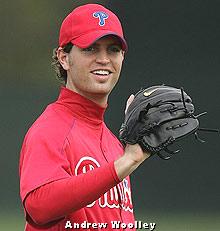

Destination Philadelphia: James Happ

happ.jpg

Destination Philadelphia is the corny nickname I’m going to give to a series of posts I plan to make highlighting different Phillies prospects that should push their way onto the big-league team sometime in 2007. Kicking off the inaugural version of this series is arguably the most polished pitching prospect in the Phillies system, James (JA) Happ. I’ve never spoken to the young man, so I don’t know if he prefers his friends to call him JA, but since I’m not his friend, I’ll just call him James. Happ turned 24 in October, which means his 2007 will be his age 24 season. Happ was drafted in the 3rd round out of Northwestern University in 2004, and had racked up several accolades as a college pitcher, including being the first Wildcat to be named to the All Big Ten team three years in a row. Upon leaving school, Happ ranked near the top of every category in school history for pitchers.

Happ’s freshman year of college, he was used primarily as a reliever, starting only 3 of 21 games in which he appeared. From 2003-2004, he started 28 games, threw 177 innings, posted a 3.10 ERA, and posted an impressive 200:66 strikeout to walk rate. Still, Happ flew under the radar a bit, having not pitched for a baseball juggernaut and not completely dominated in the Big Ten. The Phillies snatched him up in the 3rd round and assigned him to short season Batavia. He pitched just 32.2 innings, but was strong enough to put up a 2.02 ERA, allowing only 22 hits and striking out 37. The Phillies assigned him to Lakewood to start 2005, and he responded with a 2.36 ERA in 72.1 innings, again giving up fewer hits than innings (55 hits) and again striking out 70 in the 72 innings. Happ saw his control return to collegiate form, and more importantly, gave up only 3 HR. The Phillies game him 1 start in Reading at the end of the year, and he responded with 6 innings, allowing 1 run, striking out 8 and walking 2. To start 2006, the Phillies were a bit cautious, sending Happ to Clearwater. He pitched 80 innings, posting a 2.81 ERA, allowing 63 hits and 19 BB while striking out 77 and allowing a surprising 9 HR. He was promoted to Reading mid season, and his numbers actually improved. He pitched 74.2 innings at Reading, posting a 2.65 ERA, allowing 58 hits, 29 walks, and striking out an impressive 81 hitters, while allowing only 2 home runs. He capped his season by making one start at Scranton, pitching 6 innings, allowing 1 run (a home run) with 4 strikeouts and 1 walk.

So, now that we know who Mr Happ is and what he’s done, it’s time to figure out what he can do going forward. In his chat after the 2005 season, Baseball America’s Will Kimmey was asked about Happ, and he responded with these comments

A: Will Kimmey: Floyd breached the innings qualification (topping 50 in the majors for his career) with his final start. Blalock could still turn into a 25 HR per year guy because of his work ethic, and he’ll move one level at a time. Happ reminds the club of Randy Wolf in that he throws an average fastball by hitters up in the zone because of the deception in his delivery. He’s got great feel, as evidenced by his final start of the year in a promotion to Reading. He needs to tighten his slider.

Basically, this goes in line with most of the scouting reports on Happ in the past. He’s tall (6’6) and a bit wiry, yet he doesn’t have overpowering velocity, pitching mainly around 88-90. The comparison to Randy Wolf makes sense in some respects, because Wolf threw in the high 80’s, but he hid the ball well and could run his fastball by hitters up in the zone. Happ has an advantage over Wolf, because he is taller and can throw more on a downward plane. Nevertheless, let’s take a look at Happ’s numbers compared to Wolf’s. Wolf was drafted in the second round of the 1997 draft out of Pepperdine and like Happ, was assigned to short season ball. He pitched all of 1998 in the minors (AA and AAA) and he spent part of 1999 at Scranton before getting called up to the big team, and didn’t go back after (except to rehab), so he got to the majors quicker than Happ will. So, for comparison’s sake, we’ll look at both guys year by year numbers

Happ, 2004 (SS): 35.2 IP, 22 H, 18 BB, 37 K, 1 HR allowed
Wolf, 1997 (SS): 40.0 IP, 29 H, 8 BB, 53 K, 1 HR allowed
Happ, 2005 (A-): 72.1 IP, 2.36 ERA, 57 H, 26 BB, 70 K, 3 HR allowed
Wolf, 1998 (AA/AAA): 173 IP, 4.16 ERA, 182 H, 52 BB, 151 K, 16 HR allowed
Happ, 2006 (A+/AA): 160.2 IP, 2.70 ERA, 124 H, 49 BB, 162 K, 12 HR allowed
Wolf, 1999 (AAA/MLB): 199 IP, 4.79 ERA, 199 H, 96 BB, 188 K, 28 HR allowed

If we look at those numbers, the first thing we have to realize is that Wolf was moved much quicker and much more aggressively than Happ was. Wolf dominated in 2 seasons at Pepperdine, posting a 25-8 record, a 1.97 ERA and 328 K’s, the most in school history. Happ, as we talked about above, hasn’t been quite as dominant. That said, Happ is right on track, in terms of age and level in the system, to still be considered a prospect. Most minor league experts are hesitant to heap praise on Happ because he doesn’t have marquee “tools” like a blazing 95 mph fastball, a devastating changeup, or a nasty 12-6 curveball. That said, most are starting to come around on Happ and see him as a useful part. Lots of guys have gotten by without dominating stuff, but they have to be much more refined and their margin for error is smaller. The biggest asset Happ has, both over Wolf and over other guys like him with similar stuff, is his height. One of the biggest indicators of future success is a pitcher’s ability to get swings and misses, but also his ability to keep the ball in the park and not let batters get good swings on him. Happ does a pretty good job of getting swings and misses (9.09 K/9 in his career), but he does an even better job of keeping the ball in the park, allowing only 16 HR in 277 innings. In addition, he induced 199 groundballs, compared to only 155 flyballs and 57 line drives….that bodes well if he’s going to pitch half his games in Citizens Bank Park.

Now, the whole destination Philadelphia thing. At this point, it’s tough to figure out where Happ stands in the Phillies plans. Currently, the big club has six starters, with Jon Lieber figuring to be traded for fringe minor leaguers or a journeyman reliever. However, two members of the rotation have medical issues (Eaton, Hamels), one is 93 years old (Moyer) and one has off the field issues in his past (Myers), so there’s a pretty decent chance that all 162 starts this season aren’t coming from those five guys. With Gavin Floyd and Gio Gonzalez being sent to Chicago for The Chief, two roadblocks to Happ’s ascendancy have been removed. The Phillies do have three other viable options in Fabio Castro, Zach Segovia and Justin Germano, but the plans for the first two haven’t been decided, and it appears Germano will start the season in Ottawa. Castro and Segovia figure to be bullpen options and also emergency starter options, along with Happ. At this point, Happ’s numbers have been good against both lefties and righties, but he’s actually been better against righties (.615 OPS in 2006, compared to .664 against LHB) which means he really doesn’t profile as a LOOGY candidate. It seems he’d be best suited for a 6th inning role with the big league club if he isn’t starting, or he’d be better off just starting every 5 days at Ottawa. However, if he is going to be the first option to make a start, he might be kept at Reading because of the proximity to Philadelphia.

Happ, to date, has done nothing but pitch well, and he’s beginning to prove the doubters of his stuff wrong. Because he doesn’t overpower hitters, keeping the ball down and staying on top of his pitches will continue to be of the utmost importance to him going forward. Right now, by most accounts, his changeup is an above average pitch, while his curve is merely average. To succeed at the highest level as a starter, he’s probably going to have to sharpen his curveball a bit, but as a reliever, he’s probably more than capable now. The Phillies likely will add a veteran or two to the bullpen this winter, which means Happ will probably start somewhere in the minors, whether it be at Ottawa or at Reading, but he’s on the shortlist to head to Philadelphia, and if his past success translates forward, he could become a quite useful part.

ETA, June 2007

What makes a prospect?

milblogo.JPG

Happy New Year everyone, this post will be kind of short, but it’s something I figured I’d comment on in the infant stages of this blog. One of the biggest things for me, as a big fan of minor league baseball, is understanding the context of a player’s numbers, and using said context to understand just what the numbers mean. Let me give you a quick example. Here are two theoretical pitching lines from two different minor leaguers. Which one would you choose?

Pitcher A: 130 IP, 3.78 ERA, 1.30 WHIP, 125 K, 45 BB

Pitcher B: 140 IP, 3.45 ERA, 1.28 WHIP, 130 K, 40 BB

At first glance, you’d probably take Pitcher B, right? What if I were to tell you that Pitcher B was 23 years old and pitching in the Sally League, low A ball, and Pitcher A was 19 years old, pitching in the double A Eastern League? Surely you’d take Pitcher A. A player’s statistics are the outside layer of the onion, so to speak, but you have to look a bit deeper to truly understand just what his numbers mean. It’s far more impressive for an 18 year old to hit .300 in Low A than it is for a 5 year minor league veteran to do the same. This is kind of one of those things where you say “yeah, duh”, but it’s something I often see people misunderstand when talking about prospects. By no means is this a definitive rule, but this is my “Prospect Rule” when it comes to age:

17-18 years old = Rookie Ball

18-19 years old = Short Season/Low A

19-20 years old = Low A

21-22 years old = AA

22-24 years old = AAA

25 or older = MLB

That’s a general guideline, but there are clear exceptions. Major League Baseball has placed limits on visas for foreign players, which forces teams to keep certain players out of the US, even though those players are in their system abroad. So, a 20 year old from the Dominican Republic, at a team’s academy, might have to wait to come to the US for two years, and teams are cautious with inital assignments, and may send him to Rookie Ball. That doesn’t mean that player isn’t a prospect, it means he’s a victim of circumstance or the numbers game. Another example, which is actually more common, is for a college drafted player to be sent to the lowest level of the minors after being drafted. Many college players, especially pitchers, deal with heavy workloads in college, and upon being drafted, teams tend to play things slowly at first, often times restricting pitch counts and assigning players to rookie ball or short season ball. So, a college senior, many times 22 years old, may find himself in the rookie level Gulf Coast League. That doesn’t mean he’s not a prospect, it means his team is probably being cautious.

The final thing to consider when looking at a player’s stat line is the league he plays in. All 20 HR hitters aren’t quite equal, as some leagues are more known for being offensive heavy (the PCL) while others are known more to favor pitching (the FSL), and so on. Just for reference, check out the league offensive averages for all the domestic MLB affiliated leagues:

  • Gulf Coast League (RK): .247/.323/.342
  • Arizona League (RK): .265/.355/.373
  • Appalachian League (RK): .255/.334/.369
  • Pioneer League (RK): .265/.348/.391
  • New York Penn League (SS): .242/.313/.334
  • Northwest League (SS): .251/.325/.366
  • Midwest League (A-): .254/.325/.366
  • South Atlantic League (A-): .255/.331/.376
  • California League (A+): .276/.350/.414
  • Carolina League (A+): .257/.336/.384
  • Florida State League (A+): .255/.327/.376
  • Eastern League (AA): .252/.323/.381
  • Southern League (AA): .250/.323/.368
  • Texas League (AA): .269/.344/.418
  • International League (AAA): .259/.326/.390
  • Pacific Coast League (AAA): .271/.342/.416

Just a quick guide, as I will be using these abbreviations in the future, RK stands for Rookie League, SS stands for Short Season, and the “-” and “+” represent low and high, respectively. As you can see from this list, the Texas League, the Pacific Coast League, and the California League are hitters leagues, with an average slugging % over .400. Conversely, the Southern League and Florida State League are not as hitter friendly. When looking at a player’s stats, it’s important to know where he stands in terms of his peers, as well as considering the factors previously mentioned.

So remember, when looking at a player’s numbers, consider his age and his league first, and that will give you a good jumping off point.

Make or Break 2007: Tim Moss

moss-at-st.jpg

The “Make or Break” series is something I’m going to try out, taking a look at guys who are entering a season which, in my opinion, will help determine their future (or lack there of) with the Phillies organization. As some of you may have noticed, with the new Collective Bargaining Agreement, the rules for minor league roster management/40 man roster management have changed, and the changes are significant. Under the old agreement, players signed at age 19 or older were required to be placed on the 40 man roster after their third season of pro ball, while players signed at age 18 or younger were required to be added to the 40 man after their fourth season of pro ball. If players weren’t protected, they were eligible for the Rule 5 draft. With the new change, each classification was given an extra year, so the 19+ signing group now has 4 years of eligibility, and the 18 and under group 5 years. This change is significant in that it gives organizations an extra year of time to figure out what to do in terms of player assignments. Raw, toolsy guys who might need additional time now have that extra year before they need to be placed on the 40 man roster, while guys who are close, but maybe not ready yet, can be kept in the minors an additional year without using a 40 man spot. From a player’s perspective, this hurts them a bit, in that they are kept under control of their drafting/signing org for an extra year. It would seem to also hurt the Phillies a bit, mainly because Pat Gillick is one of the more prominent Rule 5 GM’s, however, the new configuration didn’t slow him down in the 2006 draft. So, the “Make or break” column will highlight guys entering their last “freeroll” season, meaning they don’t have to be protected. At the end of their 2007 season, they will either have to be added to the 40 man roster or be left unprotected, and thus eligible for the Rule 5 draft.

I’ve decided to start with Tim Moss, for no real reason other than he’s a guy I’ve kind of watched closely since he was drafted. Moss, as of this writing, is not on the 40 man roster and is entering his 4th season of pro ball, having been drafted out of the University of Texas in 2003. Baseball America ranked Moss the 22nd best prospect in the Phillies system at the conclusion of the 2003 season, and still considered him rather raw for a college player, especially one coming from a prominent division I program. In only 160 AB at Batavia in 2003, he put up a miserable .445 OPS. 2004 didn’t prove to be much better, as he was given the assignment of starting 2B at Lakewood and responded by posting a .683 OPS in 273 AB. He drew a mediocre amount of walks (24), but struck out a ton (75) in only 273 AB, and his .342 OB% was largely inflated by his 12 HBP. He showed almost zero power, posting an anemic .341 slugging % with just 15 doubles and 2 HR. He subsequently dropped out of the Phillies top 30 prospects, which says something considering the lack of depth in the system.

Nevertheless, the Phillies decided to promote Moss to Clearwater to begin 2005, his age 23 season. Moss responded by having a vastly better season (thanks partly to a hot start), posting an .811 OPS and showing a large improvement in the power department,, smacking 17 HR in 469 AB. Will Kimmey of Baseball America bumped Moss all the way up to the 8th best prospect in the system at the conclusion of 2005, but gave this caveat

The Future:
It remains to be seen whether Moss’ breakout was a fluke. He’ll move to Double-A in 2006 and try to show that a smallish second baseman can keep punishing baseballs.

Well, it looks like 2005 was a fluke. In his age 24 season, Moss bombed at Reading, putting up a .606 OPS in 206 AB. He was sent back to Clearwater, where he “rebounded” with a .796 OPS in 264 AB. His walk rate hasn’t improved, his strikeout rate is still waaaaay too high for a guy with little power. One of his biggest strengths since being drafted was his athletic ability and speed, (69/98 in SB in his pro career), but if he can’t hit as a 2B, his bat will certainly have a tough time playing at any other position.

So, what will happen with Moss? He turns 25 in January, and will probably start at Reading. If he flouders, he may find his way back to Clearwater, and barring some sort of miracle, will be left unprotected next December. Then again, if he hits in 2007 like he did in 2006, will anyone waste the $25,000 on him (he’ll go in the minor league portion if he gets picked at all) or just pass him over? He will always have the distinction of being the first Phillie selected in the 2003 draft, in the third round, because of a number of free agent signings during the 2002 offseason. Unfortunately, it looks like he will never crack the big leagues, unless he somehow re-invents his entire game.

Prediction: Break. Left unprotected in the Rule 5 draft, 50/50 chance he’s taken by someone in the minor league phase.

What to make of Jim Ed Warden

jewarden.jpg

As most of you know, the Phillies selected Jim Ed Warden in the Major League phase of the Rule 5 draft, held at the Winter Meetings earlier in December. It should be said right away that for every Johan Santana, there are probably 50 Chris Booker’s taken via the Rule 5 draft. In the baseball economy, a $50,000 dollar gamble is a drop in the bucket, even for the smallest of small market teams. Pat Gillick has a history of using the Rule 5 draft to pluck diamonds from the rough, with the most famous case being the pickpocketing of George Bell from the Phillies when he was with Toronto. Every year, you hear substantial amounts of rumors surrounding the draft, proposing names that could be taken, trades that could be made, and normally, the event fails to live up to the hype. With the changes made to the Collective Bargaining Agreement, prospects who normally would have been eligible this year were given an extra year of protection to their team, and thus, a thin crop of players available. Josh Hamilton, the troubled former Devil Ray alum, made the most headlines, but the Phillies were active, taking Warden and catcher Adam Donachie in the major league phase, then trading Donachie to Baltimore for former Phillies farmhand Alfredo Simon. I’m going to take a look at Warden here, and possibly Simon at a later date.

Looking at history, it should be immediately noted that the odds of Warden sticking all season are less than 50/50, and the odds of him actually being a positive contributor is probably 30/70, at best. This process is a crapshoot, and every once in a while, you strike gold, but more often than not, it’s just another piece of coal. I follow the minors pretty closely, and not just the Phillies system, but I hadn’t ever heard of Warden prior to him being drafted. He was a 6th round pick in 2001 by Cleveland, drafted out of Tennessee Tech University, a member of the Ohio Valley Conference. I don’t have access to his college stats, but since his first year of pro ball was way back in 2001, I think we have enough data to draw some conclusions.

Based on scouting reports, Warden is a tall (6’7), wiry (195 lbs) righty that throws with a sidearm motion. Sidearm and submarine pitchers appear to be making a comeback (ok, not REALLY, but they still exist), but it’s important to realize what comes with a sidearm pitcher. Most guys only thrive against batters from the same side as they throw. Righties (like Chad Bradford) tend to dominate right handed batters while struggling against lefties, and vice versa (see Myers, Mike) so they need to be deployed properly. Warren’s overall minor league stat line is quite extensive, and looks like this:

187G, 371.1 IP, 8.10 H/9, 5.14 BB/9, 8.51 K/9, and 0.87 HR/9

At first glance, he gives up a tick less than 1 hit per 9, walks waaay too many batters, has a solid K rate, and is a tick or two above average in terms of home run suppression. I’m more interested in his recent track record, as he only started 1 game since the beginning of 2004, when he became a reliever exclusively, which is surely the role the Phillies see him playing. So, his 2004-2006 stat line looks like this

146G, 186.1 IP, 7.40 H/9, 4.59 BB/9, 9.04 K/9, and 0.87 HR/9

Ok, we’re getting somewhere now. He allowed about a half a hit and half a walk less per 9, he upped his K rate a tick, and his HR/9 rate was identical. He still walks waaaay too many guys, but his hit rate is tolerable, and his K rate is solid. Thanks to the slice of heaven known as minorleaguesplits, we can take a deeper look at his 2006 performance. If someone knows where I can find minor league splits for 2005, please let me know. So, here is Warden’s 2006, and also the league average for the AA Eastern League, just for comparison’s sake

EL Average: 3.23 BB/9, 7.37 K/9, 0.76 HR/9, .252/.323/.381 allowed

Warden: 4.42 BB/9, 7.17 K/9, 0.46 HR/9, .171/.304/.259 allowed

Ok, so let’s look at it. Warden still walks waaaaay too many guys (you’re picking up on a trend here, right?), his K rate is about league average, home run suppression is better than average, and his OPS allowed was a good deal lower than the league average. Not too shabby, really. But, here is where Warden’s numbers really come alive. As I mentioned above, guys with a “funky delivery” (TM, Wheeler) usually are able to tame hitters from the same side, and Warden is no exception. Look at his 2006 splits v LHB and RHP

vs LHB: 25.0 IP, 6.12 H/9, 6.84 BB/9, 8.28 K/9, 0.72 HR/9, 24:26 GB to FB ratio

vs RHB: 34.0 IP, 4.76 H/9, 2.65 BB/9, 6.35 K/9, 0.26 HR/9, 51:26 GB to FB ratio

I think we’ve found Mr Warden’s niche…..he really can get out right handed batters. Having never seen him throw a single pitch, my guess is that he drops down in his motion, and creates very violent tailing motion in to right handed batters, and because of this, gets a lot of balls in on the hands and generates a lot of weak swings. He doesn’t strike out a lot of hitters, but has a nearly 2:1 GB to FB ratio, which is very impressive. Against lefties, like most sidearmers, he’s more prone to hard hit balls because of the natural tailing motion, this time the ball coming back across the middle of the plate. He probably has a decent changeup, which he throws to lefties, and when he makes his pitch, can generate plenty of swings and misses, but when he gets under the ball, he leaves it up in the zone. Couple that with the tailing motion away from a lefty, and you get a lot more solid contact against.

So what does this mean? If Warden is used strictly as a situational righty, he can probably stick at the major league level. Bring him in to face Miguel Cabrera, but don’t let him face Mike Jacobs. Bring him in to face Ryan Zimmerman, but don’t leave him in to face Nick Johnson. Etc, etc, repeat. Now, does Charlie have the sense to use Warden in the proper spots? That’s left to be seen. If he is used in these spots, he can be successful. Warden will be 26 on opening day and turns 27 in May, so he isn’t really a “prospect”, but this is the way you build a solid bullpen, not by giving out free agent contracts to guys like Joe Borowski and Keith Foulke. The odds of Warren sticking are 50/50, the odds of him succeeding are 30/70, but with the Manuel Factor, probably more like 20/80, but who knows, Gillick may have caught lightning in a bottle here.

Those who missed the cut

I figured if anyone actually read this, they’d ask why I omitted player “x” or “y”, etc etc. I’m sure the two that will come up first are Michael Bourn and Carlos Ruiz. So, I’ll tackle them one at a time.

Michael Bourn, OF. To me, Bourn didn’t deserve to be on this list, and here’s why. He has very limited upside. I’m sure people will question this, but here’s my line of thinking. He is now 24, and 2006 was his age 23 season. He posted a .715 OPS in 318 AB at Reading, and upon being promoted to Scranton, posted a .796 OPS in 152 AB before he was brought to Philadelphia to ride the pine. Bourn played 3 years of college ball at Houston, and over that span, his single best season was an .827 OPS in 244 AB, which was his sophomore year. He followed that with an .818 OPS in 182 AB his junior year, and was then drafted by the Phillies in the 4th round. Bourn had only 23 extra base hits in 644 career college AB’s. In college, he posted on base percentages of .431, .446, and .411, and obviously drew a ton of walks, which set up his speed (90 SB/119 attempts) well. Upon his entrance to pro ball, his plate discipline remained at both Batavia and Lakewood, posting an OB% of .404 and .433 respectively. However, the last two seasons Bourn has seen his OB% dive to .348 at Reading in 2005, and then .350 and .368 at Reading and Scranton in 2006. If you take that by itself, a .368 OB% is solid, but when you factor in that he has almost zero power (60 extra base hits in 1,014 AB’s in 2005 and 2006), he’s reduced to being a one tool (speed) player. You don’t see many teams carry a guy that can’t hit or get on base, but can steal bases. Bourn is an impressive 163/191 in stolen bases in the minors, but his future (it would seem) is as a 5th outfielder, where he will be a defensive replacement/pinch runner for guys like Pat Burrell, and to me, that doesn’t warrant his placement in this prospect list. He could surprise me, or he could turn into a guy that bounces from AAA to the bigs his entire career.

Carlos Ruiz, C. Simply put, he’s too old for these lists. He’ll be 27 on opening day, and in only the rarest cases do I consider guys over the age of 25 “prospects”. That said, I think Ruiz can be a decent regular if given the chance. His defense is what people raved about, but I don’t know that we know enough about his game calling ability based on his limited exposure last season. We’ll see.

My Phillies Top 10 List

It’s that time of the year where every site is churning out their top 10 prospect lists, so I figured I’d make my first “real” post my top 10, and also give predictions for their respective 2007’s. So, without further delay, here’s my list.

  1. Carlos Carrasco, RHP. Carrasco had his breakout season in 2006, dominating the Low A Sally League at age 19. His peripheral stats were largely outstanding; 5.82 H/9, 3.67 BB/9, 8.98 K/9 and 0.34 HR/9. The only yellow flag (not serious enough for red) is his walk rate. Various scouting reports have said that his secondary pitches come and go, which is not that uncommon for a 19 year old. Carrasco has fluid, easy mechanics which bode well for his future health. Possibly the most impressive thing he has going for him is feel for his changeup. Changeup control is normally one of the last things a pitcher masters, but Carlos seems to have that down, he just needs to be consistent with his curve. After a tough 2005, which saw him bounce between Lakewood and Batavia, he opened just about everyone’s eyes. My guess is the Phillies will be cautious with him, since he only has one season of pro ball under his belt. He’ll more than likely start at Clearwater, and could possibly move to Reading by mid summer if he gets off to a fast start. Prediction: 163 IP, 7.50 H/9, 3.35 BB/9, 9.50 K/9, 0.65 HR
  2. Adrian Cardenas, SS/2B. I’ll state this now to get it out of the way…..I might just be Adrian Cardenas fan #1, so keep that in mind as you read my writeup. The Phillies have a long history of drafting “toolsy” guys who can’t hit, with the hope of teaching them how to actually play baseball later. This method seems to fail much more than succeed, yet the Phillies (and other teams), continue to go this route in the draft. Think of it like playing a slot machine. You know the odds are bad, but it’s so much fun! Well, Cardenas bucks this trend, and I couldn’t be happier. Cardenas won the Baseball America High School POY this year, and he didn’t stop upon his arrival in pro ball. He put up a solid .318/.384/.442 line in the GCL, facing mostly high school pitchers. While Cardenas doesn’t fit the “toolsy” background of your typical Phillies draft pick, he has solid baseball skills, with an advanced approach to hitting and good overall baseball instincts. He played shortstop in high school, and might stay there for a few seasons, but most think he’ll end up at 2B. If he continues to hit as he climbs the organizational ladder, he’ll be above average offensively, which should offset his defensive limitations. Prediction: (A-), .312/.415/.475, 13 HR, 25 2B, 10 SB
  3. James Happ, LHP. Many prospect ranking folks have different philosophies when it comes to weighing numbers and tools. Some go 50/50, some 70/30 or some combo in between. Happ is an interesting case, and maybe I’m being too kind, but maybe not. Happ is a tall, lanky pitcher (6’5, 205 lbs) but doesn’t throw very hard, with his fastball topping out around 91, and consistently hitting 88-90. What he lacks in power, he makes up for in command, which is evident in his 2.80 BB/9 rate between A+ and AA in 2006. Though he lacks “dominant stuff”, Happ was able to generate quite a few swings and misses, 9.22 K/9, over both levels, and even more importantly, he kept the ball in the park, allowing only 11 HR in 154.2 IP, including only 2 in 74.2 IP at double A Reading. While Happ doesn’t offer much in the way of projectability, as he’s already 23 and doesn’t look to add more velocity, he does have a good feel for pitching. Normally AA is the biggest test for a pitcher, and Happ passed his first test, posting better numbers across the board at Reading than in Clearwater. You hate comparing a non-flaming throwing lefty to Tom Glavine, but if Happ can mantain his command as he climbs the ladder, he can become a reliable middle of the rotation starter. Prediction: (AAA), 105 IP, 2.90 ERA, 3.15 BB/9, 9.25 K/9, 0.45 HR/9 (MLB), 50 IP, 4.15 ERA, 3.65 BB/9, 7.50 K/9, 1.15 HR/9
  4. Kyle Drabek, RHP. Consider Mr Drabek the anti-JA Happ. Much was made of Drabek’s off the field issues leading up to the draft, but few doubted his ability on the field. Drabek dominated on the mound in high school, pitching in the baseball hotbed of Texas, and led his team, The Woodlands, to numerous championships, both with his arm and bat. Drabek’s number one asset might just be his athletic ability, as he was one of the top rated shortstops in the 2006 draft, as well as the second rated high school arm behind Clayton Kershaw. He dropped to the Phillies because of the aforementioned off the field concerns, but the Phillies felt he was worth the risk. His pro debut was less than ideal, but has been attributed to things ranging from immaturity to a heavy high school workload. Drabek went to the Florida Instructional League with fellow draftee Dan Brauer, and reports were that he responded well to the regiments involved with playing professional baseball. Prediction: (SS) 45.0 IP, 3.50 ERA, 4.15 BB/9, 10.50 K/9, 1.00 HR/9, (A-) 35.0 IP, 3.75 ERA, 4.00 BB/9, 7.75 K/9, 1.25 HR/9
  5. D’Arby Myers, OF. Myers fits the mold of the toolsy guys the Phillies love, and as you can probably figure out from my previous comments, I was skeptical upon his selection, as I am with all outfielders like him. In the 4th round, I felt like it was too early to start “buying lottery tickets”, but I think the Phillies might have picked a winner here. Myers played the entire GCL season at the age of 17, and had arguably the most impressive debut of any Phillies draftee, putting up a line of .313/.353/.430. That may not seem significant, but for a guy with very raw baseball skills, at a very young age, it’s quite an accomplishment. Myers oozes potential and projection, with plus speed, potential for plus power, and a good arm. He still needs to “learn” the more advanced baseball skills like route running and pitch selection at the plate, but his debut showed that he might be further along in this process than most toolsy guys. Myers did a good job of keeping the ball out of the air and using his speed to his advantage. He was 11/15 in SB’s, which again, is quite solid for a guy just learning how to play the game. The Phillies could challenge him by assigning him to Lakewood, meaning he’d be one of the youngest players in the league, but he might start at short season Williamsport. I’ll do two predictions for him, one assuming he starts at Williamsport, one assuming he starts at Lakewood. Prediction 1: (SS), .325/.375/.450, (A-) .280/.340/.400 Prediction 2: (A-) .270/.335/.425, 30 SB
  6. Josh Outman, LHP. Outman, in addition to having one of the best baseball names possible, looks like one of the Phillies best picks in the 2005 draft. His 2005 debut was good, if not above average, and his 2006 saw an improvement in just about every peripheral category. His walk rate still needs some work (4.35 BB/9), but his K rate (9.33/9) and HR rate (0.29/9) were both well above average. Outman is slightly old for low A, but the Phillies apparently wanted to keep the core of the team together as they made a playoff push, which means Outman is a candidate for a double jump to Reading in 2007. He possesses above average velocity for a lefty, hitting 94 and working around 91-92 consistently. His changeup lags behind his fastball and slider, but is improving. Outman’s overall line, 155.2 IP, 6.89 H/9, 4.35 BB/9, 9.33 K/9, 0.29 HR/9 is impressive, but his line from July-September is even more impressive, at 72.2 IP, 5.73 H/9, 3.61 BB/9, 9.97 K/9, 0.25 HR/9. If he continues to improve his control, he will quickly move up the prospect lists. The Phillies should challenge him with a double jump since he is a college pitcher and is 22. Prediction: (AA), 163 IP, 3.00 ERA, 7.45 H/9, 3.75 BB/9, 8.85 K/9, 0.65 HR/9
  7. Edgar Garcia, RHP. Garcia was highly touted when he signed in 2004 as a 16 year old out of the Dominican Republic. At 6’2, 190lbs, he has room for projection, and already throws in the low 90’s. While he was at the forefront of prospect chatter in 2004 and 2005, he seemed to fade out of the limelight a bit in 2006, yet he continued to produce on the field, putting up a line of 66.1 IP, 8.41 H/9, 1.36 BB/9, 6.24 K/9, 0.68 HR/9 at Batavia. Many people point to his low K rate as a red flag, but in this writer’s opinion, that criticism is a tad overrated. Garcia has outstanding control and feel for his changeup, which as previously stated, is rare for young, raw pitchers. Garcia allowed only 18 extra base hits (13 2B and 5 HR) in 66.1 IP, good for a .369 slugging against. He also induced 87 groundballs, as opposed to 69 flyballs, and also induced 20 pop ups. This data would lead you to believe guys aren’t getting good swings against Garcia. He was equally tough on lefties and righties, and allowed only 1 HR to lefthanded batters, which speaks to the strength of his changeup. Garcia is underrated on other prospect lists, in my opinion, and has the potential to put up a solid season in the Sally League in 2007 at age 19. Prediction: (A-), 150 IP, 2.95 ERA, 1.90 BB/9, 7.00 K/9, 0.85 HR/9
  8. Scott Mathieson, RHP. Mathieson underwent Tommy John surgery in November, which is one of the main reasons he slid down the list a bit. If 100% healthy, he’d probably rank 5th on my list. Mathieson throws a mid 90’s fastball, but it lacks movement, which means he needs to command it in the zone to be effective. His changeup is average, and he’s worked with both a curve and a slider, eventually settling on a slider. While he was able to dominate minor league hitters with his offspeed stuff, he didn’t experience the same success at the big league level. Throughout his minor league career, his control improved at every level, but when he jumped to Philly, he saw all of his peripherals take a hit, which isn’t a surprise. He will miss all of 2007 and could make it back in time for the Arizona Fall League next year, but more likely won’t pitch until spring training 2008. Mathieson is still a prospect, but he will remain outside of the top 5 until we see what he looks like post surgery. If he adds velocity, like many TJ survivors do, he could consistently throw 95-96 and hit 98. If that’s the case, he profiles as a middle of the rotation starter or potential closer. He will be 23 this year in spring training, which puts him at 24 when he is recovered from surgery, and he’ll more than likely start in AAA and be the first callup, or he’ll compete for a bullpen spot in spring training. Prediction: Won’t pitch in 2007.
  9. Jason Jaramillo, C. I’ll qualify this selection, and the #10 selection, by saying that the difference between my 9th and 13th ranked prospects on this list is real small, and most guys are interchangeable. Jaramillo’s offense has been suspect, and he struggled at AA Reading in 2006, putting up a .708 OPS in his age 23 season. Jaramillo raked in college, with a .900+ OPS, but has struggled since reaching full season ball in 2005. While his bat won’t get him to the big leagues, his glove and presence behind the plate probably will. Scouts rave about his game calling ability and his arm strength, and that’s where his future lies. Catcher is not a notoriously big offensive position, but the Phillies also appear to have little patience when it comes to rookie catchers, though the organization does appear to be high on Jaramillo’s future. As a starting catcher, he probably won’t hit more than .250/.330/.450, but if he’s hit 8th in the lineup and his strong defensive presence carries over, he’ll have a fine major league career. Prediction: (AAA), .260/.350/.445, 13 HR
  10. Andrew Carpenter, RHP. Carpenter flew under the radar after being drafted, as his debut was delayed until the end of the summer, possibly because of his heavy college workload. Carpenter doesn’t possess outstanding stuff, with just a 91-94 mph fastball, average change and average curve, but he has superb command (1.53 BB/9 in college) and his K rate is good enough (7.57 in college), while his home run suppression looks just fine, at 0.31 HR/9 in college. He only pitched 11.2 innings at Batavia, so it’s tough to draw any real conclusions there, but he allowed only 1 ER in his 3 short starts. As a 3 year senior, Carpenter figures to move quickly through the system. He’ll likely start at Lakewood, but could possibly start at Clearwater and reach Reading by mid summer. For my prediction, I’ll assume he starts at Lakewood. Prediction: (A-), 65.0 IP, 2.50 ERA, 3.10 BB/9, 7.50 K/9, 0.35 HR/9, (AA), 75.0 IP, 3.50 ERA, 2.90 BB/9, 7.25 K/9, 0.85 HR/9

11-15, brief blurbs:

  • Matt Maloney, LHP: Maloney is another control lefty who offers little in the way of projection going forward. He throws in the mid 80’s but has good command. He’ll more than likely end up a 5th starter at best, and more likely be a candidate for the bullpen, but his 2006 numbers at Lakewood can’t be completely discounted.
  • Dan Brauer, LHP: Brauer is another control lefty, but he slid in the draft because of labrum surgery in 2004. He appears completely recovered, and had a solid season at short season Batavia. His stuff is on par with Happ’s, maybe a tick better, and could eventually be a middle of the rotation starter or top lefthanded reliever. He’ll more than likely start at Lakewood and move to Reading by midseason.
  • Zach Segovia, RHP. Segovia ranks behind Maloney and Brauer because he is right handed, and has similar stuff, with lefties being in slightly higher demand. He is 2 years removed from Tommy John surgery and looks to be fully healthy. Conditioning is an issue, and at this point his best bet for future success might be a 7th inning role, almost in the Geoff Geary mold.
  • Jesus Sanchez, C. Sanchez was part of the Bobby Abreu debacle, and was ranked the best defensive catcher in the GCL in 2006. He played the season at age 18, and will play 2007 at age 19, probably at short season Williamsport. He’s a strong defensive catcher already, while still raw offensively. He has solid projectability, he just needs to translate his tools to results.
  • Mike Costanzo, 3B. Costanzo is a guy I want to like, but he has numerous issues in his game that need to be resolved quickly if he’s going to become a major leaguer. His walk rate has improved as he’s progressed through pro ball, but he strikes out a ton, and at this point, he isn’t generating much power, with only 25 HR in 785 pro AB’s. If he’d put up those numbers as an 18/19 year old, you could shrug it off, but he played 3 years of college ball, and should be making better progress at this point. He’ll start 2007 in AA, and this seems like it could be a make or break year for him, at age 23.
  • A new message board

    I’ve created a new home for you to discuss/argue with your fellow minor league fans over the Phillies farm system.

    Check it out here.

    Guide to following the Phillies minor leagues

    Consider this your one stop guide to getting all of the information you need to keep up to date on the Phillies minor league system.

    1. RSS news

    What is RSS? For those who aren’t familiar with this not new, but very helpful tool, check out this guide on RSS readers, which details what they are and why they are important. My recommendation is

    Google Reader

    But there are tons of readers out there, you can find the one that suits you best.

    For those of you with an iPhone, if you choose to go with Google Reader I highly recommend the “Feeds” iPhone app, which allows you to access your Reader account on your phone. The layout is very clean and easy to figure out.

    Once you have a Reader, you need to subscribe to feeds. Here is my list of recommended feeds geared toward the minor leagues

    Phuture Phillies feed (duh!)

    Lakewood BlueClaws news
    Clearwater Threshers news
    Reading Phillies news
    Lehigh Valley IronPigs news

    minorleaguesplits Phillies daily recap

    Scouting the Sally (covers SAL league prospects)

    2. Daily Scoreboards

    South Atlantic League Daily Scoreboard
    Florida State League Daily Scoreboard
    Eastern League Daily Scoreboard
    International League Daily Scoreboard

    3. Listening to minor league games

    You can find links to the radio affiliates here

    Lakewood – Shoresportsnetwork.com
    Clearwater – Does not have a dedicated station. You can sometimes find audio from the Threshers’ opponents, so a quick google search would possibly yield results there.
    Reading – ESPN 1240
    Lehigh Valley – Official Website plus ESPN 1320

    Another incredibly useful application if you have an iPhone is Wunder Radio. At $6.99 its a tad pricey, but its well worth it. You can stream thousands of radio stations from across the world, and it now has a feature to play in the background so you can browse the web in Safari while listening.

    In the Search box, type in “WOBM 1160” for the Lakewood feed. If you type in “WNPV 1440” you should get the IronPigs feed. I’m still working on finding a working stream for Reading.

    4. Other resources

    Firstinning.com has a feature called the player tracker, which allows you to bookmark players and view their stats up a daily basis. Sign up for a free account, log in, and then search for a player’s name. When you get to that player’s page, click the link at the top that says “Add player X to your player tracker now”. This feature allows you to add a collection of players you want to follow without having to browse through the stats of guys you’re not interested in. First inning also offers a daily report of Phillies prospects which you can see here.

    Site overview

    First off, thank you for stopping in. If this is your first visit, please read the following info then take a look around the site. My hope is that you’ll keep coming back and tell others who you think might be interested about the site.

    About Me

    My name is James, I’m an avid Phillies fan now living in Boston. I started this site in late December 2006 on a whim, and the site has grown slowly and steadily over the last 2 years. I’m not a scout, I don’t work for the Phillies, and I am in no way affiliated with the organization. What you’ll find on this site is simply an aggregation of information on the Phillies minor league system from top to bottom with my opinions and takes added in along the way. If you have any questions about the site, send me an email.

    About the Site

    This site is run through WordPress.com. I’ve made the decision to keep the site ad-free, I receive no revenue from running this site, and all expenses (domain registration, media storage) are paid for by me and me only. The site features writings by me, as well as various contributors and authors. All work done here is done on a volunteer basis.

    I’ve also added a free message board, which you can find here.

    Donations

    If you would like to donate to the site, please click the “Make a Donation” link on the right side of the page. Money donated will go toward the general operation of the site, new content for the site, and anything else related to the site’s operation. Its not a tax deduction or a ponzi scheme, if you have a few bucks you want to kick in to the fund, I appreciate it, but its 100% optional and you are not obligated to do so. Any questions, you can email me.

    Rules for Discussion

    I’m not big on coming up with complex sets of rules, but I do have a few, and I’d ask that you please follow them.

    1. No foul language. This one is self-explanatory. If you can’t say it on cable tv during the day, don’t type it here.
    2. No spamming. If you have a web site that you think my readers would enjoy, please email me and we’ll talk about a link exchange. Posting your blog/site on my site over and over again won’t get you added.
    3. Please be considerate of others. This one is really simple. Just treat others here as you’d like to be treated.
    4. Please try to limit the discussion of the big league club. This has been discussed before, but the goal of this site is really to focus on the minor league aspect of the organization. If you’re looking for an outlet to discuss the big league club, I highly recommend The Good Phight and Beerleaguer.
    5. You can’t edit your comments, so please take a moment to review what you’ve typed before you hit submit.
    6. If you want to directly respond to something that someone typed, you can use this format in your comment;

    (blockquote)enter text you want to quote here(/blockquote)

    Replace the ( ) with a carrot bracket like this < on one side and the other carrot bracket to close it. I can’t type it out or it will be invisible on this page.

    And the text will show up as quoted.

    7. Do not post full articles from other sites here. I do not want to get in trouble for posting full copyrighted articles. If you find an article that you think is interesting, post a brief blurb and then give the link so others can check it out.
    8. If you make a comment and it doesn’t show up, its probably because the post has been caught in the SPAM filter. WordPress has an automatic SPAM catcher, but it sometimes catches legit posts for no explainable reason. If you made a comment and it didn’t show up, send me an email and explain what you posted and then I’ll look for your comment in the queue.
    9. Try your best to use a reasonable amount of punctuation and sentence structure. There is nothing more frustrating than seeing a good point go overlooked because the message was unreadable. Just take a few extra seconds and make sure your message will be clear and easy to understand.
    10. Do not compare current prospects to Hall of Famers.

    That’s really it. If you have any questions or concerns, please drop me an email.