Thanks for checking back. The list has generated lots of discussion so far, and I hope it continues going forward. When it was suggested to break up the list in this fashion, I wasn’t sure how it would work, but I found that I’ve spent more time working on the writeups, and in turn, I hope its been better to read more detail and thought on each prospect, especially as we get outside of the top 10 and work further down the list. Lets crank out 20-22 now. Check below
Volume 1
Volume 2
Volume 3
Volume 4
Volume 5
Volume 6
20. Kevin Walter, RHP
(Click here for larger image)

2010 Summary: Every year I seem to become infatuated with one of the prep arms the Phillies end up taking, and as the summer progressed this year, it was Kevin Walter. He didn’t get a ton of attention and was overshadowed in his own state by more highly touted righty Kevin Gausman, but he ended up having just as good a senior season, and the Phillies were able to buy him out of his college commitment. His 2 innings in the GCL were just a chance to get him the pro experience.
Strengths: Walter was somewhat overlooked because his fastball only sat in the 88-92 range, but what separates him is his advanced feel, especially with his secondary offerings. Most prep high school pitchers are airing it out and lighting up radar guns, but Walter works all 4 quadrants of the zone, and already has a feel for two different breaking balls, both a hard slider and a bigger breaking curveball. He didn’t throw a ton of changeups in high school, but he has shown a feel for the pitch. He draws high marks for his competitiveness and mound poise. At 6’5/215, he has a big frame that should be conducive to durability.
Weaknesses: Obviously he lacks innings, so we don’t have much to go on except the scouting reports. But the same was true of Brody Colvin last year, and a lack of pro experience shouldn’t be a big deterrent, especially at this part of the list. The biggest question mark on Walter is his fastball velocity. Scouts think more velocity is in there, and the bright side is that his fastball right now features good sink and movement.
Best Case: While everyone loves big velocity, Walter’s now ability to control his fastball and flash two plus breaking balls sets him apart from most typical prep pitchers. His ultimate upside depends on him adding a few ticks to his fastball, getting into the 91-94 range up from 88-91. That will be the difference between a solid #4 starter and a potential #2.
MLB ETA: Hes a long way away.
Ranking Difficulties: I like rolling the dice on guys with intriguing tools packages, especially those with advanced skills that are a bit unusual for their age. I went with his considerable upside over a few other guys with higher probability.
Final Thoughts: I really like the looks of Walter. He’s a big guy with advanced feel, and if his fastball develops, he has the makings of a front of the rotation guy. Of course we’re just dreaming on him, but that is true of most of the guys on the list. The Phillies have had some success in helping guys clean up their deliveries (Cosart), but there is no assurance he will develop. Like most guys on the list. I like Walter a lot, and I’m excited to see what he has in 2011.
21. Colby Shreve, RHP
(Click here for larger image)

2010 Summary: Finally healthy, Shreve logged 109 innings at Lakewood in 2010 and posted mixed results, but getting healthy was always the first step, and he’s reached that mark.
Strengths: Prior to the surgery, Shreve featured an excellent fastball and hard breaking ball, and the hope is that as he gets further from surgery, the velocity returns. The most impressive part of Shreve’s line was the 2.47 BB/9, as control is normally always the last thing to come back post-surgery. At 6’5/210, Shreve still has the physical frame to support a starter’s workload if his arm participates.
Weaknesses: At 22, Shreve’s season was not very impressive statistically. As we have to adjust everything, seeing Shreve on the mound was encouraging after his odyssey post draft, including surgery and other minor setbacks. This obviously makes him a red flag going forward because of the injuries. If his stuff comes all the way back, he still has mid-rotation potential. He was 91-94 in college pre-surgery, but reports had him at 88-90 last year. If his velocity doesn’t come all the way back, it is a concern, but I think its too early to tell.
Best Case: A middle of the rotation starter or late inning reliever are the two hopes right now, but just another season of staying healthy would be a big plus. He needs to move quickly, and hopefully he finds his way to AA before the end of 2011.
MLB ETA: Probably 3 years, maybe a late callup in 2012 if he is moved to the bullpen.
Ranking Difficulties: Like Walter, this is a bit of a leap of faith, but if you’re a long time reader of the site, it shouldn’t surprise you. Shreve was a guy I really liked as an amateur, and my hope is that he regains a bit of the zip on his fastabll now that hes further removed from surgery. I could have dropped him lower, but Im sticking with him for one more year.
Final Thoughts: When I put together this list in December, I was pretty comfortable with Shreve here. The more I thought about it, the more I realized maybe he belonged a bit lower, but I’m sticking with my convictions. Unlike the guys who will follow right after him, I think he still has a chance to start, and a #4 starter carries more value than a middle reliever, hence the higher rating. Of course, if his velo doesn’t bounce back, then he’s ranked too high. You live, you learn.
22. Phillippe Aumont, RHP
(Click here for larger image)
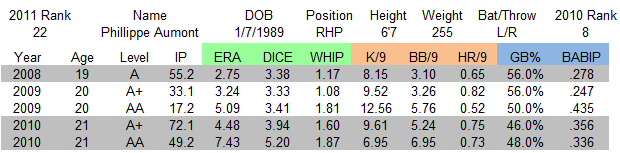
2010 Summary: Considered by the pundits to be the prize of the Cliff Lee deal, Aumont struggled mightily at Reading before finding himself demoted to Clearwater, where things really didn’t improve all that much.
Strengths: One of the only things that went right for Aumont in 2010 is that he didn’t shrink, and he didn’t suffer a major injury. He’s a beast of a man, clocking in 6’7/255 or so, and that obviously helps him create some deception in his delivery, as he has really long arms and legs. One of the biggest points in Aumont’s favor in 2010 was that he got a ton of innings under his belt, 122 of them, and that experience was needed after he pitched sparingly since being drafted in the first round in 2007. When he’s right, he features a plus fastball that sits 92-97 and features hard sink down and in to righthanded batters.
Weaknesses: Everything else. Aumont tinkered with his arm slot, lost his consistency, and more troubling, lost his velocity, as I had reports of him sitting 88-91 at times, well down from where he was prior to the trade. There were reports that he had a degenerative hip problem, but he remained healthy for the most part in 2010, but its something that needs to be monitored. As he struggled with his delivery and repeating his mechanics, he lost control of the strikezone, even after his demotion. His groundball rate also went in the wrong direction, which is odd considering the raw sink he was able to generate on his fastball in his Seattle days. All in all, it was a season to forget for Aumont from a results standpoint.
Best Case: The Phillies have officially moved him back to the bullpen, which is a downgrade for me in terms of value, and without good command and control, its tough to see him as a closer, especially if his velocity does not return. That said, he has shown flashes of dominance, and he’s the type of guy where the light could flick on and suddenly he puts it all together.
MLB ETA: He’s probably 2 years away from holding down a regular big league job, but if things turn around quickly, that timeframe could be sped up a bit.
Ranking Difficulties: Numerous. Last year, I bought into the hype, to a degree, and ranked him higher than I planned to, simply on the reports of people saying how great a prospect he was. I saw red flags and ignored them. This year, the red flags are even bigger, so I’ve downgraded him. As a reliever, he loses value, and he doesn’t have the command, control, or present velocity on his fastball that a guy like Justin De Fratus has, so its hard for me to seriously consider ranking him in that range. He’s still young and has time to figure it out, and with a big year in 2011, he’ll obviously move back up the list. But I see lots of red flags and reasons for concern here.
Final Thoughts: Everyone is pulling for Aumont, and with a move to the bullpen, where he is supposedly more comfortable, maybe he begins to rebuild his value in 2011. He needs to develop consistency with his mechanics, something already tough because of his size, and he has to show his old velocity again to be considered an upper echelon relief prospect. Lets hope he does that, and this ranking proves to be too low.
 Phuture Phillies
Gotcha. At this time in the list, a lot of “pick’ems.”
Altogether an ongoing fun list of speculations with some underlying reasons.
The good job continues…
On Aumont: if he gets his mojo back doing relieving work, that could lead to his reinstatement as a starter prospect.
The list is full of names to follow all season…and ST hasn’t even started with actual games. Oh to be in Philly now that Phillies prevail.
LikeLike
Flags, Flags everywhere. Red and Yellow flags thrown all over the field. But this is the part of the list where everybody has a few, and sometimes many, warts. Walter is young and 2 innings didn’t give me enough to go on. I had him fighting it out for the #30 slot. I make no bones about liking Shreve. This may be my last year of hyping him if he doesn’t kick it into a whole new gear. I think you chose a good spot for Aumont. I’ve always felt he’d top out as a reliever. If Schwim and Aumont make it to the big leagues at least the Phils will have a center and power forward in pickup basketball games.
LikeLike
Maybe we can get C.J. Henry back.
LikeLike
I always kinda figured that Ryan Howard would be the power forward
LikeLike
On Shreve…I’ve always heard that velocity comes back pretty quickly after TJ surgery but control trails behind. Its worrisome that he’s so down on the gun a full 2 years removed from surgery. This spring will be 3 years removed (he went under the knife in May 08 IIRC).
LikeLike
I like the list so far. Good job pp. If you have galvis no higher than 28,29 I’ll love the list! Lol!!
LikeLike
Although I had Aumont higher on my list, I am happy as a Phillies fan to see 3 arms with real potential this far down the list. These are 3 guys who could’ve probably ranked above Wayne Gomes when he was the “prospect”. That speaks to the pathetic nature of the system back then, but also to the quality of this organization right now (e.g. scouting, player selection, organizational hires, player development, etc.). This exercise has me so excited. And to consider what the the big squad has in place right now, this is like a dream.
Nice work!
LikeLike
13 years ago Ryan Brannan was our #1 prospect. He wouldn’t crack this top 10.
LikeLike
It is an interesting exercise to I look back at different eras. Listed below are the brightest names I found from 13 years ago, by a team they played for in 1998. Of course the most controversial player the Phillies had exclusive rights to 13 years ago was JD Drew, who ultimately did not sign with the Phillies. The most successful was Jimmy Rollins, with Wolf, Eaton, Marlon Anderson, Carlos Silva rounding out the retrospective top 5 in some order.
Rk
Derrick Turnbow
A-
Nick Punto
Carlos Silva
Geoff Geary
A
Johnny Estrada
Brandon Duckworth
Adam Walker
A+
Jimmy Rollins
Adam Eaton
Jason Kershner
Tom Jacquez*
AA
Reggie Taylor
Anthony Sumaker
Dave Coggin
Ryan Brannan
AAA
Bobby Estelalla
Marlon Anderson
Wendel Magee
Mike Grace
Carlton Loewer
Randy Wolf
Calvin Maduro
Ryan Nye
Mike Welch
LikeLike
Two years ago I did a retrospective on that prospect class. The top 5 in win shares were Rollins, Wolf, Anderson, Relaford and Estrada. Silva and Eaton were #’s 6-7, and Silva probably moved up a spot based on 2010. Rollins by far was the best Phillie from that class.
LikeLike
That brings to mind the last time the Phillies had 4 young stud starters for their low-A team. They got a full page write-up in BA and were dubbed ‘the four horsemen’. Coggin seemed the most promising and Kershner the least of the four. I believe that was Piedmont in 1996. The Phillies got nothing out of those 4 starters, who were almost as ballyhooed as last season’s Lakewood rotation.
In 1997, Randy Knoll was hurt and managed only 30 IP at CLW. Rob Burger turned in 161 good IP at CLW. Coggin had 155 poor IP at CLW and Kershner 99 decent IP at CLW. In a few years they had all fallen by the wayside.
Coggin (1st round), Knoll (3rd round), and Kershner (13th round) were HS draftees in 1995. With just a few IP in GCL in 1995, they were leaped over NY-P league right to full-season SAL in 1996. They had huge increases in IP as pros: Coggin( 48 to 169), Knoll (17 to 151) and Kershner (63 to 168). Burger was a HS draftee in 1994 (10th round), but only about a half year older than the others. He pitched 17 innings in 1994, then only 41 IP in repeating GCL in 1995, but then 160 IP in 2006. Kershner, although the smallest of the four, was the strikeout guy.
Whether it was too many IP in Piedmont that did them in, none of these promising 4 starters contributed to the Phillies. Just shows how likely low-A pitching prospects are to fail.
Our pitchers in A-level now pitch fewer IP. Ramierez has 142 and nobody else more than 138 this season. Last season, Drew Naylor had 158 IP for CLW, but disappointed this season.
LikeLike
Thanks for that list, I remember being so excited about that AAA team. Estalella was going to be an All-Star for sure. How over-the-top would we be right now if we had a 21-year-old C in AA with 23 HRs and an 847 OPS (that was him in 96). Anderson was going to be an All-Star too, though his minor league numbers weren’t as promising until 1998, when he was 24 in AAA. Magee looked great in 96 and in 98 at AAA. I suppose this list was a good reminder of how fickle these things are and that there’s a big difference between AAA and the majors.
LikeLike
Not to pick on Coggin, but he never had a “good” minor league season before getting called up. Just for comparison’s sake, in the SAL he had an ERA of 4.31, HR/9 of 0.6, BB/9 of 2.4 and a K/9 of 6.9 (that was his best BB/9 and one of his best K/9). Cosart: ERA: 3.79, HR/9: 0.4, BB/9: 2.0, K/9: 9.7. Colvin: ERA: 3.39, HR/9: 0.5, BB/9: 2.7, K/9: 7.8. I feel a little better about Cosart and Colvin not turning into Coggin now.
LikeLike
So, 6 potential Clearwater starting pitchers in the top 21. Bad news for Nick Hernandez.
LikeLike
okay, you didn’t quite do it, but let me just say one thing: you are one of the “pundits”! I can’t stand when some of the “experts” start referring to “they” when they are part of the “they”…I say this as a compliment and respect for you, as someone who works hard to know what he is talking about. And maybe its a bit different when you are quoting scouts and/or scouting reports, but I think your re-evaluating (ie. “i was wrong” or “i’m re-considering” comments) is part of the foundation to the site.
LikeLike
Glad to see u ranked Walter high as well. I read somewhere he had an uptick in velo in instructs so that’s why I had him number 20.
LikeLike
That uptick in velo is definitely important, because I remember reading he was only in the upper 80s in high school, which is not going to cut it. PP seems to have much better info on him than what I’ve seen come across this site. I personally would rank Garner above Walter due to present velo. It sounds like Walter has the advantage in feel for pitching (and in age), but I would still choose a guy who’s in the 90s on the gun already.
LikeLike
I had Aumont quite a bit higher, but then he was moved to the bullpen, which hurts his stock quite a bit.
I still like Aumont a lot and he’s the kind of guy who may have a much longer lead time as a prospect because he’s so big and his motion has so many moving parts. But he seems like a good kid and he has the stuff to be a beast, whether in the bullpen or as a starter. But I still have very tempered hope for this year. The Phillies should take their time with him. This year should be about mechanics, repetition and gaining confidence – I could care less whether he finishes the year at Clearwater or Reading. Next year, they can let him loose a little bit. Once he puts it together, and that may not happen with the Phillies and it might not happen until he is 25 or 26, watch out. He is going to be one hell of a player.
LikeLike
I’m with you, Catch. Too bad he’s in the bullpen. But maybe he becomes Daniel Bard light?
LikeLike
Hey, where is Rizzotti, Hyatt and Galvis? No complaints from the Reading voters?
LikeLike
You missed it – he had them ranked 1, 2 and 3.
LikeLike
you had me cracking up
LikeLike
I have big complaints about Galvis and Rizzotti but it is so not worth it to rehash all that again.
LikeLike
Lots of interesting arms in this system that provides depth. I don’t ever remember the system being this deep in terms of potential arms that could make it to the majors.
LikeLike
Quick Research Project. Do taller pitchers generally develop later? I looked up debuts for pitchers 6’7″ and taller since 1971. 90 pitchers total, here are the ages they debuted at.
20: 5
21: 9
22: 10
23: 11
24: 16
25: 18
26: 13
27: 5
28: 1
29: 1
…
32: 1
Looking at the historical pattern, it indeed seems that few than average tall pitchers debuted at 23 and far more than average debuted at 25-26. Small sample but interesting. Worth nothing that a few tall pitchers were very good even at 20, including C.C. Sabathia, Mike Witt and John Candelaria.
LikeLike
Lots of moving parts probably equals more time figuring things out from a pitching motion sense.
LikeLike
Man, either you have a good computer program at your disposal or you have an awful lot of time on your hands. I am impressed.
LikeLike
Baseball-reference.com’s Play Index. It only takes a few moments to create a query that farms all the data I need. I don’t have a scout’s eye so I like to look at patterns.
LikeLike
I was actually thinking that a little more research needs to be done for Alan’s numbers to be statistically significant – simply, what are the debut ages for pitches of differing heights (i.e. 6’2″ – 6’6″ and 6’2″ and under maybe
LikeLike
My copy of Baseball America’s Prospect Handbook arrived today (50% off at Amazon.com). The readers’ poll matched 28 of their 30 picks, only missing Mathieson and Bastardo (many were uncertain of their eligibility). I found it interesting that they rated four relief prospects back-to-back from 12-15. Obviously proximity carries some weight there.
LikeLike
It is really interesting to see the love that Colby Shreve gets here. Very high on this list and very vocal support from a few during the fan poll. None of his “red flags” ever seem to affect his prospect status.
1. Durability: Pitched one (1) season since being drafted three (3) years ago.
2. Age to level: Old for his level.
3. Velocity: below average Fastball for RH pitcher
4. Peripherals: K/9 and Gb% very average for pitcher his age at that level
I guess Shreve is one of those players who’s prospect status is based on “a hope and a prayer”.
LikeLike
I’ll translate my writeup on him, since you didn’t read it.
Pre-surgery, he had above average fastball velocity and movement, and a plus secondary pitch. He had major arm surgery in 2008, and it took him longer than expected to get back on the mound, and it appears he is not back to where he was, pre surgery. I gave him one full season to get his feet back under him. If he doesn’t regain his velocity in 2011, then his status gets downgraded. He’s not a conversion project, he’s recovering from an injury. His peripherals, for his age, were not great. His slotting in at 21 indicates my belief that he will regain his velocity and he has the tools to stick in the starting rotation.
Make sense now?
LikeLike
LOL
LikeLike
Yup…you summed it up for me.
LikeLike
I guess I consider ‘lost time’ the same whether injury or conversion. That is why, though I am not Top10 on James I am willing to give ‘him one full season to get his feet back under him’ in my projection for 2011.
I see Shreve the same way. High tools, trying to get them going again. I agree with your description of why you ranked him where you have. However, I tended to rank him based on where I wanted to see him last year (flashes of dominance). So I took the under on his status and dropped him lower than his pre-surgery talent projects. If PP is right, he could make that Clearwater staff downright frightful for opposing teams.
LikeLike
BA in their write-up on James noted his “incredible range.” I’ve noted Lakewood’s terrific defensive performance before. James may merely need to be an average hitter to be a valuable player.
LikeLike
Maybe we should just create an algorithm that we feed age, level, K rates, etc. into and it can rank prospects for us.
For chrissake, we’re talking about a guy ranked 21st, not 6th. Guys BA ranked 21st over the last 7 years: Jorge Padilla, Sean Gamble, Matt Maloney, Welinson Baez, D’Arby Myers, Travis Mattair, and Joe Savery. This part of the list is a complete crapshoot–all three guys listed today have red flags, I’d suspect the next 8 will also. That’s why you’re reading about them today and not in a post from last week.
LikeLike
The phillies claimed Brian Schlitter off of waivers.
LikeLike
Now anyone who was disappointed with the Scott Eyre trade can breathe easy again.
LikeLike
Bye bye Andrew Carpenter. The Lehigh Valley starting rotation just got that much lousier. Here’s hoping he finds his way onto the roster of a non-contender and gets a chance to break into a major league rotation.
(From twitter)
@magelb
Phillies claim LHP Brian Schittler off waivers and designate RHP Andrew Carpenter for assignment.
11 minutes ago via ÜberTwitter
LikeLike
I think this is a bit high for Walter but let’s hope you’re right and he becomes another Colvin.
Did releasing Carpenter clear up a spot on the 40 man roster or did Schittler have to be added? Carpenter is no loss and with Worley ticketed for AAA now, I guess they’re running out of starting spots there although Schlittler is a reliever.
Btw, the new Adam Sandler movie with Brooklyn Decker was directed by Dennis Dugan (father of our Dugan).
LikeLike
And not among Dugan’s finer accomplishments.
LikeLike
Carpenter could just as easily clear waivers and go back to Lehigh Valley. He’s not gone yet.
LikeLike
LOL! PP you seem to be one of the few that can put mike77 in his place. Sorry mike, you really do know your stuff also just come across a little strong on your opinions.
LikeLike
I apologize for disagreeing with some of the explanations. I’ll get with the program from now on and only criticize “toolsy” outfielders.
All “over-slot” HS and JC pitchers, off limits.
LikeLike
Im all for disagreements. I just think some of your critiques (lack of consistency) are unfounded. I ranked a raw player with substandard statistics at #6 overall on my list.
LikeLike
Just seems that some of the players that you liked at the time of the drafts, tend to get the benefit of doubt in the assessments. If that is the case, I guess it is natural.
I agree with 75% of what you have posted so far. Like the Rupp balls, and Walter at 20, curve balls.
LikeLike
Edit: Rupp @17 and Walter@20 curve balls
LikeLike
Through 21 and every single prospect is a prospect and has more than just a pulse.
Love it.
LikeLike
“He was 91-94 in college pre-surgery”
Baseball America had Colby Shreve touching 99 MPH before surgery so it would seem that the surgery failed.
Sorry to hear this news about Aumont. He was indeed a monster, looked great at the WBC pitching in relief for Canada. Vicious Roy Halladay stuff.
Until reading this I had heard nothing about Aumont losing his stuff. Thought it was just loss of control. Aumont had periodic shoulder problems with Seattle and it would seem that he’s on the road to oblivion that shoulder problems have inflicted on many a great minor league arm.
LikeLike
So im reading the BA hand book, they seem to be real high on Pettibone.
LikeLike
So…what do THEY say about Pettibone?
Give forth, please.
Thanks in advance.
LikeLike
#18, 92-93 mph fastfall, much better last two months of season with 2.37 ERA, holds velocity into game, two fastballs, change, curve, slider. Change is average, others developing. Good feel for pitching, good arm action. Good control, throws too many fat strikes. Big guy, obviously.
LikeLike
They also talk about his advanced feel for pitching. They introduced a 2 seamer and slider very early to him.
He is also listed as the systems breakout prospect.
LikeLike
Love the dialogue and happy to see Aumont in this part of the list if for no other reason then it gives my opinion some validation. So much of this is very subjective however one thing that is fact is performance.
These guys will move up and down this list based solely on that. Potential naturally will get you high on the list e.g. Biddle but only his performance will keep him there. I had Biddle at 6 but we could easily be talking about him next year in the same manner as Aumont.
I’m not rooting against Aumont or any guy that BA or someone else might have higher than I do. My point is I’m happy to be wrong when a prospect comes out of no where and exceeds expectations.
LikeLike
And that doesn’t make this season’s evaluation wrong. Pitchers slip that fast from major or minor injury or getting their mechanics out of whack. With some, like Ryan Brannan, it can be purely mental and yet they never come back.
LikeLike