Over half way through the top 30 for 2011, and today we focus on prospects 17-19. I’ll cover 20-22 on Tuesday, 23-25 on Wednesday, 26-28 on Thursday, then 29-30 and the just missed prospects on Friday. After which I’ll open it up for emails and questions about the list, and I’ll post a mailbag next Monday. With that said, lets get to 17-19. Check below the fold..
Volume 1
Volume 2
Volume 3
Volume 4
Volume 5
17. Cameron Rupp, C
(Click here for larger image)

2010 Summary: Rupp finished his junior year in fine fashion at the University of Texas, hitting for power and showing good receiving skills behind the plate. In what the Phillies probably saw as a bit of good fortune, they were able to nab Rupp in the 3rd round of the draft. He had mixed results at Williamsport, but he flashed good power, with 21 extra base hits,
Strengths: Rupp gained a reputation for his solid defensive abilities in college, as well as his raw power. The NYPL is really tough on hitters, but his .160 ISO was above league average. At 6’1, 240, he’s stocky and should prove a durable receiver. Catching at a top notch D-1 program, he has experience handling top flight pitching and plus velocity, which should bode well as he transitions to the pro game. Some of his struggles, especially defensively at Williamsport, can likely be attributed to a long college season and fatigue.
Weaknesses: Rupp is always going to strike out quite a bit, which makes his .218 average not all that surprising. His calling card will be his raw power and ability to handle a pitching staff. His defensive struggles should not be an issue, as I said, I’d chalk it up to fatigue more than anything else. His plate discipline, beyond the strikeouts, is fine, as he did draw walks in 11% of his plate appearances.
Best Case: If Rupp’s defensive reputation from college comes to fruition in the pros, the power in his bat should give him a chance to be a starting catcher in the majors. He’s like a .250 hitter, but with a good chunk of walks and 15-20 HR power. Of course, if the defense is not as advertised, or he struggles to adapt for whatever reason, it takes some of the shine off his prospect status.
MLB ETA: He’s at least 3 years away. With Sebastian Valle heading to Clearwater, Rupp may trail him by a level and catch every day at Lakewood.
Ranking Difficulties: I really debated what to do with Rupp. On one hand, he had a strong rep at Texas, he did show good pop and a strong eye at the plate, but he does have considerable risk. The value of catchers really makes me think he belongs here, because if he is an above average defender, his bat will still be an asset because of the patience and power. This is about as high as I could go on him, I debated a few spots lower, but his defensive value was the deciding factor for me.
Final Thoughts: 2011 should be a good test for Rupp. Lakewood is not a forgiving hitter’s park, but we should still get an idea if his trajectory is that of a starting big league catcher or more of a backup. He won’t get to catch the pitching rich staff at Clearwater, but he should still end up catching some quality arms at Lakewood, and he could push Valle going forward.
18. Jiwan James, OF
(Click here for larger image)

2010 Summary: In his first full season as a position player, James showed glimpses of his potential, but also ended up with a statistically poor season. His walk rate, strikeout rate, power numbers and stolen base proficiency were all lacking, but some scouts still see reason for hope.
Strengths: James has the raw tools in his locker to be an above average starting centerfield. He’s a terrific athlete, with good raw speed, the frame that would indicate power is coming down the line, and a strong arm, as he is a converted pitcher. He did swipe 33 stolen bases, and his defense in centerfield, especially his arm, figures to be a big asset.
Weaknesses: Just about everything in his offensive game could be considered a weakness. He doesn’t make elite level contact, and his .095 ISO is well below average for someone with his physical gifts and raw ability. He did steal 33 bases, but was successful in just 62% of his attempts.
Best Case: If the light turns on, he could turn himself into an above average starting outfielder. If he doesn’t make improvements to the offensive side of his game, he will be relegated to 4th/5th outfielder status, where his defense will come in handy late in games. Basically, its a huge range of outcomes.
MLB ETA: Its miles off in the distance, he is still incredibly raw and has a number of things to work on and improve.
Ranking Difficulties: Last year, I bought into a lot of the hype that 2011 would be his breakout season. Maybe we were all just a year early and I will be too low on him this season. I really hope the breakout comes. On merit, I couldn’t rank him any higher.
Final Thoughts: James has a long way to go. That’s a strange sentence to type. The report on him from Mike at scoutingthesally.com was a real eye opener. This could have been an isolated game, and maybe this was an out of character display. But the report matches up with the statistical struggles in 2010. Because he lost a bunch of time while transitioning from the mound, maybe he’s just behind the curve and the light will come on. I think that is what everyone is hoping for. 2011 should be a big test for him.
19. Harold Garcia, 2B
(Click here for larger image)
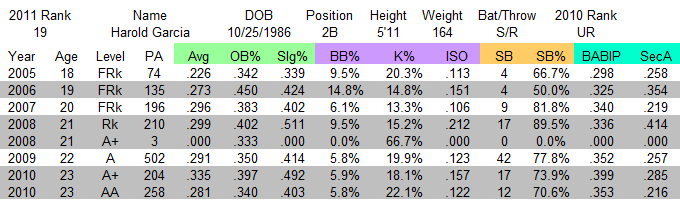
2010 Summary: Garcia was one of the big breakout players in the Phillies system this year, breaking the Florida State League hitting streak record on the way to a solid season and a promotion to Reading. Somewhat ignored prior to this year, Garcia did a little bit of everything, earning himself a spot on the 40 man roster this winter.
Strengths: Garcia’s biggest asset is his speed, which gives him solid range at a tough defensive position. Since coming to the US, he’s always hit for a solid average, though his .335 mark in Clearwater was BABIP fueled, to some degree. He stole a solid 29 bases in 2010, and showed a bit of pop in Clearwater before his promotion.
Weaknesses: Garcia’s approach may not work at higher levels, as he has a bit of swing and miss in him, and he does not draw walks. While his power isn’t bad, it projects as no more than average in the future, and at 24 now, he really needs to produce a big season in 2011.
Best Case: His best case scenario is a starting 2B on a second division team, unless he cuts down on the strikeouts and maintains his power. Hopefully he gets a few looks at 3B this season to see if he can handle the position defensively, which would set him up to be an excellent utility player at worst, if he doesn’t quite have the bat to be an every day player.
MLB ETA: On the 40 man roster, he has 3 years to figure things out. He figures to play every day at Reading this year, and could see a late September callup to get his feet wet.
Ranking Difficulties: Its tough to figure out what to do with Garcia. He’s been old for his level since coming to the US, but he got a late start here, and he’s been a solid hitter at every stop. I don’t think I could have really ranked him any higher, and I debated dropping him down a few spots. Ultimately, middle infield prospects are so damn valuable, I just couldn’t see dinging him anymore. When his BABIP normalizes to a degree, his batting average will come down with it, which is why he needs to make better contact, dropping his K rate down into the 15-16% range, and he needs to utilize his speed when he can.
Final Thoughts: Garcia seems like a great kid, from every article I’ve ever read on him, and he was a great 2010 story. He needs to back up his 2010 season with an even better year in 2011. Because of the guy ahead of him in the majors manning the position, his future may be a utility infielder, but there is a ton of value in that for a contending club, especially when the player is making the league minimum for 3 years.
 Phuture Phillies
I can understand downgrading Jiwan James. But having him back-to-back with Harold Garcia really seems like a stretch. I think James at his best could be a first-division starter. I really struggle to see that kind of upside from Garcia.
LikeLike
I think their placement back to back highlights the difficulty of ranking prospects with major red flags. JJ has tons of tools, but hasnt produced. Garcia is close to a finished product and has reached AA. JJ has big upside, but a really high flameout rate. Garcia has less upside, but plays a premium postion and has 1 plus secondary skill. Garcia wont be a star, but should be a big leaguer. JJ needs to prove he can hit good pitching
LikeLike
Although I would rank James much higher, it’s not surprising that he is ranked so low on this list. Following the site for a few years, you get a feel for what PP considers major red flags. Jiwan James’s K/bb ratio stands out.
It is disconcerting to see James’ name next to Garcia’s though. You would think that if K/bb ratio dropped Jiwan James down the list, that the same ratio would drop Harold Garcia down the list. What I take from the ranking, is Garcia’s performance at age 23 in High A is thought to be far superior in all other aspects than Jiwan James’s performance at Low A at age 20.
I don’t agree, but I understand the logic somewhat.
LikeLike
Mike…I also have James much higher (and Garcia lower) than these rankings, but I think what PP was looking at was defensive spectrum when rating them so closely in spite of the K/BB rates. At least that’s the way I read it.
LikeLike
James was 21 this year and Garcia spent just as much time in AA as in A+.
LikeLike
James had a secondary average of .182 at Lakewood, as a 21 year old. Yes, he missed a big chunk of time transitioning from pitcher to position player, but I think this only strengthens my case. You can name the number of guys who go from pitcher to position player and end up with good big league careers on…what…two hands? James is very athletic, he’s got a shot, but he’s facing very long odds of ever making it. Garcia is 2.5 years older than James, but also has a track record of success, and maybe most importantly, he’s shown he can make consistent contact and properly utilize his speed as part of his offensive profile.
If you’re a big Jiwan James backer, you’re doing it based purely on hope and a prayer. I’m hoping he has a massive 2011 season and my ranking proves to be way too low. But I can’t rank him higher than this, because he hasn’t shown much of anything on the field.
LikeLike
I ranked these two very closely as well – and in this area. J. James has tools, but he really hasn’t translated them to the field (other than defensively). He has a very high ceiling, but probably won’t reach it. Garcia has a very good chance of being a good utility infielder, but probably not much more than that. It’s a discussion that happens every year – how do you weight high percentage low ceiling versus low percentage high ceiling.
LikeLike
I think that Garcia is likely to reach the big leagues in some capacity and could be an okay starter. The only knock against his game currently is his k and BB rates (which to be fair, will drive his average down and probably keep him from being a starter). James could be a star, but he’s less likely to reach the big leagues and somewhat less likely to be a starter.
I’m curious to see if Garcia can hack it at all as a SS, enough that a team would fill comfortable with him as a mid-game injury replacement for their starter, or even him playing a game or two there. Anyone who saw him play last year and can offer their thoughts?
LikeLike
I agree with Alan that seeing the two guys next to one another is odd, but I think it’s more about downside for James at this point. He could easily bust, where Garcia handled himself at REading well enough to seem like the majors are much more of a certainty.
LikeLike
ZIPS came out for the Phillies today and Garcia’s projection for 2011 as a major leaguer is 249/296/360. That cuts it as a utility player but if Garcia can’t capably play shortstop, he’ll have a tough time sticking in the big leagues. He’s 24, he doesn’t have much projection left.
LikeLike
After reading Mike’s report on James, it really sounds like the game just hasn’t slowed down for him yet. Of all the knocks against a prospect, this one probably concerns me the least.
That said, while I like James, I’ve always wondered if his time table would be quick enough to help the Phillies. I kind of see James as a slow growing, late bloomer – kind of an Andres Torres type. I hope he has a breakout in him but I’m more expecting to see the walk rate and power ooze slowly upwards on a year to year basis.
LikeLike
Great analysis on Garcia. I think this is his year.
LikeLike
Nice to see Rupp get some props – that’s about where I ranked him. It will create an interesting problem for the Phils if he comes out gangbusters this Spring.
And count me in the “not sold on Jiwan James yet” category. I’d love to be proven wrong though – despite some holes in his game, he doesn’t seem to be lost out there like some prospects. Here’s hoping…
LikeLike
I was surprised to see Rupp this high. Perhaps I did not truly appreciate how scarce quality catching is. I also didn’t realize how good his power was in the NYPL. Hopefully he can improve his contact rate in Lakewood.
I’m higher on James, mainly because he has such a high ceiling and because he seems like such a good, hard-working guy (follow him on twitter and you’ll see what I mean). Even if he doesn’t break out this year, I think the Phils will give him a few more chances to see if it all clicks. A few people have pointed out that his second half was better than his first half; let’s hope that’s real improvement and not just fluky.
LikeLike
I agree that based on what he has done thus far, Rupp is more deserving of a #25 to #30 position. He has yet to show he isn’t the second coming of Jaramillo.
As PP states his cases, it is clear that a little English goes on the ball, depending on his gut liking of the guy. Rupp has gotten positive spin for being tired. James doesn’t get the same spin for first full season as a hitter. In truth, both guys need to show a lot more than they’ve shown to break our top dozen, where the truly interesting prospects rank. Both could as easily move out of the top 30 as up the list after 2011. James has some years on him and Rupp hasn’t shown much.
I can agree with the thought that last year was a breakout season for Garcia and that he deserves to be placed where he was. He had a good year with the bat for a good-fielding 2B.
LikeLike
“… as PP states his cases, it is clear a little English goes on the ball, depending on his gut liking of the guy.”
+1
A lot more “gut” it seems this year. Statistical applications and allowance for position scarcity/importance seem very inconsistent.
I don’t see anything wrong with Rupp being placed this high though. There is a clear drop off past #15, IMO.
LikeLike
Where have I been inconsistent with regard to position scarcity being important?
I still ranked JJ ahead of Garcia, even though 2B is the more valuable defensive position, and Garcia has produced a lot more in his pro career. Do JJ’s statistics, that impressive .182 SecA, merit a spot in the top 10? Top 5?
The reality is, after the first 5 prospects, a lot of it is guesswork. Hell, the top 5 is guesswork too. Everyone has guys they like, for no real reason that makes sense. I think I’ve been pretty consistent in explaining why I rank guys in certain spots, what things I find important, etc etc. Where have I been inconsistent?
My list is an attempt to balance upside, potential value, likelihood of making it to the majors, risk, etc etc. I think I’ve been pretty transparent in all of my explanations.
LikeLike
Your knowledge of minor leagues is exponentially greater than mine, so any argument I make is from my limited knowledge. Not trying to discredit your opinion. Your blog is outstanding, but I disagree with you from time to time.
As far as position importance, you place a importance on catcher, which you should. But position importance did not seem to apply when placing a reliever over good starters. (DeFratus over Rodriguez and or Ramirez). Also, statistically it is hard for me to make a case that DeFratus is at least Ten (10) spots better than Schwimer.
In another case. Vance Worley is ranked 8th. Statistically, his peripherals are not much better than they were last year. I done think he made the top 30 last year.
Then there is Cosart vs Colvin. I understand injury concerns, but statistically, Colvin shouldn’t be ranked ahead of Cosart or Singleton. Colvin’s numbers aren’t off the chart even if you eliminate April.
LikeLike
Of course DeFratus should be at least 10 spots ahead of Schwimmer. No offense to Schwim, but the Phils’ FO guys have gushed about DeFratus, as have some national writers.
LikeLike
I think Worley was underrated last year more than anything. Taking a look at my personal list, I had Worley at #16 last year. The high ERA was due to a double-jump and I think people jumped ship too early.
LikeLike
De Fratus has excellent raw stuff and his numbers have backed it up at every stop, and his edge in raw stuff is why he is ranked ahead of Schwimer, which I’ll address when we get to Schwimer. As for his value relative to Rodriguez and Ramirez, I noted in the writeups that both guys have big question marks with regard to their future role. I think there is a good chance both guys end up relievers. De Fratus is already a reliever, and has a really big arm. So I don’t think its a stretch for me to rank him above them. Especially when its just a handful of spots.
Worley has zero projection left, but also has very little risk. Again, the proximity to the majors and risk of flameout is a big part of any ranking. 5 years from now, I’m fairly certain Worley will have logged 25+ starts in the majors, or over 100 appearances as a reliever, depending on his role. That value, which im 95% confident of him hitting, outweighs the projections of guys who are further away and carry a lot more risk of ever making it to the majors, let alone being productive. Yes, his upside is limited, but he should be fine as a #4/5. There is value there.
Injury concers, wrt Colvin/Cosart, is a huge issue. Baseball history is littered with guys who had massive arm strength and could never stay healthy. There is a NRI in Phillies camp right now who can speak to that. I love Cosart. I explained in a lot of words why he ranks below Colvin and Singleton, and I explained why I ranked Colvin ahead of Singleton. I think its more than fair if you disagree with my logic, but I don’t see how I’ve been inconsistent at all. I’ve gone to great lengths to explain the process, and I think I’ve been pretty true to my process and methods.
LikeLike
Alan said “people jumped ship too early”
The fan poll voted Worley into the top 20 last year. PP didn’t vote him into his top 30 last year. His peripherals aren’t that much better this year. The numbers don’t support the jump from mid-30s to 8. That is what I see as an inconsistency in applying statistics with regards to Worley’s ranking.
LikeLike
Worley’s peripherals all improved, including his K rate, his BB rate, and his GB rate, and they actually improved when he was promoted to AAA. He also regained some of his velocity. I didn’t put him in the Top 30 last year because his peripherals were poor and I had reports on his velocity at 87-89, which is Kendrick like. He was back up to 89-92 touching 95 this year. That’s a big deal. And again, its proximity. He struggled at AA last year. He pitched well at AA and AAA this year. Which increases his probability for me.
LikeLike
I think Worley has some projection left. This will be his age 23 season. I’m sure pitchers can get better when they are in the ages from 23-25.
Also, it sounds from this article that Worley will have a chance to make the Phils bullpen this year, but he is a longer shot than most: http://www.philly.com/philly/sports/phillies/20110214_Phillies__pitchers_Kendrick__Worley_ready_for_anything.html
LikeLike
Did you watch the video of James and read the report?
James has the ceiling of Mickey Mantle in batting practice and the ceiling of Doug Glanville -outside of Glanville’s career year- in actual game action.
Couple this with James’ total lack of talent in using his speed on the bases and he’s a long shot to become a 5th outfielder/pinch-runner in MLB.
LikeLike
Wow. I, too, was surprised to see Rupp this high. I think he would have been in my mid to late 20s.
I think the likelihood that Philippe Aumont regains his sparke and has a solid major league career are significantly higher than Rupp’s (and others listed already) of making the show, but we’ll see.
LikeLike
I was surprised on Rupp too (and I argued his case in the fan top 30 from about #21 onwards). Its aggressive but the bar for catchers is really low and his power was impressive.
From watching him in person a few times, the guy simply had trouble adjusting to metal bats. If he makes that adjustment, he could be a tough hitter. When he did make contact, it was solid.
LikeLike
I have to confess, I see both James and Garcia as “some dudes.” Age is really a factor for them, though you might give James a pass for a year. But they both need to have breakout years at appropriate levels to be more than filler.
LikeLike
Didn’t see Rupp play last year but did see Jim Klocke catch a game in Williamsport and was impressed. He drove a ball which was caught at the base of the wall in right at Bowman that would have been out most places and pulled a single in the hole to right in another at bat. Lakewood should be set with catching this season with them.
LikeLike
It’s funny you mention Klocke, because after watching back-to-back Williamsport games last July, I was actually much more impressed by his bat than by Rupp’s.
While Rupp definitely looked good on defense – a lot of poise, good with counseling pitchers, etc. – he didn’t square up a single ball either night I watched (he DH’d the second game). Klocke hit it hard almost every time.
LikeLike
This is unrelated to the top 30 but Scott McKinney over at Royals Review (part of SB Nation) has a fantastic article on success and failure rates of prospects, really an interesting read. I’m on my phone so I can’t link it unfortunately.
LikeLike
http://www.royalsreview.com/2011/2/14/1992424/success-and-failure-rates-of-top-mlb-prospects#storyjump
LikeLike
Interesting and not surprising, except in my case I would have thought that the gap between pitchers and position players would have been even greater. But it is still pretty large and something we would do well to keep in mind in projecting pitchers, especially low level pitchers.
LikeLike
If you want cautionary tales, just look at the Phillies’ NRI list. Three of those players (Josh Barfield, Brandon Moss and Dan Meyer) were listed in Baseball America’s Top 100 list for 2005.
LikeLike
It reflects just how great the injury or fall-by-the-wayside rate is for even the best pitching prospects. This suggests that in preparing a realistic prospect list, when in doubt give the edge to the position player. Also interesting that only the top 40 prospects in baseball, as ranked by BA have a higher probability of success than bust, with a 60% bust rate for prospects 41-100.
LikeLike
So I guess Aumont would be the most notable name missing so far? There are lots of good reasons for moving him down the list, although I still think he has more value than Garcia and James.
LikeLike
Past performance is the best indicator of future performance.
Garcia makes good contact, good OBP, steals bases and can put a hitting streak together. He makes things happen. If Garcia can continue this pace and make good contact, keep his BA around .300 and steal bases and play a solid 2nd (or utility role) then I think he has very good value. No reason to believe that his skills will deteriorate.
JJ on the other hand, has shown the opposite so far. Statistically he is lacking…Does not generate walks, Strikes out are high, SB % low. On the plus side his defensive game looks solid (Speed/ arm). As James said his chances of becoming an OF after his P career was shelved is very low. That is why I have very little hope for him to make it… I hope I am wrong.
Time is on his side right now as he is still young and if can have a good season statistically (at least some improvements in these areas) then we will have real reason (past performance) to mention his name as a prospect.
LikeLike
So what kind of talent would Blanton get from the Yankees? Montero and Banuelos are out of the question, but Sanchez or one of their other arms?
LikeLike
Sanchez would be out of the question. Some observers have started rating him at or above Montero. Honestly, I wouldn’t expect the Yankees to jump at a deal. Blanton isn’t assuredly better than Freddy Garcia (who is much cheaper), and I’d prefer to plug in Ivan Nova before a veteran if I were them. I doubt the Yankees would part with a top ten organizational prospect.
LikeLike
They’ve already spent 200M, you think that question adding 4% to the payroll for a guy that will be no worse than the #4 starter? Obviously they aren’t going to trade anybody today, but once the dreck of the bottom of their rotation exposes itself, they be on the market for real pitchers.
Maybe they go higher than Blanton and make a run at King Felix or somebody else, but come May 1, no way they have a rotation with two of Colon, Garcia, Mitre, and Nova.
But really they need to add a Felix type and a Blanton type.
LikeLike
The problem the Yankees have is the luxury tax. Every 4% they add becomes 6%, and it quickly compounds on itself. I get the feeling Brian Cashman is comfortable letting things ride, but the Steinbrenners may force a move. I think though that with the Yankees’ farm talent, if they are adding $8.5 million in payroll they will want more than a steady 4.50 ERA.
LikeLike
That might change come the trade deadline but by then, the Phillies may not be comfortable trading Blanton.
LikeLike
I picked up a Sporting News baseball preview magazine recently. David Rawnsley from Perfect Game CrossChecker Baseball provided top ten prospects for each team. Here’s his Phillies list.
1. Domonic Brown
2. Jonathan Singleton
3. Trevor May
4. Brody Colvin
5. Jesse Biddle
6. Jarred Cosart
7. Vance Worley
8. Kelly Dugan
9. Cesar Hernandez
10. Aaron Altherr
Dugan at #8 is extremely interesting. He’s a guy who really could shoot up the list this season.
LikeLike
And how does May best colvin and cosart? Doesn’t make much sense, nor does the exclusion of valle.
LikeLike
Dugan at #8 doesn’t make an ounce of sense. He is older than Altherr and Hasn’t put up the numbers Altherr has. Plus he has less defensive value. Even if you wanted to argue he is a top 10 prospect, there is no way you can argue he is better than Altherr or Cesar Hernandez.
LikeLike
Its the classic “He was a top pick so he MUST be good”.
LikeLike
Which explains the placements of Kyrell Hudson and Anthony Hewitt on the list.
Its a scouts list. I can see some things to quibble with but at the same time, I like seeing some observers promote different players. I got to see Dugan once and I think his bat is legit. If someone says “I saw both players and I like this one better,” who is to say they are automatically wrong?
LikeLike
Hewitt was on these lists last year and Savery was on them a couple years ago despite no real reason statistically.
List makers have a tendency to overrate top prospects early on because they figure they MUST have been selected for some reason. It happens all the time.
LikeLike
Normally, they WERE taken for a very good reason. I’m going to trust the decision makers for the Phillies far more than a disparate group of anonymous posters on a message board. If they thought Savery was good enough to take, I’m going to take their word for it until it’s obvious the guy has bombed out.
LikeLike
“He was a top pick so he MUST be good”.
Which explains Jesse Biddle at #5. You can easily make a case for him to be #11 in the organization.
Terrible list past Singleton. At least he didn’t screw that up.
LikeLike
Remember everyone: Don’t feed the troll.
LikeLike
Trust ok But people make mistake e.g. Knapp.
LikeLike
That should be on a T-shirt.
LikeLike
The whole value thing is not only subjective, it is fluid. On this team a starter at the upper levels is discounted. Any upper level starter behind Worley is an afterthought at least for now. Upper level relievers gain value.
But then it changes again from the viewpoint of keepers or trade bait.
e.g. Singleton gains a ton of value if he handles left but his stats are the same either way.
LikeLike
Personally, I don’t change my evaluations based on the needs of the big club. If a player is completely and utterly blocked, he still has trade value if nothing else.
BTW, the depressing thing about Ryan Howard’s contract is that there’s a great chance Singleton will be a better player by 2014., straight up.
LikeLike
I am not a huge fan of James. I still think Roberson is a likely projection. However, he did have a hit streak so I think the flashes are there. In my ranking value I was willing to give his stats less weight due to it being his first full season. I think there are some similarities to Gose though age difference is significant.
My view of Rupp is that I do not believe in his defensive value until he proves it as a pro but he will stay at catcher so that is his benefit.
Garcia has produced at every level, just been to old. I think Hernandez is on a similar path but is younger.
LikeLike