Monthly Archives: February 2007

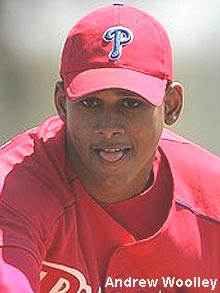
Player Profile: Edgar Garcia

edgar-garcia.jpg

I’ll be grading Edgar soon, as I get to the short season and rookie leagues, but I wanted to do a proper writeup on him, because I feel he might be one of the most under the radar guys in our system, and there’s really no real reason for that. The Phillies signed Edgar Garcia as a 16 year old free agent out of the Dominican Republic in 2004, after following him for quite a while in his home country. At 6’2, 190 pounds, Garcia offers a bit of projection, on-top of an already lively arm. He was sitting in the high 80’s/low 90’s as a 16/17 year old, there’s plenty of reason to believe he might improve. He featured an above average changeup, considering his young age, and an erratic curveball that the Phillies thought would improve. After signing him for $500,000, they were eager to see what he could do.

Garcia made his Phillies debut in the GCL, at the tender age of 17 in 2005.  He pitched just 55.2 IP, putting up a 3.56 ERA, allowing 63 H, 13 BB and striking out 42. Those numbers might not jump out at you as outstanding, but for a 17 year old, in his first exposure to pro baseball, they were quite solid, especially his walk rate, which was well above average. Because he was considered quite raw, people tempered expectations heading into 2006, probably for good reason, but Garcia just kept getting better. He pitched all of 2006, his age 18 season, at Batavia, and pitched extremely well. He posted a 2.98 ERA in 66.1 IP, allowing 62 H, 10 BB and struck out 46. Those numbers look pretty damn solid for an 18 year old competing against a lot of refined college players. Again, though, the hype and praise for Garcia was somewhat absent from the discussion. With the drafting of Kyle Drabek, and the big time success of the Lakewood rotation, it was easy to miss Garcia’s fine season in 2006. The strikeout rate still isn’t where most people want it, but two things should be pointed out. First, his walk rate, which was already excellent in 2005 (2.10/9), got even better in 2006 (1.36/9), at a higher level. Control, for young pitchers, is the thing you often see come last. Carlos Carrasco put up a great 2006, I rave about him constantly, but Garcia has much better control, and is a year younger. Carrasco struck out more guys, but also walked more. You can’t put everything together at 17/18 years old unless you are an absolutely one of a kind talent. The second area where Garcia improved was his hit rate, going from 10.19/9 in 2005 to 8.41/9. This is significant, again, because he lowered his rate drastically against tougher competition.

I don’t want to pretend his K rate isn’t at least a reason to pause, because it is. However, at this point, it’s not something that should diminish his potential as much as it has. He generated 1.26 ground balls per fly ball in 2006, that’s a decent ratio, but it doesn’t seem to indicate he’s going to be pitching primarily to contact and not trying to strike guys out. He held both lefties and righties to under a .670 OPS, which speaks to him working more on his changeup and having a weapon to use against LH batters. It’s my opinion, based on nothing other than the logic in my head, that Garcia’s low K rate comes from him not wanting to walk batters. It’s simply an approach that he’s going to have to work on, and it might just be a matter of him not being afraid to miss off the plate. As he continues to move up the organizational ladder, it’s something he will learn from, and something he will be able to hopefully improve. If the high strikeout numbers don’t come, it doesn’t necessarily mean he can’t be a solid middle of the rotation starter, but he will need to improve his GB:FB ratio, and he will need to maintain his good command. However, he’s posted two strong seasons, at a very young age, so at this point, it almost feels like nitpicking. A 6.49 K/9 ratio, which is what his average over his first two seasons is, would be league average as a starter at the big league level, of course, that number isn’t big league adjusted, but I’m just throwing it out there. However, his walk rate, 1.70, would be in the top 4 or 5 of regular, 160 IP a year pitchers. I weigh strikeouts as much as the next person, but right now, I’m not terribly worried.

Garcia also benefits (I think) by having his pitch selection trimmed down to 3 pitches (that I know of), which means he’s confident in what he has, and isn’t tinkering with 5 or 6 different pitches. He features a fastball that sits in the low 90’s, can touch 94/95, and might improve a tick or two in the next two to three years. He also has an above average changeup, which could eventually rival Carrasco’s for best in the organization. He commands it well to all areas of the zone, and has good arm action, which adds to the decepcion of the pitch. His third pitch, both in counting and effectiveness, is a 12-6 curveball, which has been inconsistent at times, and may also be a factor in the low K rates. You can keep hitters off balance with a fastball and a changeup, but unless you have one of the best around (Cole Hamels, Pedro Martinez), it’s tough to be a strikeout artist without a reliable breaking ball. If he can tighten the pitch and gain confidence in it, at least making it average or a tick above average, it will improve his other two pitches, and if he can figure it out and turn it into a plus pitch, then he has all the makings of a solid, 200 inning, middle of the rotation starter.

2007 should be a fun year to watch Garcia, and we should be watching him at Lakewood, in what is shaping up to be a powerful rotation yet again. He’s only thrown 55 and 66 innings the last two seasons, but in his age 19 season, the Phillies might be ready to take the training wheels off. It wouldn’t surprise me to see them try to limit him to 120 innings or so, but that’s not the worst thing they could do. If he gains confidence in his curveball, he could be in for a dynamite third season, and at this time next year, will be generating a lot more buzz than he is now.

Prospect Grades: Blaine, Hill, Savage

We’re gonna keep on keepin’ on here with the grades.

blaine.jpg

Blaine, Justin, LHP (age 22) Grade = C

If I were to tell you a guy was 35% below league average, would you guess he had an ERA under 4? Probably not, but that’s the case with our 6th round pick in 2005. Blaine, a 6’4 LHP, had pretty awful peripheral numbers across the board, 9.27 H/9 (-5%), 5.43 BB/9 (-20%), 5.91 K/9 (-16%), but the only bright spot is that he didn’t allow a single HR in 56.1 IP. Even with his terrible peripheral numbers, he posted an ERA of 3.82. So, we clearly need to look deeper at his performance and adjust his grade, as I find it hard to give him an F. Start with his age….he was 22 in 2006, at Low A. That’s the top end of the age spectrum, and he probably should have been at Clearwater, but because he was a 2005 draft pick, it’s not that unusual. He started 6 of the 18 games he appeared in, so his role isn’t crystal clear just yet. His OPS allowed by month improved after a bad May (.824) to .595 in June and .690 in July, that’s decent. He was equally good against LH and RH batters, .706 OPS against LH, .705 against RH. So really, what gives? Well, check out this statistic. He allowed 119 groundballs to 34 flyballs. That’s right, over 3.5 GB to FB….that’s pretty ridiculous. The trade off is, of course, that he can’t strike anyone out. I’m not sure where he’ll end up in 2007, but it will probably be in relief, probably at Clearwater. I don’t have the video handy, but his delivery reminds me a little of Huston Street, the A’s closer, but with a lot less velocity, and from the left side.

Ceiling: I think his ceiling is a #5 starter, probably similar to a guy like Carlos Silva.

Floor: Organizational filler.

Conclusion: The Phillies have two more years to figure out what to make of Blaine. As he moves up the organizational ladder, his control is going to have to greatly improve, or his ERA is going to skyrocket. Ground ball specialists can survive, but they can’t give out free passes at the alarming rate Blaine was issuing them in 2006. If he figures out how to throw stikes and maintains his strong GB tendencies, he could be a useful backend option or a swing man.

(NO PHOTO, SORRY RON)

Hill, Ronald, RHP (age 24) Grade = C-

Ronald Hill? Who? I’m sure that’s what most of you are saying. Hill was taken in the 17th round in 2005, and after a nice run at Batavia in 2005, he was sent to Lakewood in 2006. He impressed, putting up a 2.30 ERA in 54 innings from the bullpen, and was sent to Clearwater, where his results weren’t nearly as good, putting up a 7.88 ERA in 16 IP. His peripheral numbers at Lakewood were good, 8.56 H/9, 2.47 BB/9, 9.22 K/9, and 0.00 HR/9, but at Clearwater, not so good, with 14.63 H/9, 2.25 BB/9, 6.75 K/9, 1.69 HR/9. It’s important to realize the CLW sample is much smaller. It’s also important to realize his Lakewood numbers came at age 23, too old for the league. As a reliever only, his value is diminished further. However, I do like guys who show quality control, and he did so over the course of 2006. His K rate dropped at Clearwater, but was still 6.75/9, which considering an adjustment time is normally necessary, isn’t the end of the world. In his two other split areas, he got more than 2 ground balls to every fly ball, which is a positive, and he was tough on RH batters, holding them to a .629 OPS, while lefties knocked him around to the tune of a .931 OPS. Clearwater is his likely destination for 2007.

Ceiling: A ROOGY who gets lots of groundballs would be a nice role for Hill, who isn’t on anyone’s radar right now.

Floor: Out of baseball in 5 years.

Conclusion: Hill is a guy who most people have never heard of, which isn’t uncommon for late round draft picks. I can’t speak to his “stuff”, but he probably has a sinker or a big two seamer that moves, which is what generates all the ground balls. He has good control, he got a fair amount of swings and misses, so he does have some promise. His 2007 season represents his age 24 season, so he’s gotta move quickly if he’s to be considered a prospect at this time next year. If he pitches well at Clearwater, he should be moved to the Reading bullpen by June, and then we’ll have a better clue on what he can offer, if anything.

savage.jpg

Savage, William, RHP (age 22) Grade = B

Savage, a 26th round pick in the 2006 draft, is already looking like a potential steal. Assigned to Batavia after the draft, he pitched 9 scoreless innings, allowing only 6 H, 1 BB and striking out 8. He was sent to Lakewood, and his numbers there solid, putting up a 3.45 ERA in 31.1 IP, with 31 H, 5 BB and 28 K. His peripherals as a pro so far are better than his college numbers, which has to be a bright note for the Phillies, even at this early stage. His composite puts him around 30% better than league average for his time in the SAL, which would earn him a B+, but I dropped him to a B because he’s strictly a reliever as a pro. He did start some in college, and was able to bounce back after pitching multiple innings in relief, so he could be looked at as a multi-inning reliever at the top level. His stuff appears to be largely average, but the word is that he has a deceptive delivery, which makes his stuff play up a notch. He could start back in Lakewood, but the Phillies may challenge him and skip him to Clearwater, as he was a 4 year senior and does have late game experience in college. As of now, there are no real flaws to criticize him on. 2007 will be his age 22 season, so he’s ok age-wise. I guess his hit rate could stand to drop a hit or so per 9, but he did have good success against RH batters, holding them to a .563 OPS, and he got more GB than FB, so he has those two things working for him.

Ceiling: A 7th/8th inning reliever. Probably lacks the stuff to close, but could be a useful medium leverage kind of reliever.

Floor: AAAA pitcher, swingman type role in the mold of Clay Condrey.

Conclusion: For a 26th round pick, Savage did well for himself by moving to Lakewood and pitching well. Because of his experience and versatility, he could move quickly through the system. Mediocre stuff normally requires excellent command, which he appears to have. The role he eventually plays with the big club, if he makes it that far, will be determined by his ability to put hitters away without a true out pitch. He’s definitely one to watch in 2007.

Prospect Grades: Carrasco, Mitchinson, Zagurski

We’re deep into the Low A level, which leaves only short season and rookie ball, but we’re now entering into the area with the most promise, but also the least predictability. Keep that in mind going forward.

carrasco.jpg

Carrasco, Carlos, RHP (age 19) Grade = A

Talk about raising your stock. In 2005, Carrasco struggled mightily at Lakewood and was sent back to Batavia, where he again struggled. The Phillies readily admit he wasn’t ready for full season ball at age 18, but he was sure ready at age 19. He posted a 2.26 ERA in 159.1 IP, allowing only 103 H and 65 BB while striking out 159 and allowing only 6 HR. His composite stats put him at around 44% above league average, good enough for a straight A in my system, but close to the A- range. What pushes him over the A- grade, though, was that he did all his work at age 19, and he won’t turn 20 until March. At 19, the most impressive thing about Carrasco is his feel for his changeup, which is often the missing piece, or the last piece to develop for young pitchers. With an advanced changeup at a young age, you’re one step ahead of the competition. Carrasco’s fastball is already in the 91-93 range, and because he has a projectable body (6’3, 175lbs), there’s reason to believe he may add 1 or 2 mph going forward. His curveball was inconsistent and is behind both his fastball and change, but scouts and experts tend to think it will improve the more he throws it, and this could have led to his 3.67 BB/9 in 2006, the only blemish on his record. He gets a lot of ground balls, he doesn’t give up many home runs, and he strikes guys out….all the qualities of pitcher who will likely succeed going forward.

Ceiling: I’m very bullish on Carrasco, so I’ll go ahead and say a #2 starter, maybe better. With Cole Hamels ahead of him, how could he be a #1? I joke, but really, the sky is the limit. His changeup is the best in the system and one of the best in the minors, it would appear. He throws it with great arm speed and gets superb late fade on the pitch, which will help him neutralize LH batters. The key, which will determine where he pitches in the rotation, is how well his curveball develops. If it becomes an above average pitch, he should/could be a top of the rotation starter. If it lags and is merely a show me pitch, he might be a middle of the rotation starter.

Floor: A back of the rotation starter. Really, his arm is too good for anything else.

Conclusion: His 2006 represents one of the best pitching seasons in the minors at any level. The Phillies tried to double jump him before, I doubt they do the same thing again. He’s going to start at Clearwater, and will probably stay there all season, unless he really does go crazy and dominate in his first few months. He’s probably 2 years away from the majors, at least, but that would make him 21/22 when he’s pushing for a job, and that’s just fine.

mitchinson2.jpg

Mitchinson, Scott, RHP (age 22) Grade = B

Mitchinson, another Aussie product, took a step in the right direction in one sense this year, but also a step back. Mitchinson struggled on the field in 2005, both with performance and his health, and in 2006, he righted one area, the one the field performance, but struggled in the other area, as he threw only 61.1 innings at Lakewood. When he did pitch, he did a real nice job, allowing only 53 hits and 18 walks against 64 strikeouts in his age 21 season. Mitchinson’s 37% above league average composite would be good enough to put him in the B+/A- range, but he has to be dropped to a straight B based on his health issues. If he can remain healthy for an entire season, we’ll know more about what kind of value he has going forward. He’s shown an ability to get swings and misses at every stop thus far, and his hit rate in 2006 is probably more in line with what to expect going forward, as he didn’t have a fluky BABIP rate (.313) which could skew his H/9 way up or way down. His control seems to be pretty solid, but the one area of concern is his G:F rate, which is almost 1:1. Being a flyball pitcher isn’t a “bad” thing, as long as you can get guys to swing and miss at a high rate, which it appears he can. Because he will only be 22 at most likely at High A, he’s on track, age wise. Whether he remains a starter or not will ultimately impact his long term value.

Ceiling: I’m not really sure here. I guess a #3 starter or a late innings reliever. If he can’t stay healthy, he’s bullpen bound, but his stuff appears solid, all things considered.

Floor: Swing-man/long reliever seems plausible.

Conclusion: Injury seems to be his number 1 obstacle at this point. If he is healthy for the entire 2007 season, we should be able to better gauge his value in the long run. From what we’ve seen so far, he looks like yet another promising arm in the pitching pipeline.

zagurski.jpg

Zagurski, Mike, LHP (age 24) Grade = B-

Zagurski is an interesting guy, a guy who I might not be as high on as some others that follow the Phillies minor league guys, but a guy who could be a decent role player down the road. A 12th round pick in 2005, he struggled at Batavia last year, probably due to a tired arm, but was pretty solid in 2006 at Lakewood. His composite numbers put him at 64% above league average, but obviously adjustments are needed. Numbers wise, he put up a 3.51 ERA in 56.1 IP, allowing 7.35 H/9, 3.51 BB/9, 0.00 HR/9 and 11.98 K/9, those are solid peripheral numbers in all cases except the walk rate. The first adjustment we need to make is for age. He was 23 in 2006, which is too old for Low A, so we move his grade from an A to a B+. The second adjustment comes from him being reliever exclusive, so we bump him from B+ to a B. The fact that he is left handed is a credit to him, but it’s offset by his splits. He actually put up better numbers against RH batters (.588 OPS allowed) compared to LH batters (.712 OPS allowed), so I’m not sure if it’s a fluke, or if it’s a developing pattern. Conversely, he is an extreme groundball pitcher, with an over 2:1 ratio, and he didn’t allow a HR in the 56 IP in 2006, and that definitely lends support to him being a good reliever going forward. Honestly, I was on the fence between a B and a B-, but I just worry about a guy who, at 23, walked 3.5 batters per 9 at Low A. He’s now 24, and it’s unclear whether he’ll go to Clearwater or Reading. If he goes to Clearwater, he’ll still be too old for his level, and if he’s 24 at Reading, he might still be at the top end of the prospect age group, so he’ll need to again dominate. I think if his control lags behind, he’s going to struggle at higher levels. In terms of what he throws, I really don’t know for sure. I’ve read before he throws a hard sinker (that’s evident by the GB:FB ratio), a curve, and a changeup. If someone can clarify that, I’d appreciate it.

Ceiling: A high leverage reliever, but probably short of closing material

Floor: AAAA pitcher who can pitch in most bullpen roles and bounces between AAA and the bigs

Conclusion: There’s a lot to like about Zagurski, starting with the high K rate/GB tendencies combo, but he was way too old for his level, so I want to see what he does against better hitters. I’m also slightly worried about the splits, but it could be a sample size thing. Every organization needs good, cheap bullpen options, especially lefties, so if he proves to just be a 6th/7th inning reliever, there’s nothing wrong with that, but it also limits his prospect value, which is ultimately why I decided to go with a B- instead of a B heading into 2007.

Prospect Grades: Henry, Maloney, Outman

Back to the grades

henry.jpg

Henry, CJ, SS (age 20) Grade = C-

CJ Henry, another cog in the Abreu trade, unfortunately comes with more hype than substance, but not enough performance to save him from this disappointing grade. Henry, a first round pick in 2005, was like the Yankees version of Greg Golson, so it was only natural that the Phillies asked for him in the Abreu deal. He was a basketball ace in high school and gave up a scholarship in favor of baseball. Always modest, he compares himself as a cross between Derek Jeter and Alex Rodriguez. Yeah, so he’s modest at least. Unfortunately, his composite put him at around 3% below league average in the SAL, his OB% just .001 under league average (.330) and his slugging % (.366) about 2.6% under league average. He’s the classic tools guy, good athlete, potential power, good speed, but he hasn’t shown it on the field yet, much like our own Greg Golson. He played SS, but many feel he’s going to have to move off the position and move to 3B, possibly the OF down the road. He was only 20 in 2006 playing in the SAL, and will be 21 at the end of May, so even if he repeats Lakewood, he won’t be too old for the league. Maybe moving off of shortstop will allow him to relax a bit and focus more on hitting. There is one silver lining to his 2006. He drew 32 walks in 77 games for New York before the deal, which helped compensate for his poor .240 BA. For Henry, it’s all upside, not much performance.

Ceiling: An everyday 3B. Seriously, he has the tools to be an impact player. It’s the translation of the tools that is the current issue. Which leads to…

Floor: A basketball player. Maybe Henry made the wrong choice to play baseball, maybe not. Unfortunately, with a player like him, the gap between what he can be is huge. If he learns how to refine his approach at the plate, if he better utilizes his speed, and if he can take to 3B, he could turn into a superstar in short order. If not, he’ll never make it past AAA.

Conclusion: Henry, like Golson, is one of the guys that drive you insane, because you see the potential, but you don’t see the results. 2007 should give us a good idea whether he’s moving closer to being a useful player, or if it’s time to give up completely.

maloney.jpg

Maloney, Matt, LHP (age 23) Grade = B

On paper, Maloney should be an A++. He put up a sparking 2.03 ERA in 168.2 IP in 2006, allowed only 120 hits and struck out 180 batters, en route to helping lead the Blueclaws to the SAL title. However, there are some problems, in my view. First, he was 22 the entire year, on the high end of the prospect spectrum. College pitchers should dominate at low A, and Maloney did. The second problem, which ties in with the third, is his walk rate. He walked 73 in the 168.2 IP, which is a lot of walks. This ties in with the third problem, his mediocre stuff. He has a deceptive delivery (but it looks max effort to me, which could be a problem), and he relies on his slow curveball to get outs. The problem is, at higher levels, batters are less likely to swing at breaking balls out of the zone. Most guys with fringe stuff are pinpoint control guys, like Kevin Slowey and Jeremy Sowers, and scouts even question their success at higher levels. For a guy with an 86-89 MPH fastball, even for a lefty, I think he’s going to need to really refine his control at the higher levels, or he’s going to hit a wall quickly. Because he clearly didn’t belong in the SAL, we’ll have to see how he does against better competition. I’m not writing him off, though my writeup seems harsh, but I want to see him dominate (or at least pitch well) at higher levels against more advanced hitters. If his control improves, so will his grade.

Ceiling: Because of the lack of a high quality fastball or above average stuff, his ceiling is probably as a 4th/5th starter.

Floor: Brian Mazone without the steroids?

Conclusion: Finesse pitchers are really tough to figure out and project. If his control improves, he’s got a much better shot to reach his ceiling. If it doesn’t improve, he looks more like a AAAA pitcher, or maybe a possible reliever down the road. His 2007 should land him in Reading, where he’ll be the proper age for his level, and will be facing much more advanced prospects. If he repeats his numbers from 2006, he’ll be a legit prospect, and the ceiling might even improve.

outman1.jpg

Outman, Josh, LHP (age 22) Grade = A-

When you consider their numbers, Maloney had the better 2006, but when you consider the stuff, Outman gets the nod, and it’s not really close. Outman was well above average in H/9, K/9 and HR/9, but like Maloney, struggled a bit with command, allowing 4.35 BB/9. However, he scrapped his slower slider/curve in favor of a hard biting slider, and that might be a possible reason for his lack of control. His fastball sits in the 92-94 range, which is outstanding for a LHP, and while his changeup is average, it could improve as he throws it more. His new-found hard slider was a true out pitch, evident in the 9.33 K/9. He didn’t turn 22 until September, so he basically pitched 2006 at age 21, which gives him another edge on Maloney. His composite numbers, about 31% above league average, probably should put him in the B+ range, but he gets the bump up for his strong performance as the season progressed, with his August (32 IP, 10 BB, 16 H, 35 K) showing that he’d truly taken things in the right direction. Because he possesses better stuff, he’s a better bet going forward. He’s also a personal favorite of mine, so that might skew my grade a bit, but lefties with his type of power don’t grow on trees. Chris Kline mentioned he might end up a reliever if he doesn’t harness his changeup, but I think he has plenty of time to work on it, and there’s no need to rush him. Power lefties are rare, and are much more valuable in the rotation. He’ll likely start at Clearwater and possibly move to Reading at mid-season.

Ceiling: #2 starter. I stated above that he’s a favorite, so maybe I’m being unrealistic, but really, if he lowers his walk rate while maintaining his strong K rate and hit rate, he’s got the makings of a front of the rotation starter. He keeps the ball on the ground and gets lots of swings and misses….really the perfect combination for a pitcher.

Floor: A reliever. If his changeup doesn’t become at least average, this is a possiblity.

Conclusion: The sky is the limit for Outman, a 10th round pick in 2005. If he harnesses his stuff, he’s a lock to stay in the rotation, and probably pitch in the top half of said rotation. If he pitches well in 2007, he should finish the season at Reading, which means he’ll be poised for MLB action sometime in 2008. There’s no need to rush him at this point, and focusing on his control within the strikezone and his command of his secondary pitches are the big areas to watch in 2007.

Prospect Grades: Kennelly, Marson, Harker

Rockin’ and rollin’ along. Busy day today, plus a long drive home because of the snow/rain/sleet, so this posting is a bit delayed.

kennelly1.jpg

Kennelly, Tim, C (age 20) Grade = C-

Another Aussie leads off our list today. Kennelly had a stellar 2005, posting an .835 OPS at the GCL level in his age 18 season. Everyone loves .800+ OPS catchers, especially organizations that lack true top notch catching prospects. Unfortunately, Kennelly went backwards in 2006, struggling to a brutal .577 OPS at Batavia in short season ball. Really nothing went right, as his .293 OB% was pretty lousy, but not quite as bad as his .284 slugging %. Was he playing with an injury? Was he just over-matched? In 2005, he drew 21 walks to only 16K, but he reversed the trend in 2006, walking just 11 times to 26 strikeouts. He had an impressive 11 doubles in 112 AB in 2005, only 6 in 134 AB in 2006. Needless to say, every step of his game went backwards, but he was still sent to Lakewood for the final 8 games of the season. It’s reasonable to assume he will be kept at Lakewood if Lou Marson, who was also bad in 2006, goes to Clearwater. Because 2006 was his age 19 season, we shouldn’t be totally down on him. He struggled defensively, committing 10 errors in 44 games at Batavia, but I don’t know how good his arm is, I don’t have his SB/CS ratio. If he does play full season ball at age 20 and can post a .725+ OPS, then there is definitely reason to hope. His composite numbers put him about 21% below league average, normally that would be grounds for a straight F, but he gets a boost because he is a C, and because he was only 19. I was between a D+/C- on him, but went with the C- based on his strong 2005. If he can rebound in 2007, he has the ability to improve significantly, grade-wise, by this time next year.

Ceiling: A major league catcher. Really, that’s all I can say based on the data we have. If he’s a butcher behind the plate and needs to be moved, his bat is going to have to carry him, but if his bat doesn’t rebound, he’s going to be a working civilian like you and me.

Floor: See above. His floor is organizational filler.

Conclusion: As we get lower and lower on the chain, it’s tougher to really know what we’re looking at. Kennelly is a guy I followed this year with great expectations after last season. Unfortunately, as many prospects do, he let me down a bit. He’s still real young and has plenty of room to grow. If he can replicate his offensive success and cut down on the errors, because he is a catcher, he’ll shoot up many prospect lists.

marson.jpg

Marson, Lou, C (age 20): Grade = B-

I like Lou Marson. Lou is a pretty cool name. Lou Brock. Lou Gehrig. Lou Marson. Well, except those guys were Hall of Famers, and this Lou didn’t crack the .700 OPS mark this season at Low A. That said, he did play half the Low A season at age 19, not turning 20 until late June, and his .694 OPS, while somewhat stinky compared to the league, for a catcher, a young catcher, it’s not the end of the world. His OB% was about 3% above league average, his slugging % about 6% below league average, bringing his composite rating to about 3% below league average. Like his catching counterpart above, we have to make a few adjustments. First, the fact that he played a full season at 19/20 gets him a slight bump, and the fact that he’s a catcher gives him another slight bump. So, his C turns into a C+. Marson has moved one level at a time, going from the GCL (.722 OPS) in 2004 to Batavia (.720 OPS) in 2005 and then to Lakewood (.694 OPS) in 2006. The most promising thing about Marson offensively, to me, is the walks. He drew 49 walks in 104 G, which aided his OB%, as he hit just .243, but gained an extra 100 points on the strength of the walks and his 5 HBP. He also got to handle the strongest pitching staff in Low A, and you’d think some of their success would be a credit to his handling of the staff…..or maybe it was just luck, that part of the game is really hard to measure and draw conclusions from. Because of that, though, and because of his strong plate discipline, I bumped his grade to a B-. As I mentioned with Kennelly, the organization is really thin at C, especially with the questions now on Jaramillo’s defense, so I’m begging that one of these guys steps up this season. It’s reasonable to assume Marson will go to Clearwater, where he’ll be only 20/21 for the season, playing against guys 2-3 years older than him. If he holds his own again and can raise his OPS into the .760 range, he’ll be a legit top 15 prospect next year.

Ceiling: Marson is still 3-4 years away from Philly, but age is on his side, and so is his patient approach at the plate. If he continues to draw walks at the rate he did in 2006, he’ll be more than an all catch no hit catcher. It’s wish-casting to assume he’ll be anything more than a #7 hitting catcher, but if his game calling and defense are legit, there’s no reason to think he couldn’t turn into a major league catcher, probably a starter, at some point down the line.

Floor: Organizational filler/AAAA player. He can’t be worse than Sal Fasano, so you’d have to think a career backup, as long as he can remain behind the plate, is a reasonable future.

Conclusion: All things considered, Marson is a step or two ahead of Kennelly on the spectrum, but Kennelly is a bit more of an unknown still, while we’ve seen flashes of what Marson can do. If the plate discipline remains and the defensive aspect is there, he’s going to be fine. I don’t know if he’ll add any power, he had just 25 XBH in 2006, but he did have 5 triples, so he might be able to run a little bit. A very young Jason Kendall in the making? I could think of worse guys to hope he becomes. No use placing odds on guys this far away.

harker.jpg

Harker, Brett, RHP (age 22) Grade = B

As I detailed here, I’m a Brett Harker fan. In his first full season, he held his own in the Lakewood pen, posting a 2.92 ERA in 64.2 IP. His important stats were all above average as he allowed 7.38 H.9 (+15%), 2.64 BB/9 (+30%), and 0.54 HR/9 (+15%) while striking out 7.65/9 (+1%) for a composite average of 62% above league average. Of course, we have to make some adjustments. As he is a reliever exclusively, he gets docked points from an A to an A-. He’s on the high end of the prospect age spectrum for Low A, but I wouldn’t have docked him just for that, however, he did post a 5.06 ERA in 2005 at Batavia, and when looking at the big picture, that along with him being 22 convinced me to drop him down a half grade. He then loses his final half grade based on his K rate. I hate to keep harping on it, but strikeout rate is a really important indicator, and to me, it’s the most important for a reliever, followed closely by BB/9. As you can see, he was above average in his hit rate and walk rate, but was merely league average in the swings and misses category. His fastball is fringy, but he does have a great curve/slider offspeed pitch. The question is, will it translate to higher levels? He’s likley headed to Clearwater, where he should get some save chances.

Ceiling: A major league setup man. He saved 17 games in 2006 and has college level experience in closing games, however, if he doesn’t add to his fastball (he probably won’t), he might not have enough to close games out in the majors unless he develops a plus changeup or a split of some sort. His offspeed pitch appears to be a plus offering, from the reports I’ve read, but he won’t be able to live off of it, especially at higher levels.

Floor: Worst case scenario, he’s a poor man’s Geoff Geary.

Conclusion: I like Harker, and I think he’ll be a useful piece in the ML bullpen in a few years, but the leverage of the situations he is handed could depend on his fastball and his control. He seems to have the mentality to pitch late in games, but that won’t be enough if the stuff doesn’t translate. We’ll see as he faces tougher competition in 2007 and beyond.

Quick Draft and Follow Update

Thanks to minor league/draft guru SQUIRE for bringing it to my attention, but the JuCo season is under way, and some of the Phillies prospects are off to a flying start. In 3 games, Rashad Taylor has scored 9 runs, hit 3 HR and drove in 11, while also drawing 4 walks. Not a bad debut, eh? You can follow his progress here. Personal favorite Dan Faulkner’s season doesn’t start for a few more days, but some other DFE’s are already in action. Yazy Arbelo hit a HR in his first start of the season, and you can follow his progress here. I’m updating the side bar that currently has the minor league rosters to include all links for the DFE updates as well, so you can have easy access to that info all season long.