Monthly Archives: February 2007

Some odds and ends

Here is a nice article about Kyle Drabek’s time sent at Spring Training so far, including his talks with Jamie Moyer and Brett Myers. Normally pieces like this are just filled with cliche, and you’d just cast them aside, but because of the “maturity issues” that have surrounded Drabek long before he was drafted by the Phillies, it’s nice to read nonetheless.

The Courier Post ran an article a few days back about Joe Bisenius and him wearing the #67 in camp. Joe admits it’s gonna be tough to win a bullpen job in Spring Training, but he seems to have the right attitude.

Prospect Grades: Carpenter, Cardenas, Myers

We’re almost finished at Batavia, which means only the GCL guys left to go, and then the wrap up.

carpenter.gif

Carpenter, Andrew, RHP (age 21) Grade = B

Carpenter, the Phillies 2nd round pick in the 2006 draft, is really impossible to grade because he threw only 14.2 innings in his debut. Due to his heavy college workload, the Phillies, as they many times do, decided to rest Carpenter after signing him, as he only emerged near the end of August to make a few brief appearances at the GCL level, then three starts at Batavia. His numbers were good, 14.2 IP, 1 ER, 12 H, 5 BB, 12 K, but they don’t tell us a whole lot. The book on Carpenter, upon being drafted, was “solid, not spectacular”, and many were a bit puzzled by the Phillies decision to take a somewhat low ceiling college pitcher so early. However, maybe some are just slighting him a bit. He features a low 90’s fastball, a slider, a splitter and a changeup, and all of his pitches figure to be at least average, maybe a tick above. Finding a starter with four good pitches, with good command, isn’t always the easiest of tasks. But because he lacks the one dominant pitch, his ceiling is already being set at 4th starter. Whether or not that ends up being reality, picking a polished, reliable pitcher isn’t the worst thing the Phillies could have done, considering the uncertainty surrounding the Drabek pick.

2007 Outlook: Because he pitched at a good baseball school (Long Beach State) and because he is polished, he’ll probably jump right over Lakewood and start at Clearwater, giving the Phillies a real solid 1-2-3 in the Threshers rotation of Carrasco, Outman and Carpenter. While the rotations at both A level clubs are strong, the Reading rotation might be less dominant, so with a strong first half, he could find himself in Reading by the end of the year. He turns 22 in May, so he’ll be the correct age for his level, all things considered.

cardenas1.jpg


Cardenas, Adrian, SS/2B (age 19)
Grade = A

If you’re reading this site, you know who Adrian Cardenas is. Baseball America’s 2006 High School Player of the Year carried over his phenomenal senior season in the GCL, posting an .826 OPS in 154 AB and excelling at pretty much every facet of the game. He hit .318, he drew 17 walks to only 26 K’s, he stole 13 bases in 16 attempts, and he logged 5 doubles, 4 triples and 2 home runs to round out his campaign. Cardenas is a great story, as his draft stock rose off the charts when people came to watch his high school teammate, Chris Marrero, who was taken by the Nationals in the first round. Cardenas was drafted as a SS and played the position at the GCL, but some think he lacks the range for the position, and is better suited for 2B. Because of his advanced hitting skills, he’s virtually a lock to open up at Lakewood, and will be moved to 2B to play next to Jason Donald. 2007 represents his age 19 season, so a solid year at Lakewood will raise his already high prospect status. With Chase Utley now signed for 7 years, Cardenas could eventually move to 3B or a corner OF spot, but if he continues to hit, his bat will carry him at any position.

2007 Outlook: Considering tools and every offensive metric, Cardenas might be the most complete prospect in our system. The only area he’s “lacking” is in raw speed, but he showed enough ability to steal 13 bases and only get caught 3 times. Whether that translates or not at higher levels is left to be seen. He’s the type of talent that could move quick, despite being only 19 years old.

Myers, D’Arby, OF (age 18) Grade = A

Many of you have already read my piece on D’Arby Myers (it’s gotten the most hits of any piece I’ve written), so I don’t have to express to you how high I am on this kid. At age 18, he’s right behind Adrian Cardenas in terms of our best position player prospects. Thought of as a really raw athlete who needed to learn how to hit, D’Arby blew the doors off the place after a slow start, finishing with a .783 OPS, including a .313 average and 10 extra base hits. He also stole 11 bases in 15 attempts and played a good center field, by all accounts. The Phillies initially thought of Myers as a project, almost like a Greg Golson type, but in 128 AB, he’s already proven himself more of a “baseball player” than Golson has in 2.5 seasons. Originally slated to spend 2007 in short season ball, it now looks like Myers will force his way onto the Lakewood team and into the every day center field role. If he adjusts well and puts up a solid season, he’ll shoot up every prospect list at this time next year, just like the Yankees’ Jose Tabata did after his impressive 2005 in the GCL and his good performance in the SAL at age 18 in 2006.

2007 Outlook: The sky is the limit for Myers. He’s shown more than expected in every facet of the game thus far. He has the projectable raw power to hit 18-20 HR per season, he has the speed to leg out 40+ doubles and 10+ triples, the pure hitting skills to post a .300+ batting average, he could steal 30+ bags, and once he learns the nuances of route running, could be a plus defender in center field. Really, he has the entire package. The only area that he’s going to need to greatly improve is his batting eye, and that will come with experience.

Prospect Grades: Walls, Cruz, Byrd

The Saturday edition.

walls.jpg

Walls, Sam, RHP (age 23) Grade= C+

Walls, the Phillies 10th round pick out of NC State, is a pretty interesting guy. A redshirt junior, he could have returned to NC State for his senior season, but because of his numerous injuries and setbacks in his college career, he decided to start his pro career at the age of 22, turning 23 in October. At NC State, he pitched at the back end of ball games, and often times pitched multiple innings, including 17 of his 23 appearances in 2006. Because of his litany of injuries, his stock fell a bit, allowing him to drop to the Phillies in the 10th round. In what became a trend in the 2006 draft, the Phillies were willing to take risks on guys with some injury risk in order to possibly maximize their return. Walls had a nice debut at Batavia, posting a 2.67 ERA in 30 IP, allowing 32 hits and 6 walks to his 26 strikeouts. He obviously got hit around a bit, but only allowed 5 2B and 1 HR. Lefties and righties had a nearly identical OPS against him, .650 and .651, and he generated an astounding 52 groundballs to only 14 flyballs. His K/9 rate was about average, his H/9 below average, and his BB/9 well above average, which means he’d probably be a B- prospect, but because he was old for the league and he is a reliever, his grade dropped a bit.

2007 Outlook: My guess is that he gets some late inning looks at Lakewood, and if he pitches well, will move to Clearwater pretty quickly, and could end the season in Reading. Because he is older, he should be able to move quicker, but since he’s already destined for a bullpen role, there’s really no sense of urgency in his development.

(NO PICTURE)

Cruz, Reymond, RHP (age 23) Grade = B-

Cruz signed as an undrafted free agent out of the Dominican Republic in March of 2004, and didn’t make his US debut until 2005. He pitched 9 games in the GCL, posting a 4.00 ERA in 45 IP, allowing 49 hits and 7 walks to his 43 strikeouts. In 2006, the Phillies moved him to the bullpen in Batavia, and he blew the doors off the place. In 36 IP, he posted a 1.25 ERA, allowing 19 hits and 9 walks compared to his 42 strikeouts. Opposing hitters hit only .150 against him, posting a combined .435 OPS, with only 2 extra base hits in 36 IP. He also induced 43 groundballs to only 24 flyballs. Because he was older than his competition, you have to take these numbers with a grain of salt, but because it was only his second season in the US, you have to cut him an equal amount of slack. His control is impeccable, and he pretty much shut down the opposition completely in 2006.

2007 Outlook: Because 2007 is his age 23 season, he should be moving quickly if he’s to become a more household name and future big league contributor. He’ll likely start in Lakewood and move quickly. Guys with great control and the ability to miss bats are quality commodities.

byrd.jpg

Byrd, Darren, RHP (age 20) Grade = B

Byrd, an 18th round pick in 2005, is looking like a quality mid round pick by the Phillies staff. In his debut, he was solid, posting a 2.66 ERA in 44 IP. He proved in 2006 that it was no fluke. Starting back at the GCL level, he posted a solid 3.22 ERA in 36.1 IP, allowing 33 hits and 15 walks to go with his 27 K, not outstanding, but workable. However, in his 15 innings at Batavia, he held his own, allowing 10 hits and 11 walks to go with 14 strikeouts. Obviously, his number 1 enemy right now is control, and if he’s going to be successful, he’ll need to really work on his walk rate, but he was only 19, and to see his hit rate drop and K rate rise when promoted, even if it was only 15 innings, is somewhat promising. Byrd is still more projection than anything, as his 6’3/170 lb frame lends itself to increased velocity in the future. As of now, he throws in the high 80’s, but gets a lot of sink on his fastball, which led to a nice 79:43 GB to FB ratio in 2006. He’s still a project, but for an 18th round pick, he’s on the right track. He was ticketed as a draft and follow guy after 2005, but signed almost immediately, and the Phillies have been impressed with his attitude and approach.

2007 Outlook: The Phillies will probably play it safe with him, starting him at Williamsport, and then possibly bumping him to Lakewood for a few starts at the end of the season. Since 2007 will only be his age 20 season, no need to hurry him along, especially as he continues to grow into his body and add to his fastball velocity.

Phillies system finally gets some respect

The Hardball Times, one of the best baseball information sites out there, put out a piece ranking all 30 minor league systems in baseball. The Phillies system ends up at #10 overall, namely on the strength of our pitching, which was ranked 4th overall. Here is an excerpt, but be sure and check the link above for the full piece.

The Stats

To keep things simple, I used a single stat for every pitcher and hitter in the minors. OPS was a natural choice for hitters, and to keep the graphs (which we’ll get to a bit later) on the same scale, I used OPS against for pitchers. To enable comparisons of everyone from Low-A to Triple-A on the same scale, I used equivalent (MLE) OPS, which is adjusted for park, league and level.

I took into account only two other variables for each player: their playing time and their age. It’s foolish to compare a 21-year-old in the Florida State League to a 25-year-old in the International League, and, as you’ll see in a moment, my ranking approach reflects that.

I considered playing time mainly to differentiate relief pitchers from starters. A team with a bunch of great relief prospects doesn’t have as strong a system as a team with several good starting prospects. (You could argue that adjusting for playing time isn’t sufficient, especially since differences in OPS against will be more extreme for relievers.)

Rating Players

First, I found averages and distributions for every age throughout the minors. In other words, I could compare every player to the average production from his age group. I included all players with reasonable playing time between the ages of 19 and 27—younger than 19, there are only a few players at low-A or above in all of baseball, and older than 27, players don’t really count as prospects anymore. (You could set the age limit lower, of course. It doesn’t end up mattering very much.)

Then, for every player in the minors, I determined whether he was above average for his age group, and whether he was in the 90th percentile or higher for his age group. (I also determined whether he was in the 75th percentile or higher, which helps make the graphs more interesting, but doesn’t affect the rankings.)

Prospect Grades: Hill and Dubee

Happy Friday everyone. I’m still not quite caught up, which means I’m going to have to limit it to two grades again today. However, tomorrow I will try and get a few more done, and I should be able to wrap it up by the end of next week.

ghill.JPG

Hill, Garet, RHP (age 22) Grade = B-

The Phillies took Hill, a 4 year senior from Biola University, in the 24th round of the 2006 draft. Hill is a tall, lanky RHP, checking in at 6’5, 217lbs, and he had a nice debut at Batavia. In 47 innings, he posted a 2.49 ERA, allowing 39 H, 7 BB, and struck out 35. Hill’s numbers in college were pedestrian his freshman and sophomore seasons, but he put up a 2.10 ERA in 98.2 IP his junior year, and was starting to look like more of a prospect. However, in his senior season he fell again, posting a 4.15 ERA in 97.2 IP. Nevertheless, the Phillies took a gamble, and it might have been a good one. Because of his height, he’s able to throw on a downward plane, and that manifested itself in the 78 to 33 GB to FB ratio he posted at Batavia. Of his 17 appearances, only 4 were starts, so it appears the Phillies plan to use him as a reliever, which makes sense based on the logjam at Lakewood and Clearwater in the rotations. Hill’s peripherals suggested a higher grade, but due to his apparent role as a reliever, and the fact that he’s already 22, he gets a B-.

Outlook: In lieu of posting ceiling/floor/conclusion for guys now that we’re getting down to the bottom of the organizational ladder, I felt I’d just post a 2007 outlook and make some general comments. Hill will probably start at Lakewood in the pen, and could move quickly based on how well he performs. He could return to a starting role at some point if he continues to impress as a pro.
(No Picture, sorry)

Dubee, Michael, RHP (age 21) Grade = C

Dubee’s already made a name for himself to Phillies fans because he is the son of current pitching coach Rich Dubee. As the son of a pitching coach, people are always going to talk about your “feel for pitching”, and it makes sense. Dubee, who only turned 21 in January, was drafted 3 times, and finally decided the 3rd time was the charm after the Phillies went above slot to sign him. His debut was less than fantastic, as he struggled a bit at Batavia in his age 20 season. In 37.1 IP, he posted a 4.82 ERA, allowing 49 H and 15 walks compared to only 27 strikeouts. While his “feel for pitching” is no doubt mentioned as a strength, I have no idea what kind of stuff he actually has. I’m guessing he’s got the fastball/curveball/changeup mix, but judging by his numbers, he’s less than a finished product. Because he does appear to have quite a bit of upside, I went with a straight C, though numbers-wise, he could have drawn a C- at this point.

Outlook: Because of his last name and because the Phillies did overspend on him to keep him away from Tennessee, he’ll probably get a shot in the rotation at Lakewood. I can’t see him staying in rookie ball and going to Williamsport, but I could be wrong.

Prospect Grades: Garcia and Brauer

Back to the grades. We’re closing in on the finish line, slowly but surely. I have a lot of work to catch up on, so only two grades today, but I should be able to crank out 4 or so tomorrow.

edgar-garcia.jpg

Garcia, Edgar, RHP (age 19) Grade = A-

I recently wrote a feature piece on Garcia, so I won’t go into much detail here. Pitching at Batavia, at just 18 years of age, Garcia held his own, posting great numbers in every area except K/9, and in the above piece, I detailed why I’m not to worried in that area yet. His BB/9 rate was one of the best in the league, he lowered his hit rate by over 1.5 H/9, and he kept his HR rate at the same level despite facing much tougher competition. Doing so all at the age of 18 means he’s a definite A- prospect, and if his K/9 was 7.50 instead of 6.24, I’d have given him a straight A. At 19, he’ll still be quite young for the SAL, and is in position to put up a season on par with Carlos Carrasco’s 2006 with fewer K’s. If he does that, he’ll remain ranked near the top of our prospect list.

brauer.jpg


Brauer, Dan, LHP (age 23)
Grade = B+

I also wrote a full length piece on Brauer a while back, so again, I won’t go on and on. Performance wise, Brauer deserves an A-/A, but I had to dock him points because he was old for Batavia, being 22 during the season, but his Lakewood numbers, albeit a small sample, didn’t show much of a dropoff. Brauer’s H/9, K/9 and HR/9 rates at Batavia were outstanding, his BB/9 was good as well, but will be something to watch as well. He slipped in the draft because teams were still worried about his arm, but he now looks like a possible poster boy for labrum surgery, as he’s actually working in the 90-92 range now, as opposed to the high 80’s like he did before surgery. If he is fully healthy, he’ll remain a starter until he proves he can’t handle the role. As I’ve chronicled in past writeups, the Lakewood/Clearwater rotations are going to be packed this season, and my guess is Brauer could start at Clearwater, which may be aggressive, but for a polished lefty in his age 23 season, he might be able to handle it. If he dominates at Clearwater, he could see his grade rise ala James Happ.

Real Quick Draft and Follow Update

Yazy Arbelo and Rashad Taylor are both off to flying starts,  both with an OPS over 1.000. I created a spreadsheet to track all the draft picks, and I’ll share it here for anyone that wants a copy.

Click this link, it should prompt you to open the file or save it, it’s an EXCEL file, do either. I’ll probably update the sheet every few weeks or so, so check back here to get the latest updates. We’re in the beginning of the season, so a lot of guys haven’t played yet, or their stats haven’t been updated on the various sites. Some sites don’t give things like walks/strikeouts, so it’s tough to get complete info sometimes, but anything is better than nothing. The EXCEL file is up to date as of today, with the info I could find.

Prospect Grades: Dempsey, Concepcion, Cruse

Back after re-charging the batteries this weekend. Should be able to finish up the grades in the next week or so, we’ll do a recap, and soon we’ll have spring training stuff to discuss. Let the good times roll.

dempsey.jpg

Dempsey, Jacob, OF (age 23) Grade = C+

Dempsey, the Phillies 21st round pick in the June draft, had a decent but not outstanding debut at Batavia, posting a .756 OPS in his age 22 season. A four year senior from Winthrop, Dempsey hit for good power, posting a .443 slugging percentage with 24 XBH in 210 AB, but he wasn’t a big fan of taking a walk, as he drew only 17 to 65 strikeouts. He hit only .262 with a .313 OB%, so that is definitely going to need some work, but his power was a nice surprise. Four year seniors are expected to hit for some pop in rookie ball, and he did, but he’ll need to step his game up at Lakewood if he’s to be considered a real prospect. In his senior season at Winthrop, he drew 49 walks to only 36 strikeouts in 64 games, so the potential is there, but doing it in college and doing it at Low A against advanced competition are a different thing. Dempsey will likely have a shot to start some games at Lakewood, sharing a corner spot with Gus Milner and Quintin Berry.

Ceiling: A fourth/fifth OF in the majors. Anything more at this point is being overly optimistic.

Floor: Organizational filler. You’ll start to see that tag come up more and more.

Conclusion: Dempsey’s 7 HR at Batavia were nice, but we’ll have to see how it translates to full season ball. Some guys get stronger as they face better pitchers, some guys fade, and some guys fall flat. It’s nearly impossible to know which path he’ll take.

(No Photo, if you have one, let me know)

Concepcion, Alex, RHP (age 23) Grade = B

Concepcion, a free agent signed out of the Dominican Republic in 2003, is a personal favorite of mine, so maybe this grade is a bit biased, but maybe not. In 2006, his age 22 season, but also only his second season of pro ball in the US, Concepcion posted a 3.76 ERA in 83.2 IP at Batavia, allowing only 73 hits and 17 walks to go with his 72 strikeouts. Concepcion’s peripheral numbers were actually much better than his ERA would indicate, as he was about 55% above league average for the NY Penn League. He has outstanding control while still getting a lot of swings and misses. The only flaw in his game, at this point, is that he allows more fly balls than ground balls, and he did give up 8 HR in 83 innings last year. However, as he refines his approach to pitching, this could very well change. He features a low 90’s fastball, a good changeup, and a decent breaking ball which I believe more resembles a curveball, but I could be wrong there. He’ll move to Lakewood in 2007, but because he is still somewhat raw, there is no need to rush him.

Ceiling: A #4 starter maybe?

Floor: I’d guess, at this point, a AAAA pitcher or swingman

Conclusion: Rating guys in short season ball is tough enough, but rating foreign players with only two years or US baseball experience is a bit harder. If Concepcion’s breaking ball and changeup continue to improve, so will his prospect status. If not, he may be moved to the bullpen. His long term value will depend on the quality of his secondary pitches, but he appears to have a pretty good arm, so he should stick around for a while.

cruse.jpeg

Cruse, Andrew, RHP (age 22) Grade = C+

Cruse, our 9th round pick in the June draft, had a nice debut at Batavia, but his ERA, 2.56 in 66.2 IP looks a little better than his actual peripherals, as he was about 4% below league average in his composite stats. He allowed about 8 hits per 9, showed good control, but didn’t generate many strikeouts, K’ing only 48 in 66 innings. Cruse, a shortish RHP from South Carolina, had remaining eligibility, but because of an injury plagued college career, was already 22 years old decided to forgo his final two seasons of eligibility to start his pro career. Used primarily as a reliever and swingman in college, Cruse started all 13 games he appeared in for Batavia, but is likely to resume his relief role going forward. Because of his versatility he does deserve a little extra credit, despite being 22 and not putting up mindblowing stats are Batavia. Cruse has an average fastball, velocity wise, but he gets great cutting action on it, and because of it, gets a lot of ugly swings and poor contact. He got almost 2 ground balls to every fly ball, and lefties had only a .584 OPS against him. He fits the role of the useful bullpen piece going forward.

Ceiling: A very poor man’s Mariano Rivera working in the 7th/8th innings

Floor: Probably a AAAA type pitcher capable of eating up innings in various roles.

Conclusion: Cruse is an interesting guy. He started only 3 times in 37 appearances at USC, but started all 13 times as a pro. His stuff isn’t great, velocity wise, but as I mentioned, he gets a ton of movement. He had success starting, but the Phillies have a ton of starting pitching prospects, both at Lakewood and Clearwater, so it seems unlikely he’ll remain a starter. If he can ramp it up a bit and add another 2 MPH on his fastball in relief, he could move quickly through the system as long as he stays healthy. Ground ball pitchers who don’t get a lot of K’s are tough to predict, but we’ll see if the modest K rates remain if he does move to the bullpen. For now, the lack of strikeouts haven’t hurt him, so you have to be somewhat pleased with his performance. He could see time closing out games at Lakewood, but should definitely get some high leverage innings even if he isn’t closing.

Prospect Grades: Milner and Berry

Happy Friday. I don’t have a lot of time today, so only two writeups but we’re in the lower levels now, so most writeups will be shorter, because there’s less of a history to discuss. After I finish the rest of the grades, I’ll be posting a summary of all the grades based on position, and I’ll open it up to final suggestions and tweaks. I’m also working on a prediction equation to try and come up with more exact predictions to replace the lame guesses I made in my Top 10 Prospects writeup. But, here are today’s entries.

milner.jpeg

Milner, Gus, OF (age 22) Grade = C+

Milner, a 14th round pick in 2006, had a decent campaign at Batavia, posting a .725 OPS, which isn’t great, but was still about 24% above league average, all things considered. Milner despite being HUGE, (6’5, 240 lbs), played CF in college, and apparently played it well, which means that when he moves, he might move to RF, not automatically to 1B. Milner is a great athlete with great size, but based on his offensive numbers, is far from a finished product. He did log 6 triples in 70 games, but only stole 4 bases in 7 attempts. I like the upside on Milner, but he was 22 and will be 23 in 2007, so he needs to have a big year at Lakewood, along the lines of Jeremy Slayden’s 2006, in order for him to improve his grade.

Ceiling: Who knows, at this point. With his frame and athletic ability, he could be a Vlad Guerrero type, or he could be a complete dud. Until he has at least one full season of pro ball, it’s impossible to know.

Floor: Like most toolsy guys, his floor is really low.

Conclusion: If you love tools, you probably think Milner has a good chance. If you like numbers, well, he was old for the league, but was still above average. If Milner remains in RF, the offensive requirements are a tick lower than at 1B. Again, he needs to have a big year at Lakewood because of his age.

berry.jpeg

Berry, Quintin, OF (age 22) Grade = C

All things considered, Berry is probably a better prospect than Milner, but because his performance was so much worse at Batavia, I gave him a half grade lower than Milner. Berry was taken by the Phillies in the 5th round of the 2006 draft, adding to the many OF the Phillies took in the first 15 rounds. Berry was a very well thought of talent entering his sophomore year at San Diego State before being forced to have labrum surgery, which greatly impacted his development. He has great physical tools, and studied under one of the greatest hitters in history, San Diego State coach Tony Gwynn, but he didn’t apply those tools, maybe because he still isn’t healthy. Berry’s speed is his single best asset at this point, as he stole 19 of 23 bases at Batavia. If he indeed 100% recovered now, he might surprise some non-believers at Lakewood in 2007. He’ll probably open in RF if D’Arby Myers makes the Lakewood squad.

Ceiling: A baseball player who can run, hit and catch. Specific, huh?

Floor: See Milner, Gus.

Conclusion: As with all toolsy outfielders, temper expectations. One half season doesn’t tell us much about a player, especially a season in which he was recovering from major surgery. Chances are, had he not hurt his shoulder, he’d have gone in the 2nd or 3rd round, so the Phillies may have gotten a steal here, if he does pan out.

Prospect Grades: Pfinsgraff, Donald, Yarbrough

As I finish up the prospects who spent time at Lakewood and move into short season prospects, I just want to remind everyone how difficult it is to figure out players who have only played for a half season, or at most, two seasons, against mostly high school competition. You can draw some conclusions based on the numbers, you can make some guesses, but for the most part, you’re in “wait and see” mode, which while true with all prospects, is even more relevant for guys playing in the lower levels.

pfinsgraff.jpeg

Pfinsgraff, Ben, RHP (age 23) Grade = B+

Pfinsgraff, the Phillies 22nd round pick in 2006, isn’t a scouts dream, but he’s a guy I’m going to keep an eye on in 2007, because he could surprise some people. Drafted as a college senior out of Maryland, the expectations weren’t high, particularly because he was coming off a minor shoulder injury (inflammation) and because he is a smallish RHP (6’0, 180lbs) without dynamite stuff. He features average stuff across the board, but has good command, and is most widely praised because of his baseball aptitude and ability to prepare for a game. The Phillies started him at Batavia, where he dominated for 40 innings, posting a 1.12 ERA, allowing only 25 H and 10 walks to 44 strikeouts. He was quickly promoted to Lakewood, where he logged another 23.2 IP, posting a 2.28 ERA, allowing 17 H, 8 BB and striking out 25. The thing that jumps out at me are the strikeouts. In his junior and senior seasons, he averaged 8.51 and 6.75 K/9 at a big NCAA school, but he jumped that number up to 9.70/9 over two levels. His control was excellent (2.53 BB/9), he was pretty unhittable, holding opposing batters to an OPS of .491, and he didn’t allow a single HR in his 64 IP. The reason I can’t give him higher marks is his age, as he was 22 in 2006 and turned 23 in November. He’s likely to stay in Lakewood, which means he’ll be old for the league, unless he’s turned into a reliever, in which case he could move much quicker through the system. My B+ grade is optimistic, and I rate him much much higher than any other outlet, but I like intelligent pitchers who understand how to get guys out and don’t rely purely on being able to ramp it up to 97 and blow guys away. There’s something to be said for being smarter than the batter and using average stuff to get lots of swings and misses and induce poor contact. Could he fall on his face at High A or AA? Sure, and there’s a better chance he will than won’t, but based on what he’s done, I’m giving him a B+, all things considered, even though based on pure numbers, he’s probably deserving of an even higher grade.

Ceiling: #3 starter or 7th inning reliever….not bad for a 22nd round pick.

Floor: Out of baseball in 3 years. Ben talked about how he wasn’t sure if baseball was his career after struggling a bit his senior year, but he decided he wants to give it his all until he realizes there’s no career in it for him. That seems like a somewhat morbid attitude, but it also sounds like it’s out of the Chris Coste playbook, and he turned out ok….eventually.

Conclusion: I like Pfinsgraff, for many of the reasons I stated above. He has an 89-92 mph fastball, little room for projection, and average secondary pitches. If his location remains a plus, if he keeps the ball on the ground, and if he continues to work and prepare, he will be a big league pitcher. The role in which he plays won’t be clear for a while, as it was thought he’d be moved to relief even in 2006, but he remained a starter, and pitched very well at Lakewood, so they might not be as quick to turn him into a reliever. He should see High A by July, if all goes well, and we should know a lot more about his long term future at that point.
donald.jpg

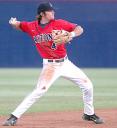
Donald, Jason, SS (age 22) Grade = C+

I wasn’t crazy about it when the Phillies took Donald in the third round of the 2006 draft, but I can see why they did. The Phillies have basically 1 legit prospect in the middle of the infield, and that’s Brad Harman, who had a nightmare 2006 season. Donald was a premier prospect a few years ago and turned down a 1 million dollar bonus from Anaheim as a 20th round flier pick to attend Arizona. His stock has dropped since then, but he hit enough and was solid enough defensively to go in the third round. The Phillies think he’ll have enough range to stay at SS, but his bat is the big question mark. His composite numbers at Batavia put him 19% or so above league average, but for a college player, this isn’t exactly lighting the world on fire. His one surprising area was that he managed to steal 12 bases in 13 tries, after never stealing more than 7 in a season at Arizona. Donald appears to have another skill, getting plunked by pitches. In his three seasons at Arizona, he was hit a grand total 39 times, and he managed get hit 5 times at Batavia. This helps to raise his otherwise modest OB%, as he doesn’t draw a ton of walks. He made 9 errors at SS, but as I mentioned before, it’s tough to really assess fielding stats, especially in the lower levels, where field conditions are, shall we say, less than ideal. Donald’s grade was lowered based on his poor walk rate and lack of power at Batavia, but he could very well bounce back once fresh at Lakewood, and if he can steal 15-18 bases in 2007, it will improve his stock a bit.

Ceiling: A major league shortstop, but to what degree is uncertain. If his fielding drops off a bit, he looks more like a backup, especially if his bat doesn’t improve at Lakewood.

Floor: A utility infielder that bounces around and never really makes a mark.

Conclusion: Donald seems to do a bunch of things in above average fashion, but doesn’t really do anything overly well. He has a good hitting record in college and was lauded for his defense, we’ll have to see if it translates to his pro career. He’ll be the everyday SS at Lakewood, partnered in the middle of the infield with Adrian Cardenas at 2B. It should be an interesting combination to watch.

cyarbrough1.jpg

Yarbrough, Charlie, 1B (age 22) Grade = C+

Yarbrough, the Phillies 7th round draft pick in 2006, really is an interesting guy. He has been overlooked since high school, attending smaller schools, despite his huge frame (6’6, 255 lbs) and his massive power potential. He played two seasons at Longwood University, a D-II program, and then transferred to Eastern Kentucky, another small school. In his junior year, he tossed up a .739 slugging %, including 18 HR in 55 G. Still, he went under the radar, mainly because of his lack of a position other than 1st, and his playing at a smaller school. The Phillies nabbed him, and I’m sure in the back of their mind, they were thinking “a righthanded Ryan Howard”, and it’s clear why, based on physical stature and college background. Yarbrough got his first taste of advanced competition by being sent to Batavia, and he struggled, putting up a .625 OPS in 204 AB. He struggled in every facet of the game, but again, you have to be somewhat lenient, based on his lack of top competition in college, going to a league where some guys are playing for the second time, and others are high profile college pitchers. His numbers against LHP and RHP were fairly similar, and he made 5 errors. I could probably give him a straight C, but his college performance was strong, from all accounts he has a tremendous work ethic, and he is entitled to a free pass for his 2006. He’ll probably be the full time 1B at Lakewood, and if he turns it on, we’ll see what he can do, and if he doesn’t, his grade will drop.

Ceiling: A major league 1B who hits the ball really hard

Floor: Organizational filler

Conclusion: The Ryan Howard paralells are there, both on and off the field, but Howard put up an .840 OPS at Batavia in his age 21 season, compared to the .625 from CY. In his first full season, Howard put up an .827 OPS at Lakewood, with 19 HR in 493 AB. If Yarbrough ends up in that area, then we’ll be talking. However, anything in the .780-.800 range would be acceptable, in his first pro season. With guys like this, the chances of them succeeding are smaller than most, mainly because they are position locked. The potential for a 40 HR hitting beast is there, but we’ll see what happens. If he can’t adjust to offspeed pitches, he might not even hit 4 HR. Like Pfinsgraff, my grade might be generous now, but I’m willing to risk it.