The most common question I get when people e-mail me is “What do you think of pitcher X” or “what is pitcher X’s upside”. I figured that this would be a good spot for me to talk a bit about how I look at pitchers, what I focus on, and why, and then to also talk a little about my theory on starting pitching designations in the majors. Hopefully this will answer some questions that people have, or just serve as a good discussion on player evaluation. So check below and we’ll get started.
As I’ve mentioned, notably when doing my SONAR writeups, I’m a very big believe in the DIPS statistics, or defense independent pitching statistics. The research, which was spearheaded by Voros McCracken about 10 years ago, outlines that pitchers have very little control over what happens when a ball is put in play, which goes against a lot old school beliefs. McCracken’s research highlighted 3 things that pitchers have control over; strikeouts, walks, and to a lesser extent, home runs allowed. I’m not going to go into great detail discussing this, or his research, but I suggest you do some reading, and if you have specific questions, I’ll try and address them. I recommend you check out this article, and this one, and this wikipedia entry for a general overview.
Having outlined that, when I evaluate any pitcher, I consider the following 6 factors;
1. Starter or reliever – Its a fairly well established fact that starters are more valuable than relievers, and that over a 162 game season, the difference will be quite stark. Elite relievers are valuable, but relievers’ performance fluctuates much more wildly than that of a starting pitcher because of batting average on balls in play (luck)
2. Strikeout rate – Strikeouts indicate that a batter is swinging and missing. Obviously! But when a batter doesn’t make contact, the pitcher has complete control over the outcome of the PA.
3. Walk rate – Likewise, if a pitcher can’t control the ball, the batter gets a free ride to 1B. Putting lots of guys on without making them work for it is a recipe for disaster, because..
4. Home run rate – When a pitcher misses with location over the middle of the plate, bad things often happen. While a pitcher does not have complete control over home runs (HR per flyball percentage is a great stat to show relative luck here), most home runs are the result of a very poor pitch.
5. Groundball percentage – Take a look at the 3 slash batting lines on balls in play, broken down by groundball, flyball, and line drive for the American League in 2009
Groundball: .239/.239/.259 (.020 ISO)
Flyball: .224/.218/.603 (.379 ISO)
Line Drive: .739/.736/1.015 (.276 ISO)
When the ball is put on the ground, it has a better chance of going for a hit than a flyball, but 99% of the time its going to go for a single. When the ball is hit in the air (fly ball) it might go for a hit fewer times, but the potential for a home run is 100% higher than for a groundball. Line drives are basically toxic poison for pitchers.
6. Fastball velocity – Kevin Goldstein at BP talked about velocity and its importance a while back (subscriber content for the whole article, the preview is free). As we know, baseball is a game of inches, and for pitchers, its all about the margin for error. The difference between a perfectly located fastball and one that flies over the fence is only a few inches, and because of this, every mile per hour on a fastball is important. The difference between a guy throwing 90 mph and 95 mph is astronomical. For lefthanders, velocity is not as big a concern, but for righthanded pitchers it is vitally important.
So that is what I’m focusing on when I look at a pitcher. The other big thing I wanted to discuss is “#1 starting pitcher” and other designations like it. When I look at pitchers, both in the minors and majors, I think it makes sense to break up starting pitching into 3 categories; aces, surefire starters, and #5/swingmen starters. Roy Halladay is an ace. Tim Lincecum is an ace. You know that, barring injury, these guys will throw 215+ innings in a season, strike out their share of batters, limit the home runs, and be on average 35-50% better than the league average starter. Kyle Kendrick is a 5th starter. With Kendrick, you know he doesn’t strike anyone out, his control is adequate, but he’s largely dependent on the ball being put in play and hit at someone. He’s capable of throwing a great game, but more often than not, you’re wondering how he got it done. You can fill in lots of names between. Cole Hamels has shown flashes of brilliance, but he’s very home run prone, which will always impact his ERA. In a given season (or postseason) he can dominate, but he doesn’t have a track record of dominance. Joe Blanton, prior to this season, was a guy who belonged in that middle group. He threw 200 innings every year, he was always at or above the league average ERA levels, and you know you could expect good middle of the rotation stuff from him.
When I look at a prospect, this is how I look at it. I like at Brody Colvin and Jarred Cosart and see them as potential #1 guys, with their fallback plan being somewhere in the middle guys. With a guy like Drew Carpenter, he’s a #5 starter, with very little chance to crack that second group. I don’t think about #2 starters, or #3 starters, or anything else. I view it more as a caliber of pitcher, and I think that’s how most things should be looked at. Jeremy Guthrie is the Orioles “#1 starter”, but is he a #1 caliber starting pitcher? Probably not. Actually, I know he’s not. So that should explain where I’m coming from.
Looking at our current starting pitching prospects, I think I’d divide them up as follows
Potential Ace
Cosart
Colvin
Potential Solid Starter
May
JC Ramirez
Aumont
Worley (borderline)
Sanchez (borderline)
Hernandez (borderline)
Shreve (borderline)
Potential #5/Swingman
Carpenter
Pettibone
Hyatt
Flande
Correa
Way
Julio Rodriguez
Cisco
This is a very back of the envelope ranking without a ton of analysis done. I didn’t include Biddle or Garner, because they have so little experience. But you should get the idea. I wanted to close with a chart. This chart captures the top 25 pitches in baseball in 2009, ranked by VORP, or value over replacement player, at Baseball Prospectus. Take note of the K rates and velocity
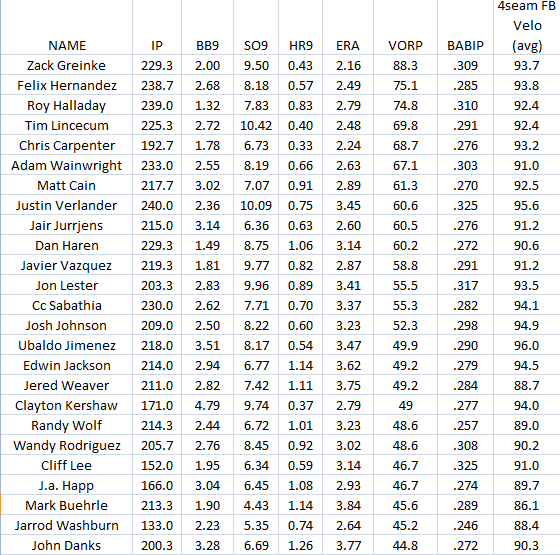
* On this list, only 1 RHP had an average fastball velocity of less than 90 mph, and that was Jered Weaver. Weaver has a very deceptive delivery, which helps. Also of note, his velocity on his fastball has ticked up this season.
* Dan Haren’s average fastball velocity was only 90.6, but his absurdly low walk rate is the big reason for his success. He gives up a lot of home runs, but lots of them are solo shots because he doesn’t issue many walks.
* As I noted above, velo is less important for lefties, evident in the success of the guys at the bottom of the top 25.
Velocity isn’t the end all be all. But if you’re a righthanded pitcher who consistently pitches in the 88-90 range, and you don’t have 2 knockout secondary pitches and extreme precision, you’re probably not going to be an elite starting pitcher. Everyone loves the Greg Maddux comparison for righties that don’t throw hard, but in his prime, Maddux sat in the 92-95 range with pinpoint command and control, much more velocity than he featured at the end of his career. Throwing hard helps. So does having incredible control. So does having great secondary pitches. You really need all of those to be an ace. You need 2 of 3 to be a good solid starter, and you need at least 1 of 3 to be a fringe starter. But when you have 1 of 3, more times than not you’re a #5 starter at best, a good reliever at worst.
 Phuture Phillies
Another thing to consider, and admittedly it would be tough to do without knowing the player very well, is his baseball IQ. Often times, the difference between a great pitcher and a good one is more than just the “arm.” The “head” has a lot to do with it. The write-up mentions Greg Maddux. Yes he had a great arm and pinpoint control but he also knew how to work the batter, the count and the umpire. He would start on the black and move off it to finish off the batter when the ump gave him the pitch.
Without seeing the kids in the lower levels pitch very often, it’s difficult to tell if they work the strike zone effectively. Are the pitchers setting up the batters for the pitcher’s pitch (a la Jamie Moyer who doesn’t throw hard at all) or are they just relying on 95 mph fastballs b/c that’s all they’ve had to do in the past.
LikeLike
Jurrjens seems a little out of place. Happ as good as Lee is interesting.
Prospect-wise I agree with your list given recent performance.
I think May has ‘ace’ stuff but obviously (like Aumont) walks are a huge concern. I do not know much about Pettibone or Julio Rodriquez to make a guess on their projection. Thought Hyatt would have to move to reliever but it sounds like he has both a good changeup and slider so maybe he can remain a starter. I have no idea what pitches Sanchez throws but I assume they would be limited since he was a catcher.
LikeLike
Worley is trying to move up the rankings from borderline to solid starter…so far through 7 innings he is looking good today..can you say hello Lehigh Valley?
LikeLike
Vance Worley has now thrown 17 shutout innings, and in his last 10 starts, 8 has been quality starts. He is on a serious roll.
LikeLike
I think Heitor Correa’s upside is far, far higher than #5/swingman. He’s a bit of a dark horse, but there’s a serious arm there.
LikeLike
Too early to classify Pettibone and Rodriguez, think their upside is still considerable even if they are far from realizing it. Pettibone in particular was drafted with the expectation he would add velo in time. A report on BA had him showing significant improvement.
LikeLike
I was high on Correa once upon a time.
But he’s not really impressed this year, and losing that entire season because of suspension has set him back.
LikeLike
Correa has a serious arm, but it seems like he hits a batter every other inning.
PP seems to have raised his opinion of Worley significantly since the end of last season.
LikeLike
Great point on Maddux…most people I talk to forget that he used to throw low 90s with no issue and only remember the 85-87 mph Maddux. Maddux could bring it early in his career.
LikeLike
PP distinguished between the potential Aces and the solid starters. It would have been nice if he went further and labled the potential #2s and #3s, if any. BA says a #2 has two plus pitches, plus command. T May has 2 potential plus pitches, but doesn’t have control or command yet (same for Aumont). I hear varying reports on Ramirez’s plus pitch potential. BA said Worley doesn’t have any plus pitches, but has decent command on everything.
I would be interested to see what PP sees as each of their ceilings.
#2 or 3/4 starters.
LikeLike
I know this is semantics, but I would distinguish between an ace and a No. 1. I think a No. 1 is a top 30 starter, while an ace is a starter who gives consistently outstanding performances every 5 days, i.e., a stopper.
There are very few true aces; even fewer who have been aces over an extended period of time. Halladay is a long-time ace. Santana also has been an ace for several years, but may be slipping as his velocity and K rate decline.
Although he is No. 2 on the Phillies, I think Hamels is a No. 1.
LikeLike
good stuff, although i don’t think maddux was ever sitting 92-95.
LikeLike
I remember Maddux pitching at 90-92 in his prime. Pedro is the command artist who pitched at 95-96.
LikeLike
Maybe the Cubs version of Maddux was in the low to mid 90s, but the dominant Maddux I saw was in the high 80s, occasionally going to about 90-92. His FB sat around 90, but it didn’t matter. Maddux was a lot like Halladay, except he didn’t throw as hard, actually had more movement and had the most amazing pinpoint precision with all of his pitches PLUS he was like a tenured Professor of Pitching. He just toyed with batters. They had almost no chance against him as he was always 3 chess moves ahead. He’s a pretty bad example of velocity being important, but he was a rare find. For every Greg Maddux there are 10,000 Drew Carpenters.
LikeLike
Pedro Martinez was, for about 5 or 6 years, quite possibly the greatest pitcher in baseball history . . . and that is saying something. Koufax was as dominant, but thrived in a pitchers’ era, with bad hitting and raised mounds. Martinez pitched at the height of the greatest hitters era since the 1930s.
LikeLike
My point was, the distinction between a #2 and a #3 starter means nothing to me.
LikeLike
Great insights into your view of prospects.
I’d like (maybe during the offseason) an article or two on the prospects who suprised you the most, either good or bad. I haven’t been following minor leagues very long, but one name which sticks out to me is Andy Marte, who everyone was sure was going to be a perrineal all-star, and instead became a fringe bench player. On the other side, who knew Happ could have the kind of season he did last year? Even if you subscribe to the theory that he got incredibly lucky, it’s hard to put up those kinds of numbers and still somehow suck.
Once again, great article.
LikeLike
I like the general classification PP has chosen. Depending on the quality of the team, as PP mentioned, #1 starter means different things.
No prospect (even Strasburg but it is tempting) should ever be labeled ‘Top 5 in baseball’ even on potential because that distinction requires at least a few years of major league production.
Endless debate can be made on the fine distinction of ‘Top 5’, ‘proven ace’, ‘young ace’, and ‘ace stuff”. On the prospect front, if you have ace stuff and consistently dominate the minors per age/level you deserve that level of projection.
Inconsistent ‘ace stuff’ or great pitchability probably goes into the Potential Starters category where certain prospects move up or down from there.
Fringe starters generally have neither great stuff nor consistence dominance but seem to be successful through the minors. Extremely unlikely to become an ace under any definition but could move into consistent starter but with little margin for error.
LikeLike
If I understand correctly, the distinction between a #1, #2, and #3 might mean something in the majors, but makes no sense in evaluating minor league talent. You can’t possibly be that fine-grained because too many variables will intervene during a players development.
It’s like trying to predict precisely where a particle where hit in a test chamber. You can make some general statements, but you don’t know precisely where it will hit ever.
LikeLike
Can you explain why velocity isn’t a big concern for LHP? Is it just because they’re more rare than RHP?
LikeLike
There is a stat that is very effect in measuring how good a starting pitcher is doing over an entire season. The stat is the yearly average starting pitcher game score. It can tell you if a pitcher is pitching as an Ace (#1), #2, #3, #4 or a #5 in that particular year. It also shows how well a prospect is doing. It is a very accurate stat since run, earned runs, innings pitched, hits, walks and strikeouts are all used in determining the starting pitcher game score.
A pitcher who puts up an annual score of between 56 to 60+ is an Ace or # 1.
A pitcher who puts up an annual score of between 52 to 55.99 is a # 2.
A pitcher who puts up an annual score of between 48 to 51.99 is a # 3.
A pitcher who puts up an annual score of between 44 to 47.99 is a # 4.
A pitcher who puts up an annual score of between 40- to 43.99 is a # 5.
The scores for the top 25 major league pitcher in 2009 are;
Greinke Zack – 09 — 63.4
Hernendez Felix – 09 — 60.4
Roy Halladay – 09 — 60.4
Lincecum Tim – 09 — 64.5
Carpenter Cris – 09 — 62.1
Wainwright Adam – 09 — 59.4
Cain Matt – 09 — 58.3
Verlander Justin – 09 — 58.6
Jurrjeins Jair – 09 — 57.1
Haren Dan – 09 — 60.8
Vazquez Javier – 09 — 61.6
Lester Jon – 09 — 57.2
Sebathia CC – 09 — 57.2
Johnson Josh – 09 — 57.1
Jimenez Ubaldo – 09 — 56.9
Jackson Edwin – 09 — 54.1
Weaver Jared – 09 — 54.4
Kershaw Clayton – 09 — 58.0
Wolf Randy – 09 — 56.8
Rodriguez Wandy – 09 — 56.6
Cliff Lee – 09 — 56.3
JA Happ – 09 — 55.6
Buehrle Mark – 09 — 51.1
Washburn Jarrod – 09 — 53.1
Danks John – 09 — 53.2
The average score of these 25 for 2009 is 57.8.
The scores of recent Philly Major League Pitchers:
Halladay – 10 — 64.1 — 1
Hamels – 10 — 54.7 — 2
Moyer – 10 — 50.5 — 3
Kendrick – 10 — 48.0 — 3
Blanton – 10 — 41.0 — 5
Happ – 10 — 55.5 — 2
Figueroa – 10 — 51.0 — 3
Happ – 09 — 55.6 — 2
Lee – 09 — 55.7 — 1 — 56.3
Blanton – 09 — 52.5 — 2
Hamels – 09 — 51.5 — 3
Moyer – 09 — 47.1 — 4
Myers – 09 — 49.7 — 3
Bastardo – 09 — 43.8 — 5
Martinez – 09 — 52.1 — 2
Lopez – 09 — 41.7 — 5
Kendrick – 09 — 50.0 — 3
Park – 09 — 40.0 — 5
Hamels – 10 — 54.7 — 2
Hamels – 09 — 51.5 — 3
Hamels – 08 — 58.8 — 1
Hamels – 07 — 57.7 — 1
Hamels – 06 — 53.9 — 2
Halladay – 10 — 64.1 — 1+
Halladay – 09 — 60.4 — 1+
Halladay – 08 — 60.4 — 1+
Halladay – 07 — 53.6 — 2
Halladay – 06 — 56.4 — 1
Halladay – 05 — 63.5 — 1+
Halladay – 04 — 50.6 — 3
Halladay – 03 — 58.0 — 1
Halladay – 02 — 56.9 — 1
Moyer – 10 — 50.5 — 3
Moyer – 09 — 47.1 — 4
Moyer – 08 — 51.2 — 3
Moyer – 07 — 46.6 — 4
Moyer – 06 — 48.9 — 3
Myers – 09 — 49.7 — 3
Myers – 08 — 50.5 — 3
Myers – 07 — 39.3 — 5
Myers – 06 — 53.9 — 2
Myers – 05 — 55.5 — 2
Myers – 04 — 45.6 — 4
Myers – 03 — 49.0 — 3
Myers – 02 — 48.3 — 3
Blanton – 10 — 41.0 — 5
Blanton – 09 — 52.5 — 2
Blanton – 08 — 47.5 — 4
Kendrick – 10 — 48.0 — 3
Kendrick – 09 in Majors — 50.0 — 3
Kendrick – 08 — 42.6 — 5
Kendrick – 07 — 49.9 — 3
Happ – 10 in Majors — 55.5 — 2
Happ – 09 — 55.6 — 2
Happ – 08 — 56.3 — 1
Happ – 07 — 46.2 — 4
Happ – 06 — 59.3 — 1
Happ – 05 Est — 60.6 — 1+
Happ – 04 Est — 54.5 — 2
Lee – Playoffs – 09 — 70.0 1++
Hamels – Playoffs – 08 — 66.4 1++
All 2010 scores are through July 15, 2010.
Scores for Philly Minor Leaguers:
Jarred Cosart – 09 —- 56.1 —- 1
Brody Colvin – 10 —- 52.2 —- 2
Trevor May – 10 —- 51.0 —- 3
J.C. Ramirez – 10 —- 52.0 —- 2
Phillippe Aumont – 10 —- 42.6 —- 5
Vance Worley – 10 —- 52.9 —- 2
Jesus Sanchez – 10 —- 56.2 —- 1
Nick Hernandez – 10 —- 66.5 —- 1+
Colby Scheve – 10 —- 54.3 —- 2
Andrew Carpenter – 10 —- 52.3 —- 2
Jonathan Pettibone – 10 —- 48.6 —- 3
Austin Hyatt – 10 —- 55.2 —- 2
Yohan Flande – 10 —- 48.7 —- 3
Heitor Correa – 10 —- 42.8 —- 5
Matthew Way – 10 —- 52.0 —- 2
Julio Rodriguez – 10 —- 55.0 —- 2
Michael Cisco – 10 —- 47.7 —- 4
Andrew Carpenter – 07 —- 54.4 —- 2
Andrew Carpenter – 08 —- 48.7 —- 3
Andrew Carpenter – 09 —- 51.1 —- 3
Andrew Carpenter – 10 —- 52.3 —- 2
Austin Hyatt – 09 —- 63.7 —- 1+
Austin Hyatt – 10 —- 55.2 —- 2
Brandon Duckworth – 10 —- 52.1 —- 2
Brian Mazone – 10 —- 50.7 —- 3
Brody Colvin – 10 —- 52.2 —- 2
Drew Naylor – 07 —- 58.5 —- 1
Drew Naylor – 08 —- 54.3 —- 2
Drew Naylor – 09 —- 51.8 —- 3
Drew Naylor – 10 —- 51.1 —- 3
Heitor Correa – 09 —- 49.1 —- 3
Heitor Correa – 10 —- 42.8 —- 5
Nick Hernandez – 09 —- 55.5 —- 2
Nick Hernandez – 10 —- 66.5 —- 1+
J.C. Ramirez – 10 —- 52.0 —- 2
Jarred Cosart – 09 —- 56.1 —- 1
Jarred Cosart – 10 —- 54.8 —- 2
Jesus Sanchez – 10 —- 56.2 —- 1
Joe Savery – 07 —- 52.3 —- 2
Joe Savery – 08 —- 48.3 —- 3
Joe Savery – 09 —- 48.0 —- 3
Joe Savery – 10 —- 45.3 —- 4
Jonathan Pettibone – 10 —- 48.6 —- 3
Matthew Way – 09 —- 59.1 —- 1
Matthew Way – 10 —- 52.0 —- 2
Michael Cisco – 08 —- 64.6 —- 1+
Michael Cisco – 09 —- 51.7 —- 3
Michael Cisco – 10 —- 47.7 —- 4
Nate Bump – 10 —- 53.4 —- 2
Phillippe Aumont – 10 —- 42.6 —- 5
Trevor May – 08 —- 48.8 —- 3
Trevor May – 09 —- 57.5 —- 1
Trevor May – 10 —- 51.0 —- 3
Vance Worley – 08 —- 56.3 —- 1
Vance Worley – 09 —- 45.7 —- 4
Vance Worley – 10 —- 52.9 —- 2
Yohan Flande – 08 —- 56.8 —- 1
Yohan Flande – 09 —- 52.8 —- 2
Yohan Flande – 10 —- 48.7 —- 3
All 2010 scores are through July 15, 2010.
LikeLike
I’m surprised you didn’t talk at all about movement. A Ubaldo Jimenez 95 MPH FB is nothing Like Verlander’s 95 MPH Fastball. Maddox could start his 2 seam at a lefty and bring back to the inside corner at will.
Baseball peeps now a days like to call it “Stuff” meaning the hitters have a hard time squaring up or barrelling up a pitcher because his stuff is all over the place.
In addition to that there are heavy balls. Ever play catch with someone that does not have big time velocity but the ball hits your mitt like it was 5 pounds? My point being this information is probably in the periphial numbers but when scouting these would be notes that ride along with the report.
LikeLike