The third installment of the SONAR position by position breakdown focuses on the hot corner, looking at the best 3B prospects in the game and how they fared with my newly created metric. if you’re new to the whole SONAR concept, I recommend you start here, then check out the report for first base and second base. Third base has its difficulties, just like the up the middle positions, because the defensive value dropoff from 3B to the positions further down the defensive spectrum is steep, especially the drop from 3B to 1B, which is a common transition for some slow footed sluggers. Check below the fold and we’ll dig right in
I feel compelled to mention this caveat prior to all of my SONAR related work now, since it seems I’ve had to make the same statement over and over again when discussing the concept. SONAR scores are meant to be one data point that you consider when trying to evaluate a prospect. There is no one statistic, whether it be OB%, SLG%, stolen bases, or any defensive metric that can tell you everything you need to know about a prospect, either for good or bad. When evaluating prospects, its vitally important to look at every piece of data available and use it to come to a conclusion on a guy, and even then, you have to admit that you could be very wrong about a guy, simply because of how fast prospect status can change. SONAR is an attempt to look at 1 season of data and put that season into the proper context, based on the player’s age, what league he was in, and how he was impacted by his home park. SONAR doesn’t know how tall a guy is, how fast he is, whether he’s likely to have to move to another position, whether he’s a good guy off the field, or whether he’s as dumb as a sack of doorknobs. The subjective nature of evaluating baseball players (so and so “just looks like a player” and “his speed is gamechanging”) is just that, subjective, and it doesn’t interest me as much as the objective. Again, not everything you need to know is in a player’s numbers. And 1 year of data is far from perfect. After the 2010 season, there will be a companion score to SONAR, maybe called SONAR2, which will be a weighted 2 year average, and then maybe SONAR3 after 2011, which, you guessed it, will be a 3 year weighted average. Sample size is important (and accounted for in the SONAR score given below), and so these 2 and 3 year weighted scores will be another important data point to consider. For now, SONAR only considers 2009 data, which is why some guys who didn’t play, or only played small chunks of time, will have lower scores and rank lower than consensus opinion would have you believe. That’s why I go through these lists, talk about the top 20 guys, and then hit on other prospects who fell outside the top 20, or had negative scores. I want to try and figure out what the player’s score tells me, and whether I think its predictive for future years, or simply statistical noise.
So with that out of the way, here is the chart for 3B. (Click here if it doesn’t display properly)
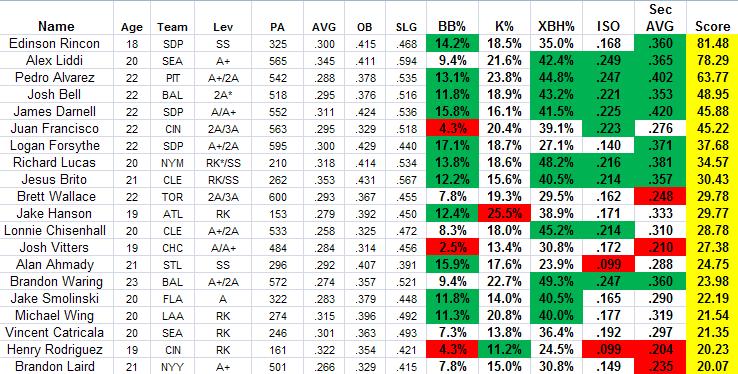
01 – Edinson Rincon (SDP) – SONAR 81.48
Rincon might come as a surprise, but I like everything I see here. I did some searching for info on him, but he doesn’t appear to be a big bonus guy, with the Padres signing him out of the Dominican in 2006 or 2007. He started the 2007 season, at age 16, in the Dominican Summer League, coming to the US for a brief 53 PA cameo, which didn’t go so well. He repeated the rookie level AZL in 2008 and put up a very solid .308/.429/.354 line in a short 85 PA sample. He was nowhere to be found in San Diego’s Top 30 according to Baseball America, so apparently the scouts weren’t overwhelmed. The Padres bumped him to the Northwest League, another rookie level league but with more advanced players, and he responded with a convincing .300/.415/.468 line in 325 PA. The first thing that jumps out at you is Rincon’s advanced approach at the plate, as he drew 46 BB in 2009, after drawing 14 in just 85 PA the year before. While the 60 strikeouts aren’t great, he’s now hit .300 or better the last two seasons, and has 60 BB in just 410 PA, an excellent ratio. His .168 ISO isn’t spectacular for a 3B, but its important to remember that he didn’t turn 19 until the middle of August, and that he was younger than a lot of prospects in the NWL. He has a solid 6’1/185 frame, and he should fill out a bit more and add muscle over the next few seasons. He’s likely headed to the MWL, where he’ll play the majority of the season at age 19, young for his level. He appears to have the physical tools, and more importantly, an advanced approach at the plate. BA had him rated the #2 prospect in the NWL, so it seems that people are catching on.
02 – Alex Liddi (SEA) – SONAR 78.29
Liddi was a great test case, as he played his home games at High Desert in the Cal League, one of the best hitting parks in all of the minors. Even with major adjustments for his home park, he still scores very highly, which doesn’t come as a complete surprise to me. Though his surface numbers weren’t good last year (.244/.313/.360) he seemed to have potential, as he’s got a projectable frame (6’4/180) and was always one of those guys who seemed like he could take off at any moment. Coming from Italy, he was obviously going to be slightly behind the curve because of the lack of experience against top competition. Seattle rushed him to the MWL at age 18 in 2007, had him repeat the level in 2008, and then sent him to the Cal in 2009. His raw numbers were video game like; .345/.411/.594 in 565 PA, and as I mentioned, High Desert was the best hitting park in the Cal League. While his numbers were dominant at home (.370/.457/.664), his away line was still respectable at .303/.348/.500 in 254 AB. Its also important to note that 2009 was his age 20 season, so he was still younger than the average A+ level prospect by a year. Liddi isn’t a 1.000 OPS player going forward, and his overall line was influenced by his league and park, but his away line shows he still has power. The only blip on the radar is that his BB rate of 9.4% is good, but not great, and it will be an area he’ll need to work on going forward. He also struck out in 21.6% of his PA’s, and its not too tough to see him as a guy who could turn into a .275/.340/.480 guy in the big leagues, kind of like the recently departed Adrian Beltre. I’m sure Seattle would be fine with that. Liddi is still young, he’s still learning, and he’s probably still got room to fill out and add some muscle to his frame. He’s going to see some regression next year moving to AA, but I like the overall package here.
03 – Pedro Alvarez (PIT) – SONAR 63.77
The 2nd overall pick in 2008, Alvarez had to deal with a bunch of drama before ever stepping onto the pro stage, as his contract negotiations became a national story, with him finally signing after the deadline, which MLB somehow allowed. Then there were questions about his conditioning in instructional league, and whether he was fully committed. The Pirates started him in A+, and the results were modest for a player with such high expectations, as he went just .247/.342/.486 in 284 PA. However, he kicked it up a few notches after a midseason promotion to AA, posting a .333/.419/.590 line in 258 PA, giving him an overall line of .288/.378/.535 in 542 PA, a very solid debut. Alvarez already appears to be a 3 true outcomes type of player, posting a 13.1% BB rate and a high 23.8% K rate, while also showing great power, with a .247 ISO and a .402 SecA. The biggest issue surrounding him now is his defensive position, as lots of scouts tend to think he’s going to be forced to move to 1B sooner rather than later. His bat will play at 1B for sure, but he becomes less valuable there defensively. The strikeouts are a modest concern, as is the .714 OPS against LHP in 2009.
04 – Josh Bell (BAL) – SONAR 48.95
In what is becoming a yearly occurrence, the Dodgers decided to trade away a future everyday player for a bit part at the deadline, this time trading Bell to the Orioles for LOOGY George Sherrill, a year after trading away one of the best catching prospects in the minors (Carlos Santana) for caveman Casey Blake. Bell is a gifted athlete with great tools, but is still a bit rough around the edges. He was having a nice year in the LA system at AA before the deal, hitting .296/.386/.497, but turned on the power game after the deal, hitting .289/.346/.570 in 114 PA with AA Bowie in the Eastern League to finish the season. His overall line of .295/.376/.516 is quite impressive, and at 22 and spending the whole year in AA (in two different leagues), he was age appropriate. His 11.8% BB rate and .221 ISO are both excellent, and he’s kept the strikeouts manageable. He doesn’t appear to have much in the way of speed, as he has just 4 triples and 7 stolen bases (as well as 7 caught stealing) in the last 2 seasons, so he’s going to get to the big leagues on the strength of his bat. Scouts seem mixed on his ability to stay at 3rd, and he has less room for error if he has to move to another position.
05 – James Darnell (SDP) – SONAR 45.88
The Padres second representative on this list, Darnell comes with a higher profile, as he was a 2nd round pick in the Padres plentiful 2008 draft. Darnell had a good but not amazing college career at South Carolina, putting up better numbers his sophomore year before dealing with some minor injuries his junior year. He started off in Low A, a passive assignment for a refined college bat, but he finished up strong at A+, posting a .930 OPS in the Cal League, for an overall line of .311/.424/.536 in 552 PA. His 15.8% BB rate is outstanding, the .225 ISO is solid, and he doesn’t have big strikeout issues. His .420 SecA ranks at the top of the list for all 3B prospects. Speed does not appear to be a part of his game going forward, and I haven’t heard strong positive or negative accounts of his defense at 3B. He looks legit, he just needs to dominate at AA/AAA in 2010 to remain near the top of the list.
06 – Juan Francisco (CIN) – SONAR 45.22
Francisco has been on scouts’ radars for a while, as he was seen as a raw prospect with tons of tools, but with a propensity for the swing and miss, and questions about his defense. He’d put up decent numbers considering age and level prior to 2009, but 2009 was his best statistical season, posting a 3 slash line of .295/.329/.518 in 563 PA between AA and AAA, while also making a brief big league cameo in September. Francisco’s raw power is excellent, evident in the .223 ISO and 27 HR in 2009. In fact, he has an impressive 75 HR over his last three seasons. The big issue, however, is his lack of contact and also the lack of walks. His 4.3% BB rate is poor, and the 20.4% K rate is still highish, even if its an improvement from prior seasons, when he struck out 161 and 123 times respectively. It doesn’t appear he’s ever going to draw at least an average amount of walks, but if he can cut down on the strikeouts while maintaining the power, he’ll be an above average offensive player. Where he plays defensively is another question, as he could have to move to LF or RF, which would raise the requirements for his bat.
07 – Logan Forsythe (SDP) – SONAR 37.68
Forsythe is the Padres’ 3rd entry on this list, quite an impressive feat, and I like his game quite a bit. Limited by injuries in his debut 2008, the supplemental 1st round pick had a nice 2009, posting a combined .300/.429/.440 line in 595 PA across A+/2A. His game is built on his keen batting eye, as his 17.1% BB rate topped the charts for all 3B. What worries scouts is the lack of power, evident in the .140 ISO he posted this season. He did manage to steal 11 bases in 13 attempts and added 6 triples, so he appears to be a decent base runner, but likely won’t do quite enough to add a whole lot of value offensively. His bat actually profiles perfectly at 2B, and there have been some musings that San Diego could try him there, especially with their apparent depth at 3B. The lack of power + tons of walks is often a trouble sign, because its tougher to maintain the walk rate if pitchers aren’t scared to throw you fastballs. But Forsythe seems to have good enough contact skills to be an offensive asset, and the power could still emerge, at least solid doubles power, which will play up in PETCO’s spacious confines.
08 – Richard Lucas (NYM) – SONAR 34.57
A 4th round pick in 2007, Lucas was terrible in his first two seasons, posting a .669 OPS in his debut, then a .570 OPS last year across two levels. He saw his fortunes change a bit in 2009, as he posted a .318/.414/.534 line in 210 PA across three levels, all short season leagues. The majority of his 210 PA came in the rookie level Appalachian League, where he posted a .357/.471/.622 line in 121 PA. His NYPL stint (69 PA) didn’t go quite as well, with a .250/.319/.400 mark, but even that is a huge improvement over his 2007 and 2008 numbers. Lucas turned 21 in November, so he’ll likely be a year too old for Low A next year, but not too out of line. His BB rate (13.8%) and ISO (.216) are both in line, and his K rate was decent, so no big red flags. He needs to replicate his success from 2009, but if he does, he’s a very real prospect.
09 – Jesus Brito (PIT) – SONAR 30.43
The Pirates acquired Brito in a minor deal this winter in which they sent middling shortstop Brian Bixler to Cleveland. Brito looked to be a middling prospect as well prior to his 2009 breakout in which he hit .353/.431/.567 across two rookie levels in his US debut. He’d spent his prior three seasons in the Dominican Summer League, so this was quite a stateside debut, even if he was too old for rookie ball. His 12.2% BB rate was good, as was the .214 ISO and his 15.6% K rate was excellent considering his power. He only stole 2 bases, but did have 10 triples, so he appears to have some raw speed. At 6’1/160, he has room to add muscle and possibly a bit more power. Because he was 21 and in rookie ball, its tough to really get a grasp of his upside. SONAR adjusts his score because of his age related to level, but his score is still impressive. He turned 22 at the end of December, so he certainly needs to start in Low A, preferably in A+ with a move to AA by the end of the year, but the offensive package looks promising.
10 – Brett Wallace (TOR) – SONAR 29.78
Wallace is one of the more famous names on the list, as he was part of the Roy Halladay/Cliff Lee musical chairs deal back in December. Wallace is a 3B in name only, and Toronto has already indicated that he’s going to be moved to 1B next season. But since he was a 3B in 2009, I’m doing his writeup here. If you’re curious where he ranks among 1B prospects, I added him in to that list, so check back through the archives. Wallace has always been labeled “a pure hitter”, and while his 2008 debut was excellent (.337 BA across two levels), he hit .293/.367/.455 across three stops in 2009, a good line but maybe not quite up to his standards. In fact, none of his peripherals stand out, whether it be the 7.8% BB rate, the .162 ISO or the .248 SecA. The offensive requirements are much higher at 1B, so its tough to see Wallace as an elite option unless he rebounds in 2010.
11 – Jake Hanson (ATL) – SONAR 29.77
Hanson, a 14th round pick in 2008, was repeating the GCL this season, and showed much improvement, hitting .279/.392/.450 in 153 PA, an improvement over his .246/.371/.333 line in 2008. His numbers are helped by a solid 12.4% BB rate and .171 ISO, but his 25.5% K rate is a definite red flag. While I’m not one to really place much weight at all on minor league fielding numbers, his .798 fielding percentage (18 errors in 33 games) is rather alarming. At 6’0/180, he’s probably maxed out physically, or close to it, and it seems that because of his defense he might be forced to the outfield at some point, where the demands on his bat would increase.
12 – Lonnie Chisenhall (CLE) – SONAR 28.78
Chisenhall was a somewhat surprising pick by Cleveland at the tail end of the first round in 2008. Off the field trouble forced him to a Junior College program, and questions about his makeup pushed him down many draft boards. Cleveland was convinced it was a one off issue, and they liked his offensive game. In his first full season he posted a .258/.325/.472 line across A+/AA. His overall line is somewhat deceiving, as he was great in A+ ball, hitting .276/.346/.492 in 432 PA before a disastrous taste of AA, where he hit .183/.238/.387. His AA line definitely brings down his overall SONAR score, but as a 20 year old, he was very young for AA, and was actually a year young for A+ ball as well. His .214 ISO is the only standout peripheral on his ledger, but his BB rate and K rate are still decent, especially considering his age related to level at both stops, notably AA. He’s a guy I like to move up this list next season.
13 – Josh Vitters (CHC) – SONAR 27.38
Vitters is going to be an interesting test case for SONAR. Most outlets consider him an elite prospect, one of the 50 best prospects in baseball, and its based largely on his “pretty” swing, and his track record as a high schooler in California. The 3rd overall pick in 2007, his track record is all over the place at this point. In just a short 55 PA cameo in 2007, he hit .118/.164/.118 in rookie ball. In 2008, he dealt with a hand injury, struggled in Low A, but flourished in shortseason ball, where he hit .328/.365/.498 in 277 PA. In 2009, he started off back in Low A as a 19 year old and hit .316/.351/.535 in 288 PA, an impressive line for the MWL. After promotion to the FSL, he hit .238/.260/.344 in 196 PA’s, not so impressive. Vitters has great bat control, striking out in only 13.4% of his PA’s, but he is allergic to walks, like, really allergic. His 2.5% rate in 2009 was terrible (12 in 484 PA, even Jeff Francoeur would blush at that) and in his minor league career, he’s drawn a grand total of 28 walks in 830 PA, a rate of 3.4%. His .172 ISO in 2009 was decent, but not elite, and speed is not a part of his game. His defense at 3B has also been questioned, with some hinting he might be forced to left field. If you didn’t know Vitters was the #3 overall pick, looking at his career output, would you consider him an elite prospect? I wouldn’t.
14 – Alan Ahmady (STL) – SONAR 24.75
The Cards grabbed Ahmady in the 14th round of the 2009 draft out of Fresno State, where he was part of the team that won the 2008 College World Series. He was sent to the NYPL, a common first stop for college draftees, and he showed a good approach at the plate, posting a 15.9% BB rate, the second best mark of any player on the list. What he has in patience he lacks in power, as he posted just a .099 ISO and 23.9% XBH rate. Looking at his college numbers, this seems just about right, as he drew 48 and 47 walks respectively in 2009 and 2008 at Fresno State, while compiling only 14 and 30 total extra base hits respectively. His bat looks like a better fit in the middle of the diamond, as the complete lack of power will be an issue at 3B. At 5’11/195, he doesn’t have the frame of a power hitter, and there’s little projection left here.
15 – Brandon Waring (BAL) – SONAR 23.98
The Orioles got Waring from the Reds in the Ramon Hernandez deal prior to 2009, and he posted a good season in the pitcher friendly Carolina League, going .273/.354/.520 in 543 PA. Fredrick, his home park, is a hitters park, but surprisingly Waring did all of his damage away from home, posting a .300/.366/.574 line on the road compared to a .247/.336/.475 line at home, but that appears to be BABIP driven. Waring had some trouble with contact against LHP in 2009, hitting only .235, but was excellent against them in 2008, so not much to discern there. His BB rate is close to the magic 10% range, but his K rate is also on the high side, at 22.7%, though his .247 ISO puts him tied for 2nd in that category on this list. The big issue here is that he was 23 and doing his damage in A+ ball, which is why his score is lower than some of the others on this list. He got a brief taste of AA to end the year, he’ll likely start there in 2010, and he should move to AAA at some point. Speed is not part of his game, so he’ll need to draw his share of walks and hit for power. He split his time almost equally between 1B and 3B in 2009, I’m putting him in here, but he could easily be forced to move to 1B full time next season.
16 – Jake Smolinski (FLA) – SONAR 22.19
The Marlins acquired Smolinski from the Nationals in the Scott Olsen/Josh Willingham/Emilio Bonifacio blockbuster, and after two sluggish seasons, he got back on track in 2009, posting a .283/.379/.448 line at single A Greensboro. Smolinski has been limited by injury since being taken in the 2nd round in 2007, and 2009 was no exception, as he logged only 322 PA, 7 less than his 2008 campaign, and after 3 pro seasons he has only 770 total PA. There is room for optimism though, evident in the 11.8% BB rate, low K rate (14%) and the 40.5% XBH rate. The raw power hasn’t fully emerged yet, and with a smallish frame, I’m not sure it will. Like a few others on this list, his bat and approach profiles better at 2B, but defensively that isn’t likely. Smolinksi’s biggest plus, outside of his plate discipline, is his age, as he turns 21 in February.
17 – Michael Wing (LAA) – SONAR 21.54
Wing is an obscure 26th round pick from the 2007 draft, and the Angels have chosen to move him very slowly, as this was his 3rd season and he spent all of it in the rookie level Pioneer League. He spent the bulk of his first two seasons in the rookie level Arizona League, a less advanced short season league, and showed steady improvements from 2007 to 2008, jumping from a .723 OPS to an .812 OPS last year. He bettered that in Orem, posting a .315/.396/.492 line, with an 11.3% BB rate and a .177 ISO. His K rate of 20.8% is a tad on the high side, and the fact that he’s been moved so slowly means the Angels must have their reservations. He does have a solid frame (6’1/180), and I wonder if maybe he can still add a bit more power in the next season or two. He spent some time at shortstop, which to me indicates some athleticism, so he’s kind of an interesting guy to ponder. He turned 21 in October, and we should know more after a full season in a full year league.
18 – Vincent Catricala (SEA) – SONAR 21.35
After two poor seasons at Hawaii, Catricala had his breakout season at the right time, posting a .349/.452/.596 line, prompting the Mariners to grab him in the 10th round of the 2009 draft. His best attribute right now is his promising contact rate (13.8% K rate) and his power, as his .192 ISO is solid. He doesn’t appear to be much of a speed guy, and his 6’2/210 frame seems more geared toward power. He hit only 7 HR in 2007 and 2008 combined, but hit 13 his junior year, and then managed 8 in 246 PA during his pro debut. A full season split between the MWL and the CAL should tell us more about his offensive abilities.
19 – Henry Rodriguez (CIN) – SONAR 20.23
Rodriguez was signed out of Venezuela and was making his US debut in 2009, getting his first taste of pro ball in the rookie level GCL. He showed a knack for contact, posting a .322/.354/.421 line in 161 PA. The obvious red flags are here, he posted a poor 4.3% BB rate and a .099 ISO, and his .360 BABIP would indicate regression is in order here. He stole 9 bases without being caught in his debut, and stole 21 in the Dominican Summer League last year, so he has speed, and with his wiry 5’10/150 frame, it seems like he’s never going to be a power threat. His game is going to be built on making contact and making the most of his speed, which doesn’t really seem to fit at 3B. He spent an equal amount of time at 2B, and a few games at SS, so it seems his future might be best served up the middle. He’s very raw, and with his BABIP regression, I’d expect to see him struggle a bit next year unless he alters his approach a bit.
20 – Brandon Laird (NYY) – SONAR 20.07
Laird is the younger brother of big leaguer Gerald, and after a blistering debut in 2007 he’s gone backwards the last two seasons. The Yankees gave him an above slot bonus after grabbing him in the 27th round in 2007, and his .945 OPS in the GCL looked promising. In his full season debut in 2008 he had a good but not great year in the SAL, posting a .273/.334/.498 line with an impressive 23 HR and 55 XBH total. This season, moving to the more pitcher friendly FSL, he struggled to the tune of a .266/.329/.415 line, with 13 HR and only 37 total XBH. He makes good enough contact (15% K rate), but his 7.8% BB rate is modest, and his raw power dipped this year in a more pitcher friendly environment. He struggles against lefties, posting a .694 OPS this season after a .752 OPS last year, contrasted to his .875 OPS v RHP in 2008 and .756 OPS v RHP in 2009. Laird is the type of fringy prospect that probably doesn’t have a future (at least starting) for a tier 1 team like the Yankees, and might be more of a utility infielder.
The Sleeper
Matt Sweeney (TAM) – SONAR 17.12
Sweeney missed the entire 2008 season due to injury, and was part of the Scott Kazmir trade over the summer. His 2009 was shortened recovering from injury, but he put up a .286/.371/.482 line in 281 PA, most of them coming in the Cal League before the trade. He posted a solid 11% BB rate and a .196 ISO with a .331 SecA. His score was suppressed a bit due to the low number of PA’s, but if hes finally fully healthy in 2010 he has a shot to move up into the top 10 or so of this list next season.
Some other notables
23 – Matt Dominguez (FLA) – SONAR 18.03
Dominguez, a first round pick in 2007, posted good numbers in the hitter friendly confines of Greensboro in 2008 in Low A, but struggled with the more pitcher friendly FSL. None of his peripherals stand out, but he played 2009 at age 19, very advanced for A+ ball, and he didn’t turn 20 until the end of August. He has a very advanced glove, and could be a gold glove caliber defender at 3B in the majors. Thus far, his glove is ahead of his bat, but because of his youth, the Marlins can be patient with him. He’s likely going to be one of the youngest every day players in AA this year.
27 – Neil Walker (PIT) – SONAR 15.96
Walker was taken 11th overall in 2004 and slated to be the Pirates catcher of the future. He’s since moved off the position and stagnated at the hot corner. His .212 ISO is excellent, but his approach at the plate appears to be lacking, indicated by his 6.4% BB rate. He turned 24 in September, and it seems like 2010 is setting up to be his make or break season.
28 – Will Middlebrooks (BOS) – SONAR 15.81
The Red Sox had high hopes for Middlebrooks, who they gave decent money to in order to convince him to turn pro, and after a poor debut in 2008, he rebounded with a decent effort in 2009 at Low A Greenville, posting a .265/.349/.404 line in 427 PA. His 11.2% BB rate is good, his 28.8% K rate is poor, and the power is yet to emerge. At 6’4/200, he has an ideal frame and he’ll play all of 2010 at age 21, so time is on his side.
31 – Mat Gamel (MIL) – SONAR 15.17
Gamel is another good test case. Most prospect gurus still have confidence and project him to be an above average regular, but I’m not so sure. He’s a 3B in name only, like Brett Wallace, and does not have the tools to stick here in the bigs. He spent all of 2009 at AAA as a 23 year old, posting a .278/.367/.473 line with a solid 11.9% BB rate but a troubling 27.8% K rate and only a .195 ISO. If he’s forced to move to 1B or LF, his numbers won’t look quite as impressive. Gamel has exactly 130 MLB AB’s, so he just barely qualifies.
42 – Matt Mangini (SEA) – SONAR 10.29
Mangini was a supplemental 1st round pick in 2007, and a name some fans mentioned when the Cliff Lee deal popped up as someone to target. I hadn’t paid much attention to him until running these numbers, but his 2009 doesn’t jump out. He played the whole season at AA as a 23 year old, putting up a .273/.339/.424 line in 469 PA. None of his peripherals stand out, and the .261 SecA kind of sums up my feelings on him.
55 – Jason Taylor (KCR) – SONAR 7.01
Taylor created a decent amount of scouting buzz after his solid 2008 in the MWL, where he hit 17 HR and stole 40 bases while drawing an impressive 81 walks. He spent most of 2009 back in the MWL, where the results weren’t as promising, as he went .272/.357/.391 in 230 PA, a season shortened because of an apparent drug violation of some sort. So there could be makeup issues here. The walk rate was still good (11.1%), but the power completely evaporated. He still managed 17 SB but was caught 10 times, a disappointing success rate. He appears to have plenty of tools/raw talent, but might have other issues that prevent him from moving up this list.
60 – David Freese (STL) – SONAR 6.05
Freese appeared to have a shot at the Cardinals starting 3B gig last spring before injuries sidetracked him. After turning 26 in April, he found himself back in AAA where he hit .300/.369/.525 in 225 PA. Freese has excellent power, evident in the .238 ISO and the 25 XBH in only 200 AB, and his walk rate is a solid 9.8%. His biggest problem right now appears to be time, as he’ll turn 27 in April and missed big chunks of 2009 because of injury. The Cards may well turn to him again at 3B this year, and he appears to have the power to do a job there.
74 – Mike Moustakas (KCR) – SONAR 3.94
Moustakas is the lefthanded hitting version of Josh Vitters. If you looked at just his numbers and didn’t know he was a first round pick (2nd overall in 2007), you’d probably be pretty unimpressed. He posted a decent .805 OPS in the pitcher friendly MWL in 2008, and the Royals bumped him up to A+ this year in the again pitcher friendly Carolina League, but his .250/.297/.421 line can’t be viewed as anything more than a big disappointment. Drafted as a shortstop and moved to 3B last season, he was lauded for his “light tower power” coming out of high school, and his solid approach. His 22 HR in 2008 in the MWL were definitely decent, but he followed that up with only 16 HR in 2009 in 4 fewer AB’s. Wilmington is a very very pitcher friendly park, and it was evident in his splits. He went .208/.269/.381 in 226 home AB compared to .292/.331/.473 in 281 road AB. Did the park just get into his head? His 6% BB rate is poor, and the .244 SecA is discouraging. Though he nabbed 10 bags in 2009, speed won’t be a part of his game long term, and at this point, I’m wondering what his game will be. He’s likely ticketed for AA in 2010, and NW Arkansas, his AA park, plays neutral in an otherwise good hitting Texas League, so we should know a lot more about him going forward after next year. At this point though, it would be tough to sell him as a top 50ish prospect like some outlets are doing.
A few other guys with negative scores who might have some name recognition if you’re an avid minors fan
Michael Almanzar (BOS, SONAR -61.22) – A big bonus baby out of Latin America, 2009 was a disaster for Almanzar, who posted a .220/.276/.298 line in 446 PA across shortseason ball and Low A. Really zero positives here, except that he was only 18 and still has a ton of time to figure out how to translate his massive raw tools into performance.
Dayan Viciedo (CHW, SONAR -2.21) – The White Sox gave the Cuban Defector a $10M package, including a $4M bonus, and maybe they were a bit aggressive with him, as he wasn’t impressive in 540 AA PA’s, posting a .280/.317/.391 line. A poor 4.3% BB rate, not much power (.111 ISO) and no speed. Scouts also questioned whether he had the athleticism to stay at 3B. He needs a bounceback 2010 for sure.
Neftali Soto (CIN, SONAR -18.53) – Soto looked like a nice sleeper guy entering 2009, but disappointed in the FSL, posting a .248/.282/.362 line in 537 PA at age 20. His poor 4.3% BB rate and lack of power are definite issues. He should repeat the level, and would be age appropriate, but he needs a big rebound in 2009. BA had him ranked #7 in Cinci’s system last year.
Jefrey Marte (NYM, SONAR -41.23) – Marte, like Almanzar, suffered a setback after a promising 2008 as a 17 year old. The Mets, always aggressive with their promotions, sent him to the SAL where he was one of the youngest regulars. His .233/.279/.338 line indicates he might not have been ready. He lacks power (.105 ISO) and patience (4.8% BB rate), and he struggled with contact, striking out in 22% of his PA’s. Like Almanzar, time is on his side. Marte was ranked 6th in the Mets system last year.
Anthony Hewitt (PHI, SONAR -7.45) – There’s our old friend. Hewitt moved to the NYPL in 2009 and put up a .223/.255/.395 line at age 20. He struck out a ton (31.2%) and didn’t walk much (3.6%), but he did show some raw power, with a .172 ISO. Its still an extremely long road for Mr Hewitt, we’re all pulling for him, but its going to require a ton of patience/luck/voodoo.
Conor Gillaspie (SFG, SONAR -0.55) – A supplemental first round pick in 2008, Gillaspie struggled a bit in 2009, posting a .286/.364/.386 line 530 PA in A+ ball. His eye at the, a strength when he was drafted, is still there, as he posted a 10.4% BB rate even as he struggled to hit for power. He also showed excellent contact skills, striking out in only 12.8% of his PA’s. The question is, where did the power go? It doesn’t appear to be a factor of his home park, and he did hit more flyballs than groundballs with a .334 BABIP. Its tough to really figure out what happened, but hes a guy I could easily see bouncing back in 2010.
Summary: As is the case with middle infield prospects, when looking at 3B its important to judge a player’s skill set, how good his bat is, and then figure out how his bat will play if hes forced to move to another position further down the defensive spectrum. The dropoff from 3B to 1B is substantial, and the drop from 3B to LF is almost as steep. A number of the guys on this list seem to be under the radar types, but I feel really good about Rincon at the top, and I think SONAR is on to something with guys like Wallace, Vitters and Moustakas ranking lower than the consensus opinion.
Next up is Shortstop.


No good news for the Phils here.
signed BEFUDDLED
LikeLike
Wow– I like that list. The under-the-radaar guys beating out the big names might make you look like a genius in a few years if they catch on.
LikeLike
not a good sign for Mattair.
LikeLike
Just some random comments on individual players…
— I was trying to figure out why I remembered being significantly more skeptical of Liddi’s statistical profile, and I figured it out: he actually posted a 24.7% K last year (122 K in 493 AB), not a 21.6% K. I’m sure it’s just a typo since you have to enter all the data by hand, but how much does that change his outlook? For me, personally, that’s bordering on too much swing-and-miss, unless you’ve got Chris Carter-esque power or Jaff Decker-esque patience.
— I’m surprised SONAR likes Juan Francisco so much. The power is nice, but I figured it would see through his flimsy plate discipline.
— Chisenhall fell victim to some bad luck in Akron, as he controlled the strike zone reasonably well considering his age (6.9% BB, 17.2% K), hit for a bunch of power (.204 ISO)… and only managed a .178 BABIP. Agreed that he’ll probably shoot up this list next year.
— Agreed completely on Moustakas and Vitters: I like them considerably less than the consensus. I think Wallace will be fine once he has some time to adjust; no matter how polished they are, a first full season split between Double-A and Triple-A is a big challenge for a college hitter. Still, considering his move to first base, he’s edging closer to the “solid regular” (as opposed to the “impact bat”) side of the spectrum for me.
— Love the Padres trio, but I think I might actually like Forsythe the best. He may not hit for much power, but he’s a good natural hitter, and he’s easily the best defender of the three (whereas Rincon seems destined for the outfield, and it’s touch-and-go whether Darnell’s sticking at the hot corner). I can see him as a .270/.370/.420 guy with above average D at the hot corner, which is a darn good player.
Anyway, great work on this as always.
LikeLike
Just in my limited reading around on some players, many guys at around the top of the list , it has been speculated they won’t be 3B upon arrival in MLB. This also applies to guys further down the top list, and numerous among the mentioned below. This has been mentioned in the write-ups frequently, but not in every case. I would say 3B is a position of shortage in professeional baseball, as SS seems to be as well. That is why it does not bother me that the Phillies 3B situation in the minors does not meet some people’s standards. They can find some good fielders , which they have, and it will take a bit longer for them to learn to hit, hopefully, due to an overall talent shortage in baseball , which they have seemed to select from the low end of it. Phillies minor leaguers – Cody Ransom could fill in at MLB level, and I hope for big improvements for Tim Kennelly at 3B in Reading, Travis Mattair at Clearwater, Luis Paulino at Williamsport, and maybe even Marco Davalillo at the GCL as he played for extended periods at 3B in Venezuela though mostly a Catcher and some 1B. That’s how I see it, that’s some wish list.
On a side note, and I don’t know the perfect place for it on here, Larry Shenk’s blog on the Phillies website, says the Phillies have opened their own brand new academy in the Dominican Republic in the past month. Glad to see the guys at philly.com and the rest of the regular media have done such a good job keeping up with that stuff.
3
LikeLike
K rate is done based on plate appearances, not AB. 122 K in 565 PA = 21.6%.
On Mattair, I actually forgot to post his score. He was at -12.37. The 10.4% BB rate was good, the power wasn’t at all, with an ISO of .097.
LikeLike
Since Hewitt was only -7.45, then it seems he outscored Mattair as a 3B. Or is it an “only part of the story ‘ application?
LikeLike
I think it’s fair to say Hewitt outranks Mattair. Hewitt was terrible but his ISO displays a significant power ability. Mattair has nothing that stands out in his profile.
LikeLike
Ahhh, gotcha. I was going by the Fangraphs calculation, which uses PA for BB% and AB for K%.
LikeLike
I use PA for both to keep it consistent.
I’d definitely rank Hewitt above Mattair at this point
LikeLike
How about Mike Costanzo? Is he still in the Orioles organization?
LikeLike
Hewitt ranks above Mattair additionally because he’s going to be a CF next year, and the offensive performance levels for CFs are lower than for 3B.
I can’t figure Mattair out at all. High draft pick, good defensive skills, good eye, huge guy, somehow gets no bat speed.
LikeLike