Daily Archives: January 9, 2007

Nightly Roundup, 1/9/07

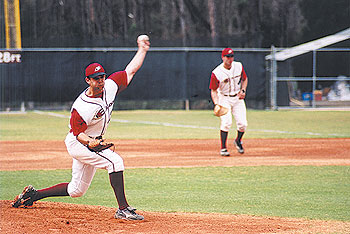
landonjacobsen.jpg

According to this nugget in Baseball America, the Phillies have signed Landon Jacobsen to a minor league contract. No mention of it on Phillies.com yet, to my knowledge. Jacobsen appears to be filler for the Ottawa rotation. He’s 28, so he isn’t a prospect, and his numbers aren’t very impressive overall. He’s experienced fluctuating strikeout rates, but his numbers have dipped in that category at higher levels. He doesn’t walk a ton of batters, but gives up about one hit per inning, though he does keep the ball in the park. He could be this year’s Brian Mazone, pitch well, and position himself to come up in an emergency situation. Or, they plan to give him a chance at a bullpen spot. His numbers were nearly identical against lefties and righties last season, .699 OPS against LHB, .689 OPS against RHB, and he has extreme groundball tendencies, inducing 263 groundballs to 166 flyballs.

2002 Draft Report Card, Part 4

whitbryant.jpg

Today, we’ll look at rounds 21-30 and give them a grade. For my grading guidelines, please see Part 1. If you haven’t already, read the first three installments to figure out what I’m doing here. Lets get on with the picks.

Brett McMillian, 3B
Brad McCann, INF
Jason Fletcher, RHP
James “Whit” Bryant, LHP
Zach Minor, RHP
Erik Winegarden, C
Brad Busbin, RHP
Derek Brewster, RHP
Adam Steen, RHP
Ryan Wardinsky, SS

Ok, first things first. Of the ten picks, one was a high school player (McMillian), two were JuCo players (McCann and Fletcher), and the other 7 were all four year college guys. The Phillies failed to sign McMillian, Fletcher and McCann, the next 7 all signed. Position breakdown, they drafted three infielders, one catcher, five right handed pitchers and one left handed pitcher. All of the four year college players selected were seniors, hence, they had little choice but to sign. McMillian went to UCLA, McCann went to Clemson, and Fletcher remained at Indian River CC in 2003.

Now, the results…..it’s not good. McCann might be the only name on the list you’d recognize, and it’s for being the less talented brother of current Braves catcher Brian McCann. I’ll always remember Whit Bryant, because he went to Elon and I got to see him pitch quite a bit while I was in school. He was a warrior on the mound, but never had dynamite stuff. I was happy for him that he got picked, and even more excited he was picked by my team, though I knew the chances of him making it weren’t great. Sure enough, he went on the voluntarily retired list in the spring of 2003. Minor only lasted till the end of 2003, pitching well at Batavia, but bombing both times he was promoted to Lakewood. He ended up with Bluefield, the Orioles affiliate in the short season Appalachian League, but his 8 innings in 2005 appear to be his last.

Winegarden struggled in the GCL and at Batavia in 2002, then missed all of 2003. He was assigned to Lakewood in 2004, where he put up a .674 OPS in 185 AB, and hasn’t been seen since. Busbin pitched well in 2002 upon being drafted, posting a 1.80 ERA in 20 IP, but for some reason (that I don’t remember), he was released prior to the 2003 season. Brewster was a similar deal, pitching only 4 innings after being drafted, then released prior to the 2003 season. I can’t find any reference to Adam Steen pitching after his brief 22 inning cameo at Batavia in 2002, and he was more than likely released in 2003. Wardinsky was awful from the get-go, and his .527 OPS at Clearwater in 2003 signaled the end of his run with the Phillies, and in pro ball all together.

The good news, if you can call it good, is that we didn’t miss much in terms of players we could have drafted. Travis Ishikawa was taken by the Giants in the 21st round after we had picked, and he is the highest profile guy to sign in these 10 rounds worth of picks. Jacoby Ellsbury and Travis Buck both were drafted, but both chose college, and are now in the Boston and Oakland organizations respectively.

It’s really tough to grade anything after the first 20 rounds because teams will begin to draft guys they think slipped due to signability issues, and most of these guys never sign. Also, teams begin to take four year seniors to fill our their rosters, and as in the Phillies case, many of these guys don’t stick. You get the rare gem (Ishikawa for the Giants), but for the most part, you aren’t drafting guys who are going to impact your system in these rounds, therefore, it’s tough to really punish teams for taking guys that never amount to anything. Because the Phillies first three picks in the round didn’t sign, I’m deducting points, and because three of the guys they did sign debuted well but were released, I’m deducting minimal points. No steals in this section, no guys even in the organization anymore, and in fact, no guys even playing pro ball anymore, period. Grade: C- My first instinct was a D, but really, this is probably par for the course for most teams every year. I’ll give them the benefit of the doubt because they didn’t miss much talent here, but I will penalize them for not at least drafting one guy capable of being organizational filler for 3 years.

We’ll finish the last 20 picks tomorrow. And just a heads up, it’s not going to be good.

Destination Philadelphia: Joe Bisenius

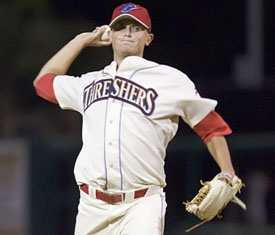
bisenius2.jpg

I’m back, I’m dry, and I’m ready to go. The second installation of Destination Philadelphia will look at a guy who’s name has been coming up a bit in the minor league circles of late, one Joe Bisenius. Joe fits the mold of the under the radar type of player who can make an impact seemingly out of nowhere. In a future writing, I plan to look at more of these types of players, but those guys will mainly be guys who can elevate their stock in the minors in 2007, in the case of Bisenius, I think you’ll see him in Philly at some point, so he’s a different case.

First, some background info. The Phillies took Bisenius in the 12th round of the 2004 draft out of Oklahoma City college, an NAIA school, after his junior season. In college, he was used mainly as a starter, pitching 93 innings his senior year. He was very tough to hit his junior year, allowing only 73 hits in 93 innings while striking out 86, but he also allowed his share of walks, with 41 in the 93 innings. He was all state (Iowa) all four years in high school, and was ranked in the top 40 of all junior college players in the country after 2003 by Baseball America. The Phillies liked his arm and felt that if they cleaned up his violent, herky-jerky delivery, they could have a found a diamond in the rough.

Upon being drafted, Bisenius was sent to Batavia, where he again was used as a starter. He put up an eye popping 1.43 ERA in 50 innings, allowing 39 hits and 14 walks while striking out 38. In 2005, the Phillies sent him to Lakewood, but he started only 4 games out of his 40 appearances, and his conversion to relief began. He struggled in 2005, posting a 5.88 ERA in 64.1 innings, allowing 66 hits and 37 walks, but missed a few more bats, striking out 56. With such varied results, it was hard to figure out what to expect from him in 2006. The Phillies started him at Clearwater, and with new-found command of his slider, he dominated the FSL, posting a 1.93 ERA in 60.2 IP, allowing only 48 hits and 22 walks, while striking out 62. The Phillies promptly promoted him to AA Reading, and he didn’t disappoint. His ERA rose to 3.09, but his stuff actually got better, as he allowed only 14 hits and 8 walks in 23.1 innings while striking out an eye popping 33 batters. He was sent to the Arizona Fall League, but pitched only 4.2 innings, allowing 6 runs on 7 hits, walking 4 and striking out 6, though much of the damage done against him was in his first outing. The Phillies capped off his 2006 by sending him to the Venezuelan Winter League, where he wasn’t quite as successful, posting a 5.06 ERA in only 10.2 innings, giving up 11 hits, 8 walks, with 11 strikeouts. However, his ERA looks bloated because of a few rough outings early on.

Bisenius had a wild ride in 2006. He started in the FSL and ended up in Venezuela, and in the end, he opened some eyes. He’s been invited to spring training and by all accounts, he’ll have a shot to win a job in the Phillies bullpen. Having not seen him pitch in person, I can’t speak to his abilities first hand. Basically, he throws a mid 90’s fastball that can touch 97, and he throws a slider. His changeup is a show me pitch, and he’ll use it against LH batters to keep them off balance, but it’s not a true out pitch. He was tough on both lefties and righties, but moreso on righties, holding them to a .584 OPS, while lefties had a .657 OPS against him, still very respectable. He also induced 1.5 groundballs to every flyball, another promising sign.

Since modifying his delivery, he’s added the extra life on his fastball, and it appears that he has a future as a 7th/8th inning setup kind of guy. That would sure be valuable to the Phillies, who in the past, have been ever so eager to give that role to the likes of Mike Williams, Arthur Rhodes, and Turk Wendell, based purely on reputation. If Bisenius has a strong spring, he’s likely to earn a bullpen spot. If he pitches well in April and May, he could find himself in higher leverage situations come the summer. 2007 will be his age 24 season, so he’s still “of prospect age”, but because his future (at this point) is as a middle reliever, you won’t find him on many prospect lists. That’s just fine, because teams need young guys like Bisenius, even if they aren’t heralded as the next Mariano Rivera or the next Miguel Cabrera. Bullpen parts are essential to winning teams, and the Phillies may have plucked a very useful bullpen part out of the 12th round of the draft.

ETA: With a good spring, he makes the team out of spring training. If he struggles, he will probably start at Ottawa, but should make it to Philly by June if he pitches well.