Category Archives: Destination Philadelphia

Destination Philadelphia: Joe Bisenius

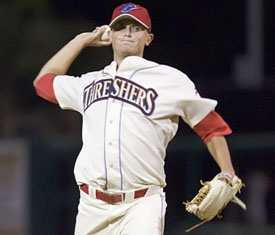
bisenius2.jpg

I’m back, I’m dry, and I’m ready to go. The second installation of Destination Philadelphia will look at a guy who’s name has been coming up a bit in the minor league circles of late, one Joe Bisenius. Joe fits the mold of the under the radar type of player who can make an impact seemingly out of nowhere. In a future writing, I plan to look at more of these types of players, but those guys will mainly be guys who can elevate their stock in the minors in 2007, in the case of Bisenius, I think you’ll see him in Philly at some point, so he’s a different case.

First, some background info. The Phillies took Bisenius in the 12th round of the 2004 draft out of Oklahoma City college, an NAIA school, after his junior season. In college, he was used mainly as a starter, pitching 93 innings his senior year. He was very tough to hit his junior year, allowing only 73 hits in 93 innings while striking out 86, but he also allowed his share of walks, with 41 in the 93 innings. He was all state (Iowa) all four years in high school, and was ranked in the top 40 of all junior college players in the country after 2003 by Baseball America. The Phillies liked his arm and felt that if they cleaned up his violent, herky-jerky delivery, they could have a found a diamond in the rough.

Upon being drafted, Bisenius was sent to Batavia, where he again was used as a starter. He put up an eye popping 1.43 ERA in 50 innings, allowing 39 hits and 14 walks while striking out 38. In 2005, the Phillies sent him to Lakewood, but he started only 4 games out of his 40 appearances, and his conversion to relief began. He struggled in 2005, posting a 5.88 ERA in 64.1 innings, allowing 66 hits and 37 walks, but missed a few more bats, striking out 56. With such varied results, it was hard to figure out what to expect from him in 2006. The Phillies started him at Clearwater, and with new-found command of his slider, he dominated the FSL, posting a 1.93 ERA in 60.2 IP, allowing only 48 hits and 22 walks, while striking out 62. The Phillies promptly promoted him to AA Reading, and he didn’t disappoint. His ERA rose to 3.09, but his stuff actually got better, as he allowed only 14 hits and 8 walks in 23.1 innings while striking out an eye popping 33 batters. He was sent to the Arizona Fall League, but pitched only 4.2 innings, allowing 6 runs on 7 hits, walking 4 and striking out 6, though much of the damage done against him was in his first outing. The Phillies capped off his 2006 by sending him to the Venezuelan Winter League, where he wasn’t quite as successful, posting a 5.06 ERA in only 10.2 innings, giving up 11 hits, 8 walks, with 11 strikeouts. However, his ERA looks bloated because of a few rough outings early on.

Bisenius had a wild ride in 2006. He started in the FSL and ended up in Venezuela, and in the end, he opened some eyes. He’s been invited to spring training and by all accounts, he’ll have a shot to win a job in the Phillies bullpen. Having not seen him pitch in person, I can’t speak to his abilities first hand. Basically, he throws a mid 90’s fastball that can touch 97, and he throws a slider. His changeup is a show me pitch, and he’ll use it against LH batters to keep them off balance, but it’s not a true out pitch. He was tough on both lefties and righties, but moreso on righties, holding them to a .584 OPS, while lefties had a .657 OPS against him, still very respectable. He also induced 1.5 groundballs to every flyball, another promising sign.

Since modifying his delivery, he’s added the extra life on his fastball, and it appears that he has a future as a 7th/8th inning setup kind of guy. That would sure be valuable to the Phillies, who in the past, have been ever so eager to give that role to the likes of Mike Williams, Arthur Rhodes, and Turk Wendell, based purely on reputation. If Bisenius has a strong spring, he’s likely to earn a bullpen spot. If he pitches well in April and May, he could find himself in higher leverage situations come the summer. 2007 will be his age 24 season, so he’s still “of prospect age”, but because his future (at this point) is as a middle reliever, you won’t find him on many prospect lists. That’s just fine, because teams need young guys like Bisenius, even if they aren’t heralded as the next Mariano Rivera or the next Miguel Cabrera. Bullpen parts are essential to winning teams, and the Phillies may have plucked a very useful bullpen part out of the 12th round of the draft.

ETA: With a good spring, he makes the team out of spring training. If he struggles, he will probably start at Ottawa, but should make it to Philly by June if he pitches well.
Destination Philadelphia: James Happ

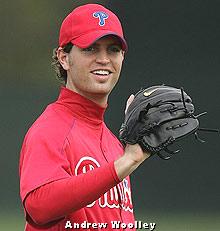
happ.jpg

Destination Philadelphia is the corny nickname I’m going to give to a series of posts I plan to make highlighting different Phillies prospects that should push their way onto the big-league team sometime in 2007. Kicking off the inaugural version of this series is arguably the most polished pitching prospect in the Phillies system, James (JA) Happ. I’ve never spoken to the young man, so I don’t know if he prefers his friends to call him JA, but since I’m not his friend, I’ll just call him James. Happ turned 24 in October, which means his 2007 will be his age 24 season. Happ was drafted in the 3rd round out of Northwestern University in 2004, and had racked up several accolades as a college pitcher, including being the first Wildcat to be named to the All Big Ten team three years in a row. Upon leaving school, Happ ranked near the top of every category in school history for pitchers.

Happ’s freshman year of college, he was used primarily as a reliever, starting only 3 of 21 games in which he appeared. From 2003-2004, he started 28 games, threw 177 innings, posted a 3.10 ERA, and posted an impressive 200:66 strikeout to walk rate. Still, Happ flew under the radar a bit, having not pitched for a baseball juggernaut and not completely dominated in the Big Ten. The Phillies snatched him up in the 3rd round and assigned him to short season Batavia. He pitched just 32.2 innings, but was strong enough to put up a 2.02 ERA, allowing only 22 hits and striking out 37. The Phillies assigned him to Lakewood to start 2005, and he responded with a 2.36 ERA in 72.1 innings, again giving up fewer hits than innings (55 hits) and again striking out 70 in the 72 innings. Happ saw his control return to collegiate form, and more importantly, gave up only 3 HR. The Phillies game him 1 start in Reading at the end of the year, and he responded with 6 innings, allowing 1 run, striking out 8 and walking 2. To start 2006, the Phillies were a bit cautious, sending Happ to Clearwater. He pitched 80 innings, posting a 2.81 ERA, allowing 63 hits and 19 BB while striking out 77 and allowing a surprising 9 HR. He was promoted to Reading mid season, and his numbers actually improved. He pitched 74.2 innings at Reading, posting a 2.65 ERA, allowing 58 hits, 29 walks, and striking out an impressive 81 hitters, while allowing only 2 home runs. He capped his season by making one start at Scranton, pitching 6 innings, allowing 1 run (a home run) with 4 strikeouts and 1 walk.

So, now that we know who Mr Happ is and what he’s done, it’s time to figure out what he can do going forward. In his chat after the 2005 season, Baseball America’s Will Kimmey was asked about Happ, and he responded with these comments

A: Will Kimmey: Floyd breached the innings qualification (topping 50 in the majors for his career) with his final start. Blalock could still turn into a 25 HR per year guy because of his work ethic, and he’ll move one level at a time. Happ reminds the club of Randy Wolf in that he throws an average fastball by hitters up in the zone because of the deception in his delivery. He’s got great feel, as evidenced by his final start of the year in a promotion to Reading. He needs to tighten his slider.

Basically, this goes in line with most of the scouting reports on Happ in the past. He’s tall (6’6) and a bit wiry, yet he doesn’t have overpowering velocity, pitching mainly around 88-90. The comparison to Randy Wolf makes sense in some respects, because Wolf threw in the high 80’s, but he hid the ball well and could run his fastball by hitters up in the zone. Happ has an advantage over Wolf, because he is taller and can throw more on a downward plane. Nevertheless, let’s take a look at Happ’s numbers compared to Wolf’s. Wolf was drafted in the second round of the 1997 draft out of Pepperdine and like Happ, was assigned to short season ball. He pitched all of 1998 in the minors (AA and AAA) and he spent part of 1999 at Scranton before getting called up to the big team, and didn’t go back after (except to rehab), so he got to the majors quicker than Happ will. So, for comparison’s sake, we’ll look at both guys year by year numbers

Happ, 2004 (SS): 35.2 IP, 22 H, 18 BB, 37 K, 1 HR allowed
Wolf, 1997 (SS): 40.0 IP, 29 H, 8 BB, 53 K, 1 HR allowed
Happ, 2005 (A-): 72.1 IP, 2.36 ERA, 57 H, 26 BB, 70 K, 3 HR allowed
Wolf, 1998 (AA/AAA): 173 IP, 4.16 ERA, 182 H, 52 BB, 151 K, 16 HR allowed
Happ, 2006 (A+/AA): 160.2 IP, 2.70 ERA, 124 H, 49 BB, 162 K, 12 HR allowed
Wolf, 1999 (AAA/MLB): 199 IP, 4.79 ERA, 199 H, 96 BB, 188 K, 28 HR allowed

If we look at those numbers, the first thing we have to realize is that Wolf was moved much quicker and much more aggressively than Happ was. Wolf dominated in 2 seasons at Pepperdine, posting a 25-8 record, a 1.97 ERA and 328 K’s, the most in school history. Happ, as we talked about above, hasn’t been quite as dominant. That said, Happ is right on track, in terms of age and level in the system, to still be considered a prospect. Most minor league experts are hesitant to heap praise on Happ because he doesn’t have marquee “tools” like a blazing 95 mph fastball, a devastating changeup, or a nasty 12-6 curveball. That said, most are starting to come around on Happ and see him as a useful part. Lots of guys have gotten by without dominating stuff, but they have to be much more refined and their margin for error is smaller. The biggest asset Happ has, both over Wolf and over other guys like him with similar stuff, is his height. One of the biggest indicators of future success is a pitcher’s ability to get swings and misses, but also his ability to keep the ball in the park and not let batters get good swings on him. Happ does a pretty good job of getting swings and misses (9.09 K/9 in his career), but he does an even better job of keeping the ball in the park, allowing only 16 HR in 277 innings. In addition, he induced 199 groundballs, compared to only 155 flyballs and 57 line drives….that bodes well if he’s going to pitch half his games in Citizens Bank Park.

Now, the whole destination Philadelphia thing. At this point, it’s tough to figure out where Happ stands in the Phillies plans. Currently, the big club has six starters, with Jon Lieber figuring to be traded for fringe minor leaguers or a journeyman reliever. However, two members of the rotation have medical issues (Eaton, Hamels), one is 93 years old (Moyer) and one has off the field issues in his past (Myers), so there’s a pretty decent chance that all 162 starts this season aren’t coming from those five guys. With Gavin Floyd and Gio Gonzalez being sent to Chicago for The Chief, two roadblocks to Happ’s ascendancy have been removed. The Phillies do have three other viable options in Fabio Castro, Zach Segovia and Justin Germano, but the plans for the first two haven’t been decided, and it appears Germano will start the season in Ottawa. Castro and Segovia figure to be bullpen options and also emergency starter options, along with Happ. At this point, Happ’s numbers have been good against both lefties and righties, but he’s actually been better against righties (.615 OPS in 2006, compared to .664 against LHB) which means he really doesn’t profile as a LOOGY candidate. It seems he’d be best suited for a 6th inning role with the big league club if he isn’t starting, or he’d be better off just starting every 5 days at Ottawa. However, if he is going to be the first option to make a start, he might be kept at Reading because of the proximity to Philadelphia.

Happ, to date, has done nothing but pitch well, and he’s beginning to prove the doubters of his stuff wrong. Because he doesn’t overpower hitters, keeping the ball down and staying on top of his pitches will continue to be of the utmost importance to him going forward. Right now, by most accounts, his changeup is an above average pitch, while his curve is merely average. To succeed at the highest level as a starter, he’s probably going to have to sharpen his curveball a bit, but as a reliever, he’s probably more than capable now. The Phillies likely will add a veteran or two to the bullpen this winter, which means Happ will probably start somewhere in the minors, whether it be at Ottawa or at Reading, but he’s on the shortlist to head to Philadelphia, and if his past success translates forward, he could become a quite useful part.

ETA, June 2007