Category Archives: 2002 Draft Review

2002 Draft Report Card, Part 5

timgradoville.jpg

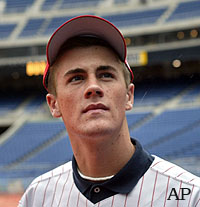
(Tim Gradoville)

Welcome to the 5th and final installment of the first set of Draft Report Cards. They’ve been fun to write, I hope they’ve been fun to read, and possibly brought back some memories, both good and bad. The final selection will cover the most picks (rounds 31-50) but will also be the shortest, as there is very little to say about most of these players. The final 20 rounds of the draft are normally used for 3 things: 1.) Taking 4th year seniors to fill out your rookie ball/short season teams 2.) Taking a flier on guys who you doubt you can sign, but will try anyway 3.) Taking guys who you think could be possible draft and follows. If you don’t know, a draft and follow is a player you take out of high school who chooses to attend a junior college. If he attends a junior college and not a 4 year school, you retain his rights up until a week before the next June draft. If the player performs well and you can come to terms on a bonus amount, you can still sign the player. The Angels and Braves have used this system well in recent years.

All of that said, here are the Phillies final 18 picks (we passed after Rd 48), with brief comments

Jeremy Isenhower, 2B – .696 OPS at Lakewood in 2003, released.
Rob Cafiero, 1B – .602 OPS at Batavia in 2002, went to Atlantic League in 2003.
Jeremy Rogelstad, RHP – 3.77 ERA at Batavia in 2002, went to Independent League in 2003.
Beau Richardson, LHP – Reached Clearwater, pitched well from ’02-’04, bombed out in 2005.
Josh Paddock, RHP – ERA (5+) never matched decent peripherals at higher levels. Released after ’05.
Keahi Rawlins, RHP – HS Senior, did not sign
Tim Gradoville, C – Played 36 games in 2006, has been all glove no hit. Non-roster ST invitee
Corey Carter, OF – HS Senior, did not sign
Daniel Lewis, RHP – HS Senior, did not sign
Brandon Joseph, OF – HS Senior, did not sign
McCay Green, RHP – HS Senior, did not sign
Clayton Dirks, LHP – HS Senior, did not sign
Byron Cragg, RHP – HS Senior, did not sign
Jacob Habsieger, LHP – HS Senior, did not sign
Sam Lecure, RHP – HS Senior, did not sign
Dusty Ryan, C – HS Senior, did not sign
Ryan Greives, RHP – HS Senior, did not sign
Dennis Winn, SS – HS Senior, did not sign

I told you this part would be interesting, didn’t I? Oh, you’re right, I didn’t say that. Out of 18 picks, we signed only 6, and of those 6, only Gradoville and Paddock stuck around for an extended period of time. However, most teams it would seem experience the same type of thing in these rounds, which again makes it tough to grade this section. What’s more interesting, perhaps, are the players other teams took. I’ve glanced at the late rounds in 2001, 2003 and 2004, and the final 20 rounds seem to include quite a few more “flier picks” where guys who became higher draft picks were taken in later rounds, and guys who teams went over slot on actually made it to the big leagues. In this draft, that list is really small. These guys are considered prospects and were drafted, but didn’t sign: Cesar Carillo, Tony Sipp, Ryan Patterson, Ricky Romero, Luke Hochevar, Hunter Pence, Ian Bladergroen, and Shawn McGill, who coincidentally, was drafted as a 4 year senior by the Phillies in 2006.

In the 20 rounds and nearly 600 picks, only 4 guys you’ve maybe ever heard of have made it to the big leagues. They are, in order of notoriety, Jon Papelbon, Brian Bannister, Ty Taubenheim and Scott Feldman. All four were drafted by different organizations than they made their breakthrough with, most notably Papelbon, who was a late round pick by Oakland, then later a 4th round pick by Boston. Bannister was drafted by Boston in 2002, then later by the Mets. So, in retrospect, we really didn’t miss much.

Grade: C The last part of the report card was tough to grade, and this part is even tougher. Most teams final 20 picks look just like ours. The fact that Gradoville is still around is surprising, and I think based on the lack of prospects even taken with flier picks by other teams, it’s tough to give the Phillies a harsh grade there. They took their chances on a lot of high school guys, and they didn’t sign any of them. However, none of the guys they chose to not sign amounted to much of anything. Lecure has been modestly successful in the Cincinatti system, but that’s about it.

Final Draft Grade

Now that we’ve completed the report card for the 2002 draft, it’s time to see how the Phillies did. Here’s a recap of their scores for each section

Part 1

Hamels: A-
Segovia: B
Fisher: C-
Bourgeois: D-
Blalock: B-

Part 2

Gwaltney: B
Read: D
Doetsch: F
Harrand: F
Barthelemy: B

Part 3 (Rd 11-20)

B : 3.00

Part 4 (Rd 21-30)

C- : 1.75

Part 5 (Rd 31-48)

C : 2.00

Using my advanced math skills, the Phillies final “GPA” for this draft was 2.13, which is a solid C. This draft produced one potential superstar in Cole Hamels, one potential middle of the rotation starter/closer in Scott Mathieson, one back end of the rotation/bullpen guy in Zach Segovia, and then a bunch of organizational filler. It’s disappointing to not have been able to even land a few bullpen arms or utility infielders in this crop of suspects. Without Hamels and Mathieson, this draft is a complete disaster.

Hope this was a good read. I plan to move on to 2003, but probably not for a while. These things are exhausting.

2002 Draft Report Card, Part 4

whitbryant.jpg

Today, we’ll look at rounds 21-30 and give them a grade. For my grading guidelines, please see Part 1. If you haven’t already, read the first three installments to figure out what I’m doing here. Lets get on with the picks.

Brett McMillian, 3B
Brad McCann, INF
Jason Fletcher, RHP
James “Whit” Bryant, LHP
Zach Minor, RHP
Erik Winegarden, C
Brad Busbin, RHP
Derek Brewster, RHP
Adam Steen, RHP
Ryan Wardinsky, SS

Ok, first things first. Of the ten picks, one was a high school player (McMillian), two were JuCo players (McCann and Fletcher), and the other 7 were all four year college guys. The Phillies failed to sign McMillian, Fletcher and McCann, the next 7 all signed. Position breakdown, they drafted three infielders, one catcher, five right handed pitchers and one left handed pitcher. All of the four year college players selected were seniors, hence, they had little choice but to sign. McMillian went to UCLA, McCann went to Clemson, and Fletcher remained at Indian River CC in 2003.

Now, the results…..it’s not good. McCann might be the only name on the list you’d recognize, and it’s for being the less talented brother of current Braves catcher Brian McCann. I’ll always remember Whit Bryant, because he went to Elon and I got to see him pitch quite a bit while I was in school. He was a warrior on the mound, but never had dynamite stuff. I was happy for him that he got picked, and even more excited he was picked by my team, though I knew the chances of him making it weren’t great. Sure enough, he went on the voluntarily retired list in the spring of 2003. Minor only lasted till the end of 2003, pitching well at Batavia, but bombing both times he was promoted to Lakewood. He ended up with Bluefield, the Orioles affiliate in the short season Appalachian League, but his 8 innings in 2005 appear to be his last.

Winegarden struggled in the GCL and at Batavia in 2002, then missed all of 2003. He was assigned to Lakewood in 2004, where he put up a .674 OPS in 185 AB, and hasn’t been seen since. Busbin pitched well in 2002 upon being drafted, posting a 1.80 ERA in 20 IP, but for some reason (that I don’t remember), he was released prior to the 2003 season. Brewster was a similar deal, pitching only 4 innings after being drafted, then released prior to the 2003 season. I can’t find any reference to Adam Steen pitching after his brief 22 inning cameo at Batavia in 2002, and he was more than likely released in 2003. Wardinsky was awful from the get-go, and his .527 OPS at Clearwater in 2003 signaled the end of his run with the Phillies, and in pro ball all together.

The good news, if you can call it good, is that we didn’t miss much in terms of players we could have drafted. Travis Ishikawa was taken by the Giants in the 21st round after we had picked, and he is the highest profile guy to sign in these 10 rounds worth of picks. Jacoby Ellsbury and Travis Buck both were drafted, but both chose college, and are now in the Boston and Oakland organizations respectively.

It’s really tough to grade anything after the first 20 rounds because teams will begin to draft guys they think slipped due to signability issues, and most of these guys never sign. Also, teams begin to take four year seniors to fill our their rosters, and as in the Phillies case, many of these guys don’t stick. You get the rare gem (Ishikawa for the Giants), but for the most part, you aren’t drafting guys who are going to impact your system in these rounds, therefore, it’s tough to really punish teams for taking guys that never amount to anything. Because the Phillies first three picks in the round didn’t sign, I’m deducting points, and because three of the guys they did sign debuted well but were released, I’m deducting minimal points. No steals in this section, no guys even in the organization anymore, and in fact, no guys even playing pro ball anymore, period. Grade: C- My first instinct was a D, but really, this is probably par for the course for most teams every year. I’ll give them the benefit of the doubt because they didn’t miss much talent here, but I will penalize them for not at least drafting one guy capable of being organizational filler for 3 years.

We’ll finish the last 20 picks tomorrow. And just a heads up, it’s not going to be good.

2002 Draft Report Card, Part 3

mathieson.jpg

If you’ve been following along with Part 1 and Part 2, you know the rules already. For those who haven’t read the previous parts (you should), basically, I’m just looking back on the 2002 draft and grading all of the Phillies picks. I gave more detailed write-ups on the first 10 picks, but I’m going to group picks together from here on out. My grading scale can be found in Part 1. Now that we got the formalities out of the way, let’s continue on.

Here are the Phillies 11th-20th picks. Just click their names for their stats.

11.17: TJ Beam, RHP
12.17: Trent Pratt, C
13.17: Brian Manfred, C
14.17: Darin Naatjes, RHP
15.17: Victor Menocal, SS/RHP:
16.17: Leslie (Omar) Bramasco, SS:
17.17: Scott Mathieson, RHP:
18.17: Chad Oliva, C/OF:
19.17: Robert Korecky, RHP:
20.17: Karl Nonemaker, OF:

Let’s just do a quick summary first. Beam was the only pick out of this group to not sign a contract. He was later drafted by the Yankees and ended up getting a cup of coffee at the big league level in 2006. He’s a decent middle reliever going forward. You’d have liked to see them take a chance on him in the middle of this group, not at 11. All of these guys, except Mathieson, were college level players, so it seems like the organization was trying to fill out the rosters of the minor league affiliates here. They took 2 catchers (3 if you count Oliva) 5 righthanded pitchers (if you count Menocal) and 2 outfielders.

Pratt put up big numbers in college, but completely fell on his face in pro ball. He was last seen in Reading circa 2005, where he put up a .564 OPS. Manfred won the “Team MVP” award at San Diego State in 2001 for being “a good team player and his positive attitude”. Maybe that was a sign of things to come, because he sure couldn’t hit, racking up 15 total hits in 93 AB’s after being drafted. He hasn’t been seen since that brief cameo at Lakewood in 2002. Naatjes was the typical Phillies draft pick, he was 6’7, 245 lbs and oozing tools. He was very baseball-raw for a college pitcher, but the Phillies thought they could teach him to be a pitcher, not a thrower. Unfortunately, he’s spent more time on the disabled list than on the mound, missing parts of 2003, all of 2004, most of 2005 (only 2 innings at GCL), and all of 2006. His career looks finished.

Menocal was a great athlete at Georgia Tech, playing mostly SS but also pitching a bit in 2002, and the Phillies liked his chances in both areas, but drafted him as a shortstop. He spent all of 2003 and 2004 pitching, and he didn’t do very well, striking out less than 5 per 9 and walking over 4 per 9. He vanished after the 2004 season. On Leslie Bramasco, Scouting Director Marti Wolever said that “He’s got a chance to hit a little bit”, which I guess is what you say about a guy who only hit .287 in college his sophomore year. Well, he hit a little bit, .234 to be exact, in his 2.5 seasons with the Phillies, making it as high as Reading before being released and turning up in the Independent League.

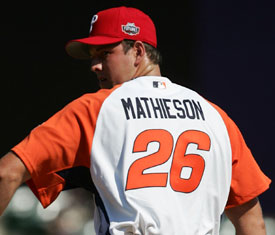
Then we get to Scott Mathieson, and he get’s an entire paragraph in this writeup. In high school, Mathieson threw in the mid 80’s (touching 90 with a tailwind) and being from British Columbia, he obviously wasn’t getting a ton of attention. He had a scholarship to a junior college in El Paso, but the Phillies were able to sign him. He was your typical Phillies pick in a way, as he was already 6’4, 195lbs and the Phillies felt he offered a lot in the way or projection. They were right, as he added a good 8-10 mph of velocity, getting his fastball up into the 93-94 range, topping out around 97 and even being able to dial it up to 99 mph. Mathieson was still very raw in the GCL in 2003, but he was starting to piece things together. In 2004, he started at Lakewood, and though the numbers don’t look great, his stuff was starting to come around. He notched 112 K’s in 131 innings and was starting to refine his curve/slider and changeup a bit more. He was sent to Clearwater in 2005, and again showed signs of improvement across the board. In 121 innings, he allowed only 111 hits, struck out 118 and walked only 34. He started to gain attention with a strong Arizona Fall League stint, ranking 9th overall among AFL prospects, the top rated pitcher. He had settled on a slider as his main breaking ball, and his changeup was now an average pitch.

2006 was Mathieson’s banner year and also his undoing, all in one swoop. He’d finally seen the tools become results, mowing through AA Reading with 99 K’s in 92 innings, harnessing his command (only 29 walks) and limiting good swings against him allowing only 73 hits. He made a brief cameo at the big league level (not so good, 5.48 ERA in 4 appearances) and then went to Scranton. He proved even more unhittable at AAA, allowing only 26 hits in 34 innings, striking out 36 and walking 10. He was called back up to the bigs in August after the trade of Cory Lidle and made 5 starts, giving up 18 runs in 16 innings. In what proved to be his final start of the season, Mathieson had to leave the game in the first inning after feeling a sharp pain in his pitching arm. It was later announced he would need Tommy John surgery and miss all of 2007. The good news is, he is still just 22 (23 in February), so in 2008 when (hopefully) he is healthy, he’ll only be 24 and still on track in his development. This pick was an obvious home run in the middle of a bunch of double plays.

Rounding out the selections. Chad Oliva was a masher in college, holding the school record at Jacksonville in both home runs and rbi’s. Unfortunately, it didn’t translate in the pro game once he got passed Batavia, as he put up a .680 OPS at Lakewood in 2003 and then disappeared. Korecky was a four year senior from Michigan. He had a bad freshman year, good sophomore and junior years, then a mediocre senior year (4.35 ERA), but he wasn’t a strikeout pitcher (only 168 K in 294 IP), but he harnessed his control after his freshman year and didn’t give up many home runs. His pro debut actually surpassed his college career, as he put up ERA’s of 2.31 and 3.00 at Batavia and Lakewood in 2002, and then 2.26 at Clearwater in 2003 as a reliever. He had an 86:18 K to BB ratio with the Phillies in 121.2 innings, but he was traded to Minnesota at the end of 2003 as part of the Eric Milton deal. He made it to AAA in 2006, posting a decent 3.33 ERA in 51 innings. Nonemaker was a 4th year senior, had decent tools, but limited projection. After a good debut in the GCL, he floundered with a .548 OPS at Lakewood and a .370 OPS in limited time at Reading. He voluntarily retired in 2004.

The Phillies didn’t miss many guys in these rounds. Prospects like Paul McAnulty, Jeff Clement, Mike Pelfrey, Anthony Reyes and Dustin Nippert were taken in rounds 11-15, but all went to college. Daniel Haigwood, who was acquired in the Jim Thome deal, then dealt for Fabio Castro, was picked in the 16th round, exactly one pick after the Phillies selected Bramasco. Brandon McCarthy, the former White Sox farmhand who was recently traded for fellow prospect John Danks, was taken immediately after the Phillies took Mathieson, and Dodgers catcher Russell Martin was taken with the very next pick. A few interesting guys like Boone Logan (LHP), George Kotteras (C), Kameron Loe (RHP) and Braves starter Chuck James were 20th round picks. All in all, they didn’t miss too many superstars in this part of the draft, and they nabbed Mathieson.

So, it’s grade time. Drafting and not signing Beam is a D- move, Naatjes was a great pick at the time, but he couldn’t stay healthy. They get a C- for taking a bunch of filler with low ceilings in the middle of these rounds, they get an A for getting Mathieson as late as they did, and they only lose minimum points for not grabbing Russell Martin, who could have been a cornerstone type player, but was drafted as a 3B and converted to catcher. Final Grade: B. I’ll weigh this one 5 times in their overall GPA, since these rounds are tough to handicap, based on what is available, and really, looking at guys they could have picked is the ultimate exercise in hindsight.

Rounds 1-10: 1.93 GPA
Rounds 11-20: 3.00 GPA

Things are certainly looking up.

2002 Draft Report Card, Part 2

Ryan Barthelemy

Today we’ll cover part 2 of the 2002 draft. To figure out exactly what I’m talking about, check yesterday’s post for part 1 of this feature. Let’s get on with the picks

6.17: Lee Gwaltney, RHP. Part 2 isn’t starting out so good, is it? Well, at the time, Gwaltney was actually a highly touted prospect. He had a good pitcher’s body (6’6, 215 lbs), was polished (4 years of college, LA Tech), and the Phillies felt he was a steal in the 6th round. At the time, you couldn’t really argue against this pick too much. Some experts felt he could have gone a few rounds higher, but the Phillies were happy to get him in the 6th. It didn’t really work out that well, as he was only in the organization for 2.5 seasons. He started out well enough at Batavia and Lakewood (3.60 and 3.06 ERA’s respectively), but his peripheral numbers weren’t great, as he struggled to generate swings and misses (6.48 and 5.41 K/9 at Batavia and Lakewood), and his walk rate spiked at Lakewood. Nevertheless, the Phillies sent him to Clearwater to start 2004, and he didn’t really pitch poorly, putting up a 3.80 ERA, but his peripherals again lagged, allowing more than a hit per inning, not getting many K’s. The Phillies sent him to Reading for 4 starts, where he bombed, posting a 7.71 ERA and walking 11 to only 17 K’s. Then, something strange happened. The Phillies released Gwaltney in January after his involvement in a Clearwater bar fight with another Phillies farmhand…..a guy named Cole Hamels. The Phillies were very critical of Gwaltney and claimed he was a bad influence on Hamels. The Cubs claimed him, but after two seasons in the Chicago system, he was recently released. Grade: B. I give this pick a B because at the time of the draft, it made some sense. Gwaltney had pretty good stuff, he was polished, and he seemed like he could move through the system quickly, maybe helping the back end of the rotation by sometime in 2005. His numbers weren’t great, but they weren’t horrible, even if his peripherals weren’t outstanding. The off the field stuff is really tough to figure out, because we only know what the front office tells us. He didn’t work out, and ultimately he isn’t ever going to make the bigs unless he greatly reinvents himself, but at the time, it wasn’t a bad pick, considering it was the 6th round. Of the players taken after this pick and before their 7th pick, only two players are really major league quality, and both are relievers in Pat Neshek and Matt Capps.

7.17: Robby Read, RHP. This was a puzzling pick at the time. Read was drafted as a third year college player out of Florida State. His college ERA was bloated thanks to his home park, but his peripheral numbers weren’t exactly great, as he’d always averaged around 4 walks per 9 and close to 1 hit per inning. Read also didn’t really fit the Phillies mold, as he was only 6’1, 190 lbs, with the Phillies preferring to draft tall, lanky pitchers and dream on their projection and added velocity. That said, Read did have a strong arm and had a slew of pitches to choose from, so the pick wasn’t an instant disaster. His full season debut came in 2003 at Lakewood, and let’s just say he didn’t blow the doors off the place: 77 IP, 5.61 ERA, 79 hits, 51 walks, 73 K’s. As you can see, he was allowing close to 2 base runners per inning, and for a college guy at low A, that’s not so good. Read started 2004 at Clearwater, and things got worse, with an ERA over 6 and over 7 walks per 9 innings pitched. He was let go, and ended up in the Frontier League, where he also pitched in 2005 before washing out of baseball. Grade: D. These are the types of picks that puzzle me. I know it’s the 7th round, but come on. Yes, he pitched at a large baseball school, and yes he had a tough home park, but where was the real upside here? Bad college peripherals doesn’t usually signal pro ball success. The “good news” is that the Phillies didn’t really miss anyone between this pick and their 8th pick, with the exception of possibly Jeff Salazar, an OF prospect in the Rockies system.

8.17: Steve Doetsch, OF. Ah, the most controversial pick in the first 10 rounds for the Phillies. Doetsch wanted a bigger bonus than the Phillies were willing to offer, so he chose to go to junior college in 2003, meaning the Phillies could still sign him before the 2003 draft. They couldn’t come to an agreement, and he went back to the draft in 2003, this time being taken by Atlanta in the 14th round, and eventually signing. Many were disappointed he didn’t sign, and felt like he could be an impact guy. Well, maybe it’s a good thing the Phillies saved their money, as he hasn’t amounted to much in the Braves system, posting a career .280/.352/.395 line in 1500 minor league AB’s. 2006 was his age 22 season, and he still hasn’t gotten past High A. When you consider his .663 OPS at High A Myrtle Beach this past season, he probably will be out of baseball in the next few years. Grade: F. A quick caveat on this pick, which will apply to future comments. You should never have a top 10 round pick go unsigned, unless the player backs out on a pre draft deal. You can’t afford to squander these picks, and you should always know that you can or can’t get the player for “X dollars in X round”, or you should just pass and take someone else. The draft is the best way to acquire talent, and not signing a guy taken in the first 10 rounds is really wasting that resource. To make matters worse, Adam Lind and Clay Hensley were taken after this pick and before the Phillies next pick. Admittedly, Lind didn’t sign, but is a premier talent now, maybe the Phillies could have pried him away from college.

9.17: Rob Harrand, RHP. This pick stinks. It’s really that simple. Harrand’s numbers at San Diego State were not good, at all. His ERA was bloated (5.82 and 5.44) and his peripheral numbers were just as bad, with less than 7 K’s per 9 and close to 4 walks per 9. Still, the Phillies liked his arm, like his frame (6’5, 205 lbs), and felt like he was just under-performing. His fastball was real heavy and had good sink, and his home run suppression in college was quite good, having allowed only 3 home runs in 60 innings combined. However, he didn’t figure things out and struggled at Batavia upon being drafted. He was sent to the GCL to start 2003, but threw only 5 innings. I believe Harrand suffered through a number of arm maladies, and hasn’t been since since his 5 inning stint at the GCL. Grade, F. Could I have given a D-? Maybe. However, after botching the Doetsch pick (which I guess they didn’t think they did at the time), you’d think they’d have taken a guy here who at least had some upside. Marti Wolever, the Phillies scouting director, actually said Harrand was a good candidate for long relief. When your projected role is “long relief” upon being drafted, that’s not a good sign. This pick ultimately gets an F, though, because Howie Kendrick was taken by Anaheim before the Phillies next pick, and he turned into one of the best hitting minor leaguers in the last 10 years. Ouch.

10.17: Ryan Barthelemy, 1B. I liked this pick at the time, but I was skeptical for a reason similar to a pick above. Barthelemy was taken as a senior out of Florida State, and had light tower power in college, with monstrous .607 and .649 slugging percentages his junior and senior years. However, his home park was a hitter’s paradise and no doubt inflated his numbers. At 6’3, 225 lbs, he was well built and looked like a legit power threat. He was considered a well rounded athlete and most thought he’d be above average defensively at 1B. His full season assignment in 2003 put him at Lakewood, and he struggled, posting a .554 OPS in 312 AB. Undeterred, the Phillies promoted him to Clearwater in 2004, and he showed flashes of brilliance, finishing with a respectable .825 OPS in 475 AB. However, 2005 was the beginning of the end, as he bombed at Reading with a .693 OPS in 358 AB. At the bottom of the defensive spectrum, and failing to show the power that got him drafted, he was released and wound up in the Cardinals system. He spent 2006 at High A Palm Beach, and posted an .803 OPS in 463 AB. However, because he’s 26 already and has only played one season above A+, he really doesn’t look good going forward, barring some crazy turn of events. Grade: B In the 10th round, the Phillies really thought they’d found a gem, and at the time, I did too. He had solid raw power in college, as well as a good strikeout to walk rate. However, those skills just didn’t translate to the pro level, and without the DH in the NL, he probably was never going to see the light of day for the Phillies. After bombing out in Reading, he really had no value, so it was probably wise just to allow him to start over in another organization. Because of his power potential and baseball skills, this could have almost been a B+ pick, but because the Phillies missed out on Joel Zumaya and Ryan Shealy, I have to drop it a grade.

Let’s add these grades to the grades from part 1

Hamels: A-
Segovia: B
Fisher: C-
Bourgeois: D-
Blalock: B-
Gwaltney: B
Read: D
Doetsch: F
Harrand: F
Barthelemy: B

GPA: 1.93 (2.4 in the first 5). Uh oh, the draft team is getting dangerously close to Academic Probation.

2002 Draft Report Card, Part 1

375005_hamels082803.JPG

Only 4.5 years late, right? Well, not really, this is just another idea I came up with. It’s my firm belief (I’m sure it won’t be a shock, considering I’m running this site) that the best way to build your team is from within, and then supplement your homegrown core with talent from the outside in areas where you are weak. Many teams have done this (Cleveland, most recently) and the benefits are two fold. First, the cheapest talent is the kind you draft (or sign internationally) because you don’t have to give up anything (other than money) to acquire these players. Second, you have control of these players for 6+ years, which many times will take a player close to the peak of his production level. Now, before we go further, a quick qualifier. A strong farm system and a strong core of youth doesn’t always translate into wins. Cleveland, the example I gave above, has developed a really strong core of young players (Sizemore, Perralta, Lee, Martinez) but they struggled in 2006, though there is good reason to believe they were unlucky. However, the actual results of the team at the major league level is the last step of the process. As Phillies fans can see, with the likes of Cole Hamels, Ryan Howard, Brett Myers, Chase Utley, Jimmy Rollins and Pat Burrell, a strong young core sets your team up for years down the road, you just need a competent general manager to add the right complimentary pieces. Mark Shapiro might have failed there in Cleveland, or they might have just been unlucky.

So, that brings us to today’s essay. Players taken in the 2002 draft have now been in the Phillies system for 5 seasons (really 4.5, since players taken in June 2002 only had a half year, if they signed right away) so we can start to draw some conclusions about the draft and what might have been. I’m not looking for an avenue to bash our former GM Mr. Wade, because I really don’t know how much impact he had, many GM’s trust their scouting directors and their scouts, and just deal with issues like going above slot or avoiding a guy they perceive as a big injury risk. So, when reading my grades, consider them a grade of the entire Phillies drafting machine, not just one guy.

Here’s the way I’ll lay this out. I’ll break down the first 10 rounds of the draft, and then after that, just discuss the next ten picks together in shorter form, and do that until the final pick. I’m going to use a grading school similar to the 4.0 college grading system:

A = 4.0
A- = 3.5
B+ = 3.25
B = 3.00
B- = 2.75
C+ = 2.50
C = 2.00
C- = 1.75
D+ = 1.50
D = 1.25
D- = 1.00

For the first 10 rounds, I’ll give each pick a grade, then I’ll grade rounds 11-20, 21-30, 31-40, and 41-50 as a whole, with the letter grade above. Add then scores together, divide by 14, and we’ll have the final draft grade. Sounds like fun, huh? My criteria for determining the grade of each pick/round is pretty simple. 60% comes from the player’s performance. Did the guy perform well in the system? Was he a flop from the get go? Was he strong early and then struggled? 35% will come from the longevity of the player. Is he still in the system? Is he still in pro ball? Did he wash out after 1 year? If you’re drafting guys who play 1 season then quit baseball, you’re squandering resources. Maybe you can’t know that before hand, but that’s why you do your homework on these guys, and that’s why area scouts and crosscheckers get paid to watch high school kids play. The final 5% will come from the guys taken after the pick, and before the next Phillies pick, and basically any other wildcard criteria I choose to use. Did the Phillies pass up a kid who became a future star to draft someone who flopped? Again, maybe that was bad luck, but someone has to be accountable and this is my grading system, so they can deal with it! Ok, I got carried away there. Basically, this is just going to be a fun exercise for me, my grades really don’t mean anything, it’s just a fun way to look at the draft in more detail. The deeper the pick, the lower the expectations. In other words, if the Phillies get a major league contributor in the 25th round, they’ll be rewarded for it. Without further delay, let’s begin

1.17: Cole Hamels, LHP. How’s this for a start to your draft? Hamels’ history is well known, but for those who are a bit foggy, here’s how it happened. Hamels broke his arm his junior year of high school, and because of it, his draft stock dropped. He was considered a top 5-10 pick before the injury, and was considered very advanced for his age with much more polish than most high schoolers, and an already established changeup. When he broke his arm, despite a good senior year, he dropped in the first round and the Phillies gambled. The pick was questioned almost immediately, but the Phillies stood firm. Hamels, when actually on the field, was brilliant at every level and showed people why the Phillies were so in love with him. Hamels’ minor league numbers were video game like, but he was bogged down every season by a number of medical maladies until finally staying healthy (for the most part) in 2006. He pitched 181.1 innings in 2006 across 4 levels after having thrown a total of 152 innings from 2003-2005. After a slow start at the big league level, he turned it up a few notches and finished the season strong, posting a tremendous 9.86 K/9 rate and a solid 1.25 WHIP. Looking back, this was a huge gamble, and though people doubted the pick even mid way through May 2006, it looks like Hamels has proven worthy. Grade: A- The only reason it’s not a straight A is because Hamels still does have some injury/durability concerns, but if 2007 is a repeat of 2006, healthwise, this becomes an A.

2.17: Zach Segovia, RHP. Segovia was dominant in high school, including an astouding 150 strikeouts in 77.2 innings pitched his senior year. He already had a large, strong body build, a plus fastball and a plus slider, so the Phillies felt he had a decent amount of polish for a high school player. He had a scholarship to Florida but signed with the Phillies and was sent to the GCL. He started well, he performed well at Lakewood in 2003, and then he hit a common (at least it’s becoming) roadblock, in needing Tommy John surgery. The surgery has become common that it now isn’t looked at as a probable career ender, and some pitchers even thrive moreso after surgery. Segovia missed all of 2004 and was assigned to Clearwater in 2005. He struggled, but many attribute this simply to trying to rebuild arm strength and shake off the rust. He re-established himself in 2006, and all the qualities the Phillies liked about him pre draft came back to the forefront. He still projects as a back of the rotation starter/7th inning reliever, and his odds of making the big leagues and contributing is pretty good right now. His grade gets dropped 1 level because the Phillies had the chance to draft Brian McCann, who could be a cornerstone piece of the core, but chose a pitcher in this slot. There weren’t too many other options between this pick and the third round pick, so only one grade drop. Grade: B This was a good pick at the time, because Segovia flat out dominated in high school and had all the makings of a top flight pitcher. His role is still a bit cloudy, so he doesn’t get a B+ just yet.

3.17: Kiel Fisher, 3B Houston, we have a problem! The Phillies, to their credit, forsaw the Scott Rolen exodus and decided to try and fill the void by drafting multiple third baseman in hopes of adding some dynamic talent at a position they knew was weak across the board within the system. Fisher was a solid high school bat, he had great raw tools, the Phillies loved his swing, etc etc. Well, Fisher struggled from the get-go, and was forced to repeat the GCL in 2003, which isn’t a good sign early in your career, but isn’t the end of the world. In his second trip through the GCL, he lit it up with a .908 OPS, and was promoted to Batavia, where he put up a solid .874 OPS in 96 AB’s to cap the 2003 season. Things were looking good…..then trouble hit. Fisher sustained a lower back injury that required surgery, and he subsequently missed the entire 2004 season. Lower back injuries for position players (and anyone really) are bad news. Fisher came back in 2005 and spent the entire year at Lakewood. Unfortunatey he hit just .173 with a .443 OPS in 98 AB, and that proved to be his last action in professional ball. Grade: C-. Honestly, I think I’m being generous here. The Phillies drafted Fisher here based on need rather than raw talent, and I can’t say I agree with that philosophy so early in a draft. Between this pick and their 4th round pick, pitchers Rich Hill and Josh Johnson were picked, and both have huge upside, with both already showing flashes of brilliance in 2006, not to mention Jeff Baker, who at the time, was still playing third base, though he has since moved to the outfield in Colorado.

4.17: Nick Bourgeois, LHP. One word sums up this pick for me. Blech. The Phillies, in prior years, had kind of neglected left handed pitchers, but seemed to have a knack for plucking good right handers (Myers, Madson come to mind), but in 2002 they tried to focus more on lefties. Bourgeois was drafted out of Tulane as a junior, but his numbers were fairly unimpressive, even in his junior year, where he posted a 3.29 ERA with an 8.92 K/9 and 3.52 BB/9. The strikeouts were nice, the walks not so much. The Phillies, upon drafting Bourgeois, said they didn’t think he had top of the rotation stuff, but could be a good #4 or #5 starter. He didn’t have a ton of velocity (87-88, topped out around 90), but had a good 12-6 curveball. To me, at this point, this just seemed like a bad pick. The Phillies were admitting he didn’t have impact potential, he was already tabbed for the back of the rotation (normally you start with higher goals and end up here) and to me, in the 4th round, you have to do better. After being drafted, he went to Batavia and was fairly unimpressive in only 18 innings. Nevertheless, he was sent to Lakewood in 2003. The strikeouts were still there (8.84/9) but unforunately, the walks were there too (4.99/9) and the end result, a 4.42 ERA, was not good for a college age pitcher at Low A. Again, the Phillies promoted him in 2004, this time to Clearwater. The results were similar, but actually got worse, with a lower K rate (7.25/9) and a higher walk rate (5.09), with an ERA of 4.94. The result? He was released and picked up by Seattle. He struggled in 2005 for Seattle, and hasn’t pitched in pro ball since. Grade: D- I think my reasons are clear here. Low ceiling pick, poor results, out of the org in just 2.5 seasons. Not good at all. While the bluechippers aren’t plentiful in round 4, the Phillies had the chance to grab Delwyn Young, a solid 2B in the Dodgers org, as well as Hayden Penn, one of the better pitching prospects in the Orioles system, who went early in the 5th round.

5.17: Jake Blalock, 3B. Ah, Jake Blalock. This pick was the follow up to Operation Third Baseman that I talked about earlier with the Fisher pick. Blalock played shortstop in high school, but was drafted as a 3B mainly because of his size, with some feeling he’d outgrown the position. His biggest strength was his baseball pedigree, being the younger brother of Hank Blalock, a quality hitting prospect for the Rangers at the time, and the son of a baseball coach, Sam Blalock. The Phillies liked his physical tools and felt he could play 3rd, 1st, or RF, possibly even catcher. He had a scholarship to Arizona State, but opted to sign and was sent to the GCL. At this point, it looked like a solid pick. At the time, I felt he was a good value in the 5th round. He had position versatility, he had a lot of potential, but like every high school guy, he was a long way away. His first two seasons followed the normal path, that is GCL to Batavia, and the results (.669 OPS and .767 OPS) were less than inspiring. However, because of his youth and tools package, hope still remained. However, in 2004, it became clear that Blalock’s future would be in the outfield, which reduced his value somewhat, as his bat would be his main contribution. His 2004 was good, not great, with a .799 OPS at Lakewood…average on base (.350) and decent slugging % (.449), but you were kind of expecting more, especially now that he was playing the outfield. 2005, things took a turn in the wrong direction as he put up a .747 OPS at Clearwater. The plate discipline was still there (.359), but the power was completely gone (.388 slugging), and that was a big problem. Light hitting outfielders only survive if they play lights out defense (normally center field, Jake was always corner bound) or they steal a ton of bases (he stole 28 bases total from 2003-2005) so he was in trouble. Blalock was traded along with Rob Tejeda to Texas for Dave Dellucci right before the beginning of the 2006 season, and may have sealed his fate with a .711 OPS at doube A Frisco. I haven’t read up on his future, but I’d guess 2007 will be his last shot, or 2006 might have been it. Grade: B- Maybe I’m being generous here. Blalock looked real good as a high school prospect. Good background, good tools, high baseball IQ. Unfortunately, he just didn’t make it work. Grade drops to B- because two quality arms, John Maine and Scott Olsen, were taken in the 6th round before the Phillies next pick, though admittedly, a position player was probably needed here.

This concludes Part 1. Let’s do a quick recap:

Hamels: A-
Segovia: B
Fisher: C-
Bourgeois: D-
Blalock: B-

GPA: 2.4. That’s around the B- range. Part 2 will come either later today or tomorrow. If you have quibbles with my grades, let me know, if you make a convincing argument, you just might help Eddie Wade make the honor roll.