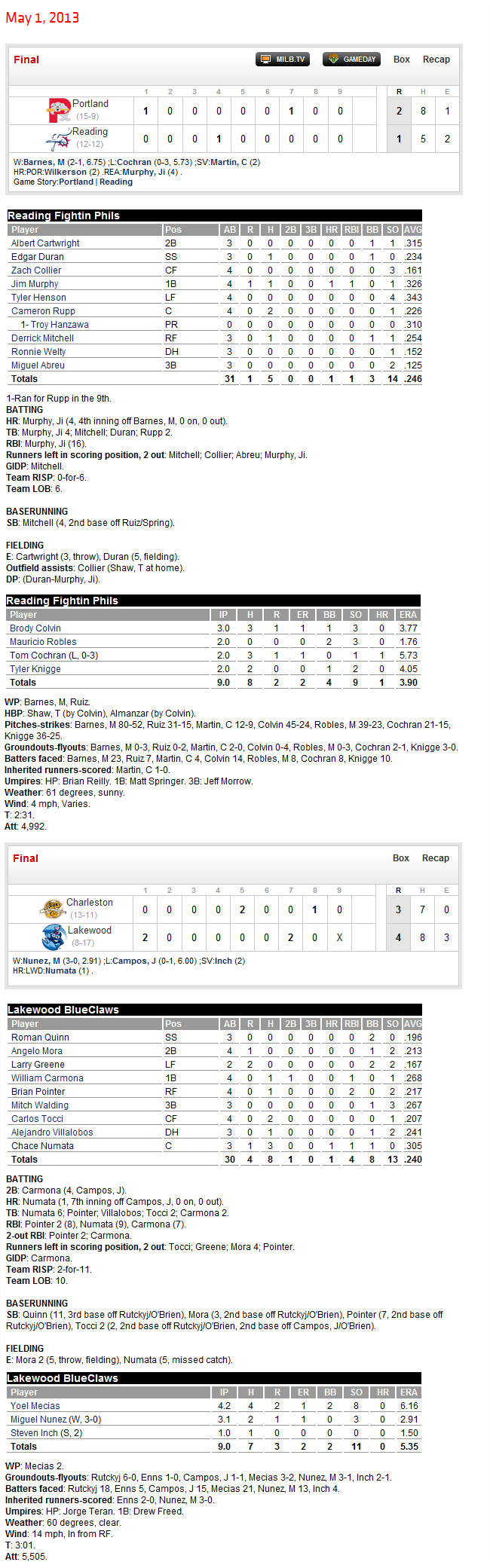
Yoel Mecias struck out eight of the 21 batters he faced. Chace Numata hit his first homerun of the year, and is now (after an admittedly “spike-enducing” game), OPSing .784 in a reasonably-age-appropriate league. He’s about a year younger than the average SAL hitter at around 20.7, compared to the league’s hitters, who average 21.6, (per BRef). Also in that contest, Roman Quinn stole his 11th base. He’s only been caught once, which puts him on pace for a success rate of 11/12. You’re welcome.
Here’s the affiliate Scoreboard from MiLB.
http://www.milb.com/scoreboard/index.jsp?sid=milb&org=143&ymd=20130501
 Phuture Phillies
Is Larry Greene walking so much because he knows that if swings, he’ll strike out?
LikeLike
He has had a lot of 2BB and 2SO games. Not many hits that is for sure.
LikeLike
He has only played in 11 games thus far and has 11 BB. Has had 36 AB–I would give the guy a chance first. He’s doing better than Roman Quinn who has played 23 games and has had 92 AB’s. The rest of your starters have had 80-90 AB’s at this point of the season. Charles, Walding and Mora–all have about the same amount of BB’s. Let him play another 12 games and have another 64-65 AB’s–then we’ll compare apples with apples.
LikeLike
Somebody better tell him what Ruben thinks about ‘walks’.
LikeLike
He’s looking like a two-true-outcomes player.
LikeLike
20.7 average hitter’s age’s… what’s the average pitcher’s age in the SAL?
LikeLike
Sorry that should say average age of the pitcher’s in the SAL… not average pitcher’s age
LikeLike
BRef says Hitters average 21.6 yrs, pitchers 21.8 yrs. Lots of last year’s lesser college draftees in there, so take the average ages for what they’re worth. Numata’s a year behind where the better talents of his HS draft class probably ought to be, as he spent two years in the GCL while learning to catch.
LikeLike
We really need to sit this numata guy…. i bet carman would be better!!!!!!
LikeLike
Before 2010 Numata was a SS and a pitcher. Has had a lot of passed balls, but I still think he will come around. Let’s check back mid-season. Remember they are learning and developing at this level still also and he’s young.
LikeLike
Pretty sure anonymous was busting up the people who were saying how bad Numata was a couple weeks ago.
LikeLike
You are correct Brad. Uploading sarcasm is tough for the computer illiterate.
LikeLike
Thanks for the info… Still seems like a pretty big adjustment for the younger guys, even if they are higher picks.
LikeLike
Anyone know what the average age for a catcher in the league is. Catchers are well known to develop more slowly.
LikeLike
Don’t know the answer to that, but there are only 10 players younger than Numata who are ahead of him in OPS on the Sally leaderboard.
Overall, some guy named Brian McCann leads the league in OPS.
LikeLike
Is’nt that McCann guy way to old for this league……….sorta non-prospect-ish old.
LikeLike
Aww get the bumb out of there. Chad Carman is the next Yadier Molina.
LikeLike
Gentlemen,
I can appreciate your sarcasm on here towards this John fellow, but I would appreciate it if you would direct it towards him and not my son, Chad. He has done nothing towards any of you. He’s just doing his best to realize his dream. Thanks.
LikeLike
My apologies. You are correct, and he has done nothing to invite criticism.
LikeLike
Accepted. Thank you sir.
LikeLike
Tocci still hanging in there. Contact rate looks good and a couple mulit-hit game in his last 10. I expect him to trend upwwards as he gets more comfortable facing advanced pitching.
Quinn and L. Greene have been major dissapointments for me.
LikeLike
Agree with you on Tocci’s start. Hard to be disappointed with him at his age in that league. Greene’s still just 2 weeks into his season. Yes, he’s striking out a ton right now, but a couple extra base hits this weekend probably jacks his OPS up by around .200 points. Fair enough, though, to be disappointed in him for showing up without proper conditioning.
LikeLike
I thought I’d drilldown a little bit on L Greene. His number of ABs is the epitome of small sample size but you can see some “trends” starting to develop. SSS eliminates the idea of a trend but here it goes anyway. Greene is showing a lack of hitting ability with no one on base. He’s 2 for 23. He has 15Ks in those 23 ABs which is an alarming 65%. Needless to say, but I’ll say it anyway, Greene should be pinch hit for anytime he comes up with the bases empty. BUT… with runners on base he’s hitting .308 with a .550 OBA. He’s hitting .500 with a .636 OBA with runners in scoring position.
If these trends continue, we can make something out of this. Maybe, Quinn and Mora have to hit better so Greene can hit better. Or Possibly, the pitching changes or Greene’s focus changes, when men get on base. Certainly a pitcher could get a little nervous seeing a fire plug standing at home plate waving a chunk of lumber with Quinn or someone else jumping around on the bases. Or maybe Greene gets more focused. He grits his teeth. He’s looking for certain pitches. He’s making the pitcher come to him. He wants to… no, he needs to knock that run in or at least not be the out maker.
Then again, maybe it’s just small sample size and as the season progresses, other trends will appear.
LikeLike
I agree 100%. He likes the fast stuff!
LikeLike
Anytime you say that a hitter is better at hitting with or without runners on the bases you come across sounding like an idiot. That’s not a real thing.
LikeLike
Thanks for your support.
LikeLike
Quinn is horrific!!!!!
LikeLike
The Phillies minor league teams are not providing much solace to those of us who are disappointed in the performance of the big club. Reading is our best farm team at .500, while Lehigh Valley and Clearwater are below .500. Lakewood has the worst record in the entire SAL. Of course, one hopes that things will turn around, but at this point it is beginning to look as if the entire organization is in deep trouble. We have an aging big league team and a lack of minor league talent that crippling any efforts to either replace them directly or acquire suitable replacements elsewhere. .
LikeLike
Don’t look at minor league W-L record, it often does not correlate to how good the prospects on the team are (unless it is the Twins system where Sano and Buxton are carrying teams to ridiculous records). That being said if people are looking for big time help, it isn’t really on the way (though when it comes to farm systems you don’t always need a guy at every position, a couple of really strong players like a Biddle, Morgan, and Franco can make a big difference)
LikeLike
1) Win-loss records for minor league teams are not indicative of prospect status. 2) Win-loss records 3 weeks into the season are not indicative of where teams will end up.
It’s really not hard to be optimistic, people. If you want a reason to hope, we have Franco, Altherr, Asche, Hernandez, Joseph, Biddle, Pettibone, and Morgan all relatively close to the majors (with varying combinations of upside and proximity). Guys like Tocci, Quinn, Greene, Walding, Watson, and Gueller have loud enough tools and not enough track record to panic about a slow start. Indicting an entire organization because of SSS win-loss records is just silly.
Now you could argue that the lack of “stars” in our system is worrying, and that’s true to a certain degree. But we’ve already got our star SP in Hamels, so if Biddle, Morgan, and Pettibone can give us effective, cost controlled 3-4-5, then we’ve got plenty of money to spend on a #2 and we don’t need to have a star SP in the pipeline (this is also assuming Lee is no longer in Philadelphia, for one reason or another). It might be harder to mask not having a star position player prospect, but Franco’s worth will be extremely jacked up if he turns into the player we foresee him becoming because 3B is so barren. Also, Quinn and Tocci both have it in them to be stars (Quinn because of his 80 speed and now a projection of average to above-average power to go along with it, Tocci because of his combination of plus tools and the possibility of a hope for power in the future). Are they far away? Yes, but if we’re really close to contending there’s nothing preventing us from using one or both as a trade chip for what we need at the major league level.
So basically all I’m saying is the good is there if you look for it. Don’t just focus on the bad.
LikeLike
Biddle will be a top of the rotation pitcher. Not sure he’ll be an ace but he will be damned good.
LikeLike
I agree, which means we’d be in even better position than my hypothetical situation presented. I also think Morgan will be more of a 3 than a 4, so theoretically the only FA pitcher we’d need to sign would be a (again assuming Lee is no longer in Philly). Plenty of things to be excited about.
LikeLike
“Roman Quinn stole his 11th base. He’s only been caught once, which puts him on pace for a success rate of 11/12”
Yep.
Stolen bases and RBI are the stats that count in the land of the Phillies. If a position player is going to get paid a lot of money he has to hit a lot of HR and accumulate a lot of RBI. If not then he’s “not worth the money” (see Bobby Abreu and Jayson Werth).
That’s why movies are made about Eagle’s fans and not fans of the Phillies. Philly guys have a football between their ears.
LikeLike
A 91.7% SB success rate is pretty darn good. It wasn’t even about the counting numbers. I’m not sure what this rant was all about.
LikeLike
To be fair, Jayson Werth turned out to actually not be worth the money.
LikeLike
Are there any studies that show that minor league win-loss records don’t translate eventually to major league win-loss records? I admit that I haven’t done the research on this, but baseball is competition and it seems to me that if the Phillies’ minor league teams are losing to other teams, then overall, they have less talent than those teams. In the long run this lack of talent will catch up with them. Of course, it is possible that the Phillies’ under-performing teams have as many good major league prospects as the better teams, but this seems like a stretch. We can point to our good prospects, but I would bet that the teams ahead of the Phillies’ teams would have, on average, more prospects and better prospects than the Phillies do. Since most of the Phillies roster will need to be replaced in the next few years, this relative lack of prospects will be severely felt.
There is also the concern that players coming through a farm system with one loser team after another may not have a winning attitude when they get to the major leagues.
I am not necessarily pointing any fingers of blame here. Given that the Phillies have had one of the best records in baseball over the last several years and have therefore selected later in the draft, it is not surprising that their minor league system is not very strong. In addition, they have traded many of their best prospects to acquire major league help in a ‘win now’ attitude, which most of us probably were in favor of.
The small sample size argument is an interesting one. The combined record for the four Phillies’ minor league teams playing now is 41-58. Is that too small a sample size? If so, how many games will it take to reach significance?
LikeLike
“I admit that I haven’t done the research on this, but baseball is competition and it seems to me that if the Phillies’ minor league teams are losing to other teams, then overall, they have less talent than those teams.”
Not necessarily. A team without much talent could stack their Low-A team with recent college draftees who are more advanced hitters/pitchers than young guys experiencing that level of competition for the first time, even if those young guys end up being better prospects in the long-run.
LikeLike
The reason it doesn’t matter is that prospect aren’t necessarily the best players at their level. For example, Darin Ruf was the best player in the Eastern League last year and he wasn’t the best prospect on his own team and didn’t even crack the top 20 prospects in the league. A couple years ago the Daytona Cubs dominated the FSL with a team almost devoid of prospects but heavy on college guys old for the league (they had a system just barren of depth). Organizations do want their affiliates to win, but not at the cost of development; that is why you will see starters go longer to get their work in, struggling batters near the top of the order, pitchers with their best pitch taken away from them, and players like Tocci who orgs know are not going to put up good stats. But it is also why a guy like Jim Murphy sticks around, because he isn’t blocking a prospect, helps a team win, and can mentor younger players. It is also why you may see late season promotions to get a player in a playoff chase. Development always comes first, but if you have the chance to win as well you try for it.
There is still a lot unknown about “winning attitude” as there is about much of the mental part of baseball. I would be much more concerned with individual failure and how a player deals with it, than team failure.
LikeLike
And yet our minor league teams actually are subpar in terms of actual prospects, especially impact prospects, so the W-L record isn’t completely misleading. Part of the lack of success is supposed prospects having awful Aprils. You can say that guys like Joseph, Martin, Valle, Collier, Greene, Quinn will be just fine, but they haven’t performed and that is one of the reasons their teams aren’t winning. I think Quinn will be just fine, really not all that sure about the others though. Some of our marginal older prospects who might have helped in the bigs, like Ruf and Cloyd, have also started slow.
I think you give a false impression, which you likely don’t mean to, that our bad W-L records in the minors is because our teams are unusually loaded with younger prospects.
LikeLike
Yeah I didn’t mean to say that it was because we had prospect loaded teams, just that having prospects vs not, is not always correlated with winning games. Prospect loaded teams can dominate leagues, as I noted earlier the Twins A ball affiliates are leading the FSL and MWL because of Buxton and Sano, and the 2009 Lakewood team was good because it was stacked with prospects, all of who had great years.
LikeLike
Move Ruf up in July and platoon him with Howard at first. Hey between the two of them they might make a good player. Its not like Howard can earn his 25 mil paycheck by himself.
LikeLike
First off, get a handle and join the conversation on everyone else’s terms. Second, your comment has some merit. It sounds a little cynical but it’s worth a comment. On the surface, Howard/Ruf combo would be interesting. How’s 35 HRs and 120 RBIs at an average of $12.5M a player? We need it. We’ll take it. But that would be 2 roster spots for the same guy, mirror images but same guy. They can both only play 1B or pinch hit. Ruf might slip into the OF a little but needs more work before he can handle LF. Also when Howard gets hot, if he gets hot, he can carry a team all by himself. Would you want Ruf sitting on the bench, getting cold during that stretch? Would you still want to continue the platoon? If you’re the manager, how do you know who’ll have the hot game that day or that series? Did you ever think that the Phils have everything they need on that 25 man squad but as the manager you just keep playing the wrong guy at the wrong time? I saw an interview between Geno Auriemma (UConn’s women’s basketball coach) and Bobby Knight (the former Indiana/Texas Tech coach). They both agreed that a coach loses more games for his team than he/she wins. They can’t make the shot or hit the HR or strike the guy out but they can put in the wrong sub or draw up the wrong play or pinch hit for the guy who was just about to launch the 3 run HR that will win that game. Or maybe stays too long with a player on a cold streak.
LikeLike
“First off, get a handle and join the conversation on everyone else’s terms. ”
Yes, because the constant bickering between people who just look at the other person’s username is great for discussion.
LikeLike
The guy who isn’t starting at 1B pinch hits. Ruf plays some games in the OF. Seriously, Ruf is not going to be a worse defensive OF than Delmon Young.
LikeLike
I cannot see this happening. Charlie will never do it.
LikeLike
I think this Tocci guy is a little old for the Sally League… IMO
LikeLike
“Roman Quinn stole his 11th base. He’s only been caught once, which puts him on pace for a success rate of 11/12”
Yep.
Stolen bases and RBI are the stats that count in the land of the Phillies. If a position player is going to get paid a lot of money he has to hit a lot of HR and accumulate a lot of RBI. If not then he’s “not worth the money” (see Bobby Abreu and Jayson Werth).
That’s why movies are made about Eagle’s fans and not fans of the Phillies. Philly guys have a football between their ears.
.
LikeLike
i’m pretty sure you won’t find anyone in baseball who thinks werth is what the nats paid him.
LikeLike
Free AEC is back and bashing Roman Quinn now? What a doofus.
LikeLike
Jayson Werth is worth no where near the money the Nationals pay him. I’d rather have his contract than Howard’s but that doesn’t justify it.
LikeLike
The pro-Werth comment is particularly poorly timed considering he came out of Washington’s game last night with yet another injury, to his hamstring.
LikeLike
I don’t know if Quinn’s stolen base success rate is correct. I demand a recount
LikeLike
Can anyone explain to me why the Phillies waste so much time and money drafting guys in certain positions just to waste years trying to turn them into something else. I use Numata as an example. Wouldn’t it be better drafting a good catcher & spending 2 years making him a great catcher rather than trying to turn a non catcher into one. And in some cases finding out that,hey we were wrong he’s not a catcher. The same goes with Quinn. He could be spending his time becoming an outstanding center fielder instead of a short stop , that he is clearly struggling with. Don’t get me wrong they have made great strides in their new positions but can you imagine what kind of stride a player who actually plays that position would be at by now. And the list goes on & on. The Phillies have drafter multiple Short Stops but guess what non of them are playing Short. Are you telling me of all the Catchers out there, High School & College the best Minor league Catcher is a former infielder / pitcher. I’m sure a lot will make the adjustment & be good but in what time frame. These young men are wasting valuable years trying to learn a position that some other kid has been playing his whole life, and is good at it. I just don’t get it. Now if you draft a player at a certain position and he just doesn’t pan out & he can be utilized in a different one well that is different. But Quinn & Numata weren’t even given the chance. And I know that the Scouts & Club see things in different players when they draft them but come on. In closing, if we need a Catcher draft a Catcher, if we need a Short Stop draft a Short Stop. If we need a Outfielder there is always Roman Quinn. Just a thought. I do truly hope they all turn out great in the next few years.
LikeLike
The Phillies moved the guys you mentioned up the defensive ladder, not down, so saying they were never given a shot is not true. If either Quinn or Numata can’t play the positions they’re at now, they could always move back to the ones they played in HS, provided they’re showing enough offensively to stick around. The Phillies tried them at those other positions because, if they can stick there, they’ll be more valuable players than if they had stayed where they were.
And besides, it’s not like ALL of the teams’ prospects fit this mold. The Phillies have drafted plenty of outfielders, catchers, etc that stayed at their regular positions
LikeLike
They were never given a shot at their regular position. Numata never played Short stop or pitched. Roman has never played the outfield for the Phillies,
not once. Walding played at Short for a week before he was moved. I not sure but I think Perkins was a third baseman & now he is a outfielder. I’m just not sure I agree with the logic.
LikeLike
Perkins is on a team with Maikel Franco this year and Walding last year. Would you suggest he just never play, since 3B wasn’t an option for him? Besides, teams have to do a lot of projection when they’re drafting these players. It’s part of the deal, and every team does it. Perkins wasn’t good enough at 3B to play there in the major leagues, like Walding at SS. When guys move down the defensive spectrum it’s either because 1) there’s another, better prospect at the same position or 2) they’re not good enough to play there full time in the majors.
And guys like Quinn and Numata, as I said before, move up the defensive spectrum to give them more value, and a better chance to play in the majors. Quinn at SS is a more valuable player than Quinn at CF. So if you think he can play SS, why wouldn’t you try him there?
LikeLike
Carlos Ruiz was a 2nd Baseman as an amateur.
LikeLike
Lieberthal was a 2B in HS when we drafted him. Most HS position players drafted play SS, CF, or C because they are the best guy on the team and good enough defensively to be the best at a primo defensive position, even if their skills don’t come up to major league defensive level. A lot of HS SS move off SS. HS CFs move to the corners. HS 3B become 1B in the pros or LF quite often.
LikeLike
Larry Greene is a joke.. At what point do we give up his “prospect status”. Coming in over weight just adds on.. Lazy, bad work ethic, no power, that 1st round pick is looking worse and worse every day
LikeLike
RE: “At what point do we give up his “prospect status”
I don’t think we should close the book on any prospect a few weeks into their first year in A ball.
LikeLike
Agreed but it ain’t looking too good for Larry.
LikeLike
If he doesn’t significantly improve, he will be rated a lot lower as a prospect this winter. When do you give up on him as a prospect? Not until you have to protect him from the Rule 5 draft, and even then you may stick with him another year or two, depending how many guys need protecting on the 40-man. I hate to give up on a ‘power prospect’ until he has had his shot at Reading. I share your disappointment in Greene.
LikeLike