Welcome to the first edition of the midseason prospect grades. I outlined a few days ago the system I have developed to try and evaluate our prospects, so we should have a pretty good idea of how to read and interpret the data. I’ll only do 1 grade today and give more detailed explanations of how to read and interpret, and then after today, I’ll try and do 5-6 grades per day. I’m starting at the bottom of the list in terms of where prospects ranked in my end of 2006 list, found here. I’ll also omit guys who have not made their 2007 debut, for obvious reasons. At the end of the grades section, I’ll post their 2006 scores, but since you won’t have anything to compare it to in 2007, it won’t be that much of a help. Ok, enough blathering, on with the grades.
I used MS Paint to create “cards” for each player. I think it makes reading the statistics a lot easier, and where I could find small pictures to add, I’ll use them, or just a blank picture if I can’t find something for the player. In the case where a player has spent time at multiple levels, I’ll give the information for both, but only if the player has accumulated at least 25 PA or 15 innings at a level. Fidel Hernandez, for example, only has 8 AB at Lakewood, so I chose to not include that on his card, because it really has no bearing on his overall numbers. As I mentioned yesterday, each card will contain bio info about the player, his 2006 performance and his 2007 numbers to date. Included are his raw three slash numbers, walk rate, K rate, extra base hit rate, and then Index Score and Upside Score, which I explained last time. To sum that up, the Index score represents the player’s performance relative to the league averages for all position players at that level, and covers batting average, on base percentage and slugging percentage. The Upside Score (not related to BP’s Upside Score, I just couldn’t think of a better name) takes the same numbers but adjusts for park and age. This will boost or hurt players who are too old/young for their levels and will give a better idea of how the prospect might perform in the long term. A guy with good numbers but a low Upside Score is likely to regress as he climbs the ladder, and his future might be a bit less bright than a guy with lesser raw numbers but a higher Upside. Similarly, a guy who plays in a hitter’s park and struggles on the road in more neutral environments will have a lower Upside score. I’m also going to provide a “base line” for a top prospect at the same position for each position we cover, so you have a way to compare the Phillies prospect to the top prospect from another team.
Ok, with all of that said, here we go..
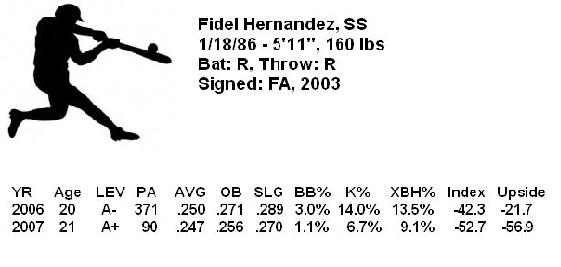
Baseline comparison: Alcides Escobar, SS (MIL)
2006 (Age 19, FSL) Index: -26.8
2006 (Age 19, FSL) Upside: 4.2
2007 (Age 20, FSL) Index: 28.2
2007 (Age 20, FSL) Upside: 34.7
Summary: As you can see, shortstop is not a loaded position, in terms of prospects in the Florida State League, and Hernandez ranks as one of the absolute worst. Alcides Escobar was really young for High A last year, but this year, repeating the level, he’s been excellent, and represents what a top shortstop prospect should look like. He’s still young for the league. In comparison, our own Fidel Hernandez is, well, he’s flat out awful. He drew 1 walk in 90 PA’s, he has zero power, and because of his age, he has zero upside. He’s back at Lakewood now, and he’s certainly off the prospect radar.
Hopefully I get back up and running at home with my internet, and if so, I’ll be able to get on track with 5 or 6 of these a day.
 Phuture Phillies
This has a huge gap in text. Is Fidel Hernandez the first card you posted? It is the only one that shows up. He seems not to be a prospect.
LikeLike
Yeah, Fidel Hernandez is the only one posted. Is his card visible? It should be a jpeg file. I tried it in both Firefox and Internet Explorer, it loaded properly.
LikeLike
Yes, it was fine.
LikeLike
What can you tell about Bastardo ?
LikeLike