Daily Archives: January 23, 2007

New Feature: Prospect Grades

This is something I wanted to do in the beginning, but I needed to put more time into it, and now that I’ve had some time to tinker, I think I’m ready to begin. Basically, the aim of this is to assign a letter grade to each prospect in the system as an easier way to evaluate and compare guys across levels. I’ve devised a spreadsheet with various formulas in it to help me with this, but it will still include some subjective analysis on my part. Don’t take these grades as a be all end all, or anything of the sort. I have my own system, which I’m sure I’ll be tweaking for quite some time. The idea of assigning a letter grade comes from John Sickels’ approach, but I have no idea how he arrives at his grades, so I’m really only using his general idea.

I don’t want to get into explaining tons of formulas, but here are my basic evaluation methods. I’m going to base most of my grades on performance, relative to the league average, and then consider age and position. For example, when looking at a guy like Mike Costanzo, I’m going to look at his performance against those in the FSL, then consider a multiplier for his position, 3B, then consider his age in relation to his league. Defensive analysis is tough, even at the ML level, so I’m not going to alter my grade much in that area, but I will consider it and weigh it slightly. I’m not really going to use a player’s tools or what others think he could be, I’m simply going to grade based on what the player has done. I’m going to place a higher weight on 2006 performance, but also consider past performance and other aspects of the player’s body of work/makeup.

Because of my above theory, grades for guys drafted in 2006 will be extremely unstable, so take that as a warning up front. Kyle Drabek, who I’ve raved about in great detail, is going to get a pretty lousy grade, but in a year from now, he’ll have a shot to completely redeem that grade. I think his potential is unlimited, but I’m not really going to grade on potential, more just on what the player has done. My goal is to do a few of these grades per day, and I’ll start at AAA and work my way back, for the reasons I stated above. I’m going to limit the grades to guys who are still prospects or fringe prospects. In other words, I won’t be grading an 8 year minor leaguer in AAA, or a 26 year old in Low A. If I miss anyone after I’ve moved from one level to another, please just make a note in the comments section and I’ll include that player in the next batch of grades. After I’ve made my way through all the levels, I’ll do a cumulative writeup and list every player under each grade, which should give us a nice overview of the level of talent in the system.

I’ve added a category on the left side under the “Features” section where all the entries will be tagged, so if you miss a day or two, you can just click there to see all of the grades. To determine what level to grade the player at, I’m simply going to use the level where he accumulated at least 75% of his AB’s or IP. If he doesn’t have 75% at one level, I’ll take the lower level, as long as it’s more than 45% of his total. One final note. There were really zero legit prospects that spent a long enough time at Scranton this season to qualify here. Ruiz and Roberson are too old, Sanches, Minix and Condrey aren’t “prospects” in the true sense, so I won’t include them. Bourn and Mathieson got the bulk of their playing time at Reading, so they’ll be graded there. The only guy I am going to include from AAA is Germano, but the bulk of his innings came in the Cinci organization. However, Cinci’s AAA team also plays in the IL, so while his numbers might have been affected by the park he pitched in, I’m just going to use his cumulative 2006 numbers to grade him.

For today, we’ll just do Germano’s grade, which will serve as an example, and I’ll give explanations. If you have questions on the process, ask away. Remember, this is just for fun, and my own subjectiveness needs to be taken into consideration.

germano.jpg

Germano, Justin, RHP (age 24): Grade = C+

I made a slight tweak, and because of it, upgraded Germano to a C+ from a C. His peripherals really are a mixed bag. He’s below average in H/9 by about 7%, below average in K’s by about 30%, he’s 1% above average in HR/9, and he’s a whopping 128% above league average in BB/9. Now, obviously that doesn’t make him 92% above league average, and this is where the subjectivity comes into play. Control is a huge issue going forward, but you have to consider he is basically 36% below average when it comes to his hit rate, K rate and HR rate, and he’s much much better than league average in walk rate. Couple that together, and I think he’s right around league average, slightly above. On my scale, 0%-4% above league average is a C+ prospect, and that’s where I’m sticking with Germano.

Ceiling: Germano’s ceiling probably sits at 5th starter, making 30 starts a year. He doesn’t have the pure stuff to be a middle of the rotation kind of guy, but could see time at the back end of the rotation.
Floor: His current role, a AAA starter.
Conclusion: Germano is probably better suited playing in a big park like PETCO or SAFECO and with a good defense behind him. I’d say he’s got a 40% chance of reaching his ceiling, he’s got a 40% chance of becoming a major league reliever/swingman, and there’s a 20% chance he languishes in the minors for the rest of his career. He’s a strike thrower, but lacks the stuff needed to overpower guys. He might not be the best fit in Philly for the reasons above, but with a strong AAA season in 2007, could be included in a trade to a better suited team, where he might be closer to reaching his ceiling.
Player Profile: Dan Brauer

brauer.jpg

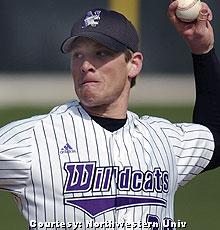
Another day, another player profile for your enjoyment. Today we’ll chronicle one of my personal favorites from the 2006 draft, LHP Dan Brauer. The Phillies selected Brauer #187 overall in the 6th round out of Northwestern University. If you remember from an earlier entry, the Phillies nabbed one of the most successful pitchers in Northwestern history two years prior in James Happ. Brauer, though, is a different case, as he was technically a senior, but with a year of eligibility left after missing all of 2005 with labrum surgery while Happ was a true junior. Brauer compiled a strong three years at Northwestern, finishing his career with this line:

236 IP, 3.24 ERA, 218 H, 103 BB, 230 K, 13 HR

Less than a hit per inning, a somewhat high walk rate, a solid K rate, and a very very good HR rate is pretty good production at a good school in a good conference, but you have to remove the top layer and look closer at his numbers. Looking at his numbers, year by year, give you a better idea

2003: 54.0 IP, 3.50 ERA, 8.33 H/9, 5.33 BB/9, 7.33 K/9, 0.00 HR/9
2004: 89.1 IP, 3.02 ERA, 8.06 H/9, 2.67 BB/9, 9.67 K/9, 0.50 HR/9
2005: Did Not Pitch (more on this in a minute)
2006: 92.2 IP, 3.30 ERA, 8.55 H/9, 4.37 BB/9, 8.74 K/9, 0.78 HR/9

So, from his freshman year to his sophomore year, he improved across the board except he allowed 5 HR in 2004 as opposed to zero in 2003, but he also pitched 30 more innings. He missed the entire 2005 season with labrum surgery. For those who follow the injury side of the game, the “l word” is the scariest word in the baseball injury dictionary. For an explanation of it, read this amazing Will Carroll article on the subject that he wrote in Slate a few years back. The rate of successful return from labrum surgery is literally less than 5%, which really meant that Brauer was battling more than uphill in 2006, he was virtually climbing straight up the mountain. However, he was strong enough to pitch the most innings of his college career, post hit and walk rates that didn’t suggest he was gone as a pitcher, post impressive strikeout and home run totals, win Big Ten Conference Pitcher of the Year and throw a no-hitter against Michigan State……not a bad return. Much like Tommy John surgery, which has a much higher “survival” rate, it takes time after labrum surgery to regain your control and feel for pitching.

A number of factors, including the shoulder surgery, his year of eligibility, and his lack of “dominating stuff” like that of his teammate George Kontos, probably led to his slide to the Phillies. He wasted little time signing for $150,000 and soon reported to Batavia. He showed the Phillies he was fully recovered and ready to go by posting a 1.96 ERA in 55 innings, allowing 39 hits (1 home run) and 18 walks to 65 strikeouts and was promoted to Lakewood, where he made 3 appearances, giving up 4 runs in 8 innings, allowing 10 hits and 5 walks to go along with 10 strikeouts. All in all, a huge season for Brauer, not only in his numbers, but in recovering from the most deadly injury a pitcher can have.

Clearly, the Phillies feel like they got a steal in Brauer in the 6th round. As I mentioned above, he wasn’t the most heralded pitcher on his team, falling behind Yankees draft pick George Kontos, who has a livelier fastball, but is also probably further away from making an impact at the big league level, and who might end up as only a reliever based on a lack of secondary pitches. What Brauer lacks in shear velocity he makes up for with his command and pitchability. Some people aren’t as high on him as me, and suggest he is ticketed to become a reliever in the near future, but I tend to disagree there. Before his surgery, his command was solid, and he was striking out people with relative ease. His control was a bit shaky in college in 2006, but that’s to be expected in trying to recover from major arm surgery. He doesn’t allow many home runs, and based on his short 60 inning sample from pro ball, he had over a 2:1 groundball to flyball ratio, though he did allow his share of line drives. His splits don’t indicate lefthanded specialist, as he had a .779 OPS allowed to LH batters and a .555 OPS allowed to RH batters. As I’ve emphasized in past write-ups, when you see a pitcher with better numbers against his opposite side, it’s normally an indication of a strong changeup and a not so strong breaking ball. In Brauer’s case, it might be just him getting unlucky, as his BABIP against LH batters was an abnormally high .412, with the “average” being somewhere between .275-.300.

So, what to expect in 2007. It’s my belief Brauer will remain a starter until he either A.) Struggles at a higher level, or B.) The Phillies deem it necessary to bring him up to the bigs and use him in relief due to injury/shortage of arms. Normally teams will leave guys in the rotation until there is a need to move them, and in Brauer’s case, there doesn’t appear to be a need to move him. He handled short season Batavia with ease, and could very well be skipped over Lakewood and go straight to Clearwater, depending on the rotation situations at both spots. If he continues to regain his control, which was ok at 3.29 BB/9, there’s no reason to believe he won’t move quickly through the system. He could end up in Reading either at the end of 2007 or mid 2008, and who knows from there, depending on the role the Phillies have in mind for him. Having pitched with extreme pain in his arm in 2004, we know he’s a fierce competitor, and if fully healthy, I think his future is quite bright going forward.

Finally, we have some video on him. If the video messes up the formatting of this page, I’ll remove it from the page and just link it, so if it disappears momentarily or the page looks funny, have no fear, I’m on the case.

His fastball sits in the high 80’s here, but some reports indicated he was in the 90-91 range near the end of the season as he was regaining full strength in his arm. He features the slow 69-72 mph curveball, ala Randy Wolf, which he can throw for strikes, as well as his slider and change, which we don’t really see on the video. The thing that I think is most important, from watching him pitch, is that he has a very simple, repeatable delivery which doesn’t appear to put much stress on his arm. He doesn’t seem to fly out of control or have a lot of extraneous movements, which probably bodes well for him going forward when considering consistency.